
Driver Loft Explained | How the Wrong Loft Costs You Distance
This post contains affiliate links. As an Amazon Associate, we earn from qualifying purchases.
This post contains affiliate links. As an Amazon Associate, we earn from qualifying purchases.
Driver loft explained means understanding the stamped number on your club is just the start. The real distance comes from matching your static loft to your swing’s attack angle to create optimal dynamic loft. Most recreational golfers play 2–4 degrees less loft than they need, a mistake that costs 15–25 yards of carry.
That 2–4 degree gap isn’t a guess. It’s the consensus from launch monitor data across major fitting centers. The stamped number on your driver is a static measurement, but the loft that actually hits the ball is dynamic, a product of your swing. Getting this right is the single biggest equipment fix for distance.
What follows: how static and dynamic loft differ, the exact numbers that fit your swing speed, and how to use an adjustable hosel without making your slice or hook worse. You’ll also see why a 10.5° driver is the default for a reason, and when to ignore it.
Key Takeaways
- Most amateurs play drivers with 2–4 degrees too little loft, sacrificing 15–25 yards of carry.
- Your attack angle determines dynamic loft; a negative angle (hitting down) requires more static loft to compensate.
- On standard adjustable drivers, loft and face angle are linked; adding loft closes the face, reducing loft opens it.
- For swing speeds under 95 mph, start with 10.5° or higher; only consider 9° if you swing over 100 mph with a positive attack angle.
- Adjustable hosels are for fine-tuning ball flight, not fixing a broken swing. Random misses mean a swing issue, not a settings problem.
What Loft Should Your Driver Be?
The answer lives in your attack angle and swing speed, not in a chart of generic recommendations. A robot test is useless if you deliver the club differently.
Static loft is the angle stamped on the sole. Dynamic loft is the actual loft of the clubface at the moment of impact, determined by your swing’s attack angle and how you release the club.
If you hit down on the driver with a -3° attack angle, a 10.5° head delivers about 7.5° of effective loft at impact. That’s too low for almost anyone. The same 10.5° head delivered with a +3° attack angle creates roughly 13.5° of dynamic loft. At 90 mph swing speed, that 6-degree difference in delivery is worth about 23 yards of carry. Your job is to pick a static loft that creates the ideal dynamic loft for your speed.
Here is the framework. It’s a starting point, not a final answer.
| Your Swing Profile | Recommended Static Loft | Why It Works |
|---|---|---|
| Swing speed < 85 mph, any attack angle | 12° or higher | Maximizes launch and carry; distance comes from height, not roll. |
| Swing speed 85–95 mph, negative attack angle | 10.5° – 12° | Compensates for de-lofting at impact to reach optimal launch window. |
| Swing speed 85–95 mph, positive attack angle | 9.5° – 10.5° | Prevents ballooning; uses upward strike to create launch, needs less static help. |
| Swing speed 95–105 mph, positive attack angle | 9° – 10.5° | Lower spin from low loft pairs with high speed for maximum total distance. |
| Swing speed 105+ mph | 8° – 9.5° (fitted) | Requires precise fitting to manage extreme ball speed and spin rates. |
The fastest-growing category in drivers today is the lightweight, high-loft model, like the TaylorMade Qi4D Max Lite or Callaway Quantum Max Fast. These are built for speeds under 90 mph. If that’s you, fighting for a 9° driver because it looks “pro” is leaving 20 yards in the box.
Static Loft vs. Dynamic Loft: The Real Distance Lever
You buy a static number. You hit with a dynamic one. The gap between them is where your money is spent or wasted.
Static loft is what’s printed on the club. It’s measured in a lab with the sole flat on the ground. Dynamic loft is the actual loft presented to the ball at impact. It’s static loft plus or minus the effects of your attack angle and hand position. A study in the Golf Science Journal found that a 9.5° driver produced 8.4 more meters (about 9.2 yards) of total distance than a 13° driver in testing, largely due to lower spin and a shallower descent angle. But that test assumed a consistent, professional delivery.
For an amateur, the math flips. A negative attack angle subtracts loft. An early release adds loft. Most amateurs have a negative attack angle and an early release, which creates a high spin loft, the difference between the club’s path and its face angle. High spin loft means high spin, and high spin kills distance.
Where this goes sideways: Chasing a lower static loft because you want to “hit it lower.” If your attack angle is negative, a lower-lofted head just increases spin loft further. The ball launches low, spins high, and falls out of the sky. You lose 20 yards of carry and gain nothing.
The fix is counterintuitive. Sometimes, a higher static loft lets you make a more confident, forward-press swing, which actually reduces dynamic loft and spin at impact. You get higher launch with lower spin, the perfect combination. That’s why a robot test by Golf Digest found adding 2° of loft (9.5° to 11.5°) produced 12 more yards of carry. The club was easier to deliver efficiently.
How Attack Angle Changes Everything
Attack angle is the vertical direction of the clubhead at impact, up, down, or level. It’s the master variable for loft.
If you hit 3 degrees down on a 10.5° driver, the effective loft is roughly 7.5°. You’ve turned a standard driver into a strong-lofted one. To get back to an optimal 13-16 degrees of launch, you’d need a driver head stamped 13.5° or higher. This is why most amateurs need more loft, not less.
Conversely, a player with a +5° attack angle using a 9° driver delivers about 14° of dynamic loft. That’s in the ideal window. For them, a 10.5° head might launch too high.
Do you know your attack angle? If not, everything else is a guess. A launch monitor session is the only way to know. The rule of thumb is simple: if you tend to take deep divots with your irons, you likely hit down on the driver. If your driver contact feels sweeping, you might be positive.
Here’s the tangible effect, drawn from TrackMan data: – A 90 mph swing with a -5° attack angle carries about 191 yards. – The same 90 mph swing with a +5° attack angle carries about 214 yards. That’s a 23-yard difference without swinging harder. Your static loft choice either helps or hurts this equation.
The Adjustable Hosel: Loft, Lie, and Face Angle Linked
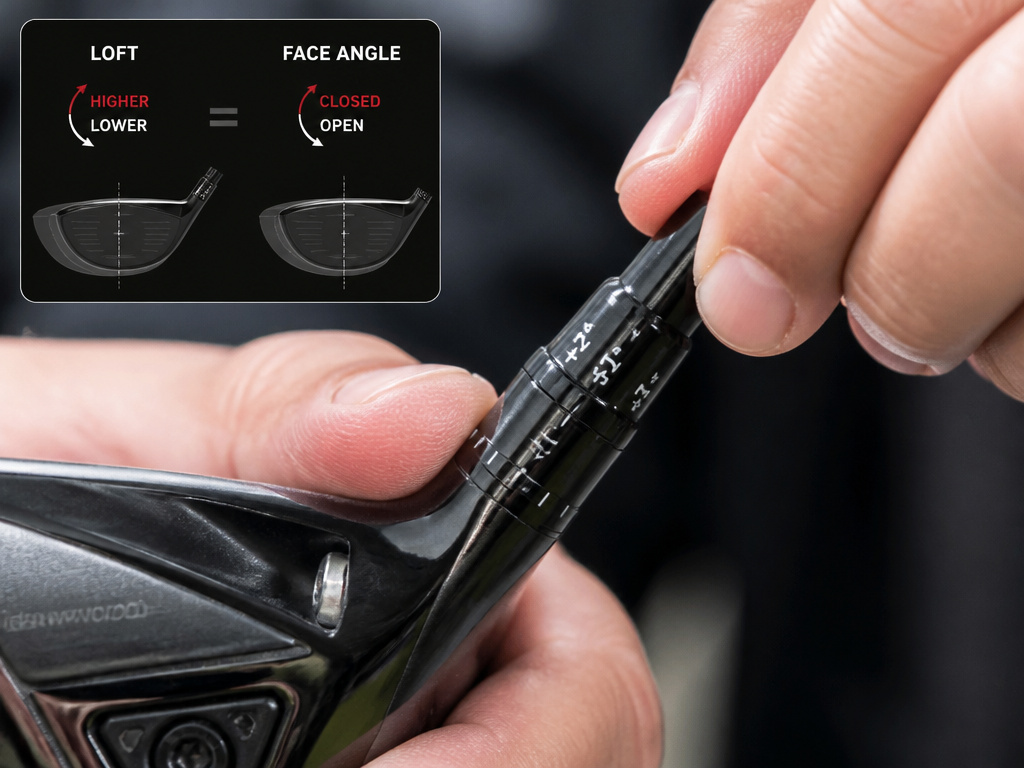
Modern drivers don’t just have one loft. They have an adjustable hosel, a sleeve that lets you change the head’s orientation relative to the shaft. This is where most golfers get lost.
The critical fact is this: on a standard single-cog hosel, loft and face angle are mechanically linked. You cannot change one without the other. When you add loft, the face closes slightly. When you decrease loft, the face opens.
The TaylorMade 4° Loft Sleeve on M6 and M1 drivers changes loft by 0.5°–0.75°, lie by 0.5°–0.75°, and face angle by 1.0°–2.0° per click. Every adjustment changes all three parameters.
This link is a tool, not a bug. A slice (curve right for a righty) often benefits from a higher loft setting. The closed face angle helps the ball start left of target, reducing the slice’s severity. A hook can be tempered by a lower loft setting, which opens the face. This is why simply tweaking the hosel can improve direction for many players, making it a useful complement to choosing the right anti-slice drivers for a chronic miss.
| Goal | Hosel Adjustment | Face Angle Change | Best For |
|---|---|---|---|
| Reduce a slice | Increase Loft (+1°) | Face closes ~1.8° | Players who need draw bias and more launch. |
| Reduce a hook | Decrease Loft (-1°) | Face opens ~1.8° | Players who fight over-draws and want fade. |
| Higher launch, more carry | Increase Loft | Face closes slightly | Slow swing speeds, negative attack angles. |
| Lower, penetrating flight | Decrease Loft | Face opens slightly | High swing speeds, windy conditions. |
Dual-cog systems like the Titleist SureFit or Callaway OptiFit allow independent adjustment of loft and lie/face angle. They’re for the player who has dialed in their launch and spin but wants to tweak face angle alone. For most, the standard linked system is sufficient.
Common mistake: Cranking the hosel more than ±1.5° from stock. This can create 3° or more of face angle change. The club looks wildly open or closed at address, wrecking alignment and consistency. Make small changes. Test them. Then decide.
What About Spin and Forgiveness?
Loft directly influences spin. Generally, higher loft means higher spin. But remember dynamic loft, a poorly delivered high-loft head can spin less than a well-delivered low-loft head.
The relationship between spin and forgiveness is clearer. Higher-lofted drivers are more forgiving. They launch the ball higher, which gives a larger margin for error on strike location. A low, heel-side strike on a 9° driver might not get airborne. The same strike on a 12° driver still gets up and carries. This is a major reason why amateur golf clubs and game-improvement drivers trend toward higher lofts.
If your miss is high spin even with a moderate loft, the hosel isn’t the fix. That’s an attack angle and delivery issue. Moving weight forward in the head (on models with sliding weights) can lower spin, but the real solution is in your swing. Don’t use equipment to mask a fundamental flaw you’re not addressing.
When to Change Your Driver Loft
You change your static loft by buying a new head or adjusting the hosel. You should consider it in these scenarios:
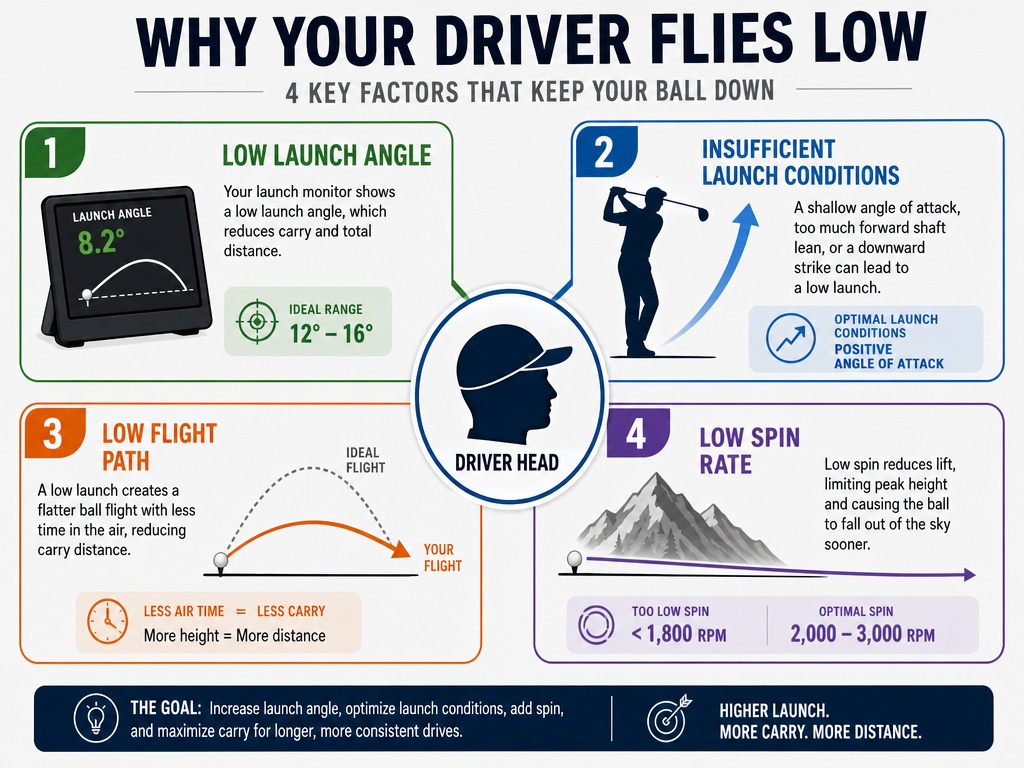
- Your launch monitor numbers are consistently off. Your launch is below 12° or your spin is consistently over 3000 rpm with a driver swing under 100 mph.
- You’ve made a lasting change to your swing. You’ve worked to create a positive attack angle; your old high-loft driver now balloons.
- You’re fighting a consistent curve and the linked loft-face adjustment seems like it would help.
- You’re moving between extremes of altitude or climate. Thinner air at high altitude requires less spin; a lower loft can help.
If your miss is random, left one time, right the next, the settings aren’t the problem. Put the wrench away and work on strike consistency. This is true whether you’re tuning a driver or selecting 3-wood clubs for your bag.
Driver Loft and the Rest of Your Bag
Your driver loft sets the top of your bag’s distance gapping. A higher-lofted driver that carries 230 yards but rolls to 240 changes the club you need at the 220-yard mark. You might need a strong 3-hybrid clubs instead of a 5-wood.
The goal is consistent gaps, not isolated distance. If adding loft to your driver brings its total distance closer to your 3-wood, you might need to strengthen your fairway wood or adjust your hybrid setup. For instance, a player who adds loft and carry might find a 2-hybrid clubs fills the gap between their new driver and their 4-iron better than a standard 3-wood.
Think of the bag as a system. A change at the top reverberates down. The Golf Science Journal driver loft study provides the hard data on how static loft influences ball flight, but your job is to fit that into your personal sequence from driver to wedge.
Frequently Asked Questions
Does more driver loft mean more distance?
For most amateur golfers, yes. More static loft increases launch angle, which can maximize carry distance, especially for players with slower swing speeds or negative attack angles. The extra carry usually outweighs any loss of roll.
How does adjustable driver loft work?
An adjustable hosel (or “loft sleeve”) rotates the clubhead relative to the shaft. This changes the static loft, but on most models it also changes the lie angle and face angle simultaneously. You use the provided wrench to loosen a screw, rotate the head to a marked setting, and re-tighten.
What happens if my driver loft is too low?
Too-low loft typically results in a low launch angle with high spin, a “spinny” low shot that doesn’t carry. It sacrifices distance and forgiveness. The ball falls out of the sky quickly and gets heavily affected by wind.
Can I adjust loft during a round?
No. According to the Rules of Golf, you cannot adjust a club’s playing characteristics during a stipulated round. Settings must be fixed before you start. You can adjust between rounds or on the range, but not once your round begins.
Is 10.5 degrees a good driver loft?
10.5° is the most common and generally the most versatile driver loft. It’s an excellent starting point for the majority of male golfers with swing speeds between 85-100 mph. It offers a balance of launch, spin, and forgiveness that suits more swings than any other single loft.
Does driver loft affect slice or hook?
Indirectly, yes. Because loft and face angle are linked on adjustable hosels, changing the loft also changes where the face points. Increasing loft closes the face, which can help reduce a slice. Decreasing loft opens the face, which can help reduce a hook.
Before You Go
Driver loft isn’t about the number on the bottom. It’s about the launch window your swing creates. The stamped loft is just a tool to get there.
If you’ve never been on a launch monitor, that’s step one. Know your speed, know your attack angle. Until you do, default to 10.5 degrees. It’s the right guess more often than not. The goal is a high, flat carry that uses the air, not a low bullet that prays for hard ground.
Your driver is the engine of your bag. Make sure it’s tuned for the way you actually drive.
