
Complete Guide to Driver Head Size Limits and Golf Rules
This post contains affiliate links. As an Amazon Associate, we earn from qualifying purchases.
This post contains affiliate links. As an Amazon Associate, we earn from qualifying purchases.
The rules for driver head size are set by the USGA and R&A. The primary limit is a maximum volume of 460 cubic centimeters (cc). A driver must also pass tests for spring-like effect (CT limit of 239 microseconds), overall distance (COR effectively capped at 0.830), and moment of inertia (MOI limit of 5900 g·cm²). The head must be “plain in shape” without adjustable external weights.
That 460cc number is a volume measurement, not a width or height. It defines the internal space of the clubhead. Every major manufacturer designs to this ceiling because it’s the largest size allowed for tournament play, including the PGA Tour.
What follows is a breakdown of each technical limit, how they’re tested, and what happens when a driver fails. You’ll see why modern drivers look the way they do and how to make sure your own club is conforming.
Key Takeaways
- The 460cc volume limit is the most visible rule, but the CT (Characteristic Time) limit of 239 µs is what actually regulates spring-like effect and is the most common failure point in testing.
- A driver’s moment of inertia (MOI) cannot exceed 5900 g·cm², a rule that prevents excessively forgiving heads that would negate off-center strike penalties.
- The “plain in shape” rule bans external features designed solely to influence ball flight, like adjustable weights on the sole or aerodynamic fins.
- Manufacturers submit every new model to the USGA for testing; an approved list of conforming driver heads is published and routinely updated.
- For the average golfer, any major-brand driver purchased new in the last 15 years is almost certainly legal. The rules primarily govern the elite competitive level.
The 460cc Volume Limit
This is the rule everyone knows. Since January 1, 2004, the maximum permitted volume for a driver head is 460 cubic centimeters. This is not a measurement of length or height; it’s the internal space, typically measured by filling the head with a fine seed or water and measuring the displacement.
Where this goes sideways: Assuming a larger head automatically means more forgiveness. Volume correlates with potential MOI, but the actual forgiveness is determined by weight distribution. A poorly designed 460cc head can be less stable than a cleverly weighted 440cc model.
All major manufacturers. TaylorMade, Callaway, Titleist, design their flagship models to this 460cc limit. It represents the optimal trade-off between the USGA’s size restriction and the engineers’ desire for a large, forgiving hitting area. There is no minimum size, which is why you see players using compact “mini drivers” or older 300cc models for specific shot shapes.
| Head Size (cc) | Typical Use Case | Trade-Off |
|---|---|---|
| 440-460cc | Modern game-improvement drivers | Maximum forgiveness, higher MOI, larger sweet spot. |
| 400-430cc | Player’s / tour-preferred drivers | More workability, often preferred for shaping shots. |
| Sub-300cc | “Mini drivers” or classic persimmon | Low spin, high control; very low forgiveness. |
The rule exists to prevent an arms race in head size that would fundamentally change the skill required off the tee. Without it, drivers would likely balloon to 500cc or more, making the sweet spot enormous and reducing the penalty for mishits to near zero.
Spring-Like Effect: CT and COR Explained
While 460cc gets the attention, the limits on spring-like effect are the real engineering battleground. This is governed by two related metrics: Coefficient of Restitution (COR) and Characteristic Time (CT).
COR measures the energy transfer between the clubface and ball. Think of it as bounciness. The rule effectively caps it at 0.830. A driver with a COR of 0.830 returns 83% of the ball’s energy; the rest is lost to heat and sound. This limit was established to curb distance gains from ultra-thin, trampoline-like faces.
CT is the modern, more precise measurement the USGA uses for on-site testing. It measures how long the ball stays in contact with the face (in microseconds). The limit is 239 microseconds. A higher CT indicates a hotter, more elastic face.
The part nobody mentions: CT can increase with use. A driver that passes at 238 µs when new can “creep” past 239 µs after repeated impacts, technically rendering it non-conforming. This is why tour players’ clubs are periodically tested and swapped out.
These limits are why driver faces have variable thickness. Engineers thicken the perimeter to stay within the CT limit while thinning the center to maximize legal ball speed. It’s a precise dance at the edge of the rules. The SAE J1052 head position standard for vehicle occupant positioning has nothing to do with golf, but it illustrates the kind of precise technical standard that bodies like the USGA rely on to define their own test protocols.
Moment of Inertia (MOI) and the “Forgiveness” Cap
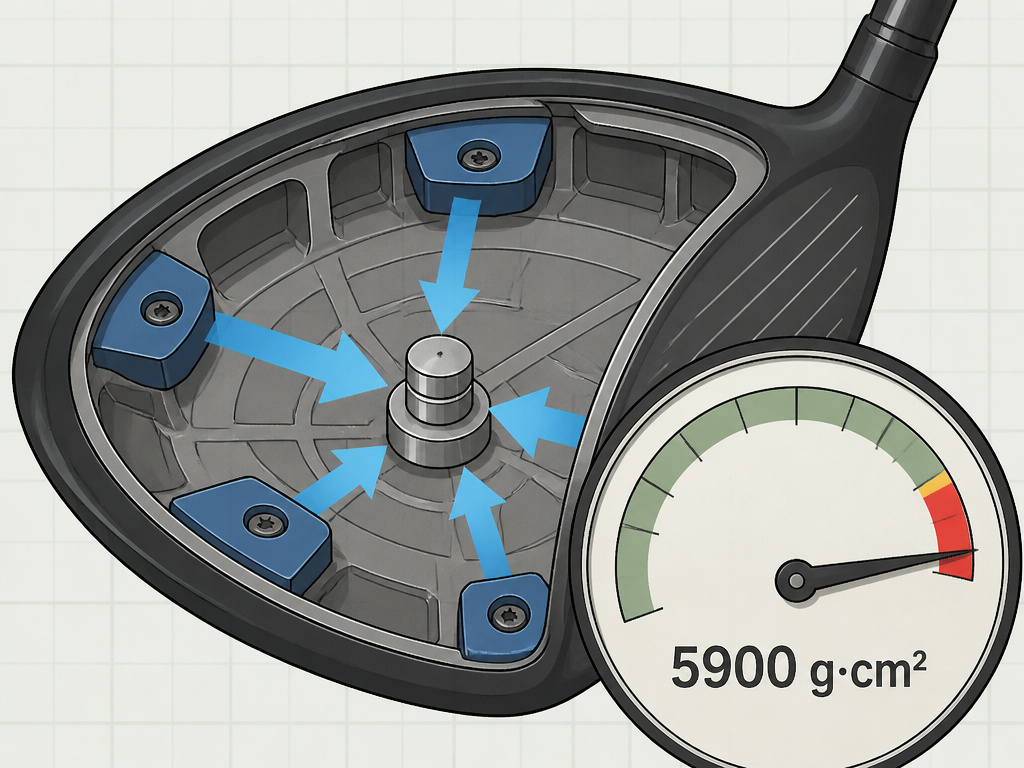
Moment of Inertia is a physics term for resistance to twisting. In a driver, a high MOI means the head twists less on off-center hits, preserving ball speed and keeping the shot online. The USGA limits MOI to 5900 g·cm² for driver heads.
This rule directly caps forgiveness. Without it, manufacturers could design heads so stable that a toe strike would perform nearly identically to a center strike. The 5900 limit forces a trade-off: you can have forgiveness, but not so much that strike quality becomes irrelevant.
Testing for MOI is complex, involving a pendulum apparatus to measure the head’s rotational resistance. It’s a safeguard against engineering around the CT limit by simply making the entire face flex uniformly, regardless of impact location.
When choosing a driver, understanding that its forgiveness is bounded by this rule helps contextualize marketing. A driver billed as “high MOI” is likely pushing close to that 5900 ceiling. This rule interacts with the 460cc limit, more volume allows weight to be distributed farther from the center, boosting MOI. This is a key reason modern driver heads are so large.
The “Plain in Shape” Rule and Adjustable Drivers
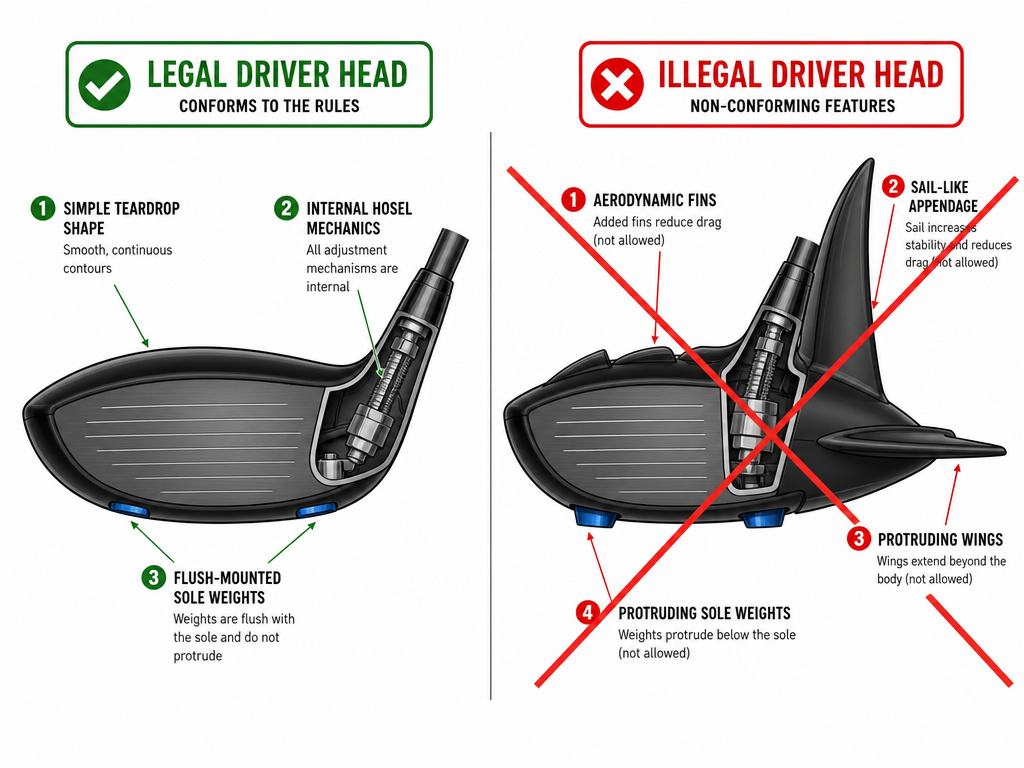
Rule 4.1a(2) states that the clubhead must be “plain in shape.” This vague-sounding rule has significant teeth. It prohibits features whose purpose is to influence ball flight through aerodynamic means or movable parts.
This is why you don’t see drivers with wings, fins, or sails. It’s also the reason for the controversy around adjustable weights. Weights recessed into the sole are generally allowed, as their primary purpose is to adjust swing weight or bias. However, a weight that protrudes to create a specific aerodynamic effect would be deemed non-conplain.
Common mistake: Thinking all adjustability is governed by the CT rule. Hosel adjustments for loft and lie are always legal. The “plain in shape” rule targets external, aerodynamic shaping, not internal mechanical adjustments.
Modern adjustable drivers are a testament to working within this rule. Their adjustability is internal (hosel) or via flush-mounted weights. The overall shape remains a simple, rounded teardrop. The UMTRI FMVSS 202a document on vehicle head restraints is a regulatory document from a different field, but it shares a core principle with golf’s equipment rules: precise, measurable standards replace subjective judgments.
How Drivers Are Tested and Approved
You don’t have to measure your driver’s CT. Manufacturers do the heavy lifting. Every new model is submitted to the USGA’s Equipment Standards department for rigorous testing. The club is checked for volume, CT, MOI, and overall shape.
If it passes, it’s added to the List of Conforming Driver Heads. This list is public, updated monthly, and is the official reference for tournament officials. If a model fails, it’s rejected, and the manufacturer must modify the design.
This process is why you can buy a driver off the rack with confidence. The NHTSA head restraint final rule is a government safety regulation; similarly, the USGA’s Conforming List is the de facto regulatory standard for competitive golf equipment. It’s the checkpoint.
What about older drivers? Models from the early 2000s, especially during the transition to the 460cc/CT rules, are a gray area. Some famously “hot” faces were later deemed non-conforming. If you’re playing in a competition that requires conforming equipment, check the list for your specific model and year.
Choosing a Driver Within the Rules
For 99% of golfers, compliance is automatic. Your main choice is between a max-size 460cc model or a smaller profile.
- Choose a 460cc driver if you want maximum forgiveness and ball speed on mishits. This is the best choice for most amateur and senior golfers. Modern drivers for seniors and drivers for amateurs are built to this limit.
- Choose a sub-460cc driver if you prioritize workability, a preferred look at address, or lower spin. Many better players and tour pros opt for 440-450cc heads for more control.
Your driver loft and shaft flex are far more important fitting variables than worrying about the 460cc limit. The rules create a level playing field; within that field, your skill and proper fitting determine success. If you struggle with a slice, a legal draw bias driver can help without breaking any rules.
Frequently Asked Questions
What happens if my driver is over 460cc?
It cannot be used in any competition that follows USGA or R&A rules. For casual play, it doesn’t matter. However, it’s extremely unlikely you own one, as no major manufacturer has sold a non-conforming oversized driver in decades.
Can a driver become illegal over time?
Yes, through CT “creep.” Repeated impacts can fatigue the titanium face, causing it to flex more and the CT value to rise above 239 µs. This is a concern only at the highest levels of play; recreational golfers will never hit the ball hard enough or often enough for this to be an issue.
Are there different rules for long drive competitors?
Yes. The Long Drivers of America (LDA) has its own equipment rules, which historically allowed larger heads (often up to 480cc) and different CT limits. Always check the specific event rules.
Is a 460cc driver the best for everyone?
Not necessarily. While it offers the most forgiveness, some players find smaller heads (like a 440cc model or a mini driver) easier to square up and control. The best driver is the one you hit most consistently, regardless of its max volume.
Where can I check if my driver is on the conforming list?
Visit the USGA website and search their “Conforming Driver Head List.” You can search by brand, model, and year. The 49 CFR § 571.202 legal text is a government regulation you can read; the USGA list serves a similar regulatory function for golf.
The Bottom Line
The driver head size rules, anchored by the 460cc limit, exist to preserve skill in the game. They are a fence, not a cage. Within them, manufacturers have engineered incredible gains in forgiveness and ball speed. Your job isn’t to police the CT of your driver; it’s to find one that fits your swing within this legal framework.
Stick with models from the USGA’s conforming list, which is every major brand driver, and focus your energy on loft, shaft, and proper fitting. The rules have already done their work to ensure the club in your bag is fair for the game.
