
What Is a Mini Driver? The Versatile Control-Oriented Club
This post contains affiliate links. As an Amazon Associate, we earn from qualifying purchases.
This post contains affiliate links. As an Amazon Associate, we earn from qualifying purchases.
A mini driver is a compact, high-lofted driver with a head volume around 300cc, designed to bridge the gap between a standard 460cc driver and a fairway wood. It offers more control and forgiveness off the tee than a driver and is significantly easier to hit off the ground than a 3-wood, making it a specialized utility club for specific course situations.
The 300cc head is the key spec. It creates a club that looks and feels like a driver but performs with the versatility of a powerful fairway wood. This isn’t a magic fix for a broken driver swing. It’s a tool for a specific job: tight tee shots where accuracy is paramount, and long second shots from the fairway where a standard 3-wood is intimidating.
What follows is a breakdown of the mini driver’s anatomy, the three players it actually helps, and the precise moment you should consider swapping out a fairway wood for one.
Key Takeaways
- A mini driver’s 300cc head is about 35% smaller than a standard driver, trading maximum distance for enhanced control and workability.
- Its primary role is to replace a fairway wood, not your driver, offering a reliable option for tee shots on tight holes and shots from the fairway.
- For players with higher swing speeds, it can function as a specialized shot-shaping club, like a dedicated “draw machine” to complement a fade-biased driver.
- The shorter shaft (often 42-43 inches) and higher loft (typically 11.5 to 13.5 degrees) make it one of the most forgiving clubs in the long game.
- If you consistently struggle to hit your 3-wood or 5-wood off the deck, a mini driver is a logical and high-performance substitute.
The Anatomy of a Mini Driver: Specs That Matter
Forget marketing terms. The difference between a mini driver and every other club in your bag comes down to three physical measurements: head volume, shaft length, and loft.
A standard modern driver maxes out at 460cc. A typical 3-wood is about 175cc. A mini driver sits squarely in the middle at roughly 300cc. This size reduction is what changes everything. The smaller head presents a smaller face to the ball, which most players find easier to square up at impact. It also moves the center of gravity, often making it easier to launch the ball with a penetrating flight.
A 300cc clubhead is approximately 35% smaller than a 460cc driver. This reduction in size lowers moment of inertia (MOI), making the clubhead easier to manipulate through impact for intentional shot shaping, but slightly less forgiving on extreme mishits compared to a max-size driver.
The shaft is the second critical piece. While a driver shaft often plays at 45.5 to 46 inches, a mini driver typically uses a fairway wood length shaft between 42 and 43.5 inches. This shorter length dramatically increases control and consistency. You give up a few miles per hour of potential clubhead speed, but you gain a much higher chance of hitting the center of the face.
Finally, the loft. Mini drivers are not low-lofted. You’ll find them ranging from 11.5 degrees up to 16 degrees, with 13.5 degrees being a very common offering. This higher loft helps get the ball airborne easily, especially from the turf, and adds spin to stabilize the flight. It’s why they are easier to hit off the deck than a standard driver.
How It Compares: Driver vs. Mini vs. Fairway Wood
This table shows where the mini driver fits in your bag’s ecosystem.
| Club Type | Head Volume | Typical Shaft Length | Primary Use Case | Forgiveness Off Turf |
|---|---|---|---|---|
| Driver | 460cc | 45.5″ – 46″ | Maximum distance off tee | Very Low |
| Mini Driver | ~300cc | 42″ – 43.5″ | Controlled tee shots & long fairway shots | High |
| 3-Wood | ~175cc | 43″ | Distance off tee & fairway | Medium |
| 5-Wood | ~150cc | 42″ | Fairway launches, par 5 approaches | Very High |
The mini driver isn’t a tweener. It carves out its own niche with a larger, more confidence-inspiring head than a fairway wood but a shorter, more manageable package than a driver. If your current best golf drivers are too wild and your fairway wood never leaves the bag, this is the gap it fills.
Who Actually Needs a Mini Driver? (It’s Not Everyone)
Most golf equipment solves a problem the player already knows they have. A mini driver solves a problem you might be ignoring: the useless fairway wood at the bottom of your bag.
Common mistake: Buying a mini driver to fix a broken driver swing. If you can’t hit your 460cc driver, a 300cc version won’t magically fix your path or face angle. It might hide the flaw slightly, but you’re treating a symptom.
The mini driver has three ideal candidates.
1. The Player Who Fears Their Fairway Wood. This is the most straightforward fit. If your 3-wood is a source of anxiety—you top it, slice it wildly, or simply have zero confidence—a mini driver is your escape hatch. Its larger head and deeper face look more like a driver at address, which psychologically helps many players make a more aggressive, sweeping swing. The result is a club you’ll actually use from the fairway on par 5s.
2. The Course Strategist on Tight Tracks. Some courses demand placement over power. On a dogleg par 4 with a narrow landing zone, pulling a driver is reckless. A 3-wood might not give you enough carry to clear a hazard. A mini driver offers the perfect blend: enough distance to reach the ideal spot, with a much tighter dispersion pattern than a driver. It’s a club for playing chess, not just hitting bombs.
3. The High-Speed Player Looking for a Shape Tool. This is the advanced use case. For players with swing speeds over 105 mph, the distance gap between driver and mini driver shrinks. Here, the mini driver becomes a specialized instrument. As noted in gear testing, some players use it as a dedicated draw club when their primary driver is set up for a fade. This allows them to work the ball both ways on command, using the mini driver’s often more draw-biased design to hit a powerful, right-to-left shot on demand.
If you don’t see yourself in these profiles, stick with dialing in your driver swing mechanics and finding a more forgiving fairway wood.
The Fairway Wood Replacement: Your Most Likely Swap
Let’s be blunt. The most logical and common bag build featuring a mini driver is one where it replaces your 3-wood or 5-wood. It is not a driver replacement.
Think of it as a “maxi wood.” It’s what a fairway wood would be if it were designed for modern players who grew up with 460cc drivers. The Titleist GT280, for example, is built on this exact principle. At 280cc, it’s far easier to hit off the deck than a standard driver, but it provides more power and a more familiar look than a traditional fairway wood.
Why does this swap work? – Psychological Edge: The larger head inspires more confidence over the ball than a shallow 3-wood. – Improved Turf Interaction: The smaller size versus a driver allows the head to glide through the grass more cleanly. – Built for the Job: Unlike a driver, which is optimized for tee height, a mini driver’s loft and center of gravity are tuned for versatility.
Where this goes sideways: Putting the mini driver in your bag while also carrying a 3-wood and a 5-wood. You now have three clubs competing for the same job—long shots from the fairway and safe tee shots. One will collect dust. Make a decision and pull the fairway wood.
If your goal is to find a club that performs this hybrid role, start your research with dedicated mini driver reviews that compare launch, spin, and forgiveness directly against traditional woods.
Performance Realities: The Trade-Offs You Can’t Ignore
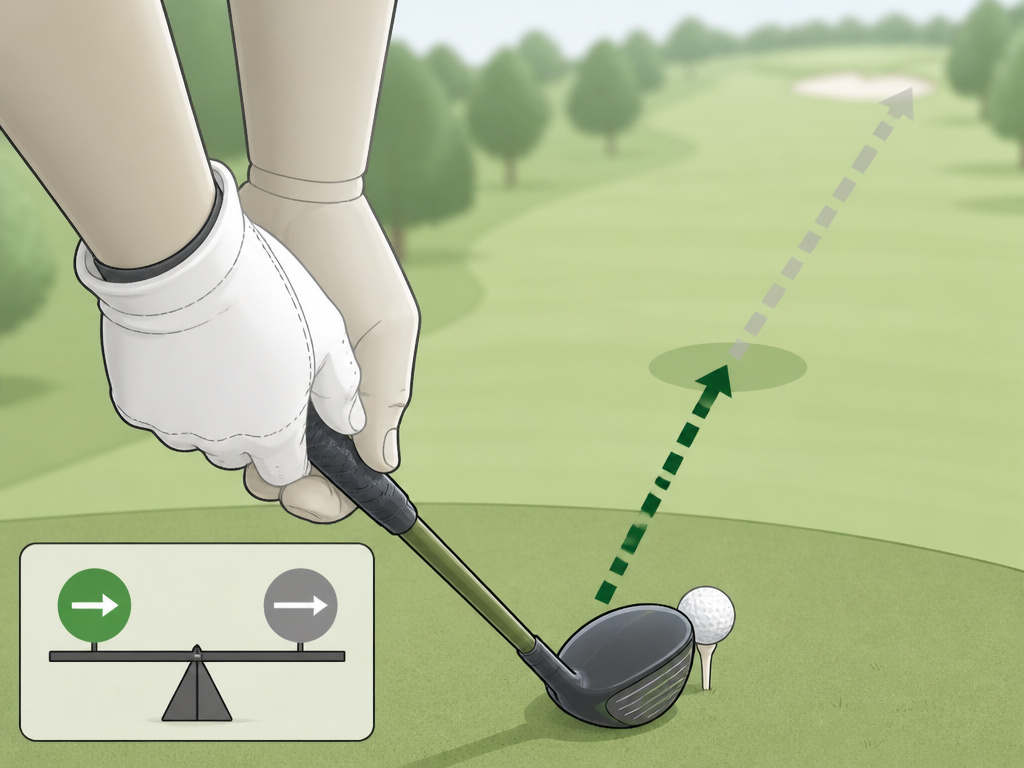
A mini driver is a compromise. Understanding the trade-offs is what separates a smart purchase from an expensive dust collector.
First, you will lose distance compared to your driver. It’s simple physics. The smaller head and shorter shaft reduce potential clubhead speed. For a player with a 100 mph swing speed, the difference might be 15-20 yards of total distance on a perfect strike. The benefit is that your “miss” will be much closer to the fairway and your average distance will be more consistent.
Second, workability is a double-edged sword. The lower MOI that makes it easier to shape shots also makes it less forgiving on toe and heel strikes than a modern high-MOI driver. Your mishits will lose more distance. This is why it’s crucial to get a proper fitting, particularly for shaft flex and weight, to maximize consistency.
When a Mini Driver is the Wrong Choice
Use this table to quickly diagnose if your bag is ready for one.
| Your Situation | Mini Driver Fit? | Better Solution |
|---|---|---|
| You slice your driver badly | Unlikely | Lessons, or an anti-slice driver with heel weighting |
| You already hit your 3-wood well | Poor | Invest in a better driver head for more distance |
| You need maximum distance off every tee | No | Optimize your current driver’s loft and settings |
| You struggle with all long clubs | Maybe, but not first | Start with game-improvement drivers for amateurs |
Finally, consider the opportunity cost. Your bag only has 14 slots. Adding a mini driver means removing something else—a wedge, a hybrid, or a fairway wood. Is the specific utility it provides more valuable than the club you’re taking out? For most mid-handicappers, replacing a rarely-used 3-wood with a frequently-used mini driver is a net gain.
How to Test and Fit a Mini Driver
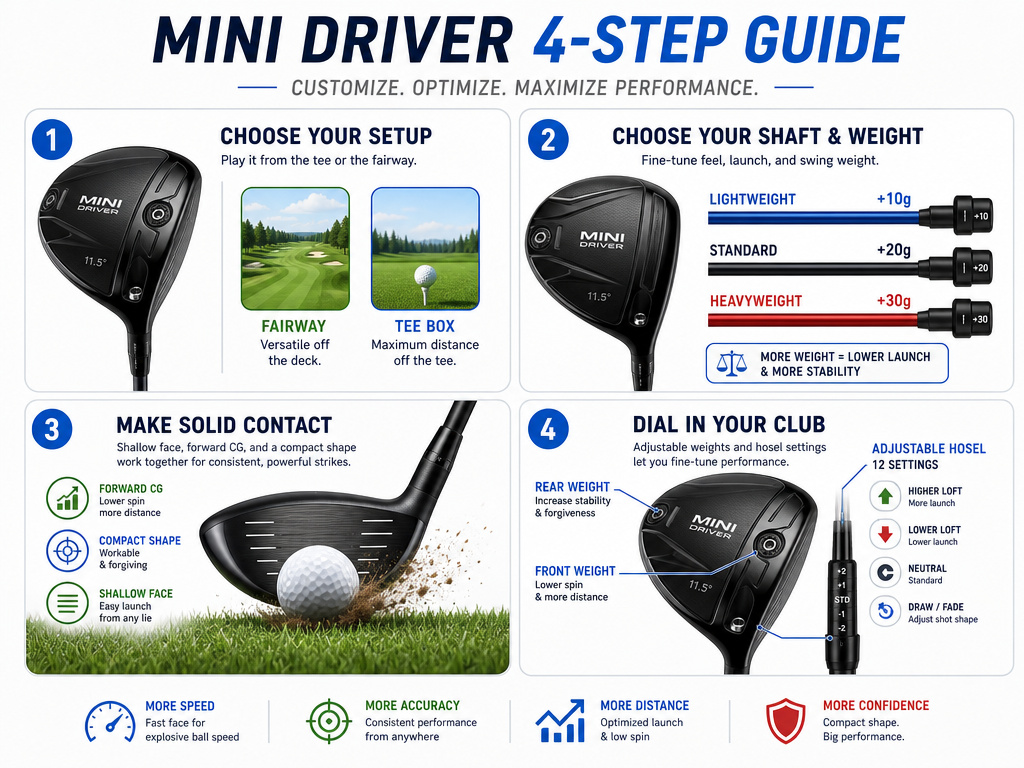
Don’t just buy the model your favorite pro uses. A mini driver must be fit to your swing, specifically to the job you want it to do.
1. Define Its Role. Walk into the fitting bay knowing if this club is primarily a fairway wood replacement or a tight-hole tee club. This will guide the loft and shaft selection. For fairway use, you may want more loft (13.5+ degrees). For tee-only use, you might go lower.
2. Shaft is Paramount. This is even more critical than with a driver. The shorter length changes weight and feel. You may need a heavier shaft to maintain proper swing weight. Try options that are 10-20 grams heavier than your driver shaft. Getting the correct stiff flex shafts or senior flex is non-negotiable for control.
3. Test Off REAL TurF. If possible, test the club off a grass range or simulate a tight lie. The whole point is performance off the deck. Seeing how it interacts with the ground is crucial. Does it bounce or dig? Does it feel easy to launch?
4. Dial in the Adjustments. Most mini drivers, like the TaylorMade R7 Quad, have movable weights. Use them. For more distance and a lower ball flight, move weight forward. For higher launches and more forgiveness, move weight to the rear. Don’t ignore the adjustable driver features; they are there to fine-tune the club for your preferred shot shape.
The bottom line: A one-hour fitting focused on this single club will tell you more than any review. It will either confirm it’s a perfect fit or reveal that a traditional 4-wood or strong 5-wood is actually what you need.
Frequently Asked Questions
Is a mini driver easier to hit than a driver?
For most players, yes, but for the wrong reasons. It’s easier because it’s shorter and has more loft, which promotes better contact and a straighter flight. It’s not inherently more forgiving on mishits than a modern 460cc driver; it’s just easier to swing consistently.
What loft should a mini driver be?
Most players should start between 13.5 and 15 degrees. This provides enough loft to launch the ball easily from the fairway while still offering a penetrating trajectory off the tee. Lower lofts (11.5-12.5) are better for faster swing speeds using it primarily as a tee club.
Can you hit a mini driver off the fairway?
Absolutely. This is one of its primary design advantages over a standard driver. The 300cc head size and higher loft make it significantly more playable from the turf than a 460cc driver, which is prone to low, screaming hooks or slices off the deck.
Does a mini driver go further than a 3-wood?
For many players, yes. The larger head can create more ball speed, and the psychological confidence often leads to a more powerful swing. However, a well-struck 3-wood by a player who is comfortable with it may still be longer. The mini driver’s advantage is consistency and ease of use.
Who makes the best mini drivers?
TaylorMade (R7 Quad, BRNR Mini) and Titleist (GT280) are the current leaders in this niche category, offering advanced adjustability and proven performance. Callaway and others have produced models in the past. Your best choice depends entirely on your fit and desired shot shape.
Do any pros use a mini driver?
Yes, but sparingly and as a situational club. Pros like Tommy Fleetwood have used them on specific courses where tight driving corridors are paramount. They use it as a specialized tool, not a full-time driver replacement, much like the strategic application described in this guide.
The Bottom Line
A mini driver is a specialist, not a savior. It won’t fix a broken swing, but it can solve a specific bag-building problem. If you have a fairway wood you don’t trust or a home course that rewards precision over power, it’s a compelling option.
The move is to replace your 3-wood, not your driver. Test one with the intent of hitting it off grass, fit it for the right shaft, and use its adjustability to lock in your preferred flight. When it fits, it becomes the most reliable long club in your bag—the one you reach for when the fairway is narrow and the stakes are high. That’s a tool worth having.
