
Golf Grip Size Fitting Guide | Find Your Perfect Grip Size
This post contains affiliate links. As an Amazon Associate, we earn from qualifying purchases.
This post contains affiliate links. As an Amazon Associate, we earn from qualifying purchases.
Golf grip size fitting requires matching two measurements: your hand size (wrist to middle fingertip) and your existing grip’s core size (M58, M60, M62) to your shaft’s butt diameter (.580”, .600”, .620”). A standard men’s grip measures 0.900 inches in diameter two inches down from the cap, but modern shaft variability means that number is a starting point, not a guarantee.
The 0.900-inch standard is a historical spec, not a physical law. Your actual installed size is the sum of your shaft’s butt diameter plus the grip’s material volume. Get that math wrong and you change how the club loads in your fingers, which changes wrist hinge, face rotation, and where the ball goes.
What follows: how to measure your hand in thirty seconds, how to decode the alphanumeric code inside any grip, and the two tools that eliminate guesswork. By the end you’ll know whether you need a midsize Golf Pride MCC, a standard grip with two extra wraps, or a complete regrip.
Key Takeaways
- Ignore glove size as a primary fit. Measure from your wrist crease to the tip of your middle finger on your lead hand. That 6.6 to 7.5 inch range points to standard; 7.6 to 9 inches points to midsize.
- Core size (M60) and shaft butt diameter (.600”) must be compared. Matching them yields the labeled grip size. Putting an M58 core on a .600” shaft builds a grip that’s +1/64” oversize.
- A grip that’s too small makes your hands overactive, promoting a hook. A grip that’s too large quiets your hands too much, promoting a slice or push.
- The definitive measurement is 2 inches down from the grip cap. Use a GolfWorks GGBD gauge or calipers. Do not measure over the rib on a ribbed grip.
- Build-up tape adds roughly 0.010 inches per layer. Two full wraps under a standard grip nudge it toward midsize feel without a regrip.
How to Measure Your Hand for Grip Size (The Quick Check)
Open your lead hand, left hand for a right-handed player. Run a tape measure from the crease of your wrist to the very tip of your middle finger. This number, not your glove size, is the reliable starting point.
Common mistake: Using glove size alone. A cadet medium glove fits a shorter palm with thicker fingers, which changes the fit. The wrist-to-finger measurement isolates bone structure.
Here is the translation from measurement to a starting grip size, based on OEM guidelines:
| Hand Measurement (Wrist to Finger) | Recommended Starting Grip Size |
|---|---|
| Less than 5 inches | Junior / Undersize |
| 5 inches – 6.5 inches | Undersize |
| 6.6 inches – 7.5 inches | Standard |
| 7.6 inches – 9 inches | Midsize |
| Greater than 9 inches | Jumbo / Oversize |
The second check happens on the club. Take your normal lead-hand grip. Look at where your longest fingertip touches the pad of your thumb. If the finger is digging into the pad, the grip is likely too small. If there’s a visible gap of more than a quarter inch, the grip is likely too large. You want light contact.
This is just the starting point. Your feel preference overrules any chart. Tom Wishon’s clubfitting research notes that ten golfers with identical hand measurements might choose ten different grip sizes based on comfort alone. The chart gets you in the ballpark. Your hands decide the seat.
The Standard .900″ Diameter and Why It’s a Myth
The old rule stated a standard men’s grip should measure 0.900 inches in diameter at a point two inches down from the end of the grip cap. A +1/32” oversize grip measured 0.930 inches at that same spot. This rule assumed every .600” shaft butt got an M60 core grip.
Shaft butt diameters are no longer standardized. You can find stiff-flex shafts at .580” and senior-flex shafts at .620”. This variability shatters the old formula.
Your actual installed grip size is the sum of two components: the shaft butt diameter and the grip’s material volume. The Mitchell Golf Grip Measuring guide provides the math: * A .600” shaft plus an M60 grip core equals 0.900” (Standard). * A .600” shaft plus an M58 grip core equals ~0.920” (closer to +1/64” Oversize). * A .600” shaft plus an M62 grip core equals ~0.880” (closer to -1/64” Undersize).
The M58 grip has more rubber (0.320” of volume), so it builds bigger. The M62 has less (0.280” of volume), so it builds smaller. This is why weighing grips reveals M58s are heaviest and M62s are lightest.
If you don’t account for core size, you’re guessing. This is why simply ordering “standard” grips can leave you with a set that feels inconsistent from your old one, even if the label is the same.
Decoding Grip Specs: Core Size, Weight, and Tape
You need to read the fine print. The spec sheet for a grip like the Golf Pride MCC lists core size (e.g., 60 Round), weight, and profile.
Core Size: This alphanumeric code is stamped inside the grip mouth. “M60” means a Men’s grip designed for a .600” shaft butt. An “R” indicates round; no “R” (or an “X” in Golf Pride’s system) means it’s ribbed. If you have a .620” shaft butt and install an M60 grip, you’ve just built an undersize grip.
Grip Weight: Heavier grips subtly affect swing weight. A standard MCC 60 Round weighs about 46.5 grams for a single-color model. The same grip in midsize jumps to 59.0 grams. That’s a 12.5-gram difference per club, which can make a full set feel head-light if you switch without adjusting.
Where this goes sideways: Stretching a grip to make it undersize. Some guides suggest stretching a grip ¾” past its length. This works for rubber but fails completely with corded or synthetic grips, they don’t stretch evenly and can tear or slip.
Build-Up Tape: This is your fine-tuning tool. One full wrap of 2” wide build-up tape adds about 0.015 inches to the diameter. Standard ¾” wide masking tape, when spiraled with a half-width overlap, adds about 0.010 inches per layer.
| Taping Method | Approx. Diameter Increase |
|---|---|
| 1 layer of 2″ build-up tape | +0.015″ |
| 1 layer of ¾” masking tape (spiraled) | +0.010″ |
| 3 layers of ¾” masking tape (spiraled) | +0.030″ (≈ +1/32″) |
Tape thickness has changed over the years. The old standard of 0.005-inch thick masking tape is hard to find now, so don’t rely on vintage wrapping guides. Test with a gauge.
How Grip Size Changes Your Ball Flight (The Why Layer)
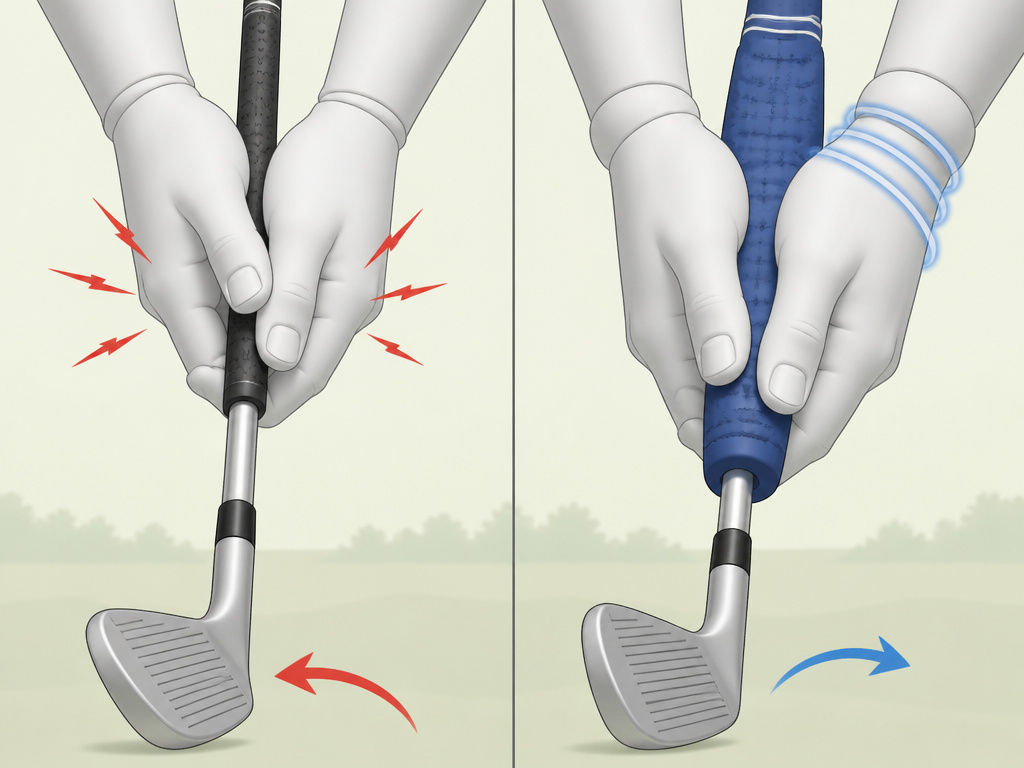 This isn’t about comfort. It’s about physics. Your grip is your only connection to the club. Its diameter dictates how your hand muscles engage.
A grip that is too small for your hand forces the smaller muscles in your fingers and palm to work harder to maintain control. This increased tension can lead to an overactive release, the hands flip through impact too quickly. The clubface closes rapidly. The result is often a hook, or a series of pulls.
A grip on the larger end of the spectrum will engage the larger muscles and take the hands out of the equation.
Conversely, a grip that is too large quiets the hands. It restricts the natural hinging and unhinging of the wrists. The clubface struggles to rotate back to square. For a player who already fights a slice or a weak fade, an oversized grip magnifies that open face. The typical miss becomes a push or a slice.
This is why players fighting a hook sometimes find relief in a midsize or jumbo grip. It calms the over-release. Players with arthritis also benefit from larger mid-size grips because the increased diameter reduces the grip pressure needed to hold the club, easing joint stress.
The effect is immediate. It’s a equipment change that directly alters kinematics, not just feel.
Step-by-Step: How to Measure Your Existing Grips
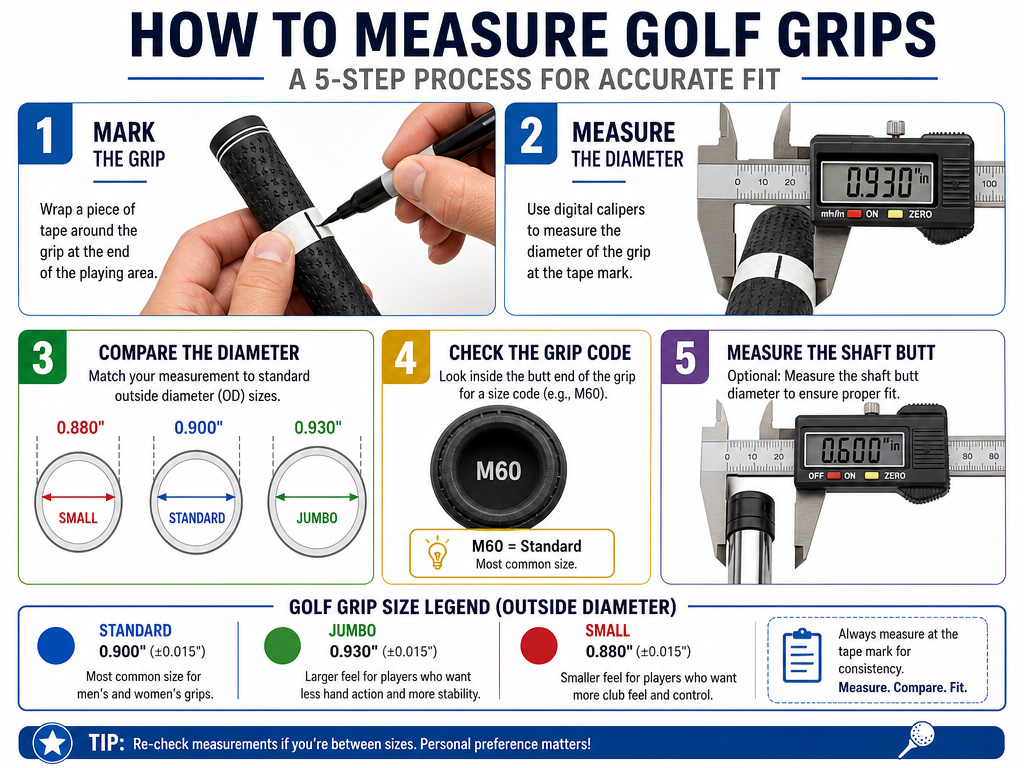 To know what you have, you need a gauge. The GolfWorks GGBD grip gauge is the professional tool, but digital calipers from a hardware store work.
- Locate the measurement point. Find the edge of the grip cap. Measure exactly two inches down the shaft. Mark it lightly with a dry-erase marker or tape.
- Measure the diameter. Place your calipers or the gauge opening at that mark. For a ribbed grip, ensure you measure on the side of the grip, not over the rib. The GolfWorks gauge instructions explicitly warn that sliding the gauge over the rib gives a false reading.
- Record the size. Compare your measurement to the standard:
- 0.900” = Men’s Standard
- 0.930” = +1/32” Oversize
- 0.880” = -1/64” Undersize
- Check the core size. Remove a grip from a spare club or wedge. Look inside the mouth for the embossed code (M60, .580, etc.). This tells you what the grip was designed for.
- Measure the shaft butt. Use your calipers on the bare shaft end to get its true diameter.
Now you have the full picture: installed size, grip core, and shaft butt. You can reverse-engineer why your clubs feel the way they do.
If your measurement shows 0.918” on a club that’s supposed to be standard, you now know it’s likely an M58 core on a .600” shaft. This data is what lets you replicate a feel or correct it across your whole set.
The Grip Size Decision: Standard, Midsize, or Taped?
You have your hand measurement and your current grip specs. Now you choose a path.
Stick with Standard if: Your hand measures 6.6–7.5 inches and you like the feel. You have no issues with hooks or excessive hand action. Your current grips measure near 0.900” and you want to maintain swing weight. For most players, a good standard grip like the Golf Pride Tour Velvet or MCC is the default.
Move to Midsize if: Your hand measures 7.6–9 inches. You fight a hook. You feel like you’re gripping too tightly. You want to calm your wrist action. The weight jump is worth noting, a set of golf grips for midsize hands will be heavier.
Use Build-Up Tape if: You’re on the border between sizes. You want to experiment without buying a whole set. You love your current grip materials but want a touch more bulk. Start with two extra wraps under your trail hand only (a “plus 2” setup) to reduce taper. This mimics the effect of a Plus4 grip.
The part nobody mentions: Trying a new size on your driver first. The driver is the longest, lightest club, and it’s most sensitive to grip feel changes. Regrip your driver with a midsize or add three wraps. Hit a dozen balls. The feedback is clearer and cheaper than doing a whole set.
Your choice in grip types, overlapping or interlocking, can also interact with size. A larger grip can feel bulky with an interlocking grip if you have shorter fingers. Always test.
Frequently Asked Questions
What if my hand size and my comfort disagree?
Listen to comfort. Every fitting expert, including Tom Wishon, states that personal feel preference trumps any measurement chart. If the chart says standard but a midsize feels more secure and relaxed in your hands, use midsize. The goal is consistent, light grip pressure, not adherence to a table.
Can grip size help with arthritis?
Yes, significantly. Larger diameter grips reduce the amount of finger flexion needed to hold the club. This decreases strain on joints in the fingers and palm. Jumbo or oversize grips are the most recommended, but a midsize is a great starting point. Softer, cushioned grip materials also help absorb vibration.
How does grip size relate to strong vs. Weak grips?
They are separate adjustments. A strong vs weak grip refers to hand placement on the club, how many knuckles you see. Grip size refers to the diameter of the handle. However, a player with a very strong grip might find a slightly larger diameter helps prevent over-rotation. It’s a secondary effect, not a primary fix.
Should my driver grip be a different size?
It can be. Some players prefer a slightly larger driver grip to promote a smoother, less handsy release off the tee. Others use the same size throughout the bag for consistency. There’s no rule, but the driver is the best club for an inexpensive experiment.
How often should I check my grip size?
Check whenever you regrip, which should be once per year for regular players. Also check if you start developing a new ball flight issue like an unexpected hook, or if you feel new hand fatigue. Worn grips also lose their original texture, which can alter feel, so regular cleaning with a dedicated grip cleaner is essential.
Before You Go
Forget the single number. Proper golf grip size fitting is about two measurements: your hand and your equipment’s specs. Use the wrist-to-finger check to get a baseline, then use a gauge to see what’s actually on your clubs. Remember that a midsize grip can quiet a hook, and build-up tape is a cheap way to experiment.
If you want one answer for a typical male golfer: start with a standard grip based on your hand measurement. If you fight a hook or have larger hands, try a midsize on your driver first. The right size won’t fix a flawed swing, but the wrong size will hide your good ones behind tension and compensation. Keep your grip tape handy for fine-tuning, and always prioritize the feel that lets you hold the club firmly, not tightly.
