
Overlapping vs Interlocking Grip Types for Golf Explained
This post contains affiliate links. As an Amazon Associate, we earn from qualifying purchases.
This post contains affiliate links. As an Amazon Associate, we earn from qualifying purchases.
The overlapping grip places your trail-hand pinky on top of the lead hand, between the index and middle fingers. The interlocking grip weaves that pinky between the lead-hand index and middle fingers, locking them together. The choice hinges on three things: your hand size, your dominant miss, and whether you have any finger joint issues. Recent data from the 2024 PGA Championship shows 58.4% of the field used interlocking, 40.9% used overlapping.
That 58/40 split flips the old script. For decades, instructors taught the overlap as the tour standard, often claiming 90% of pros used it. The 2024 audit proves that’s no longer true. Interlocking has taken the lead, driven by a generation that grew up watching Tiger Woods.
So your decision isn’t about following an outdated tradition. It’s about matching a physical connection to your body and your swing’s flaws. Get the match wrong, and you add a layer of compensations before you even take the club back.
Key Takeaways
- Tour data has shifted: At the 2024 PGA Championship, 58.4% of players used an interlocking grip, overtaking the overlapping grip (40.9%) as the most common style among elites.
- Hand size is the primary filter: Golfers with longer fingers and larger hands generally fit the overlap more naturally. Those with shorter fingers and smaller hands often find the interlock more secure.
- The overlap is an anti-hook design: By taking the trail hand’s powerful pinky off the club, the overlap grip reduces right-hand dominance and calms an over-active release. It’s a strategic choice for players fighting a hook.
- Joint health matters for players over 40: A 2024 study of golfers aged 44-62 found the interlocking grip scored a 58% comfort rating, while the 10-finger (baseball) grip scored 84%. The interlock’s finger-weave creates a pinch point under impact stress.
- Your lead hand position is more important than your pinky placement: Whether you overlap or interlock, seeing 2-3 knuckles on your lead hand at address is non-negotiable for controlling face angle.
Overlap vs Interlock: The 2024 PGA Championship Breakdown
Forget the old rule of thumb. The idea that 90% of pros use the overlapping Vardon grip is a fossil. When Golf Digest audited every player at the 2024 PGA Championship at Valhalla, the numbers told a new story.
The 2024 PGA Championship Grip Audit: Of the more than 150 players in the field, 58.4% used an interlocking grip, 40.9% used an overlapping grip, and a single player used a 10-finger baseball grip. Among the 87 American golfers, over 60 percent interlocked.
This isn’t a minor trend. It’s a wholesale shift at the game’s highest level. The influence of Tiger Woods, who has hit so many balls with his interlock that his right pinky is visibly misshapen, is undeniable. A generation of players, including Scottie Scheffler, grew up emulating that grip.
So why does the overlap persist at all? Tradition carries weight. The overlap was popularized by Harry Vardon in the early 1900s and used by legends like Ben Hogan and Arnold Palmer. It remains the first grip most beginners are taught. But the data shows it’s no longer the default for the best in the world. Your choice should be a deliberate fit, not a default setting.
The Hand Size & Finger Length Rule of Thumb
Your hands physically dictate which grip you can execute without creating tension. This is the one piece of conventional wisdom that the data still supports.
| Grip Style | Best For Hand Size | Why It Fits | Common User Profile |
|---|---|---|---|
| Overlapping (Vardon) | Medium to Large, Longer Fingers | The pinky rests comfortably in the channel between the lead-hand fingers. Short fingers leave it perched and insecure. | Traditionalists, players with swing speeds above 78 mph seeking wrist freedom. |
| Interlocking | Small to Medium, Shorter Fingers | Weaving the fingers creates a secure lock that shorter fingers can’t achieve with a simple overlap. | Modern players, those prioritizing hand unity, golfers who grew up post-Tiger. |
| 10-Finger (Baseball) | Arthritic/Joint Issues, Any Size | All fingers contact the grip, eliminating pinch points. Offers the highest comfort rating for stiff hands. | Beginners, seniors, players with finger injuries or reduced mobility. |
Golf Digest Top 50 teacher Tony Ruggiero notes the logic: golfers with longer fingers gravitate toward the overlap because interlocking can make the pinky wrap around awkwardly. The reverse is true for small hands, the interlock provides a physical connection that a short pinky can’t get from just resting on top.
Where this goes sideways: Choosing a grip that doesn’t match your hand size. A golfer with small hands forcing an overlap will unconsciously grip tighter to feel secure. That tension travels up the arms and kills rhythm within three holes.
This is the first checkpoint. If your glove size is a large or extra-large, start with the overlap. If it’s a small or medium, lean interlock. It’s not an absolute law. Phil Mickelson has large hands and uses an overlap, but it’s the highest-probability starting point.
The Mechanical Difference: Wrist Freedom vs. Hand Unity
The two grips don’t just look different; they function differently in the swing. This is the why-layer that dictates ball flight.
The overlapping grip is designed for wrist freedom and trail-hand passivity. By taking the pinky of your trail hand off the club, you reduce that hand’s ability to overpower the swing. The United States Golf Teachers Federation calls it an “anti-hooking grip” for this reason. It’s why Jim Furyk, known for excessive hand action, uses a double-overlap, to further quiet his right side.
The interlocking grip prioritizes hand unity and security. The physical lock makes it harder for the hands to work independently. For a player whose hands tend to separate during the swing, or for someone with a slower swing speed who needs to feel connected, the interlock provides a tangible sensation of one solid unit.
The overlap’s pinky isn’t a gripper; it’s a connector. It should have almost zero pressure. If you feel it squeezing, your hands are too small for the style or you’re misunderstanding its role.
What does this mean for your game? If your miss is a violent hook that starts left and curves further left, the overlap’s design directly addresses that flaw. If your miss is a weak slice or a feeling of the club “getting away” from you, the interlock’s unity can provide the stability you lack. It’s not about which is better. It’s about which corrects your specific fault.
The Overlooked Factor: Age and Joint Comfort
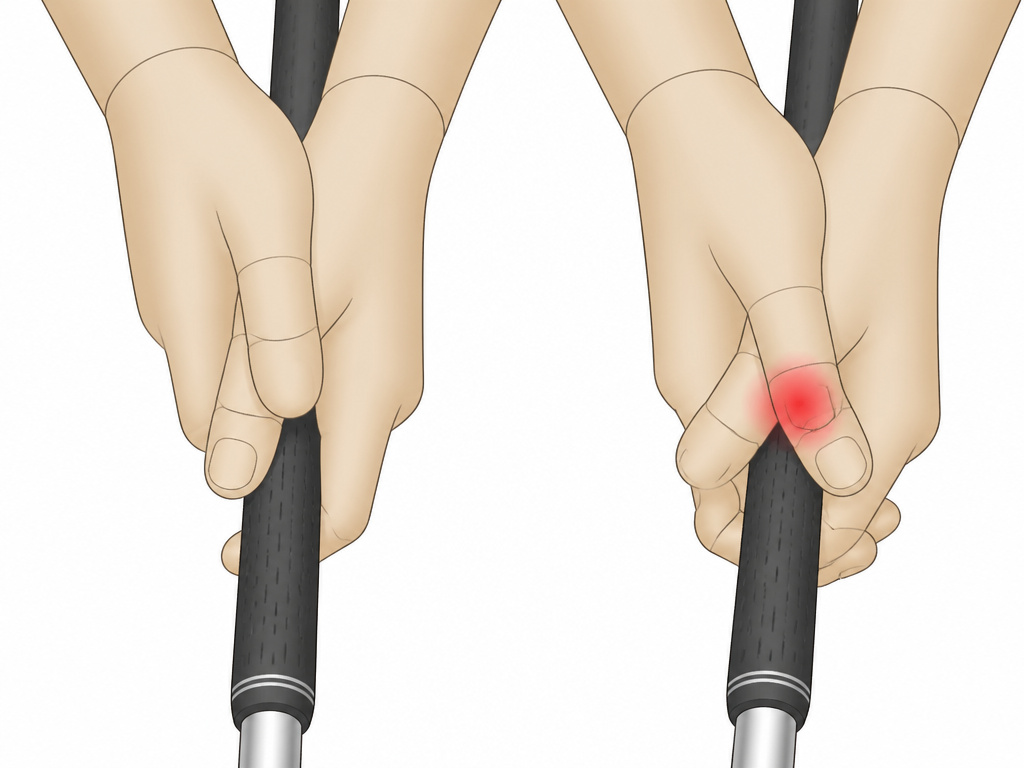 Most grip guides are written for 25-year-olds with supple joints. Reality for the average golfer is different. A 2024 trial by The Golface with 22 golfers aged 44-62 produced stark comfort data that most pros never mention.
The study had participants cycle through each grip for two weeks. The 10-finger (baseball) grip scored an 84% comfort rating. The overlapping grip scored 67%. The interlocking grip scored 58%. Among the 14 testers who reported chronic finger stiffness, the interlock’s comfort rating plummeted to 41%.
The reason is impact force. The interlock’s weave creates a pinch point between the knuckles. Over 70-80 full swings in a round, that pinch accumulates stress. The overlap avoids this by resting the pinky on top, but it still requires a degree of finger flexibility. The 10-finger grip, where every finger has its own seat on the grip materials, distributes pressure evenly, hence the high comfort score.
Common mistake: A 55-year-old with arthritic knuckles forcing an interlock because Tiger uses it. The joint pain will alter their release every time, creating a two-way miss by the back nine. Comfort isn’t a luxury; it’s a prerequisite for consistency.
If you’re over 40 and feel finger ache after a range session, this data is your permission slip to experiment. The baseball grip isn’t “lesser.” It’s functional. Kyle Mendoza, a PGA professional in the 2024 Championship field, uses it because a door injury ruined his ability to interlock. His game didn’t end; it adapted.
How to Test Which Grip is Yours: A 3-Step Drill
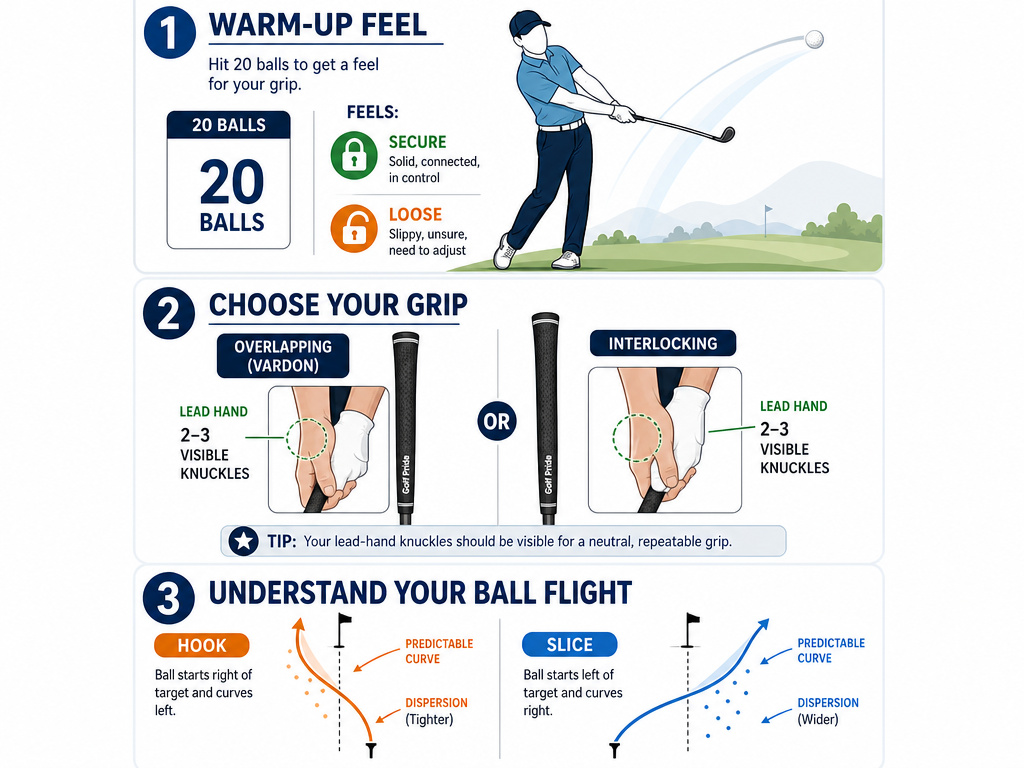 You need a real-world test, not more reading. Head to the range with this sequence.
- Hit 20 Balls with Each Grip. Use a 7-iron. Don’t judge the strike yet. Just note the feel. Does one feel strangely secure? Does the other feel loose or pinched? Write down one word for each.
- Check Your Lead Hand. After settling into each grip, look down. You must see 2-3 knuckles on your lead hand. If a grip forces your lead hand into a weak (0-1 knuckle) or extremely strong (4+ knuckles) position, it’s the wrong grip for your proper grip size and anatomy. The grip should allow a neutral hand position.
- Measure the Miss. Hit 10 more balls with each, focusing on a smooth 80% swing. Which grip produces a more predictable curve? Does the overlap straighten your hook? Does the interlock tighten your slice dispersion? The ball doesn’t lie.
This drill costs you one bucket of balls. It tells you more than any article can. If both grips feel equally awkward, you might have a fundamental basic grip technique issue that a grip trainer could solve faster.
The Verdict: Which Grip Should You Play?
Stop looking for a universal answer. The right grip is the one that matches your hardware (hands) to your software (swing flaw) without causing pain.
- Play the Overlap if: You have medium to large hands, fight a hook, have good finger flexibility, and prefer a traditional feel. It’s the tool for managing an over-active trail side.
- Play the Interlock if: You have small to medium hands, fight a slice or disconnection, have no joint pain, and want a secure, unified feel. It’s the modern choice for stability.
- Play the 10-Finger if: You have arthritis, finger stiffness, or are a complete beginner needing simplicity. Its high comfort score is a performance feature, not a compromise.
One non-negotiable: once you pick, commit for a full season. Changing your grip weekly is a recipe for chaos. It’s one of the hardest adjustments in golf. Give your brain and hands time to rewire.
TL;DR: Match hand size first, swing fault second. Large hands + hook = overlap. Small hands + slice = interlock. Sore joints = 10-finger. Then, dial in your grip pressure and strong vs weak grip position. Those adjustments matter more than your pinky’s location.
Frequently Asked Questions
Do any PGA Tour players use a 10-finger grip?
Yes, but it’s extremely rare. At the 2024 PGA Championship, only one player in the field of 150+, PGA professional Kyle Mendoza, used a 10-finger (baseball) grip. He switched after a door injury damaged his right pinky, making interlocking impossible. It proves the grip can work at a high level if it’s a functional adaptation.
Can switching from interlock to overlap fix a slice?
Not directly. A slice is caused by an out-to-in swing path and an open clubface. Switching grips can indirectly help if the new grip allows you to achieve a stronger lead hand position (showing more knuckles), which helps close the face. However, the overlap grip itself is designed as an anti-hook tool. A better fix for a slice is often adjusting your grip strength within your current style.
Did Tiger Woods invent the interlocking grip?
No. Tiger Woods popularized it for the modern era, but the interlocking grip predates him by decades. The most famous early adopter was Jack Nicklaus, who used it throughout his career because he felt it gave him more control with his smaller hands. Tiger’s unprecedented success simply made it the model for a generation of new players.
How often should I regrip my clubs to maintain feel?
For a golfer who plays once a week, regripping once per year is the standard. Worn, slick grips will force you to squeeze tighter, undermining any benefit from your carefully chosen overlap or interlock. Using a grip cleaner every few rounds extends their life. When you do regrip, having the right grip solvent and grip tape is essential for a secure installation.
Is the Vardon grip the same as the overlap grip?
Yes. The terms are interchangeable. The “Vardon grip” is named after Harry Vardon, the six-time Open Championship winner who popularized the overlapping style in the early 1900s. Some older instruction books use “Vardon,” while modern guides use “overlap.” The technique, right pinky resting on top between the left index and middle fingers, is identical.
The Bottom Line
The overlap versus interlock debate is settled by your own hands, not by tour popularity. The 2024 data kills the myth that one grip is objectively superior. Your job is to run the three-part diagnostic: measure your hand, identify your miss, and listen to your joints.
Pick the grip that passes all three tests. Then, focus on the things that actually move the needle, your lead hand knuckles, your grip pressure, and your swing path. The connection between your hands is just the foundation. Build the rest of your game on top of a fit that feels secure, not fashionable.
