
Understanding the Strong Grip vs Weak Grip Trade-Off in Golf
This post contains affiliate links. As an Amazon Associate, we earn from qualifying purchases.
This post contains affiliate links. As an Amazon Associate, we earn from qualifying purchases.
A strong grip promotes a closed clubface for a draw, while a weak grip encourages an open face for a fade. The choice isn’t about right or wrong, it’s about matching your grip to your natural swing mechanics and desired ball flight. PGA Tour data shows professionals change total grip pressure the least from start to finish, and a 2019 study found a weak grip requires 20–23% longer to dampen post-impact shock, increasing vibration exposure.
That vibration detail shifts the conversation from pure ball flight to physical consequence. A weak grip doesn’t just produce a fade; it leaves your hands absorbing more energy for a longer period, a factor amateurs rarely consider when copying a pro’s weak-looking hold.
What follows: the biomechanics of how each grip changes your wrist angles, the specific ball flights they manufacture, and the one adjustment that matters more than knuckle count. By the end, you’ll know which grip to trial based on your current miss, not on a generic recommendation.
Key Takeaways
- A strong grip (3+ lead-hand knuckles visible) promotes a closed clubface and a right-to-left ball flight (draw/hook), while a weak grip (1 knuckle) promotes an open face and a left-to-right flight (fade/slice).
- Research from the University of Warwick shows grip type significantly alters wrist kinematics, with the weak grip producing a more open clubface at impact compared to strong and neutral grips.
- Amateurs using a weak grip face higher vibratory doses; a study in Applied Sciences found impact shock takes 20–23% longer to dampen with a weak grip versus a strong one.
- Grip pressure matters more than grip position. Professionals squeeze hardest at setup and maintain stable pressure through impact, while amateurs often grip too softly initially and then over-squeeze in the downswing.
- Changing your grip is a fundamental swing alteration. Expect a two-week adjustment period of inconsistent contact before the new ball flight stabilizes.
What Does the Science Say About Grip Strength?
Forget the old “hold it like a bird” advice. Modern motion capture and pressure sensors reveal what your hands actually do during a swing. The data reframes the strong vs weak debate from style to mechanics.
A key peer-reviewed golf swing analysis from Warwick University used 3D motion capture on PGA professionals. It found that grip type creates significant differences in wrist flexion and rotation at every stage of the swing, backswing, top, and impact. The weak grip consistently produced a more open clubface relative to the target line at impact compared to the strong grip.
The technical finding: In the study, clubface angle differed significantly only between the weak grip and the other two styles. The weak grip presented a clubface that was measurably more “open” to the intended hitting direction, explaining its tendency to produce fades and slices.
But grip position is only half the story. How hard you squeeze, your grip pressure, dictates whether you can translate that position into speed and control. Golf.com’s lab data, citing biomechanist Dr. Sasho MacKenzie, profiles the pressure difference between pros and amateurs. Professionals grip the club nearly twice as hard as amateurs at address. They use that firm pressure to control the club with their body turn, not their hands. Amateurs, especially slicers, tend to grip too softly at setup and then over-apply trail-hand pressure in the downswing, shoving the club outside the ideal path.
Where this goes sideways: Copying a pro’s weak grip position without their corresponding grip pressure. You get the open face but none of the control, resulting in a weak, spinning slice instead of a penetrating fade.
The Vibration and Injury Factor
Your grip is your body’s only connection to the club, so it also governs how much shock you absorb. A 2019 study published in Applied Sciences attached accelerometers to golfers’ palms to measure hand-arm vibration per the ISO 5349 standard.
| Grip Strength | RMS Vibration at Impact | Time to Dampen Shock |
|---|---|---|
| Strong | Lower | Faster |
| Weak | 20–23 m/s² Higher | 20–23% Longer |
| Medium | Lowest | Moderate |
The study concluded that grip force is not a key parameter for reducing total vibratory dose over a day. However, it noted that the higher incidence of medial epicondylitis (golfer’s elbow) in amateurs (24%) versus professionals (4%) may be linked to amateur habits, including potentially inconsistent or tense grip mechanics that amplify vibration transmission.
The practical takeaway? If you have existing elbow or wrist tenderness, a weak grip might prolong the discomfort after a range session. The medium or neutral grip offered the lowest RMS vibration values in testing.
The Strong Grip: Power and the Hook
Rotate your lead hand (left hand for righties) clockwise so three or four knuckles face you at address. That’s a strong grip. It pulls your hand over the club, positioning the palm more behind the handle. This alignment encourages your wrist to hinge in a way that closes the clubface through impact.
Why it works: The strong grip pre-sets your body to rotate the face closed. It’s a built-in draw bias. For players who struggle with an open face and a slice, this can feel like a miracle cure. The club feels more connected to the body, and the release happens more naturally.
I spent years fighting a slice. Moving to a strong grip felt awkward for a week, my shots started leaking left. But within ten days, my natural swing path adjusted, and I found a powerful draw I could actually control. The hook is always lurking, but it’s a better miss than the powerless slice.
The strong grip is the engine behind the powerful draws of modern players like Dustin Johnson and Brooks Koepka. It allows for a more aggressive body rotation through the ball without fearing the face will stay open.
The Inevitable Trade-Off: Controlling the Hook
The downside is in the name. An overly strong grip is the primary cause of a hook. If your path is already in-to-out, a strong grip will slam the face shut, producing a quick, diving hook. The correction isn’t to weaken your grip mid-round but to check your swing path.
Common mistake: Pairing a strong grip with an over-the-top swing path. This can create a bizarre pull-hook that starts left and curves further left. If you’re hitting these, your grip is likely too strong for your current swing mechanics.
Before you strengthen your grip, ensure your grip size is correct. An undersized grip can cause you to over-activate your hands, exaggerating a strong grip’s closing effect. A midsize or jumbo grip can calm the hands and make a strong position more manageable.
The Weak Grip: The Fade and Precision
Now rotate that lead hand counter-clockwise until only one knuckle is visible. That’s a weak grip. Your hand sits more on top of the club, with the palm facing more toward the target. This position makes it physically harder to rotate the forearm and close the clubface, encouraging it to stay open through impact.
This is the classic fade or slice grip. For a right-handed player, it promotes a left-to-right ball flight. Many great shot-makers, like Ben Hogan (later in his career) and Lee Trevino, used a weak grip to manufacture their legendary fades.
Why it’s tricky: The weak grip offers less margin for error. Because the face resists closing, any slight delay in your release or a swing path that is even slightly out-to-in will produce a slice, not a fade. It demands precise timing.
Where this goes sideways: Using a weak grip to “fix” a slice. It sounds logical, weaken the grip to open the face. But if your swing path is already out-to-in (over-the-top), a weak grip exaggerates the problem. You’ll get a slice that starts left and curves violently right. The real fix is the path, not the grip.
The weak grip can be a powerful tool for players who naturally hook the ball or who play in windy conditions where a controlled fade is advantageous. It’s also common among players with very active hand action who need to quiet that movement.
Grip Pressure: The Secret Governor
You can have a perfect strong or weak position, but if your pressure is wrong, nothing works. Think of grip position as the steering wheel and grip pressure as the power steering fluid.
The Pro Profile (Based on Golf.com Sensor Data):
- Firm at Setup: Squeeze hard at address, especially with the lead hand. This establishes control.
- Pressure Peaks at the Top: A slight increase at the top of the backswing helps stop the swing efficiently.
- Drops in Transition: Pressure decreases as they start down, allowing the club to fall into the “slot.”
- Stable Through Impact: Hand pressure remains remarkably constant as the club strikes the ball.
The Amateur Slicer Profile:
- Too Soft at Setup: Holding the club like a bird.
- Spikes Trail-Hand Pressure from the Top: The right hand takes over, pushing the club outside.
- Loses Pressure Mid-Downswing: Force drops when it should be building.
- Erratic at Impact: Squeezing or loosening as they hit.
The fix for a slice isn’t always a grip change. First, try increasing your lead-hand pressure at address by 50%. Then, as you start your downswing, consciously feel your trail-hand pressure relax. This promotes a body-driven swing and stops the over-the-top move.
Finding your correct grip tension is a personal calibration. Use a grip trainer for feedback. A good drill is to swing with your feet together, focusing on maintaining constant, moderate pressure from start to finish.
Making Your Choice: A Practical Comparison
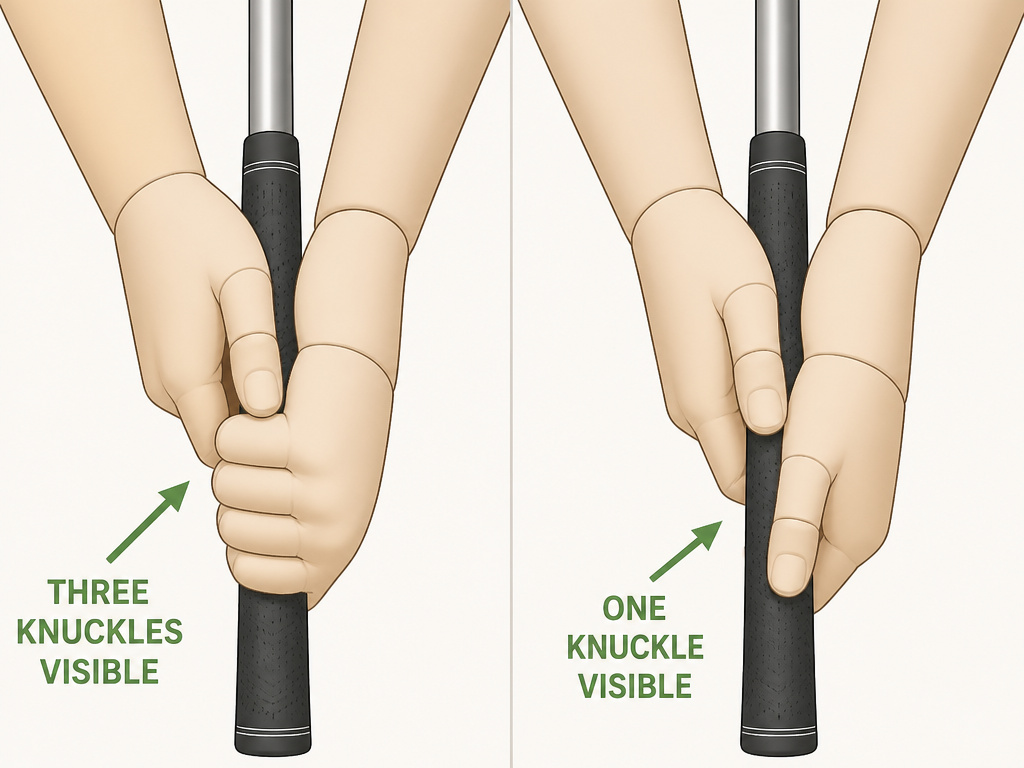
Don’t pick a grip because a pro uses it. Pick it based on your dominant miss and your athletic intuition. This table breaks down the decision.
| Factor | Strong Grip | Weak Grip | Who It Suits |
|---|---|---|---|
| Lead Hand Knuckles | 3 or 4 visible | 1 visible | N/A |
| Clubface at Impact | Closed relative to path | Open relative to path | N/A |
| Typical Ball Flight | Draw to Hook | Fade to Slice | Draw players vs. Fade players |
| Power Potential | High (promotes body release) | Can be lower (restricts release) | Players seeking more distance |
| Control/Accuracy | Can be less accurate if overdone | Demands precision, can be very accurate | Shot-makers, players in windy conditions |
| Common Miss | Over-draw, Hook | Slice, Push | Players who fight that miss |
| Swing Path Friend | In-to-Out | Neutral to Slightly Out-to-In | Must match your natural path |
| Adjustment Period | 1-2 weeks of hooks before stabilizing | 1-2 weeks of slices before stabilizing | Patient tinkerers |
The bottom line: If you slice, try a slightly stronger grip or, more importantly, fix your grip pressure. If you hook, try a slightly weaker grip. Always make changes incrementally, one knuckle at a time.
Your grip type, whether overlapping (Vardon), interlocking, or baseball, also interacts with strength. An interlocking grip can feel more secure with a strong position, while an overlapping grip might suit a weaker, more fluid feel.
How to Change Your Grip and What to Expect
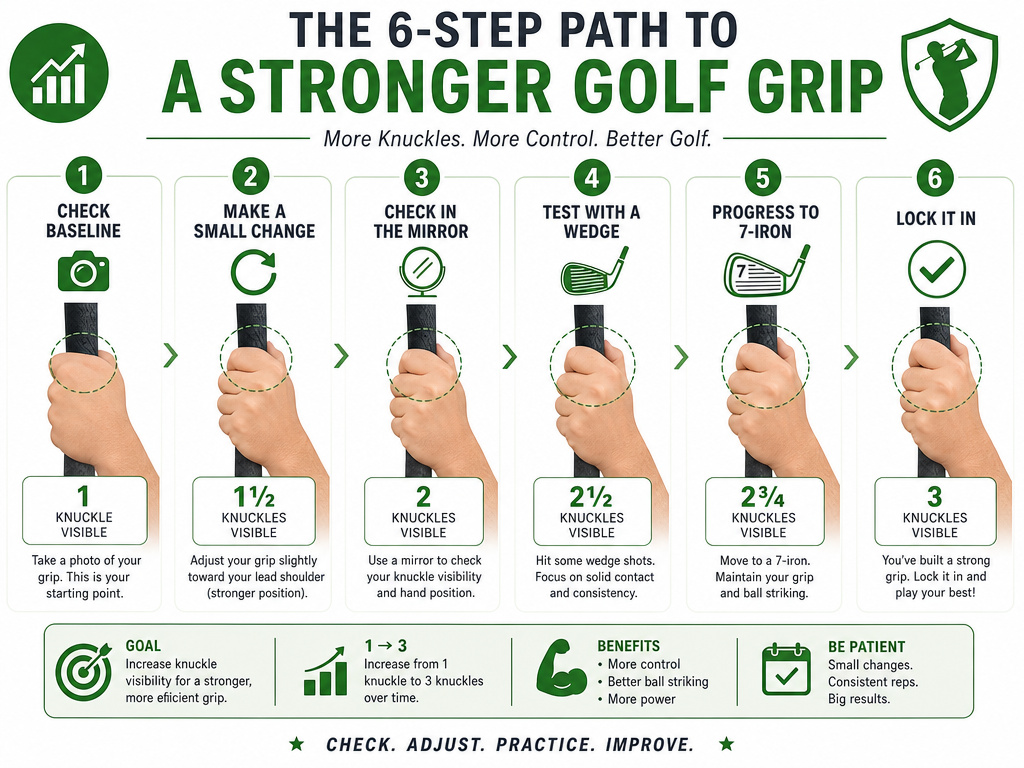
Changing your grip is a fundamental alteration. It will feel foreign, and your ball striking will get worse before it gets better. Commit to a minimum two-week trial with deliberate practice.
- Check Your Baseline. Hit ten shots with your current grip and note the ball flight. Take a photo of your lead hand at address.
- Make a Small Change. Want to get stronger? Rotate your lead hand clockwise until you see one more knuckle. That’s it. Don’t go from seeing one knuckle to four in one session.
- Rehearse Without a Ball. Take your new grip and make slow, half-swings in front of a mirror. Feel the difference in your forearm tension.
- Hit Half-Shots. On the range, hit 30-yard pitch shots with a wedge. Focus solely on the new grip feel, not the result.
- Graduate to Full Swings. After 20 pitch shots, move to a 7-iron. Expect weird shots. Your goal is not a perfect draw but to avoid reverting to your old grip under pressure.
- Stick With It. Your first full bucket will be messy. The second and third will be worse. Around the fourth or fifth session, muscle memory begins to adapt.
What most people get wrong: They change their grip and immediately try to manipulate the clubface with their hands to correct the new ball flight. This defeats the purpose. Let the new grip do the work. If you moved to a strong grip and are hooking everything, stay with it. Your subconscious will eventually adjust your path to compensate.
Equipment can help. A grip for accuracy like a firmer rubber or corded grip (e.g., Golf Pride MCC) provides more feedback. A softer, tackier grip (e.g., Winn Dri-Tac) can help if you struggle with tension. A good golf glove enhances connection without increasing pressure.
Frequently Asked Questions
Can you have a strong right hand and a weak left hand?
Yes, this is a “mixed” grip and is common among players who fight a hook. It weakens the overall grip strength slightly. For a right-handed player, a strong left hand (3 knuckles) with a weak right hand (hand more on top) can help neutralize an over-active release. It’s an advanced adjustment and requires experimentation.
Do any PGA Tour players use a weak grip?
Yes, though it’s less common in the modern power game. Past players like Ben Hogan and Lee Trevino used weak grips to hit controlled fades. Some contemporary players, like Tony Finau, have a relatively weak left-hand position. They compensate with exceptional grip pressure control and precise swing paths.
How does grip size affect grip strength?
Smaller grip can make your grip play stronger because it allows your hands to over-rotate more easily. A larger grip can make your grip play weaker by restricting hand action. If you’ve strengthened your grip and are hooking uncontrollably, try a midsize grip before abandoning the change. Our golf grip sizing guide details the fitting process.
Is it better to start with a neutral grip?
For a complete beginner, yes. A neutral grip (2 knuckles visible on the lead hand) is the best baseline. It doesn’t impose a draw or fade bias, allowing you to discover your natural swing tendencies first. Once you have a consistent pattern, a slice or a hook, you can then adjust your grip strength to correct it.
Can a grip change fix a slice permanently?
Grip change can help manage a slice, but it’s rarely a permanent fix alone. A slice is caused by an out-to-in swing path combined with an open clubface. A stronger grip helps close the face, but if your path remains severely over-the-top, you’ll just hit a pull or a pull-slice. Effective, long-term correction involves combining a grip adjustment with path drills.
The Bottom Line
The strong grip versus weak grip decision is a lever, not a light switch. It fine-tunes the clubface delivery your swing mechanics already create. Stop looking at photos of a pro’s hands and counting knuckles. Instead, listen to your ball flight.
If the ball curves right, experiment with a slightly stronger position or, more critically, firmer lead-hand pressure. If it dives left, try a slightly weaker hold. The full Warwick University research paper confirms that these changes directly alter wrist kinematics and clubface orientation. Give any change ten full range sessions before you judge it. And remember, a consistent, repeatable proper grip you can trust under pressure is always better than a theoretically perfect one you can’t find on the first tee.
