
The Complete Guide to How Golf Balls Are Made & Engineered
This post contains affiliate links. As an Amazon Associate, we earn from qualifying purchases.
This post contains affiliate links. As an Amazon Associate, we earn from qualifying purchases.
Modern golf balls are made through a multi-stage process of molding, curing, and finishing. The core is molded from a synthetic rubber like polybutadiene and vulcanized under heat and pressure. One or more mantle layers are then added, followed by a urethane or ionomer cover molded in a dimpled cavity. The entire process is governed by strict tolerances, with key steps like core heat treatment lasting up to 24 hours per US Patent 10632347.
That 24-hour window isn’t arbitrary. It’s the thermal ceiling where the rubber’s molecular cross-links set without becoming brittle. Under-heat the core and it stays mushy, losing energy transfer. Overheat it and the ball feels like a rock off the clubface. The difference between a Pro V1‘s consistent click and a range ball’s dull thud lives in that timeline.
What follows is a breakdown of the three non-negotiable phases: core formation, layer application, and finishing. We’ll pull specs from OEM patents, explain why cover hardness (Shore D 47 vs. 63) changes your short game, and show where the USGA Rules of Golf draw the line on what counts as a legal ball.
Key Takeaways
- Core vulcanization requires a precise 1 to 24-hour heat treatment between 175°C and 300°C; stray outside this range and compression consistency fails.
- Cover material hardness is a trade-off: urethane (approx. Shore D 47) gives spin and feel, while ionomer (approx. Shore D 63) prioritizes durability and distance.
- A single deep gate mark or more than four minor gate marks qualifies a ball as defective, per quality standards in US Patent 9545741.
- For non-conforming play, manufacturers can produce balls outside USGA size/weight limits, a fact documented in patent literature.
- The choice between two-piece golf balls and multi-layer golf balls fundamentally changes the manufacturing process and the resulting ball’s performance.
The Core: Vulcanization and the 24-Hour Heat Treatment
The process starts with the engine: the core. Its job is to store and release the energy from your swing. Get the formula or cure wrong, and distance vanishes.
The base material is almost always polybutadiene, a synthetic rubber prized for its high rebound. Manufacturers mix this base rubber with metal salts (like zinc diacrylate), peroxides, and other agents to create a specific reactivity and hardness profile. This mixture is then fed into a core mold.
The rubber composition is molded and vulcanized to form a core, which is then heat-treated for 1 to 24 hours at a temperature between 175°C and 300°C. This step is critical for achieving uniform hardness across the core and stabilizing its compression.
This is the sourced-number magnet from US Patent 10632347. The heat treatment isn’t just baking; it’s completing the vulcanization. The peroxides generate free radicals that form cross-links between the rubber polymer chains. More cross-links mean a harder, higher-compression core. Fewer mean a softer feel. The 24-hour maximum exists because beyond that point, the rubber can begin to degrade, losing its elasticity.
Variability here is the enemy. An under-cured core will have soft spots. An over-cured core loses its “snap.” This is why brands like Titleist invest in proprietary systems like their ZG Process, to eliminate hot or cold spots in the curing press. The goal is every core in a batch having the same compression, which is why understanding golf ball compression matters for your game.
| Core Characteristic | Material/Process | Impact If Wrong |
|---|---|---|
| Base Material | Polybutadiene synthetic rubber | Low energy return, reduced distance |
| Curing Agent | Organic peroxide (e.g., dicumyl peroxide) | Incomplete vulcanization; inconsistent hardness |
| Heat Treatment | 1–24 hrs at 175–300°C (US Patent 10632347) | Soft/mushy feel or brittle, rock-like feel |
| Target Outcome | Uniform cross-link density | Variable compression; inconsistent ball flight |
After curing, the core is cooled, measured, and weighed. Any core outside the tight tolerance for size, weight, or roundness is rejected. This core now becomes the foundation for every subsequent layer.
Layer Construction: Mantles, Casing, and the Transition Zone
Not every ball has layers between the core and cover. Two-piece golf balls skip this stage entirely, which is why they are often the most affordable and durable, making them excellent golf balls for beginners. But for players seeking more performance, intermediate layers are where engineers dial in specific behaviors.
These layers, often called mantles or casing layers, are typically made from high-modulus ionomer resins or other engineered polymers. Their primary job is to mediate the energy transfer from the soft core to the firm cover. A stiffer mantle will lower spin on long shots, promoting a penetrating ball flight. A more resilient mantle can help increase ball speed.
The application method is usually injection molding. The finished core is placed into a larger mold cavity, and molten mantle material is injected around it. The thickness and composition of this layer are precise. For example, US Patent 10632347 describes a specific construction with a 1.68 mm thick ionomer intermediate layer.
This stage is where the separation occurs between distance golf balls and models designed for maximum spin. A distance ball might use a firmer, simpler mantle to minimize energy loss. A spin ball might use a softer, more complex mantle system to create a higher spin rate off the wedges.
Where this goes sideways: Injecting the mantle layer at the wrong temperature or pressure. Too cool, and the material doesn’t flow evenly, creating thin spots that crack. Too hot, and it can thermally degrade the core’s outer surface, altering its compression.
Cover Molding: Compression vs. Injection
The cover is the interface with your club. It dictates feel, sound, spin, and durability. The two dominant materials are thermoset urethane and ionomer resin, each requiring a different molding process.
Thermoset Urethane is the premium choice, used in most tour-level three-piece golf balls and beyond. It’s softer (around Shore D 47) and provides exceptional greenside spin and a soft feel. Urethane covers are typically formed via a compression molding process.
In this method, pre-made hemispherical half-shells of uncured urethane are placed around the layered core in a dimpled mold. The mold is closed, applying heat and pressure. The shells melt, flow together, and cure into a single, seamless cover. The process takes 1 to 15 minutes at 130–230°C. The key advantage is seamlessness, which manufacturers claim promotes consistent aerodynamics.
Ionomer Resin (like Surlyn) is tougher (around Shore D 63) and more cut-resistant. It’s the standard for durable balls and many golf balls designed for senior players who prioritize straight distance. Ionomer covers are usually injection molded.
Here, the layered core is centered in a dimpled mold cavity. Molten ionomer is injected directly into the cavity, where it cools and solidifies around the core. It’s faster than compression molding but leaves a small “gate” mark where the injection nozzle met the mold. This gate must be carefully trimmed and finished.
| Cover Type | Typical Hardness (Shore D) | Molding Process | Best For |
|---|---|---|---|
| Thermoset Urethane | ~47 | Compression Molding | Maximum spin, soft feel, tour performance |
| Ionomer Resin | ~63 | Injection Molding | Durability, distance, cut resistance |
The choice directly affects play. That’s why a guide to golf ball selection always separates urethane from ionomer covers.
Dimples and Finishing: The Final Thousandths of an Inch
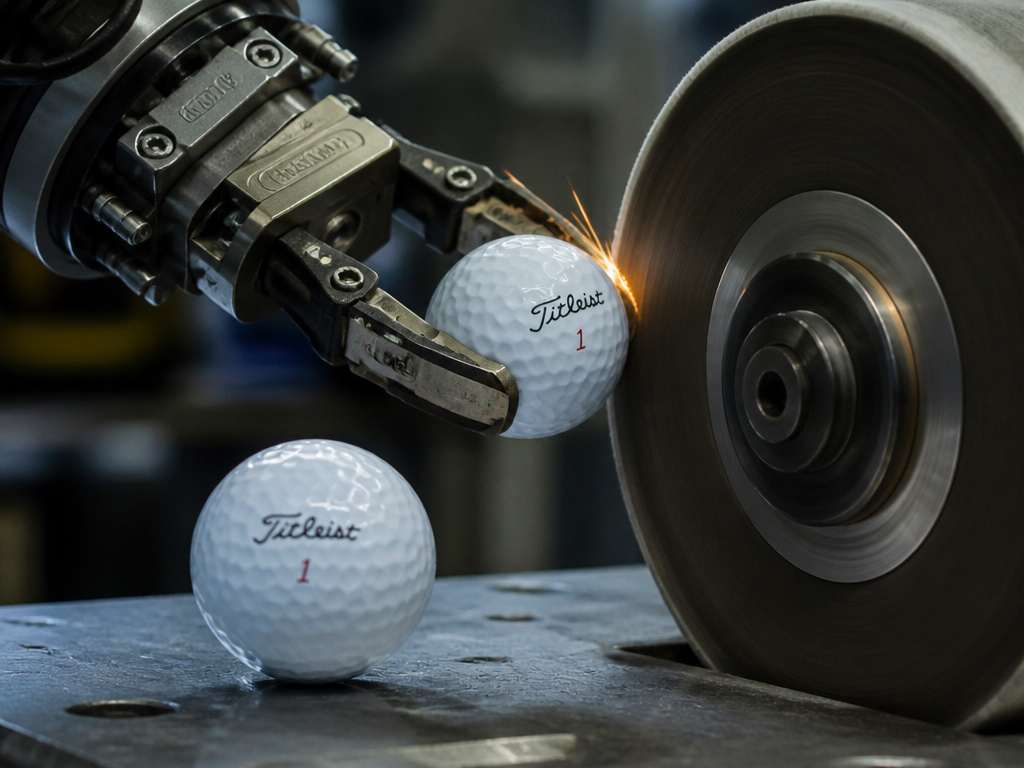 Once the ball has its final cover, it looks smooth. The dimples are actually formed during the cover molding process, the interior surface of the cover mold is covered in the dimple pattern. When the cover material sets, it takes the inverse shape of the mold, creating the dimples.
After de-molding, the ball enters finishing. This is a multi-step quality gauntlet:
- Gate Removal: For injection-molded balls, the small nub of plastic (the gate) left from the injection process is trimmed off.
- Buffing & Cleaning: The ball is buffed to a uniform surface finish and cleaned.
- Painting & Coating: Most white balls receive a paint coat and a clear, protective topcoat. This is where bright balls get their color. The coating must be perfectly even; too thick and it affects weight and balance.
- Stamping: The brand and model logos are stamped on.
- Final Inspection: Every ball is weighed, measured, and checked for visual defects. It’s also tested for roundness and symmetry by spinning it and using sensors to detect any wobble.
Common mistake: Assuming a pristine surface means perfect balance. A heavy paint spot on one side or a minuscule thickness variation in the cover can create an imbalance. This imbalance causes the ball to wobble in flight, killing distance and accuracy. High-end manufacturers use balancing systems to detect and reject these.
The defect standard is brutal. As cited from US Patent 9545741, a sample ball can be rejected for having more than four minor gate marks or a single deep gate mark. This is about cosmetics, but also about aerodynamic purity. A flaw in the dimple pattern disrupts airflow.
Rules, Tolerances, and the Machines That Enforce Them
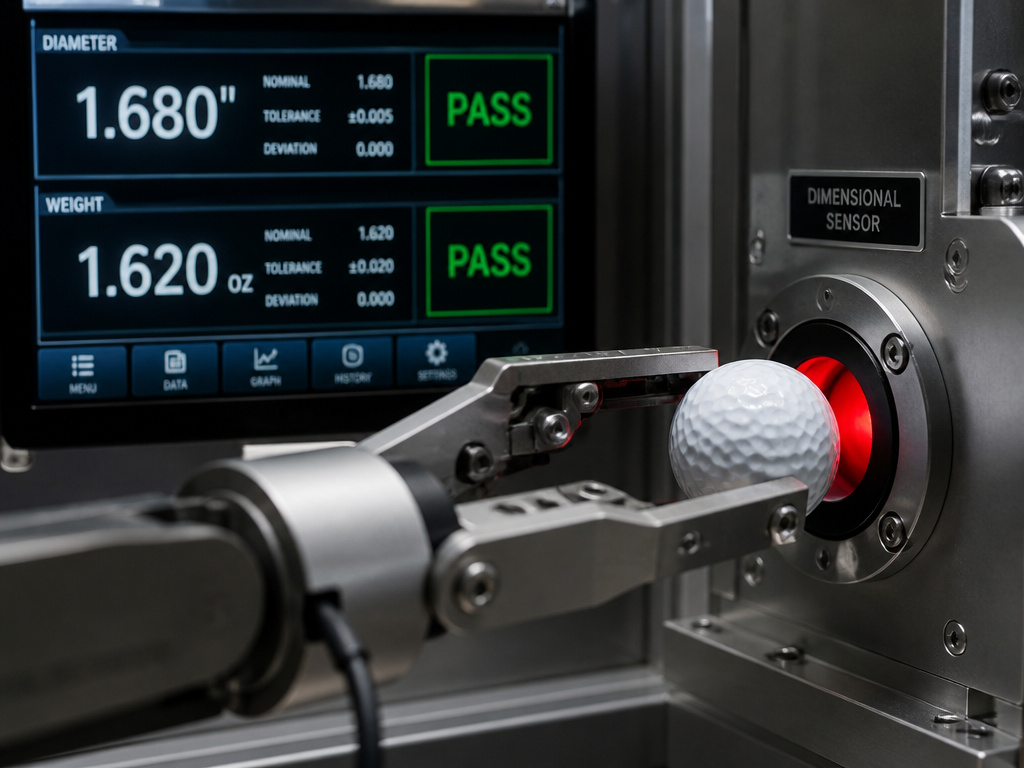 The entire manufacturing line exists within a cage of rules and physical tolerances. The most famous are the USGA and R&A rules: a competitive ball must have a diameter of at least 1.68 inches and a weight of no more than 1.62 ounces. Every ball on a pro tour meets these specs.
But the factory’s internal tolerances are far tighter. If the USGA allows a 0.005-inch variance, the factory might reject anything beyond 0.002 inches. This is controlled by automated systems that monitor temperature, pressure, humidity, and chemical timing in real-time.
Patents reveal an edge case: balls can be made for non-USGA play. They can be smaller or heavier, designed for specific recreational markets where pure distance is the only goal. You won’t find these in a tournament, but they exist because the machinery can be adjusted.
The final check is often a functional test. Random samples from a production run are fired from a cannon-like machine at a standardized clubface. Their launch angle, spin rate, and speed are measured. If the data falls outside a narrow band, the entire batch may be halted. This links back to the player’s choice, whether you need forgiving golf balls or balls for slower swings, that performance band is what the factory is built to hit.
Frequently Asked Questions
What is the core of a golf ball made of?
The core is primarily made from polybutadiene, a high-energy synthetic rubber. It’s mixed with metal salt catalysts (like zinc diacrylate) and organic peroxides before being molded and vulcanized under heat and pressure to create a solid, elastic sphere.
Why are there different layers in a golf ball?
Each layer serves a distinct function. The core stores energy. Intermediate mantle layers control the transfer of that energy and influence spin rates. The outer cover provides feel, spin, and durability. More layers allow engineers to fine-tune performance for different swing speeds and player skills, which is why exploring golf ball types is useful.
What’s the difference between urethane and Surlyn covers?
Urethane is a softer, thermoset material that offers superior spin control and a softer feel, especially on short-game shots. Surlyn is a harder, ionomer resin that is much more durable and cut-resistant, often favoring distance over spin. This difference is central to choosing between tour-level balls and distance balls.
How are the dimples on a golf ball made?
Dimples are not drilled or stamped; they are formed during the cover molding process. The cover mold has a negative dimple pattern on its interior surface. When the cover material (urethane or ionomer) is molded around the core, it sets into the shape of the mold, creating the dimpled surface.
Are expensive golf balls made differently?
Yes, but the difference is in precision and materials, not basic process. Expensive, multi-layer balls use more costly thermoset urethane covers, tighter tolerances, and more rigorous quality control. They also undergo more performance validation testing. The manufacturing line for a premium ball will reject a higher percentage of its output to ensure that every ball that ships is nearly identical.
Before You Go
A golf ball is a deceptively complex object. Its construction, from the 24-hour core cure to the Shore D 63 ionomer cover, is a direct response to the physics of a 100-mph collision. Knowing that a soft core helps slower swings, or that a urethane cover grabs the green, turns a purchase from a guess into a decision.
Your swing speed dictates the core. Your short-game needs dictate the cover. The rest, the dimple pattern, the layer count, is engineering filling in the gaps between those two points. Whether you’re looking at golf balls for women designed for a specific tempo or high-visibility colored golf balls for autumn play, that framework holds. The ball is a tool. Now you know how they forge it.
