
The Correct Driver Tee Height | How to Optimize for Distance
This post contains affiliate links. As an Amazon Associate, we earn from qualifying purchases.
This post contains affiliate links. As an Amazon Associate, we earn from qualifying purchases.
The correct tee height for a driver positions the equator of the ball level with the top edge of the club’s crown, roughly half the ball above the clubhead. For a modern 460cc driver, this requires a 3.25-inch tee. This height promotes contact slightly above the face center, reducing spin and increasing launch angle for maximum carry distance. USGA robot testing shows lowering impact by 0.6 inches can cut distance by 2 to 13 yards.
That “half the ball” rule isn’t just tradition. It’s the mechanical answer to a physics problem called vertical gear effect. Your driver face has variable loft, and where you strike the ball dictates the spin and launch you get. Teeing to the right height is the simplest way to control that strike point before you even swing.
What follows is the data behind that rule, the range used by touring pros, and a field test to find your personal height. We’ll also cover when to break the rule for wind, what tee to buy, and why women golfers face a steeper penalty for getting it wrong.
Key Takeaways
- Use a 3.25-inch tee for a modern 460cc driver to position half the ball above the crown.
- Low tees cost distance: USGA robot data found a 0.6-inch lower strike can reduce drive distance by 2 to 13 yards.
- Pros vary wildly: At the 2021 U.S. Open, Bryson DeChambeau teed at ~1.67 inches while Adam Scott used ~0.88 inches.
- The penalty is greater for women: USGA research concluded low tee heights have “much more negative effects on elite women than elite men.”
- Buy plastic step-tees for consistency; they eliminate finger-push variance, especially helpful for players with grip stiffness.
The Half-Ball Rule and Why It Works
Look at your driver at address. The goal is to see the ball’s equator sitting flush with the top line of the clubhead. That visual, half above, half below, is your baseline.
A driver face has graduated loft. The stamped loft (e.g., 10.5°) is measured at the center. Move up the face, effective loft increases. Move down, it decreases. Striking the ball above center adds launch and cuts spin via vertical gear effect, the ideal combination for distance.
This isn’t about hitting up on the ball. That’s a swing path issue. This is about ensuring your upward swing makes contact in the right vertical window on the clubface. Tee too low, and even a perfect upward strike hits the lower half, adding backspin and killing carry. Tee too high, and you risk a glancing blow off the crown, a “skyball” that goes high and short.
For a 460cc head, the largest allowed by the R&A and USGA, a 3.25-inch tee gets you there. Push it into the ground until about a thumb’s width of plastic remains above the turf. The ball will sit correctly. This is why most golf tees for distance are sold in the 3.25-inch to 4-inch range.
Where this goes sideways: Using a 2.75-inch “standard” tee with a 460cc driver. The smaller tee forces the ball down, making it nearly impossible to achieve the half-ball position without leaving the tee precariously shallow in the ground. You’ll consistently strike low on the face.
What the USGA’s Robot Testing Actually Found
General advice is one thing. Peer-reviewed equipment research is another. The USGA’s Equipment Standards department has published specific findings on tee height’s role in driving distance.
One study used a robotic swing machine and a control club, an ‘Aeson’ 360cc titanium driver, set to a constant 120 MPH swing speed. Researchers lowered the impact point on the face in 0.2-inch increments. The result? Lower strike heights consistently reduced total distance. The loss ranged from 2 to 13 yards at the lowest position, depending on the golf ball used. Ball speed sometimes increased with a lower strike, but this was offset by a poorer launch angle and higher spin rate, a net loss for distance.
A follow-up USGA tee height effects report involved both robots and human players. The robot data confirmed the earlier finding: lowering the impact location by 0.6 inches cut distance by 2 to 13 yards. The human data, from 20 elite golfers using a GCQuad launch monitor, showed a broader trend. Decreasing tee height generally led to a more downward attack angle, slower clubhead speed, lower launch, higher spin, and less carry.
The study’s most practical finding? “No relationship between men’s or women’s normal teeing height and driving distance was found.” Your inherent preference doesn’t correlate with performance. This means consciously optimizing your tee height, regardless of your current habit, is a free upgrade.
How the Pros Do It: There Is No One Answer
If you look for a single “pro” tee height, you’ll be confused. The USGA’s same study recorded the estimated tee heights of players at the 2021 U.S. Open. The variance is staggering.
| Player | Estimated Tee Height (inches) | Hole |
|---|---|---|
| Bryson DeChambeau | 1.669 | 2nd Tee |
| Sergio Garcia | 1.605 | 2nd Tee |
| Adam Scott | 0.881 | 2nd Tee |
| Hideki Matsuyama | 0.990 | 5th Tee |
Bryson DeChambeau, with his extreme speed and upward attack, teems the ball very high. Adam Scott, with a shallower, sweeping delivery, plays it surprisingly low. Both are elite drivers. This proves the half-ball rule is a starting point, not a finish line. Your optimal height is the one that delivers the center of your clubface to the ball at your ideal impact location.
Their consistency, however, is absolute. They replicate their chosen height shot after shot using a routine. Many use the same brand of tee every time, often a plastic step-tee they push in until it stops. This eliminates the variable of “feeling” the height with their fingers, which can drift by half an inch over a round.
The 3-Step Range Test to Find Your Height
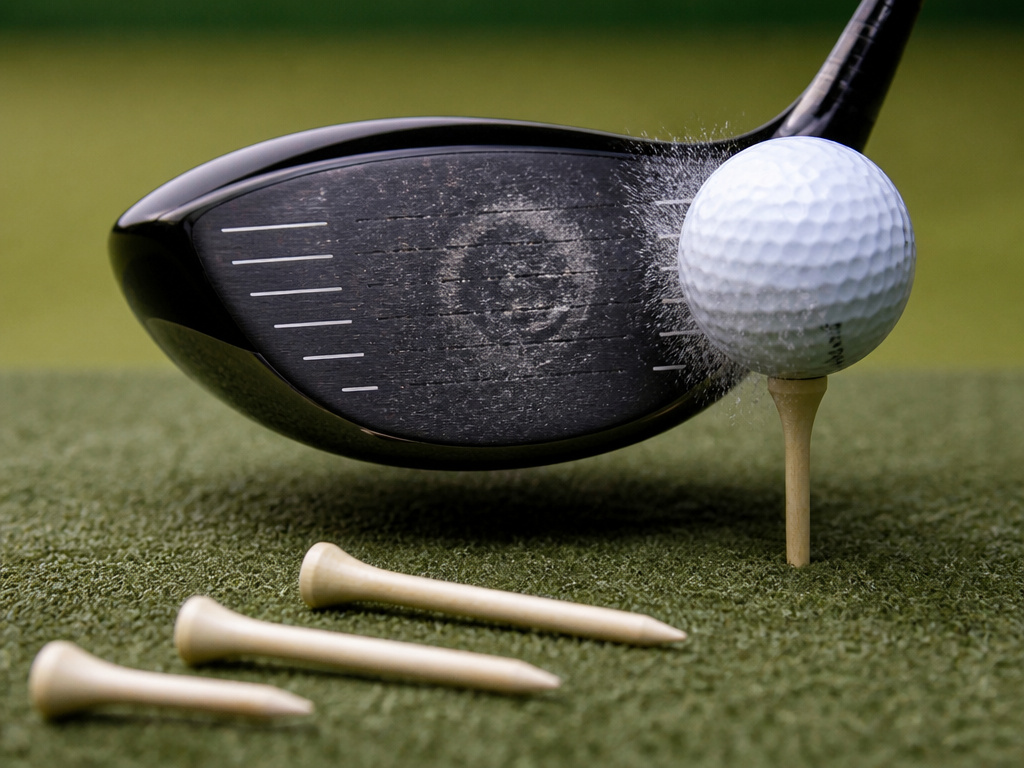
Forget theory. Use this test on your next range session with a driver. You need impact spray (Dr. Scholl’s Odor X works) and three tee lengths: 2.75-inch, 3.25-inch, and 4-inch.
- Spray and hit with the 3.25-inch tee. Hit five drives. Look at the impact marks on the face. You’re looking for a cluster. Is it centered? High? Low?
- Adjust based on the pattern. If marks are low on the face, switch to the 4-inch tee for five shots. If marks are high on the crown, switch to the 2.75-inch tee. Your goal is to move the strike pattern to the upper half of the face center, just above the sweet spot.
- Lock in the winner. Which tee produced the most consistent, high-center strikes? That’s your tee. Buy a bag of that exact length, preferably a step-tee for automatic height.
This test ties your driver setup directly to an observable outcome. It also reveals if your swing needs a change. If you hit low on the face even with a 4-inch tee, your swing is likely too steep or you’re not hitting up on the ball. That’s a cue to work on your driver swing mechanics, not just your tee.
Tee Height Adjustments for Conditions and Equipment

The half-ball rule has two important caveats: wind and driver loft.
Playing into a headwind: Tee the ball slightly lower, about a third of the ball above the crown. This promotes a lower launch angle and a more penetrating ball flight that holds its line better. Do not change your swing; just adjust the tee.
Playing with a tailwind: You can tee marginally higher to maximize carry, as the wind will help keep the ball airborne. Don’t overdo it.
Your driver loft also interacts with tee height. A low-lofted driver (8.5°-9.5°) often needs the ball teed fully at the half-ball rule or even a touch higher to generate sufficient launch. A high-lofted driver (12°+) might perform better with the ball level with the crown, as the club already has plenty of lift built in. This is where an adjustable driver is useful; you can tweak loft and then fine-tune tee height to match.
Critical Warnings and Common Mistakes
Before you start: Never use a broken or splintered wooden tee. The irregular surface can cause the ball to wobble or fall off. Plastic tees are more durable and provide consistent height if they have a step design. Always clear loose grass or debris from your teeing area to ensure a solid base.
The most frequent error is inconsistency. Pushing a tee in “by feel” leads to variance that destroys your strike pattern. A study cited by The Golface found golfers over 55 reduced tee-height variance by 31% by switching to step-tees. That consistency translated directly to tighter dispersion in launch angle.
Another mistake is using the same tee for every club. A 3.25-inch tee is terrible for an iron. You want the ball barely off the ground. Carry 1.5-inch tees in your golf tee pouches for par-3s.
Finally, understand that equipment can’t fix a major flaw. If you consistently top the ball or hit severe grounders, a tee height change is a band-aid. The core issue is likely in your fundamentals of hitting a driver.
The Special Case for Women and Senior Golfers
The USGA research made a pointed conclusion: “Low, or no, tee heights would have much more negative effects on elite women than elite men.” The reasons are biomechanical, generally slower swing speeds and different angle-of-attack tendencies. For women golfers, teeing the ball too low is a severe distance killer.
The solution is the same: use the half-ball rule as a minimum. Many women and seniors with slower swing speeds actually benefit from a 4-inch tee to help elevate the ball and maximize launch. Don’t be afraid to tee it high. The extra margin for error is worth it.
For seniors dealing with arthritis or grip strength issues, the case for plastic step-tees is even stronger. They require less force to push in to a consistent depth, preserving hand comfort over 18 holes. This small golf tournament gifts can make a real difference in enjoyment.
Frequently Asked Questions
Does tee height really affect distance?
Yes, significantly. USGA robot testing shows a strike lowered by 0.6 inches can reduce total drive distance by 2 to 13 yards. Tee height controls where on the clubface you make contact, which governs launch angle and spin rate, the two primary factors for carry distance.
What size tee is best for a 460cc driver?
3.25-inch tee is the standard for modern 460cc drivers. It positions the ball so roughly half sits above the clubhead’s crown, promoting an optimal high-center strike. A 4-inch tee can work for those seeking higher launch or with slower swing speeds.
How high do PGA Tour players tee the ball?
There is no standard. Heights vary dramatically based on swing style. Data from the 2021 U.S. Open showed a range from Adam Scott at ~0.88 inches to Bryson DeChambeau at ~1.67 inches. The consistency of their chosen height is what matters, not the specific number.
Should I tee the ball lower into the wind?
Yes. Tee the ball slightly lower, about one-third above the crown, when playing into a strong headwind. This encourages a lower launch angle for a more penetrating ball flight that holds its line better. Do not change your swing.
Do I need different tees for my irons?
Absolutely. Never use a driver tee for an iron. For irons and hybrids off a tee, use a 1.5-inch “short” tee. The ball should be teed just high enough to give you perfect contact off a tight lie, barely clearing the grass.
The Bottom Line
Find a 3.25-inch step-tee, push it in until it stops, and trust the half-ball visual. That single action does more for your driving consistency than any quick swing tip. The data proves low tees cost yards, and the pros prove your personal best height might be unique. Experiment on the range with impact spray, but start from the standard. For most amateurs, the biggest gain comes from eliminating the daily guessing game. Pick a height, buy a bag of matching tees, and stick with it for a full season. Your fairways hit count will thank you.
