
Master Your Game: Driver Setup vs Iron Setup Differences
This post contains affiliate links. As an Amazon Associate, we earn from qualifying purchases.
This post contains affiliate links. As an Amazon Associate, we earn from qualifying purchases.
Driver and iron setups differ in three non-negotiable ways: ball position, stance width, and spine tilt. The driver ball position is inside the lead heel, the stance is widest, and the spine tilts away from the target to promote an upward strike. The iron ball position is center or just forward, the stance is narrower, and the spine tilts slightly toward the target for a descending blow.
That difference between an upward and descending strike is the whole game. Get the driver setup wrong, and you lose 30 yards off the tee with a weak slice. Get the iron setup wrong, and you hit fat or thin shots that never hold a green.
What follows is a breakdown of each variable—ball position, posture, alignment—and the specific ball flight each one produces. By the end, you’ll know exactly how to stand for a 3-wood versus a 7-iron, and why changing just your feet can fix a persistent hook.
Key Takeaways
- Driver ball position sits inside your lead heel. This allows you to catch the ball on the upswing, maximizing launch and reducing spin.
- Iron ball position is center-of-stance for mid-irons, moving slightly forward for longer irons. This promotes the necessary descending strike for solid contact.
- Your spine tilt shifts with the club: tilt away from the target with the driver, tilt slightly toward it with irons. This sets the correct swing plane.
- Stance width dictates stability and rotation. Driver requires the widest stance; wedges use the narrowest.
- Tee height is a setup component. For a driver, half the ball should sit above the crown of the club at address.
The Core Setup Differences: A Side-by-Side Comparison
You don’t need to memorize ten steps. The entire adjustment comes down to three physical changes you make before you ever start your swing.
A proper driver setup positions the ball inside the lead heel, with the spine tilted away from the target and the shoulders level to slightly tilted (lead shoulder higher). This promotes a positive angle of attack, typically between +3 and +5 degrees, which optimizes launch and reduces spin for maximum carry distance.
| Setup Variable | Driver Setup | Iron Setup (e.g., 7-iron) | Why It Matters |
|---|---|---|---|
| Ball Position | Inside lead heel | Center of stance | Driver: enables upward strike. Iron: ensures ball-first contact. |
| Stance Width | Widest (outside shoulder width) | Shoulder-width or slightly narrower | Provides stability for longer swing arc (driver) and allows for controlled rotation (iron). |
| Spine Tilt | Away from target | Neutral or slightly toward target | Sets the swing plane. Away-tilt helps swing up; toward-tilt helps swing down. |
| Weight Distribution | 55-60% on trail side at address | 50-50 or slightly favoring lead side | Prevents swaying and encourages proper weight shift during the swing. |
| Posture & Knee Flex | More upright, less knee flex | More athletic bend, moderate knee flex | Accommodates longer club; maintains balance for shorter, steeper swing. |
Ball Position: The Foundation of Strike Quality
Ball position is the first domino. Place it wrong, and your body will contort to find the ball, ruining your path and strike.
For the driver, play the ball off the inside of your lead heel. This gives the clubhead enough space to reach the bottom of its arc and be moving upward at impact. If you play it too far back, you’ll hit down on it, adding excessive spin and losing carry distance. A common checkpoint is to set the ball so the club’s toe is roughly in line with your lead heel.
For irons, the position moves back. Start with a mid-iron in the center of your stance. As clubs get longer (like a 4-iron), move it a half-ball forward. As clubs get shorter (like a 9-iron), move it a half-ball back. This gradual shift ensures a consistent, slightly descending strike. A centered ball position for a 7-iron is the baseline.
Common mistake: Keeping the same ball position for every club. A driver played off the center of your stance forces a steep, downward hit, producing a low-spinning knuckleball that falls out of the sky. An iron played off your heel leads to a thin, skulled shot every time.
Posture and Spine Tilt: Setting Your Swing Plane
Your posture isn’t just about bending over. The angle of your spine at address dictates the angle of your swing.
With a driver, you need to create room for your arms to swing upward. Tilt your spine away from the target by pushing your lead hip slightly toward the target. Your head stays behind the ball. This “away tilt” encourages the upward attack angle you need. Your shoulders should be level or with your lead shoulder slightly higher—never lower.
With an iron, you want to strike down. Your spine should be more neutral, or even tilted a degree or two toward the target. This sets your upper body slightly ahead of the ball, making it easier to deliver the club with a descending blow. Your weight should feel balanced or slightly favoring your lead side.
This isn’t about a huge movement. The tilt difference between a driver and a 7-iron might only be an inch or two in head position. But that inch changes everything about your swing’s bottom.
Stance Width and Alignment: The Platform for Power
Your feet are your foundation. A wide stance provides more rotational stability for a long, powerful driver swing. Start with your feet outside your shoulders. This limits excessive lower body movement and helps you coil against a stable base.
For irons, bring your feet in to about shoulder-width. A narrower stance allows for a more aggressive weight shift and a steeper, more controlled swing. For wedges, the stance narrows further to facilitate precision over power.
Alignment is consistent: feet, knees, hips, and shoulders should all be parallel to your target line. The only thing that changes is the width. Many amateurs align their body where the ball starts, not where they want it to finish. Check your alignment with a club on the ground.
How Swing Mechanics Change with Your Setup
Your setup dictates your swing. A driver swing is a sweeping, around-the-body motion. An iron swing is a steeper, more up-and-down motion. Trying to force one swing type with the other’s setup is the source of most poor contact.
The Driver Swing: A Sweep for Launch
With the ball forward and spine tilted away, your swing path should be more shallow and around your body. Think of sweeping the ball off the tee. Your focus is on a wide takeaway and a full turn, making contact as the clubhead is ascending.
The goal is a high launch with low spin. This is why driver loft and shaft flex selections are critical. A setup that promotes a +5-degree attack angle pairs with a 9- or 10.5-degree loft to optimize trajectory. If your setup is correct but you’re still hitting low bullets, your driver loft might be too low.
The Iron Swing: A Strike for Compression
With the ball centered and posture more neutral, your swing must be steeper. Your hands lead the clubhead into impact, trapping the ball against the turf. This is the “ball-first” contact that creates backspin and control.
The swing is more up-and-down, with a shorter finish. Power comes from a crisp transfer of weight, not a huge rotational coil. This is why swing plane differences between clubs are real. Trying to swing your 7-iron like a driver—with a flat, around-the-body motion—results in weak slices and no divot.
Common Setup Mistakes and Their Ball Flights
You can diagnose most issues by looking at setup. Here’s what happens when you get the three main variables wrong.
| Miss-Hit | Likely Setup Cause | The Fix |
|---|---|---|
| Driver: High, Spinning Slice | Ball too far back, spine vertical, weight on lead side. | Move ball to lead heel, create spine tilt away, feel 60% weight on trail foot. |
| Driver: Low, Toe-Hooked Smother | Ball too far forward, excessive away-tilt, closed stance. | Move ball back half a ball width, reduce spine tilt, check shoulder alignment. |
| Iron: Fat Shot (Behind Ball) | Ball too far forward, weight stuck on trail side, no spine tilt. | Center the ball, preset weight 50-50, feel a slight forward spine tilt. |
| Iron: Thin or Topped Shot | Ball too far back, standing too upright, swaying off the ball. | Move ball forward, increase knee flex and forward bend, maintain head height. |
Where this goes sideways: Adjusting your swing to fix a problem that starts at address. If you’re hitting driver slices, your first move shouldn’t be a stronger grip. Check your ball position and spine tilt. Ninety percent of the time, the fault is there before you even move.
Integrating Adjustable Drivers into Your Setup
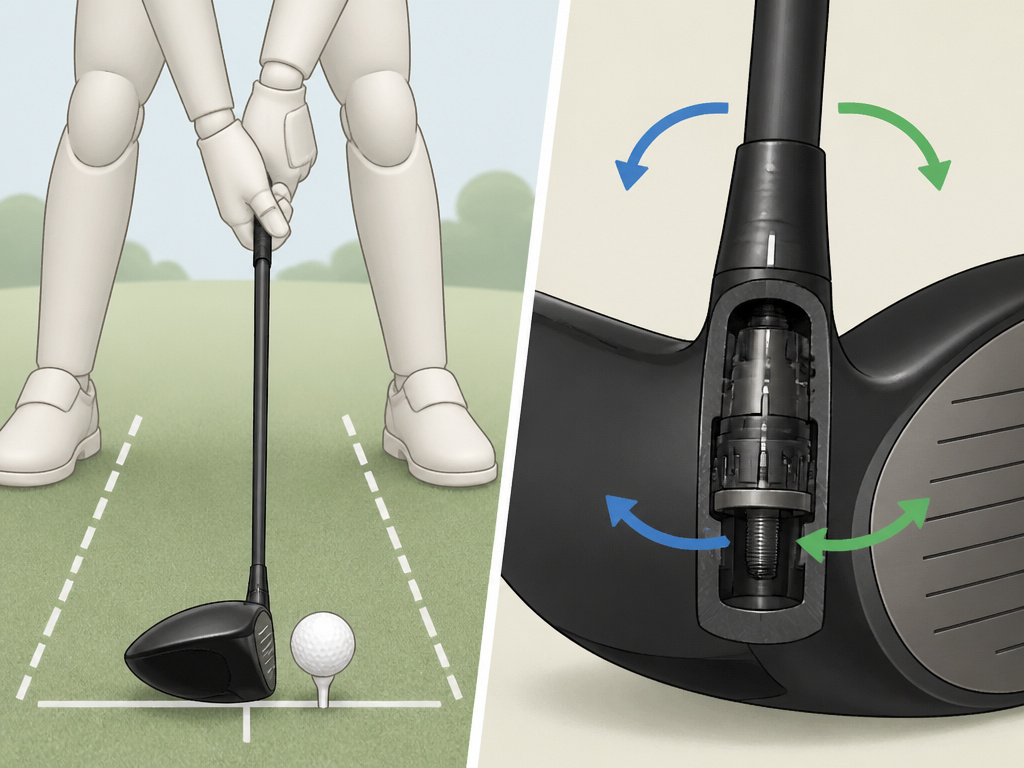 Modern adjustable driver technology lets you fine-tune ball flight, but it works with your setup, not instead of it.
If you’ve dialed in a proper setup but still fight a slice, you might use the hosel to add loft and close the face slightly. This can help, but it’s a band-aid if your stance is open or your ball position is off. The movable weights in a driver like the TaylorMade Stealth 2 or Callaway Paradym are for tweaking draw/fade bias after your basic setup is solid.
Think of it this way: setup is the foundation, the adjustable driver settings are the trim. Nail your golf stance, ball position, and tilt first. Then use the settings to optimize for your typical miss or desired flight.
Frequently Asked Questions
Should my driver and iron stance be the same?
No. Your driver stance should be wider than your iron stance. A wide base stabilizes the longer, more rotational driver swing. A narrower iron stance allows for the necessary weight shift and steeper angle of attack.
How does tee height affect driver setup?
Tee height is part of the setup. For a standard driver, tee the ball so half of it sits above the crown of the club when the sole is resting on the ground. This ensures you make contact with the club’s sweet spot on the upswing. Too low, and you’ll hit down. Too high, and you’ll pop it up or catch it on the crown.
Why do I hit my irons well but struggle with the driver?
This usually points to a setup conflict. You’re likely using an iron-style setup for your driver: ball too central, spine vertical, stance too narrow. This forces a downward strike with the driver, creating high spin and low launch. Isolate your driver practice to work on the three key changes: ball forward, spine tilted away, stance wide.
Does shaft flex change my setup?
Shaft flex influences feel and timing, not your fundamental address position. However, a flex that’s too stiff for your swing speed can make it hard to launch the driver, exacerbating a poor setup. Ensure your flex matches your speed, then build your setup around that club. Your posture and ball position don’t change based on flex.
How important is alignment for each club?
It’s equally critical for all clubs. Your body should be aligned parallel left of the target line (for right-handed golfers). The difference is that with a driver, the ball is positioned forward along that line, making it appear you’re aimed differently. Always check alignment with a club on the ground from behind the ball.
The Bottom Line
The driver and iron are different tools for different jobs. Your setup is how you tell your body which job to do.
For the driver, get wide, get the ball forward, and tilt back. Sweep it. For the iron, get balanced, center the ball, and stay neutral. Strike down on it.
Stop trying to make one swing work for every club. Change your stance, change your ball position, change your posture. The swing that follows will be the right one.
