
First Golf Course in America | The 1786 Club That Vanished
This post contains affiliate links. As an Amazon Associate, we earn from qualifying purchases.
This post contains affiliate links. As an Amazon Associate, we earn from qualifying purchases.
The first golf course in America was Harleston Green in Charleston, South Carolina, used by the South Carolina Golf Club from 1786. The first surviving, continuously operating course is Foxburg Country Club in Pennsylvania, founded in 1887. The distinction hinges on your definition: earliest documented play, first organized club, or oldest existing layout.
That 1786 date comes from a primary source, an announcement in The Southern States Ephemeris almanac. It’s not a legend. It’s a printed record. The club met on a public green, adjourned to a coffee house, and vanished from history by 1799. This creates the central puzzle of American golf origins: a documented beginning with no physical trace, versus later courses that still exist but weren’t the first.
What follows is a breakdown of the three main contenders, grounded in the documents that prove their claims. We’ll look at the 1786 Charleston club, the 1884 West Virginia links that were abandoned for 80 years, and the 1887 Pennsylvania course that never stopped operating. By the end, you’ll know why the answer isn’t simple, and which site holds which title.
Key Takeaways
- The South Carolina Golf Club at Harleston Green (1786) is the first documented organized club, with evidence from city gazettes and almanacs.
- Oakhurst Links (1884) is the first purpose-built American course but was abandoned from 1912 to 1994, breaking “continuous use.”
- Foxburg Country Club (1887) holds the claim for the oldest golf course in continuous operation on its original site.
- Early clubs used “featherie” balls and shared clubs; their disappearance is often linked to urban expansion and the War of 1812.
- The “first” title depends entirely on the criteria: first club formation, first course built, or oldest course still played.
The 1786 Contender: Harleston Green
The story starts with a newspaper notice and an almanac entry. On May 28, 1788, the Charleston City Gazette requested members of the South Carolina Golf Club to meet on “Harleston’s Green” and then adjourn to “William’s coffee house.” This wasn’t the beginning, it was an anniversary notice. The club’s formation was listed two years prior in The Southern States Ephemeris for 1788, citing a 1786 founding date.
Where this goes sideways: Assuming “first” means a course that looked like a modern country club. Harleston Green was a public common also used for cattle shows and horse racing. The “greens” were likely just scraped-earth holes.
The equipment was primitive. Players used featherie balls, boiled feathers stuffed into stitched bull’s hide, and a handful of wooden clubs that resembled hockey sticks. The game was a social pursuit for Charleston’s Scottish merchants, more akin to the principles of golf course design that emphasize natural landscapes than a formal sport. Slaves often acted as “finders,” standing by the hole to warn others of an approaching shot, which is where the term “fore” may have originated.
The club even had a clubhouse by 1795, noted in another gazette announcement. And then, it disappeared. Annual notices ceased after 1799. Historians speculate that urban encroachment onto the green and the economic isolation following the Embargo Act of 1807 killed the club. This pattern, documented existence followed by complete disappearance, defines the earliest era of American golf. You can find a deeper exploration of these foundational years in the Scottish Golf History oldest courses list.
The 1884 Pioneer: Oakhurst Links
If continuity is the standard, the 1786 club fails. The next major claimant didn’t appear for another century. In 1884, a Harvard-educated lawyer named Russell W. Montague built a nine-hole course on his farm in White Sulphur Springs, West Virginia. Oakhurst Links was a deliberate, Scottish-inspired layout, making it the first purpose-built golf course in the United States.
The sensory reality is key here. Players used hickory-shafted clubs and gutta-percha balls. The gutta-percha ball, made from dried tree sap, had a hard, brittle feel and a distinctive thwack when struck purely, a different sound from the soft thud of a featherie. They played for a sterling silver “Oakhurst Challenge Medal,” the oldest known golf medal in America.
The Oakhurst Links Challenge Medal, first awarded in 1888, is a replica of which is held at the USGA Museum. The original is secured in a private collection.
The course’s timeline is its complication. Play declined after 1910 as members moved away and the new Greenbrier resort course opened. By 1912, Oakhurst reverted to pasture. It sat dormant, forgotten, for 80 years until a restoration in 1994. This long abandonment is why, despite its early date, it cannot claim “oldest continuous” status. It was added to the National Register of Historic Places in 2001, a status you can verify in its Wikipedia entry on Oakhurst Links. The course was damaged by floods in 2016 and has not reopened.
| Claim | Strength | Fatal Flaw |
|---|---|---|
| First Purpose-Built Course | Built in 1884 with clear design intent. | Abandoned for 80 years (1912-1994). |
| First Competition | Hosted the first match for a medal in 1888. | Not a continuously operating entity. |
| Historical Restoration | Faithfully restored as a living museum piece. | Not the original, uninterrupted golfing ground. |
The Continuous Operation Champion: Foxburg Country Club
For the title of oldest golf course in continuous operation on its original site, the spotlight shifts to Foxburg, Pennsylvania. The Foxburg Country Club was founded in 1887. Its origin story involves cricket. Member Joseph Mickle Fox traveled to Britain for a cricket match in 1884, visited St. Andrews, and returned with clubs and balls from Old Tom Morris himself.
Fox built a small course on his estate. Local interest grew, and a formal club was established with a course laid out in 1887. It was expanded to nine holes by 1888. The critical point is that golf has been played there, without a multi-decade hiatus, ever since. This uninterrupted play is the bedrock of its claim.
The clubhouse, built in 1912, now houses the American Golf Hall of Fame. The course itself is a modest, rustic layout that has evolved but never ceased to function. This stands in contrast to the grander, later designs of the Golden Age of architecture. Foxburg’s claim isn’t about being the first conceived, but the first that survived.
Other Early Claimants and Important Context

The history isn’t just a three-horse race. Other clubs from the same period fill out the picture of golf’s fitful start in America.
- St. Andrews Golf Club of Yonkers (1888): Known as the “Apple Tree Gang,” this club was instrumental in forming the USGA in 1894. While not the oldest, it’s often called the “first permanent golf club” for its direct lineage to the modern American game.
- Dorset Field Club, Vermont (1886): Claims an early nine-hole course map from 1886, competing with Foxburg for “first organized club” status.
- Savannah Golf Club, Georgia (1794): Advertisements note an anniversary in 1794, suggesting another late-18th-century club that later disbanded and was refounded in 1899.
- Royal Montreal Golf Club (1873): The oldest continuously existing golf club in North America, predating all U.S. Clubs and highlighting the game’s earlier Canadian adoption.
You also have pre-club references. A 1659 Dutch ordinance in Fort Orange (Albany, NY) forbade playing “golf” in the streets under penalty of a fine. Most historians believe this referred to the Dutch game of kolven, not Scottish golf. Shipping manifests show 432 balls and 96 clubs sent from Leith, Scotland, to Charleston in 1743, implying some form of play long before any organized club. This supplementary evidence is cataloged in a Part II historical investigation.
Why “First” Is a Moving Target
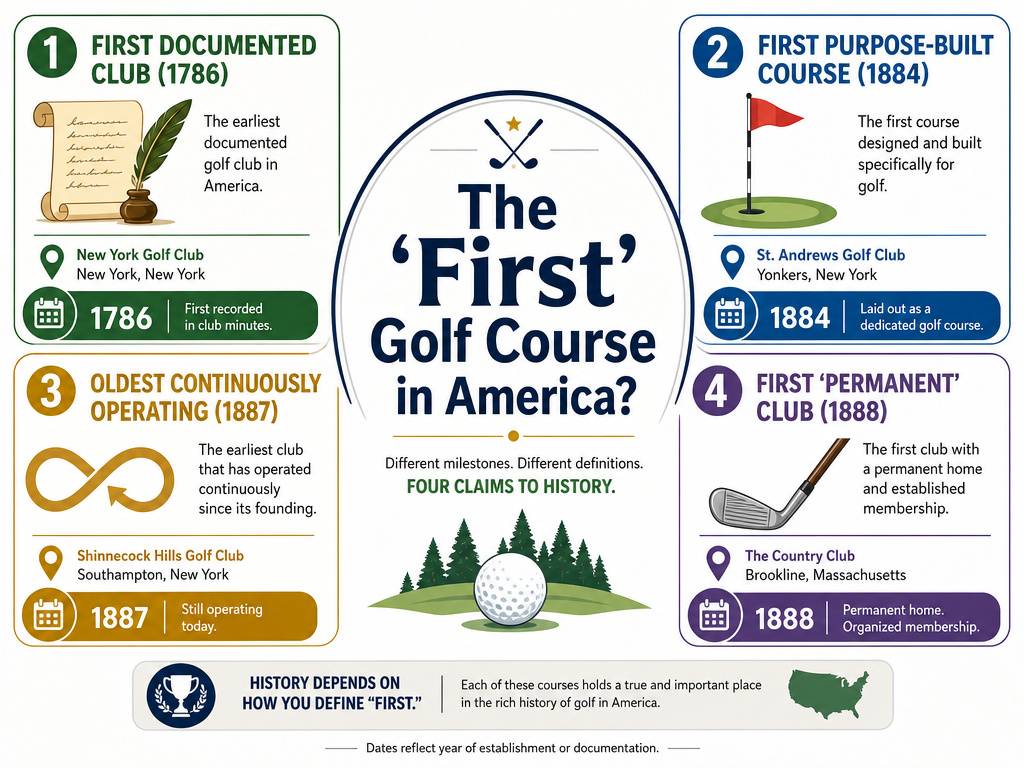
The debate persists because each claimant wins under different rules. It’s a lesson in how we define historical primacy.
- First Documented Club: South Carolina Golf Club at Harleston Green (1786). The paper trail is clear.
- First Purpose-Built Course: Oakhurst Links (1884). It was designed as a golf course, not a repurposed public field.
- Oldest Continuously Operating Course: Foxburg Country Club (1887). Play never stopped.
- First “Permanent” Club (Modern Era): St. Andrews of Yonkers (1888). It spawned the USGA and the professional game.
This matters because it shapes how we view golf’s roots. Was it an elite colonial pastime that died out? Or a 19th-century import that took permanent root? The answer is both. The early clubs show a flickering interest, snuffed out by war and economics. The later 1880s boom, influenced by figures like famous architects and their philosophies, established the game for good. The search for the “first” is really about choosing which origin story you value most.
Frequently Asked Questions
What is the oldest golf course in the world?
The Old Course at St. Andrews in Scotland is universally recognized as the oldest and most iconic golf course in the world. While the exact date of origin is unknown, golf was played on the links land there as early as the 15th century.
Is Oakhurst Links still open?
No. As of 2023, Oakhurst Links has not reopened since being damaged by floods in 2016. It operates primarily as a historic site. Before the flooding, it was a restored course where players could experience hickory-shaft golf.
Why did early American golf clubs disappear?
Two main reasons: location and politics. Early clubs like Charleston’s used public grounds that were eventually developed for housing and roads. Furthermore, the War of 1812 and subsequent embargoes made anything associated with Britain, including golf, deeply unpopular for decades.
What equipment did they use on the first courses?
The earliest American golfers in the 1700s used “featherie” balls and a small set of long-nosed wooden clubs. By the 1880s, technology had shifted to the harder “gutta-percha” ball and hickory-shafted clubs, which began to resemble modern equipment.
What defines a “links” course?
True links course is built on sandy, coastal land with natural dunes, few trees, and firm, fast-running turf. It’s a specific type of golf course architecture born in Scotland. While Oakhurst Links was inland, its designers used the term to evoke its Scottish-inspired, naturalistic design.
The Bottom Line
Strip it back. If you want the first piece of paper that says “golf club,” it’s from Charleston in 1786. If you want to walk the oldest ground where golf has never stopped, drive to Foxburg, Pennsylvania. If you want to see where the first American course was intentionally built, you’ll find a historical marker in West Virginia, though the course itself is currently silent.
The history isn’t a straight line. It’s a story of fits and starts, of clubs that flashed into existence and vanished, and of a later generation that successfully planted the game for good. That messy, complicated origin is more interesting than any single champion. It shows a game that struggled to take root, not one that was destined to succeed. That struggle makes its eventual, permanent boom in the 1890s all the more remarkable.
