
Exploring the Golden Age of Golf Course Architecture & Design
This post contains affiliate links. As an Amazon Associate, we earn from qualifying purchases.
This post contains affiliate links. As an Amazon Associate, we earn from qualifying purchases.
The Golden Age of golf course architecture was a period, roughly from 1911 to 1937, when design philosophy shifted from punishing bad shots to rewarding strategic thought. This era, peaking in the 1920s, produced timeless courses by architects like Alister MacKenzie, Donald Ross, and Harry Colt who championed width, options, and risk-reward over forced carries and symmetrical hazards.
That shift from punishment to strategy didn’t happen by accident. It was a deliberate reaction to the game’s early, brutal design school and a conscious effort to make golf more enjoyable for a broader range of players. The best architects of the time weren’t just building obstacles; they were crafting puzzles with multiple solutions.
What follows is a breakdown of the three design philosophies that defined the transition, the specific conditions that made the 1920s a perfect storm for greatness, and the tangible reasons why the courses from this period remain the gold standard. By the end, you’ll see a classic layout with new eyes.
Key Takeaways
- The era’s core innovation was the strategic design philosophy, which replaced punitive “penal design” by offering players multiple routes from tee to green based on skill and courage.
- 1926 stands out as a peak year, with eight courses from that single year, including Fishers Island and Camargo, currently ranked in the LINKS 100 U.S. List due to ideal land, talent, and economic conditions.
- The introduction of the Haskell ball in 1902 forced architects to lengthen courses and rethink hazard placement, indirectly pushing design toward a more strategic framework.
- Modern “heroic” design, often centered on dramatic water carries, is a direct descendant of this era but can skew rewards too heavily toward the longest hitters.
- The Heathland courses of England (e.g., Sunningdale, Walton Heath) served as the crucial inland testing ground where architects first learned to manufacture strategic interest on less-than-ideal terrain.
From Punishment to Puzzle: The Three Design Philosophies That Defined the Era
You can’t understand the Golden Age’s output without knowing what it was reacting against. Golf design evolved through three distinct schools of thought, and the era’s greatness lies in the pivot from the first to the second.
Penal design aimed to punish inaccuracy with severe, often centrally-placed hazards like deep bunkers and earth walls. It assumed a topped shot with the old Featherie ball could roll as far as a well-struck one, so the only way to protect par was to block the direct line. This created a binary test: execute the perfect shot or face a brutal recovery.
The strategic revolution changed that entire calculus. Pioneers like Alister MacKenzie and Harry Colt studied the Old Course at St. Andrews and realized its genius was in offering choices, not commands.
A properly strategic hole presents a clear risk-reward trade-off from the tee. The direct line to the green is guarded by a hazard, but a safer, longer route is available to the side. The player must weigh their skill against the potential reward of a shorter approach. This is strategic design, golf as a thinking game.
This philosophy didn’t just make courses more fun. It made them more sustainable and adaptable. A high-handicapper could plot their way around, while a skilled player was constantly tempted to take on more risk. The EIGCA strategic design case study on St. Andrews details how this template spread globally as the profession formalized.
The third philosophy, heroic design, emerged later but is a direct hybrid. It uses the strategic template, risk versus reward, but employs a truly penal hazard, typically water, on a diagonal. The reward for carrying it is disproportionate, favoring the ultra-long hitter. While thrilling, it can lack the subtlety and multiple options of pure strategic design.
| Design Philosophy | Core Goal | Hazard Placement | Best For |
|---|---|---|---|
| Penal | Punish inaccuracy | Central, blocking the line | Creating a severe test of execution |
| Strategic | Encourage decision-making | Diagonal, offering options | Engaging players of all skill levels |
| Heroic | Create dramatic risk-reward | Diagonal with severe penalty (e.g., water) | Spectacle and rewarding extreme power |
The Catalysts: What Fueled the Golden Age?
The shift in thinking didn’t occur in a vacuum. Three concrete factors converged to enable the era’s explosion of quality: new technology, new terrain, and a new professional class.
First, the equipment changed the game. The 1902 introduction of the rubber-cored Haskell ball meant golfers could hit it farther and higher. Overnight, existing courses became too short. Architects had to push back tees and, more importantly, reposition bunkers that were now within driving range. This forced a wholesale reconsideration of hazard placement, nudging designers away from simple penal schemes.
Second, golf moved inland. The game originated on coastal links land, but its spread demanded courses on less ideal ground. The sandy, heather-covered heathland around London and Surrey became the critical laboratory.
Where this goes sideways: Assuming all great courses are built on perfect land. The heathland was often flat and featureless. Architects like Harry Colt had to manufacture interest through clever bunkering, mounding, and green complexes, which accelerated the development of strategic design principles.
Courses like Sunningdale (1900) and Walton Heath (1903) proved strategic design could work anywhere. This mastery of inland sites gave architects the confidence and toolkit to work across North America and beyond.
Finally, golf course architecture became a recognized profession. Men like Colt, MacKenzie, and Donald Ross were not just golfers dabbling in design; they were thinkers who wrote treatises, debated ideas, and formed a transnational network. They codified the principles of golf course architecture, moving the craft from intuition to a teachable discipline. This shared knowledge base is what allowed a consistent design excellence to flourish across two continents in a short period.
Why 1926 Stands Out as the Peak
You can debate the exact borders of the Golden Age, but the concentration of masterpieces in the mid-1920s is undeniable. More highly regarded courses were built in that decade than any two before or since, and 1926 represents the absolute crest of the wave.
The evidence isn’t theoretical. Of the 58 Golden Age courses on the current LINKS 100 U.S. ranking, eight opened in 1926 alone: Fishers Island (14), Camargo (29), California Golf Club of San Francisco (30), Los Angeles North (35), Yale (53), Baltimore East (74), Bel-Air (83), and Monterey Peninsula Dunes (85).
Why that year? It was a perfect storm. Prime land was still available and affordable, giving architects room to work with the natural contours instead of forcing a layout. The economy was roaring, funding ambitious projects. Construction techniques had matured, but the destructive power of massive earth-moving equipment hadn’t yet tempted architects to completely reshape landscapes. Most importantly, the strategic philosophy was now fully understood and embraced by the leading famous architects.
The courses from this peak feel “found” rather than “built.” Their fairways follow natural ridges, their greens sit in logical hollows, and their hazards look like they grew there. This is the essence of the minimalist design philosophy that would be rediscovered decades later, a reverence for the existing land. You can trace a direct line from the restraint of 1926 to the work of modern architects like Tom Doak who champion the same ethos.
The Architects and Their Lasting Influence
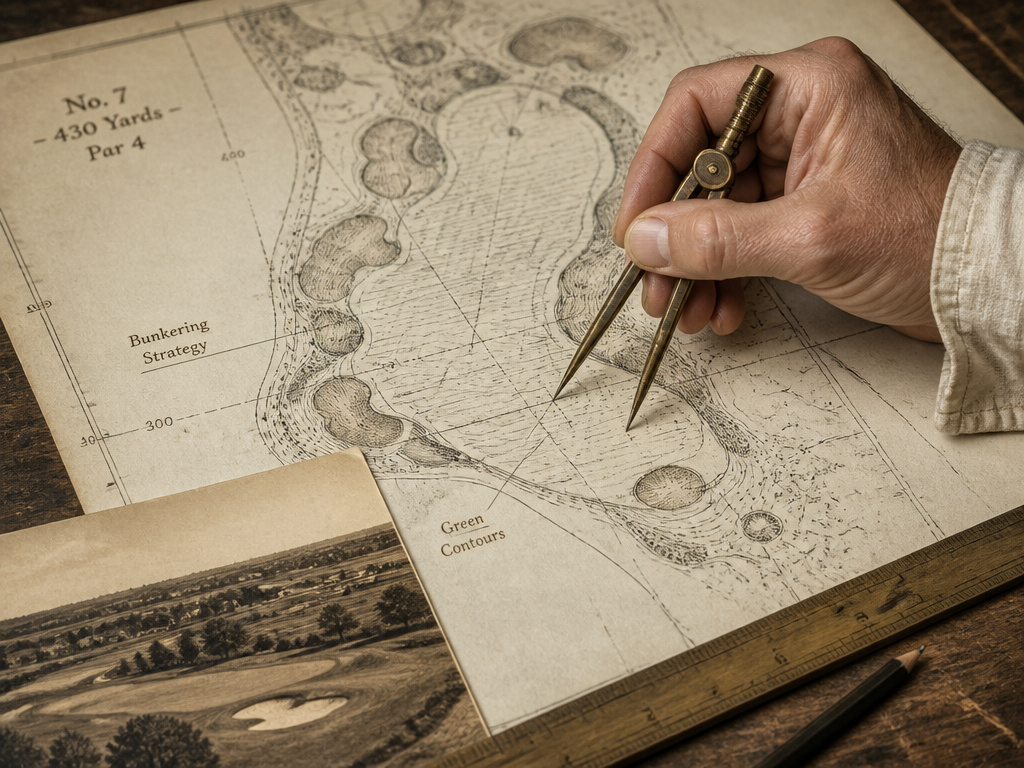 The era’s philosophy was embodied by its leading practitioners. Each brought a slightly different lens to the strategic template, but they all shared a foundational respect for strategy, natural beauty, and playability.
Alister MacKenzie was perhaps the most influential theorist. His 1920 book, Golf Architecture, is a bible of the strategic school. He argued passionately that a course should be a “stern test for the expert, yet a fair test for the novice.” His designs, like Augusta National (co-designed with Bobby Jones) and Royal Melbourne, are masterclasses in strategic deception, where the safest route is always visible but the tempting line is irresistible.
Donald Ross, a Scotsman who made his name in America, emphasized subtle ground game and intricate green complexes. His courses, such as Pinehurst No. 2, are not overly long by modern standards but remain brutally difficult because of the precision required on and around the greens. Ross believed the approach shot and the putt were the heart of the game, and he designed his hazards to challenge those specific skills.
Harry Colt was the consummate strategic technician and a prolific partner. His influence is vast, often through collaborations or through his firm’s associates, which included Tom Doak‘s early inspiration, C.H. Alison. Colt’s work on the heathland courses and later across Europe established a clean, strategic template that prioritized intelligent course routing and a seamless fit with the landscape.
These men, and others like A.W. Tillinghast and George Thomas, didn’t just build courses; they established a vocabulary. Their ideas about width, angles, and strategic options form the baseline for any discussion on what makes a great golf course today. When a modern firm like that of Gil Hanse undertakes a historically sensitive restoration, they are almost always trying to peel back decades of alterations to reveal the original strategic intent of these Golden Age designers.
The Golden Age’s Legacy in Modern Golf
 The era never really ended; it evolved and was eventually rediscovered. The post-World War II boom led to the “Heroic” age and the “Signature” era, where dramatic visuals and real estate demands sometimes overshadowed strategic nuance. Bunkers became decorative, and the types of hazards like bunkers multiplied without always adding strategic value.
The resurgence of interest in classic design, often called the “Minimalist” or “Neo-Golden Age” movement beginning in the 1990s, is a direct callback. Architects and players looked at the crowded, over-watered modern stadium course and asked for something different.
I learned that on the weekend rounds where I first got hooked. The most enjoyable courses weren’t the hardest or the prettiest, but the ones that asked the most interesting questions. A straightforward, strategic puzzle beats a complicated, punishing test every time.
This modern movement, led by figures schooled in classic principles of minimalism, seeks to reapply the Golden Age’s core tenets: width off the tee, firm and fast playing conditions, greens that accept ground shots, and hazards that influence decisions rather than just penalize misses. They study the same strategic design elements that MacKenzie and Colt codified.
The legacy is also preserved through restoration. Understanding the golf course construction process of the 1920s, often done with horse-drawn scrapers and hand labor, helps modern teams restore features that had been softened or lost. This work ensures that the strategic puzzles crafted a century ago continue to challenge and delight golfers today.
Frequently Asked Questions
When was the Golden Age of golf course architecture?
Most historians peg the core period between 1911, with the opening of C.B. Macdonald’s National Golf Links, and 1937, when Perry Maxwell opened Prairie Dunes. Its absolute peak was the 1920s, with an incredible concentration of top-tier courses built in that decade, especially around 1926.
What is the main design philosophy from the Golden Age?
The defining philosophy is strategic design. This approach moved away from punishing all inaccuracy (penal design) and instead offered golfers multiple routes from tee to green based on their skill and willingness to take risks. It turned golf into a game of choices and mental agility, not just execution.
Who were the most famous architects from this era?
The iconic figures include Alister MacKenzie (Augusta National, Royal Melbourne), Donald Ross (Pinehurst No. 2), Harry Colt (Sunningdale, Pine Valley), and A.W. Tillinghast (Winged Foot, Baltusrol). They were theorists and practitioners who formally established the principles of modern golf architecture.
Why are Golden Age courses still highly ranked today?
These courses remain relevant because their strategic design is timeless. They challenge the mind as much as the body, and their emphasis on angles, ground game, and risk-reward makes them engaging for players of all abilities with modern equipment. Their designs are often more subtle and enduring than later, more visually dramatic styles.
What is the difference between a penal and a strategic bunker?
Penal bunker is placed directly in the line of play to catch any shot that isn’t perfectly accurate, like a sentry guarding a gate. A strategic bunker is placed on a diagonal, often defining the ideal line. It tempts the player to challenge it for a better angle or shorter shot, while a safer route exists away from it.
The Bottom Line
The Golden Age’s real gift wasn’t a list of famous courses; it was a blueprint for how to think about the game. It proved that great golf is about engaging the player’s mind with options, not just testing their ability to execute a single, prescribed shot.
That’s why the era’s courses aren’t museum pieces. They are the active standard. When you play a classic layout and face a decision on the tee, to cut the corner over a bunker or play safe to the wide side, you are engaging with the very innovation that made this period golden. The best modern architects and restorers aren’t copying the past; they’re speaking its language, applying its timeless core design concepts to new land. The puzzle, it turns out, is forever.
