
Your Golf Course Management Strategy for Peak Performance
This post contains affiliate links. As an Amazon Associate, we earn from qualifying purchases.
This post contains affiliate links. As an Amazon Associate, we earn from qualifying purchases.
An effective golf course management strategy is a documented, living plan that aligns agronomic practices, environmental stewardship, and financial resources to produce consistent, high-quality playing conditions. It moves beyond reactionary fixes to a proactive system built on data, best practices, and clear operational principles.
The difference between a plan that works and one that gathers dust is specificity. A strategy isn’t a vague goal to “improve greens.” It’s a commitment to walk-mow greens four days a week from May to September, to audit the irrigation system every spring using the USGA’s Water Budget Calculator, and to sample pond water for dissolved oxygen every 14 days in July. That specificity turns intention into a schedule, and a schedule into accountable results.
What follows breaks down the components of a real strategy. We’ll move from the core pillars that frame every decision to the tactical tools that execute them, grounded in the industry standards that superintendents actually use.
Key Takeaways
- A modern strategy rests on three non-negotiable pillars: agronomic quality, environmental sustainability, and economic viability. Ignoring one collapses the other two.
- Water management is the largest operational lever. Deferred irrigation maintenance leads to 20-30% water waste within a single season, directly hitting the budget and turf health.
- Integrated Pest Management (IPM) is a diagnostic system, not just a spray schedule. Correctly identifying a disease requires documenting conditions 48 hours prior to onset, skip this and you’re treating symptoms, not causes.
- Your regional climate dictates your maintenance calendar. A system in Arizona faces different wear than one in Minnesota; a generic national schedule will fail.
- Documentation is your defense and your roadmap. A BMP plan provides a framework to communicate your strategy to regulators, members, and ownership.
The Three Pillars of a Modern Strategy
Every decision, from fertilizer selection to mower purchase, filters through three lenses. If a choice optimizes for one pillar but severely compromises another, it’s a bad choice for the long-term health of the course.
Agronomic Quality means producing the playing surfaces your design and clientele demand. For a private club hosting tournaments, that’s firm, fast greens with minimal ball marks. For a daily-fee course with high traffic, it might be durable fairways that recover quickly. The target dictates the tools and the budget.
Environmental Sustainability is the responsible management of natural resources. It’s using the GCSAA BMP planning guide to minimize runoff, selecting native plants for out-of-play areas, and implementing a water-testing protocol. This isn’t optional philanthropy; it’s a regulatory and social license to operate.
Economic Viability is the acknowledgment that everything has a cost. A strategy must work within the annual budget. This is where understanding the fundamentals of golf course management turns aspirational goals into achievable line items.
The GCSAA Foundation’s BMP model is a science-based, field-validated framework designed to reduce nonpoint source pollution, protect water quality, and conserve resources. It incorporates an iterative “plan, do, check, and act” method for continuous improvement, making it a practical core for any management strategy.
Where do these pillars conflict? Investing in a new, ultra-efficient irrigation system (sustainability, quality) has a high upfront cost (viability). The strategy must articulate the long-term water and labor savings that justify the capital expenditure. Without that math, the project stalls.
Water: The Non-Negotiable Resource
You cannot manage what you do not measure. Water strategy begins with an honest audit of your system’s efficiency and your turf’s actual needs.
Start with an Irrigation Audit. This isn’t just checking for broken heads. It’s a systematic evaluation of distribution uniformity, how evenly each sprinkler throws water across its arc. An audit often reveals dry spots next to swampy ones, meaning you’re over-watering entire zones to compensate for a few poor performers. The USGA’s Water Budget Calculator is the industry tool for translating audit data into a precise weekly watering schedule.
Understand Your System’s Lifespan and Limits. Industry guidance states a system’s useful life is roughly 25 years, with some lasting 40. But “functioning” isn’t the same as “efficient.” A 30-year-old system with original controllers cannot match the precision of a modern one with soil moisture sensors and weather-based evapotranspiration (ET) data. Deferred maintenance is a hidden budget drain.
Common mistake: Limiting irrigation maintenance to fixing major leaks. A single worn nozzle or a misaligned head can waste thousands of gallons per season. The inefficiency compounds across hundreds of heads.
Regional Demands Change Everything. Your water strategy is not your cousin’s in another state. | Climate Region | Primary Maintenance Focus | Key Risk of Deferral | | :— | :— | :— | | Arid (SW U.S.) | Maximizing every drop; managing salinity from recycled water. | Water waste directly translates to high cost and regulatory scrutiny. | | Cold (Northeast, Midwest) | Proper winterization to prevent freeze damage; spring start-up calibration. | A cracked main line from improper blow-out causes catastrophic failure and repair bills. | | Warm/Humid (Southeast) | Managing year-round wear on pumps and seals; controlling algae in ponds. | Component fatigue leads to mid-season breakdowns during peak play. |
Test Your Water Quality. This applies to both what you put on the grass and what sits in your ponds. For irrigation, know your pH and salt content, they affect nutrient availability. For ponds, dissolved oxygen (DO) is the critical metric. Hypoxia, which can cause fish kills, occurs at DO levels below 2-3 mg/L. A simple aeration system can prevent this.
Your wind strategy on the course is about adjustment; your water strategy is about precision. One is reactive, the other must be proactive.
Cultivating the Playing Surface: Beyond Mowing and Feeding
Turf management is the most visible part of the job. A strategic approach moves it from a calendar-driven chore to a physiology-based program.
Soil is the Foundation. A comprehensive soil test every two to three years is non-negotiable. It tells you not just what nutrients are lacking, but your soil’s pH, organic matter content, and cation exchange capacity (CEC), essentially, its ability to hold onto nutrients. Applying fertilizer without this data is guesswork, and over-application is wasteful and environmentally risky.
Embrace Integrated Pest Management (IPM). IPM is a decision-making process, not a synonym for “spray less.” 1. Monitor and Identify: Scout regularly. Is that brown patch fungus, drought stress, or a chemical burn? The Alabama BMPs stress that correct identification often requires sending samples to a diagnostic clinic and documenting conditions 48 hours prior to symptom onset. 2. Set Action Thresholds: Determine what level of pest damage is actually unacceptable. A few clover patches in the rough likely don’t merit a blanket herbicide application. 3. Use Multiple Tactics: This is the “integrated” part. For weeds, tactics include proper mowing height (cultural), encouraging dense turf (biological), and targeted spot-spraying (chemical). 4. Evaluate: Did it work? Record the results. This builds your course’s specific playbook for next season.
Grass Selection is a Long-Term Strategy. The National Turfgrass Evaluation Program (NTEP) provides independent data on how new varieties perform for drought tolerance, disease resistance, and wear recovery. Renovating a fairway with a modern, low-water-use grass can be a major upfront cost, but it locks in water and chemical savings for a decade. It’s a strategic capital investment.
Your club selection on the tee is about the next shot. Your grass selection is about the next ten years.
The Tools and Documentation That Make it Real
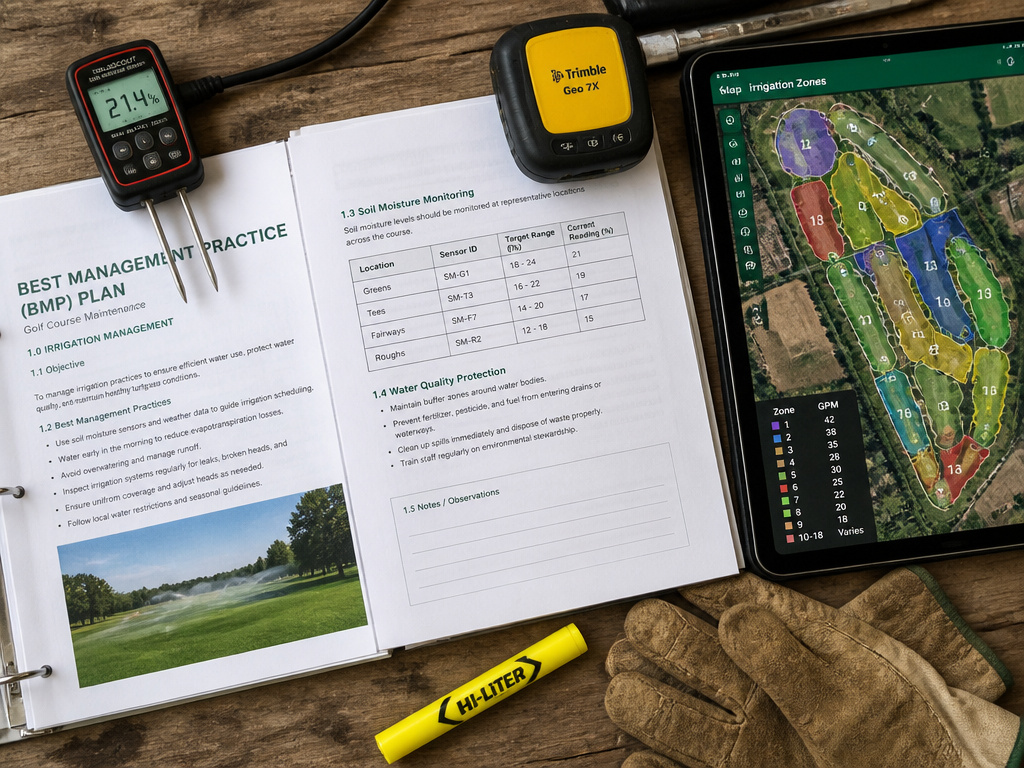
A strategy exists to be executed. These are the mechanisms that translate plan into action.
The BMP Plan: Your Operational Bible. A Best Management Practice plan is your facility-specific document. It takes the general principles from resources like the RIT sustainability handbook and applies them to your exact acreage, soil types, and water sources. It covers everything from spill response procedures for fuel to nesting box placements for pollinators. When a regulator or a concerned member asks what you’re doing about water quality, you have a documented, professional answer.
Technology for Efficiency and Insight.
- Soil Moisture Sensors: Remove guesswork from watering. They tell you what’s happening in the root zone, not just on the surface.
- Mapping Software: GIS maps can track disease outbreaks, compaction patterns, and irrigation coverage, revealing correlations you’d miss on the ground.
- Weather Stations: On-site stations provide hyper-local ET data, fine-tuning your water schedule beyond regional estimates.
Communication: The Overlooked Tool. A superintendent’s strategy must be communicated upward to ownership (for budget), laterally to the pro shop (for pace of play and pin settings), and downward to the crew (for execution). A weekly meeting agenda and a simple shared digital calendar prevent misalignment. Clear communication is part of managing emotions for the entire staff, reducing frustration when priorities shift.
Budgeting as a Strategic Document. The annual budget is your strategy expressed in dollars. It should clearly show investment in preventive maintenance (like pump servicing), technology upgrades, and staff training. A budget that only funds reactive repairs is a plan for managed decline.
The Superintendent’s Role: Strategist in Chief

The golf course superintendent is the CEO of the landscape. Their day is split between urgent tasks and strategic work. Protecting time for the latter, data analysis, planning, education, is critical.
This means delegating routine tasks to trusted assistants and using tools to automate monitoring where possible. It also requires continuous learning. Engaging with state associations and reviewing documents like the Alabama DEQ BMP document keeps a strategy current with evolving regulations and science.
The superintendent’s ultimate skill is translating complex agronomy into understandable outcomes for golfers: “We’re lowering mowing heights this week because the forecasted dry spell will firm the greens, giving you the rollout you preferred last season.”
Frequently Asked Questions
What is the most common mistake in golf course management strategy?
The most common mistake is operating without a written, integrated plan. This leads to reactive, siloed decisions, the irrigation manager waters without talking to the spray tech, who fertilizes without recent soil tests. Inefficiency and conflict are guaranteed. A documented strategy aligns the team toward the same measurable goals.
How often should a golf course strategy be reviewed?
The core pillars are stable, but the tactical plan should be reviewed annually, in the off-season. Analyze the previous year’s data: water usage, disease pressure, budget variances. This review informs adjustments for the coming year. A full strategic overhaul might happen every 3-5 years or after a major change like a renovation or ownership shift.
Can a public course afford the same strategy as a private club?
Yes, but the priorities and resource allocation will differ. The strategy’s framework is the same. A public course’s strategy might prioritize drought-tolerant turf on fairways (sustainability/viability) and exceptional customer service on pace-of-play (quality). It uses the same BMPs but may implement them on a different timeline or scale due to budget. The strategy for high handicappers often emphasizes playability and fun, which a public course superintendent bakes into their set-up decisions.
How does sustainability fit into a profitable strategy?
Directly. Sustainable practices are efficiency practices. Reducing water use lowers the utility bill. Precision fertilizer application cuts product costs. Integrated Pest Management reduces expensive fungicide and herbicide applications. Promoting sustainable maintenance isn’t an extra cost; it’s a method for reducing waste and long-term operational risk, which directly protects profitability.
What’s the first step to creating a management strategy?
Conduct a full site assessment. You can’t plan where you’re going if you don’t know where you are. This includes an irrigation audit, soil tests from every major area (greens, tees, fairways, rough), an inventory of all equipment and its age, and a review of the past three years’ budgets and agronomic records. This assessment reveals your starting point and your biggest leverage opportunities.
The Bottom Line
A golf course management strategy is the difference between hoping for good conditions and engineering them. It replaces anxiety with a checklist, and conflict with a shared plan. The work is in the upfront design, grounding your approach in the proven BMP framework, budgeting for the tools that provide data, and scheduling the maintenance that prevents crises.
From there, the job becomes one of execution and adaptation. You’ll know a strategy is working not when everything is perfect, but when challenges arise and your team has a clear, documented process to address them. That’s resilience. That’s professional management. And ultimately, that’s what preserves both the quality of the game and the health of the landscape for the long run.
