
Unlock Your Best Golf with Proven Mental Game Fundamentals
This post contains affiliate links. As an Amazon Associate, we earn from qualifying purchases.
This post contains affiliate links. As an Amazon Associate, we earn from qualifying purchases.
Golf mental game fundamentals are built on two pillars: self-efficacy, your belief in your ability to execute a specific shot, and the quality of your internal self-talk. A 2024 EEG study of 34 professional golfers found that higher self-efficacy before a putt correlated with a 53.3% success rate versus 46.7% for lower self-efficacy, alongside reduced frontal brain activity indicating more automatic, trusted execution. The mental game isn’t abstract psychology; it’s the direct wiring between belief, focused attention, and physical outcome.
That gap between belief and automatic execution is where rounds are won or lost. The neurophysiological evidence shows that a confident brain works less hard at the wrong things, freeing up your trained mechanics to operate without interference. This moves the discussion from vague “positive thinking” to specific, trainable skills that change how your brain prepares for a shot.
What follows breaks down the proven components: the neuroscience of confidence, the critical difference between helpful and harmful self-talk, the tangible impact of mental fatigue, and a practical framework to build these fundamentals into your routine. By the end, you’ll have a clear map of the mental levers you can pull, backed by studies on elite golfers, not just motivational platitudes.
Key Takeaways
- Higher self-efficacy before a putt is linked to a 6.6 percentage-point increase in success rate and lower frontal brain activity, signaling more automatic, trusted execution.
- Rational self-talk (“I can make a smooth stroke here”) improves performance, while irrational self-talk (“I absolutely must make this putt”) disrupts motor skills by increasing cognitive load and threat appraisal.
- Mental fatigue from prolonged play or walking disproportionately hurts putting performance more than driving or iron play, according to systematic reviews.
- A challenge appraisal of pressure (viewing it as an opportunity) leads to better affective states and performance than a threat appraisal (viewing it as a danger).
- The most effective mental training integrates process goals, cognitive restructuring, and simulated pressure over time, not just pre-round visualization.
The Two Pillars: Self-Efficacy and Self-Talk
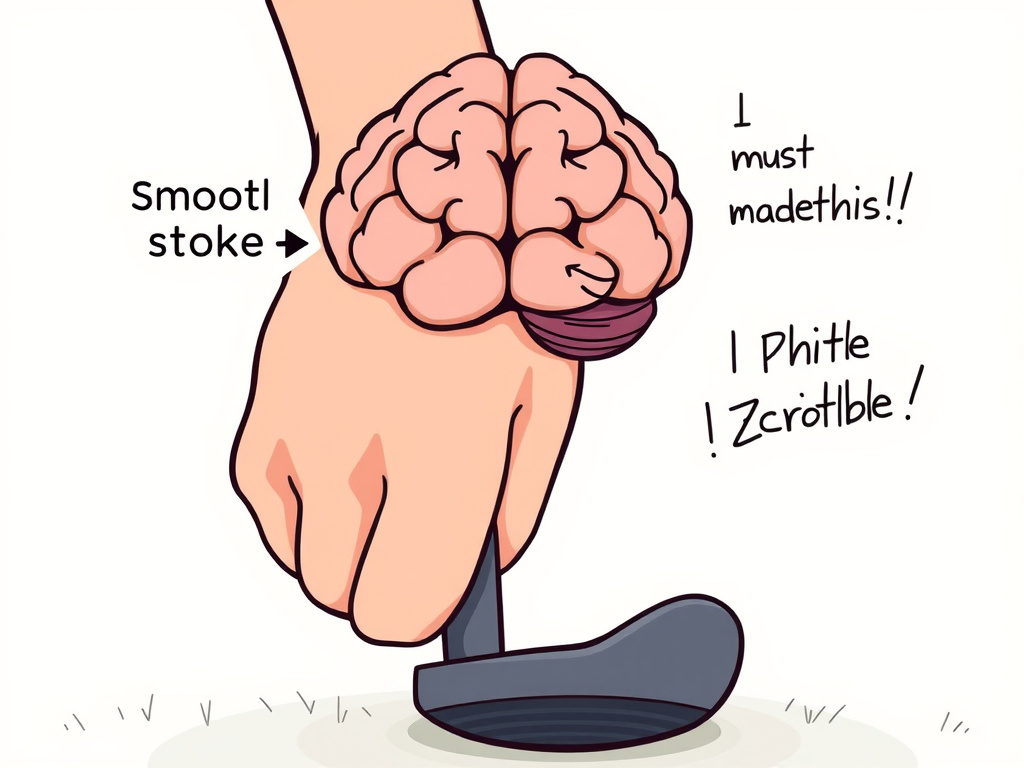
Forget “positive thinking.” The core of the golf mental game is two evidence-backed skills: your moment-to-moment belief in a specific action (self-efficacy), and the dialogue you use to steer that belief (self-talk). One dictates your brain’s readiness; the other shapes its focus.
What Self-Efficacy Actually Does to Your Brain
Self-efficacy refers to your belief in your capability to organize and execute the course of action required to produce a specific outcome, like rolling this 10-foot putt into the cup, rather than being general confidence. This distinction matters because it’s trainable.You build self-efficacy for a fade, for lag putting, for recovery shots, through mastery experiences.
The neurological payoff is concrete. A 2024 Frontiers self-efficacy and theta power study measured the brain activity of 34 professional golfers during a putting task. Before each putt, they rated their confidence on a scale of 0-10. The results were stark:
Trials with higher self-efficacy showed a putting success rate of 53.3%, compared to 46.7% for lower self-efficacy trials. EEG data revealed significantly lower frontal midline theta (Fmθ) power, a brainwave linked to intense, top-down cognitive control, during high-confidence trials.
This lower Fmθ is the neuro-mark of “automaticity.Your brain operates in a state of prepared trust, allowing your practiced mechanics to flow, rather than laboriously micromanaging the stroke. This is the ultimate goal of building confidence: not a feeling, but a quiet brain.
| Self-Efficacy Level | Putting Success Rate | Frontal Midline Theta (Fmθ) Activity | Implied Cognitive State |
|---|---|---|---|
| Higher | 53.3% | Lower (4.49 μV) | Automatic, efficient, trusted execution |
| Lower | 46.7% | Higher (5.18 μV) | Effortful, controlled, doubt-prone execution |
The mechanism aligns with Bandura’s theory and the OPTIMAL theory of motor learning. High self-efficacy enhances outcome expectations, promotes effective goal-action coupling, and reduces attention to irrelevant threats or internal noise. Your brain spends less energy on “what if” and more on “how to.”
Rational vs. Irrational Self-Talk: The Performance Divider
Self-talk is the tool you use to cultivate or corrode self-efficacy. Not all self-talk is equal. Research categorizes it as either rational or irrational, and the distinction is mechanical, not semantic.
- Rational self-talk is non-extreme, flexible, and logical. It’s instructional or motivational. “Pick a small target.” “Breathe and make a smooth stroke.” “I’ve practiced this.”
- Irrational self-talk is extreme, rigid, and illogical. It’s demanding and catastrophic. “I absolutely must make this putt.” “It would be awful to miss.” “I always choke here.”
A study on the effects of self-talk on golf found that irrational self-talk disrupts motor skill performance. The “musts” and “awfuls” trigger a threat state, increasing somatic anxiety and diverting cognitive resources away from task execution. You shift from processing target and feel to processing fear and consequence.
Rational self-talk, particularly instructional self-talk for technique and motivational self-talk for effort and persistence, acts as a cognitive cue. It directs attention externally (to the target) or to a key process element (tempo), which is exactly what the EEG study showed skilled golfers do naturally. This form of internal dialogue is a skill you drill, just like your swing. It’s the bedrock of a repeatable pre-shot visualization routine.
Where this goes sideways: Using outcome-focused self-talk (“I need to make birdie”) during the shot. That thought activates threat appraisal and raises Fmθ, pulling your brain into effortful control right when you need automaticity. Save outcome goals for between shots.
The Hidden Opponent: Mental Fatigue and Pressure
Your mental game isn’t played in a vacuum. It operates under the accumulating weight of a four-hour round and the acute squeeze of a tight match. Understanding how these forces work lets you build resistance to them.
How Mental Fatigue Warps Your Game
Golf is a prolonged cognitive task. Every shot involves decision-making, planning, and motor execution over hours of walking. This induces mental fatigue, a state of subjective tiredness and reduced cognitive efficiency. A systematic review of golf fatigue concluded that this fatigue directly impacts overall scores, iron accuracy, drive distance, and putting performance most of all.
Why putting? Putting demands fine motor control and steady attention, resources that are first to degrade under mental fatigue. The review notes a critical limitation: many lab studies only test putting, missing the broader picture. However, the on-course data shows that the delicate focus required for reading greens and controlling speed is highly vulnerable when your cognitive tank is low.
Common mistake: Thinking a bad back-nine putt is purely a technical flaw. If your focus feels fuzzy and your reads seem uncertain after the 12th hole, mental fatigue is a likely accomplice. Your putting fundamentals haven’t left; your brain’s ability to access them cleanly has.
From Threat to Challenge: Reframing Pressure
Pressure is inevitable. Your appraisal of it, as a threat or a challenge, dictates your physiological and emotional response, which in turn dictates performance.
- Threat Appraisal: Viewing the situation as a danger that exceeds your resources. This triggers higher anxiety, negative affect, and self-focused attention. “This putt to win is terrifying.”
- Challenge Appraisal: Viewing the situation as a demanding but manageable opportunity. This elicits excitement, positive affect, and task-focused attention. “This putt to win is why I practice.”
Research into pre-competitive affective states analysis confirms that challenge appraisals are linked to more facilitative perceptions of anxiety and better performance. How do you foster challenge? By building the specific resource of self-efficacy. When you believe you have the skills for the demand, pressure shifts from threat to challenge. This mindset is a non-negotiable component of the advanced mental game required for shooting low scores.
Building Your Mental Game: A Practical Framework
Theory is useless without application. This framework turns the research into a trainable system. It’s less about what you think in the moment and more about what you’ve built before you step onto the first tee.
1. Audit and Redirect Your Self-Talk
Start by becoming aware of your internal dialogue for one full round. Don’t judge it, just note it on your scorecard. You’re looking for patterns of irrational, demanding language.
- Irrational: “I can’t believe I did that.” “This always happens.” “I have to par this hole.”
- Rational Redirect: “That was a poor strike. The fix is [specific swing thought].” “I’m trending toward my target.” “My goal is to commit to my process on this shot.”
Develop two or three go-to rational phrases for key situations: a tee shot after a bad hole, a crucial putt, a difficult recovery. Write them on a note in your golf bag. This is structured practice for your mind.
2. Design a Pre-Shot Routine That Lowers Fmθ
Your routine should be a sensory ritual that quiets frontal lobe noise. It must include an external focus cue.
- Behind the Ball (Decision): Assess the shot. Use rational, factual language. “Wind is left-to-right. The miss is right.” Choose your club and shot shape.
- Step In (Visualization): See the ball flight and landing from behind. Then, from beside the ball, see the target line. This is active mental imagery, not just looking.
- Address (External Cue): Take your stance. Your final thought must be an external sensory cue. “Swing to the target.” “Listen for the strike.” “Smooth tempo.” This directly pulls attention away from internal control.
- Execute: Trust the automation your routine has primed.
The consistency of this sequence signals to your brain that it’s time for trusted execution, not frantic analysis.
3. Simulate Pressure in Practice
Confidence under pressure is earned in practice, not summoned on the course. Generic range beating builds skill but not necessarily self-efficacy for pressure.
- Create Consequences: Play games to improve your short game where you must get up and down three times in a row before leaving. If you fail, start over.
- Practice with a Routine: Every single practice shot, from wedge to driver, must use your full pre-shot routine. You are ingraining the neural pathway.
- Use Scenario Training: “This is the 18th tee, you need a par to win. Play the hole on the range with your driver and a mid-iron.” Feel the arousal and practice your routine within it.
This kind of work bridges the gap between skill acquisition and skill application. It’s how you move from needing a golf coach for technical fixes to needing one for competitive simulation.
Frequently Asked Questions
What’s the fastest way to improve my golf mental game?
Start with your on-course self-talk. For one round, simply observe it without criticism. The act of awareness alone will begin to disrupt negative patterns. Then, introduce one rational, instructional phrase for your full shots and one for your putting. This direct intervention in your internal dialogue has a more immediate impact than generalized “confidence” exercises.
How do I stop getting so nervous over short putts?
Nervousness is a threat response to outcome importance. Shift your focus from the hole (the outcome) to a specific, tiny mark on the ball or a spot an inch in front of your ball on your line (the process). Your only job is to roll the ball over that spot with a certain tempo. This external, process-oriented goal reduces cognitive threat and gives your brain a simple task to execute, which is what the skilled golfer neuromotor processes study found experts do naturally.
Can mental training really help if my swing is inconsistent?
Yes, but with a caveat. Mental game fundamentals optimize the performance of your current skill set. They help you avoid “double bogeys of the mind” and play to your potential. However, if major technical flaws are causing unpredictability, the anxiety is rational. The best approach is parallel: work with a qualified instructor on a long-term technical plan while using mental skills to manage your attitude and focus during the learning process. The right game improvement clubs can also provide the forgiveness needed to reduce fear on the course.
Is there a “best” type of self-talk?
It depends on the situation and the player. Instructional self-talk (“low and slow takeaway”) is best for technical execution and learning. Motivational self-talk (“you’ve got this”) is best for effort, persistence, and managing energy. Most golfers need a blend. The key is ensuring it’s rational, flexible and logical, not rigid and demanding. Research on cognitive appraisals in competition shows that irrational, absolute language fuels threat states.
How long does it take to see results from mental game work?
You can see a change in your internal experience within a few rounds by implementing a pre-shot routine and monitoring self-talk. Seeing a stable improvement in scores under pressure typically requires 2-3 months of consistent, integrated practice. Like physical skills, mental skills decay without maintenance. It’s not a one-time fix but a permanent layer of your practice.
The Bottom Line
The golf mental game consists of a set of cause-and-effect relationships between belief, attention, and physiology. The fundamentals are clear: cultivate specific self-efficacy through mastery, use rational self-talk to direct focus externally, and train under simulated pressure to build challenge appraisals.The PMC challenge and threat investigation and the EEG evidence make it concrete, your brain state dictates your performance state.
Start small. Pick one element from the framework, perhaps your on-course self-talk or your pre-putt routine, and commit to it for your next five rounds. Measure your improvement in the quality of your focus and the reduction of mental struggle, in addition to scores. The goal is to build a game that welcomes pressure as the test it was meant to be.That shift alone is worth more than any new driver.
