
How to Break 70 in Golf | The 0.3% Strategy That Works
This post contains affiliate links. As an Amazon Associate, we earn from qualifying purchases.
This post contains affiliate links. As an Amazon Associate, we earn from qualifying purchases.
To break 70 in golf, you must shift your goal from making birdies to eliminating bogeys. Analysis of nearly 200,000 rounds shows only 0.3% score in the 60s, and those players average just 4-5 birdies but make 3 or fewer bogeys. The path is built on hitting 13-15 greens, mastering par 5s, and a practice plan that treats every shot as data.
That 0.The 3% figure is a diagnosis, not a barrier. The rounds in the 60s share a DNA that most golfers never look for because they’re chasing the wrong thing.You don’t get there by hitting more heroic shots. You get there by hitting fewer stupid ones.
What follows is the blueprint from that data: the exact stats you must hit, the mental model that makes them possible, and the five-step practice system that replaces hope with a repeatable process. This is how the 1% plays.
Key Takeaways
- Bogey avoidance, not birdie hunting, is the engine. Players breaking 70 make only 4-5 birdies but hold bogeys to 3 or fewer per round.
- Greens in Regulation are non-negotiable. You need 13 to 15 GIR to create enough birdie looks and eliminate scrambling stress.
- Par 5s are your scoring fuel. Elite players hit over 92% of par 5 greens in regulation and play them a half-stroke under par on average.
- Your wedge game must be automatic. To break 70, your average proximity on 20-40 yard pitches needs to be inside 12 feet.
- Practice must simulate pressure. Drills without consequence build swing mechanics, not scoring skills. Change targets and clubs every ten balls.
The Non-Negotiable Stats: What Breaking 70 Actually Looks Like
Forget vague goals like “play better.” Breaking 70 is a math problem with a known solution. The dataset from Tangent Golf, covering nearly 200,000 real rounds, paints the exact picture.
Players who break 70 hit 13 to 15 Greens in Regulation (GIR), make 4 to 5 birdies, and limit themselves to 3 or fewer bogeys in an 18-hole round. They hit more than 92% of par 5 greens and average about half a stroke under par on them.
These numbers are the minimum viable product for a score in the 60s. If your current averages are far from these, you now know the size of the gap.The most revealing stat is the bogey count. Out of those 200,000 rounds, only 326 were bogey-free. That’s under 0.2%. The goal is ruthlessly efficient golf.**
The table below shows the stark difference between a good round and a great one. This is what you’re managing over 18 holes.
| Metric | Player Breaking 70 | Typical Low-80s Player | Why It Matters |
|---|---|---|---|
| Greens in Regulation | 13-15 | 8-10 | Creates birdie chances; eliminates difficult chips |
| Birdies per Round | 4-5 | 1-2 | Offsets the inevitable bogey |
| Bogeys per Round | ≤ 3 | 6-8 | The primary scorecard leak |
| Par 5 Scoring Avg. | -0.5 | +0.2 | Major scoring opportunity wasted |
| 3-Putt Avoidance | >95% | ~85% | A single 3-putt can kill a sub-70 round |
Your first job is to start tracking these. Use a free app or a notebook. You cannot manage what you do not measure. Knowing you average 10 GIR tells you your iron play is the bottleneck. Seeing you make 7 bogeys a round points directly to course management failures. This data is your roadmap from hoping to break 70 to knowing which three shots you need to find each round.
The Mental Shift: CEO of Your Own Game
Technique gets you to the course. Strategy gets you to the clubhouse. To break 80, you think about your swing. To break 70, you think about your assets and liabilities on every shot.
This means abandoning the “pin-seeking” mentality on all but the most perfect shots. Elite golfers aim for the fat part of the green when the pin is tucked behind a bunker. They will gladly take a 30-foot putt over a short-sided bunker shot every single time. Your driver isn’t just for distance; it’s a strategic tool to leave a specific club in your hand for the approach. This is the kind of thinking that separates a player who can shoot under 80 from one who can navigate into the 60s.
Common mistake: Automatically pulling driver on every par 4 and 5. Sometimes a 3-wood or a 2-hybrid off the tee leaves a full wedge instead of a half-shot, turning a potential bogey into a guaranteed par with a birdie look.
Your pre-shot routine needs a business case. What is the expected value of this shot? What is the disaster scenario? If the disaster scenario loses a stroke and has a 20% chance of happening, the shot is a bad bet. This is how you cut those 6-8 bogeys down to 3. It’s not sexy. It wins.
The 5-Step Practice Plan (Not Just Beating Balls)
Random practice produces random results. The following plan is structured to build the specific skills the stats demand. This is how you bridge the gap from golf basics to elite performance.
1. Wedge System: Own the 20-40 Yard Pitch
This is your most frequent scoring shot after a good drive on a par 5 or a missed green. It cannot be a guess.
- The Drill: Take your 60-degree wedge or your highest-lofted wedge. Don’t place balls on a perfect lie. Drop them in the rough, on bare dirt, and in light rough. Your goal is not to get it close. Your goal is to get your average proximity to 12 feet (4 yards) from 30 yards out.
- Consequence if skipped: You leave these shots 20 feet away consistently. That leads to two-putt pars instead of one-putt birdies and turns potential saves into bogeys. Over a round, that’s 2-3 strokes gone.
2. Putting: The 3-5 Foot Gate Drill
Pressure putts are missed because the stroke changes. This drill locks in face control.
- The Drill: On the practice green, set two tees just wider than your putter head, creating a gate to the hole from 4 feet. Putt 50 balls through the gate without touching the tees. Then, repeat while pretending each putt is to save par.
- The Number: To break 70, you must make over 81% of these putts. Missing two of these in a round adds a full stroke to your score.
3. Low-Point Control: Strike Your Irons Pure
Consistent, ball-first contact is the foundation of GIR. Fat and thin shots are round-killers.
- The Drill: Place a towel on the ground just behind the ball. Hit 7-irons focusing on brushing the grass where the ball was, not where the towel is. Use foot spray on the clubface to see strike location. A device like HackMotion can give real-time feedback on wrist angles that influence low point.
- Why it works: It trains a descending strike. Poor low-point control adds 10-15 yards of dispersion, turning greens into misses and easy up-and-downs into difficult ones.
4. Strategic Driving: Practice with a Target Club
Don’t just hit drivers as far as you can. Practice hitting them to a specific fairway width with a specific next club in mind.
- The Setup: Imagine a 30-yard wide fairway. Hit 10 drives with your goal being to land in that zone, not to max out distance. Then, switch to your 3-wood and do the same. Note which club gives you more consistent outcomes.
- The Transfer: This directly improves course management. You’ll know which club gives you the best chance to hit the green on the next shot, which is the entire point of the tee shot.
5. Cold-Weather Simulation
Scoring in the 60s isn’t just for perfect summer days. You need to adjust.
- The Adjustment: When the temperature drops below 50°F, the ball doesn’t compress fully and the air is denser. You will lose 5-10 yards per club. Practice hitting one extra club on approach shots into a target.
- Putting Change: Cold greens are slower. Cold hands have less feel. Practice putting by focusing on hitting the ball 20% firmer than your normal stroke to get it to the hole.
Equipment: The Tools That Support the Plan

Your gear must be a reliable partner, not a variable. At this level, consistency is everything.
For your ball, you need predictable spin and control around the greens. This is the territory of tour-level balls with urethane covers, typically 3-piece balls like the Titleist Pro V1 or the TaylorMade TP5. They provide the greenside spin necessary to stop those 20-40 yard pitches. If your swing speed is moderate, a softer feel ball like a 70 compression model can help with better feel on those scoring putts without sacrificing too much control.
In your bag, ensure your scoring tools are dialed. A trusted 60-degree wedge is non-negotiable for short-sided shots and high, soft pitches. For long par 3s and tight tee shots, a versatile fairway wood like a modern 3-wood or a driving hybrid like a 2-hybrid can be more reliable than a long iron, offering both distance and forgiveness to find more greens.
The Path from 80s to 70s: Managing Your Progression
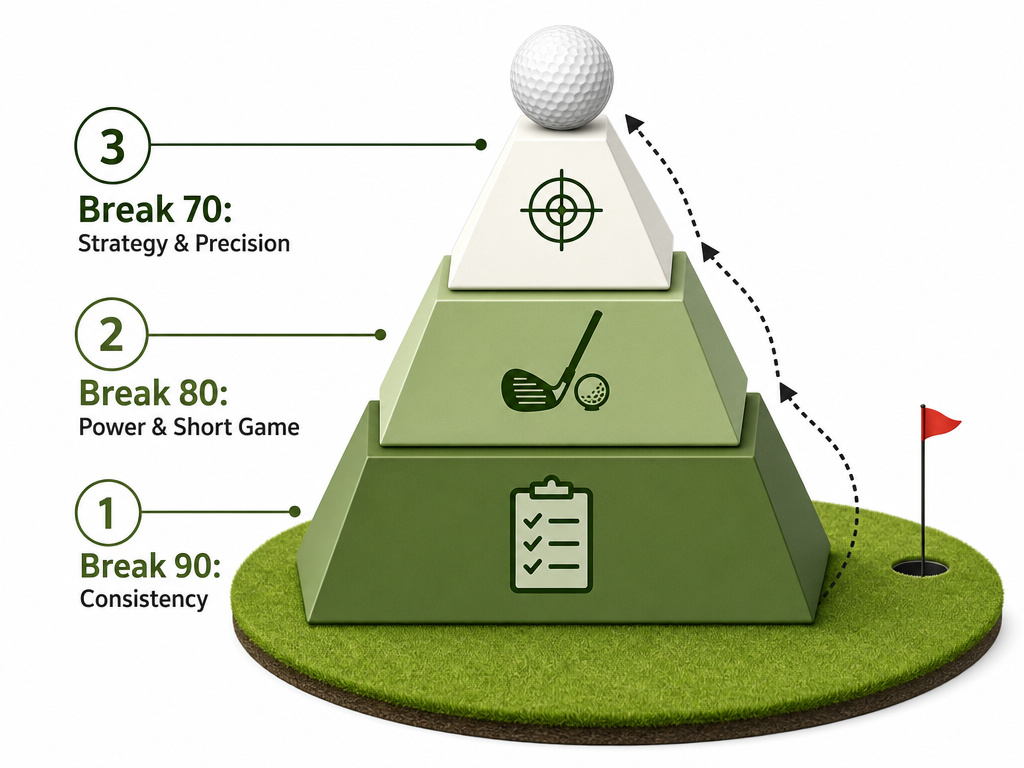
This is a systematic climb. View breaking 90 as mastering consistency and eliminating blow-up holes. Breaking 80 requires adding reliable distance and sharpening your short game. Breaking 70 demands all that plus the strategic brain and statistical precision outlined here.
Each stage builds on the last. The fundamentals for breaking 90—like keeping the ball in play—are the foundation for the aggressive plays needed to break 70. Don’t try to skip steps. Use each scoring milestone as a checkpoint to solidify one part of your game before adding the next layer of complexity.
Frequently Asked Questions
How many golfers actually break 70?
Extremely few. Based on large-scale shot tracking data, only about 0.3% of all recorded rounds are in the 60s. Consistently averaging under 70 places a golfer in an elite category, well above a scratch handicap.
Is it more about birdies or avoiding bogeys?
Overwhelmingly, it’s about avoiding bogeys. The data shows players breaking 70 make only 4-5 birdies per round but are fanatical about limiting bogeys to 3 or fewer. A bogey-free round is extraordinarily rare (under 0.2% of rounds); the goal is damage limitation.
What’s the most important stat to track first?
Greens in Regulation (GIR). Hitting 13-15 greens is the single biggest predictor. It creates birdie opportunities and eliminates the difficult up-and-downs that lead to bogeys. If you’re not hitting enough greens, no amount of putting practice will get you to the 60s.
Do I need to hit the ball farther to break 70?
Distance helps, but it’s not the primary driver. The key is what you do with your distance. Effective strategy—using driver or 3-wood wisely to set up the right approach club—is more critical than raw power. Precision with your mid-irons and wedges matters more than an extra 10 yards off the tee.
How long does it take to break 70?
There is no standard timeline. It depends entirely on your starting point, practice quality, and ability to adopt the strategic mindset. For a player consistently shooting 75-78, it might take a season of dedicated, focused work on the specific weaknesses revealed by their stats. For others, it may be a multi-year project.
Before You Go
Breaking 70 is a method. It’s the acceptance that three bogeys is an acceptable cost of business, and four birdies is a sufficient return.It’s knowing that a 30-foot putt for birdie is a victory, not a failure, because you avoided the bunker. Start by tracking the five stats in the first table. Build your practice around the wedge and putting drills that turn strokes gained into strokes saved. Manage the course like you’re protecting a lead, because from the first tee, you are. The number 70 is just an outcome. The process to get there is what makes you a golfer.
