
How to Build Confidence in Golf Using Proven Mental Skills
This post contains affiliate links. As an Amazon Associate, we earn from qualifying purchases.
This post contains affiliate links. As an Amazon Associate, we earn from qualifying purchases.
Building confidence in golf is a learned skill, not a personality trait. It requires deliberate practice in three areas: using strategic self-talk (instructional cues outperform motivational ones), maintaining an upright posture to block negative internal dialogue, and systematically reviewing only your successful shots to train your nervous system. Confidence precedes results; waiting for good scores to feel confident is a trap.
That last point is the pivot. You don’t get confident and then play well. You choose confidence as your operating system, and then you play. The research is clear, golfers who see arousal as helpful outperform those who see it as harmful, regardless of their actual skill level.
What follows is the manual your brain didn’t come with. We’ll break down the two self-talk methods with clinical results, explain why your spine angle is a mental game lever, and map the simple daily habits that build confidence brick by brick. This isn’t pep talk philosophy. It’s applied sports psychology.
Key Takeaways
- Instructional self-talk (“smooth tempo,” “low follow-through”) improves putting performance under pressure more reliably than generic motivational phrases (“you can do this”).
- Keeping your head up and eyeline at flagstick level physically blocks the space for negative internal dialogue; slumped posture invites doubt.
- Confidence is a “more please” signal to your nervous system. Replaying only your best shots from a round tells your brain what to repeat.
- Stable confidence doesn’t fluctuate with each shot. It’s built through daily, deliberate practice of mental skills, not by waiting for good results.
- Your appraisal of pressure, seeing butterflies as excitement rather than fear, directly predicts performance, independent of your swing mechanics.
Why “Fake It Till You Make It” Fails on the Course
Telling a golfer to “just be more confident” is like telling a sinking boat to be less wet. It misunderstands the mechanism. Confidence isn’t a feeling you summon. It’s a skill you build through specific, repeatable actions.
The academic work frames it as golf self-efficacy (GSE), your belief in your capability to execute shots to attain a desired outcome. This isn’t blind optimism. It’s a judgment based on processed information. A 2023 study of 375 elite Korean golfers found GSE acts as a buffer. It reduces fear of failure (FOF), which in turn lowers competitive state anxiety (CSA), paving the way for the flow state. The chain is direct: belief influences emotion, which dictates focus, which controls outcome.
Where this goes sideways: Replaying bad shots after a round. Your brain is a pattern-matching machine. Dwell on the chunked chip, and you’re wiring your nervous system to repeat that motor program. The heartache replay is a confidence demolition project.
So you stop reviewing failures. You start engineering successes, even in memory. The goal isn’t to ignore mistakes for strategy’s sake. It’s to stop actively training them.
The Two Types of Self-Talk That Actually Work
All self-talk is not created equal. You have an internal coach. Is it giving you vague pep talks or actionable technical cues?
Research from the Golf Science Journal provides the answer. A 10-session intervention with golfers prone to high-pressure putting yips tested three groups: control, motivational self-talk, and instructional self-talk. The instructional group (“keep your head still,” “accelerate through”) showed the most significant improvement. The motivational group (“come on,” “you’ve got this”) improved too, but less so. The control group barely budged.
The mechanism is attention. Instructional self-talk occupies the cognitive channel that would otherwise be hijacked by anxiety. It gives your working memory a job, managing a specific, external cue, which leaves no room for “what if I miss?”
| Self-Talk Type | Example Cues | Best For | Why It Works |
|---|---|---|---|
| Instructional | “Slow backswing,” “Finish high” | Shot execution, pressure puts | Directs focus to controllable technique, blocks anxiety. |
| Motivational | “Stay strong,” “One shot at a time” | Maintaining effort, recovering from error | Boosts perceived effort and persistence, regulates emotion. |
The IMPACT approach for self-talk, cited in the same research, gives you a framework: Identify your need, Match a phrase to it, Practice it, Assess its effect, Create a plan, and Train it continuously.
This isn’t positive thinking. It’s strategic verbal priming. You are programming your next action with a specific command. Your choice of golf clubs or golf irons matters for the shot, but your choice of internal words matters for the swing that delivers it.
Your Posture is a Confidence Switch
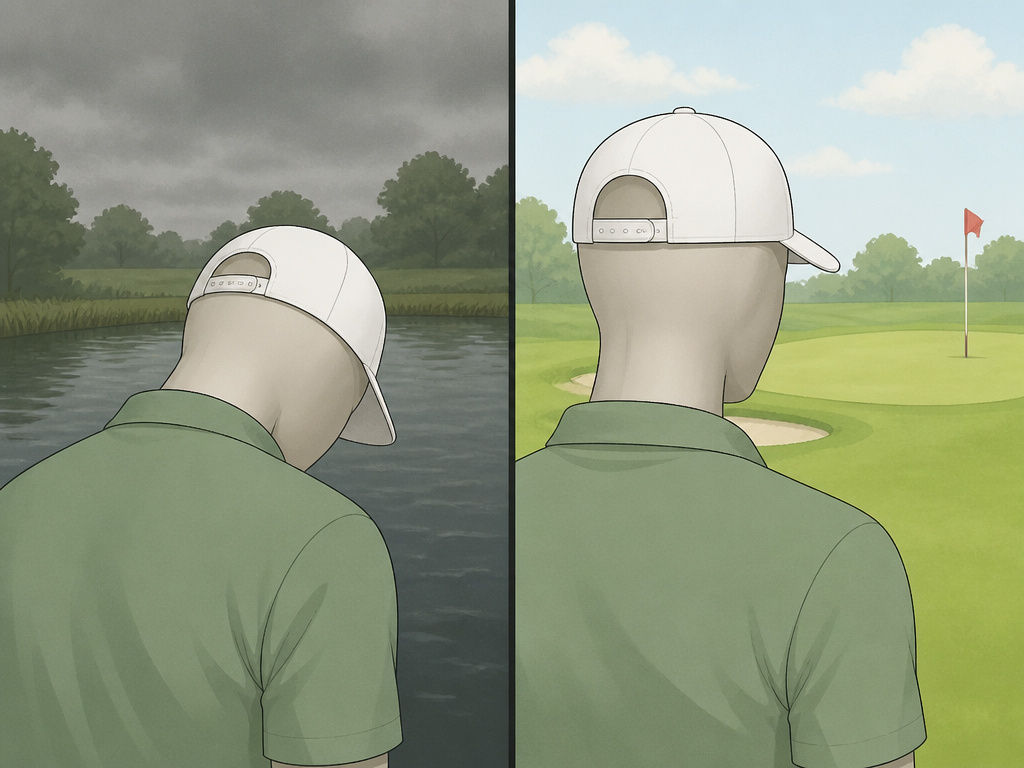 Watch a player who just hit a ball into the water. The shoulders slump. The head drops. The eyes go to the ground. This isn’t just a display of disappointment; it’s an active inhibitor of the next shot.
Sports psychologists note it’s easier to become negative when your head is down. Lowering your head creates physical space for internal dialogue, the voices that say you’re useless. Retaining an upright posture, with your eyeline at the level of the flagstick, silences these voices almost immediately. It forces an external focus.
Common mistake: The frustration crouch after a bad shot. It feels natural, but it sets the stage for a compounding error. Stand up. Look at your target. You have just cut the microphone feed to your inner critic.
Your body language isn’t just communication to others. It’s a command to your own nervous system. An upright posture broadcasts control. A slumped posture broadcasts defeat. Your brain believes what your body shows it. This principle applies whether you’re selecting golf balls for their compression or preparing for a crucial putt, the physical setup dictates the mental state.
Building Stable Confidence: The Daily Reps
 Fragile confidence is outcome-dependent. You make a birdie, you feel invincible. You double-bogey the next, you’re shattered. Stable confidence is skill-dependent. It’s the trust that persists because you know you’ve done the work, regardless of the last result.
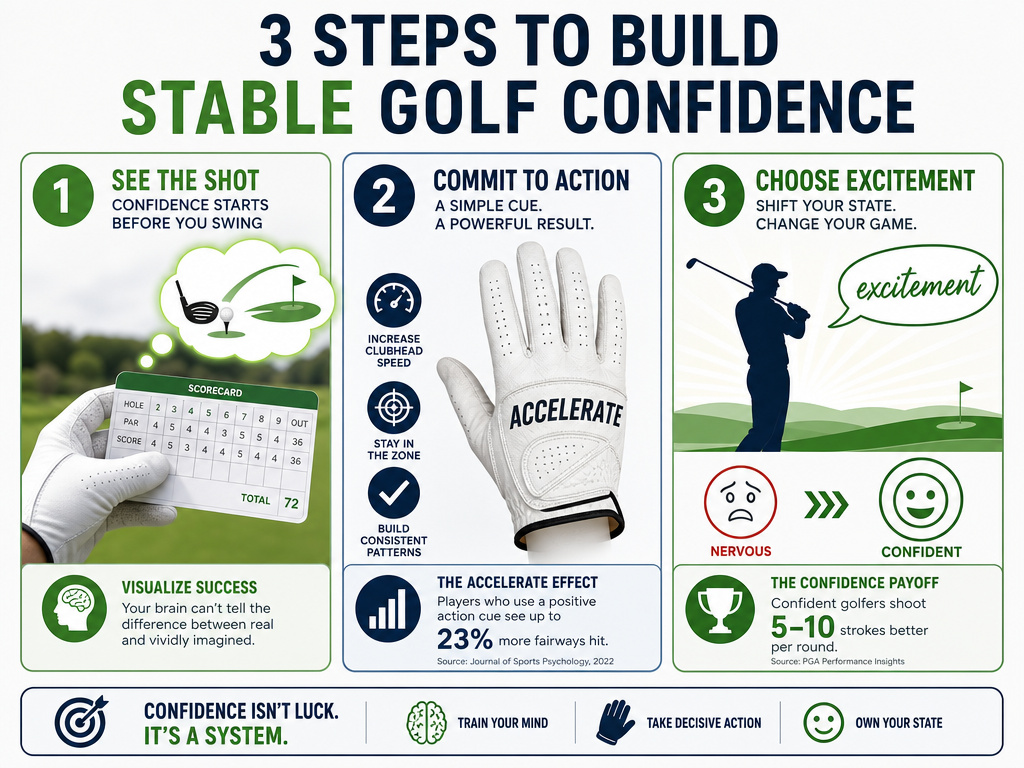
Build it like a brick house. Each row requires work. 1. The Post-Round Edit: Immediately after your round, pick your best drive, best iron, best chip, and best putt. Replay those successes in vivid detail for 60 seconds each. Ignore the bad shots. You are teaching your brain what “good” looks and feels like. 2. The Pre-Shot Cue: Adopt one instructional self-talk cue for your biggest current challenge. If you’re pulling puts, your cue is “accelerate.” Write it on your glove. Say it during practice swings. This isn’t about mechanics during the swing; it’s about focus before it. 3. The Pressure Reappraisal: When you feel nervous, label it. Say “excitement” to yourself. A study on golfers found that simply appraising arousal as facilitative rather than debilitative was linked to higher self-confidence and better performance. The physical feeling is the same; the story you tell about it changes everything.
This daily work makes confidence a renewable resource. It’s why having reliable golf shoes with proper arch support matters, you can’t focus on your mental game if your feet are screaming. Your equipment should solve physical problems so your mind can solve strategic ones.
How to Practice Confidence (When You’re Playing Horribly)
This is the test. Anyone can feel confident striping drives on the range. Real confidence is what you deploy when nothing is working.
Your action plan: – Shorten the Goal: Stop trying to save the round. Aim to execute the next single shot with your full routine and committed focus. The goal is quality of process, not outcome. – Use Your Routine Religiously: Your pre-shot routine is an anxiety vacuum. It’s a series of familiar, controllable actions that crowd out doubt. Do it with extra deliberation. – Switch to “Curiosity”: Instead of “I need to fix my swing,” think “I wonder what happens if I feel more weight on my right side here.” This removes judgment and engages problem-solving.
I’ve walked off courses where the score was a write-off but the mental win was real. The days I managed to stick to my routine and stay upright after disasters were the days my actual confidence grew. The scorecard lied. The skill didn’t.
These are the reps that count double. They prove to you that your confidence isn’t tied to your score. It’s tied to your conduct. This mindset is as crucial as having the right golf wedges for your short game, it’s the tool you use to extract yourself from trouble.
Frequently Asked Questions
What’s the fastest way to boost golf confidence before a round?
Spend 10 minutes in quiet visualization. Don’t just see good shots; feel them. Feel the smooth tempo of a driver swing, the solid strike of an iron, the roll of a putt going in. This isn’t magical thinking. You’re priming the neural pathways for those movements, which increases golf self-efficacy. Pair this with selecting versatile golf balls you trust, so equipment doubt is removed before you tee off.
How do I stop doubting my swing mid-round?
You need a circuit breaker. The instant you feel doubt, engage a physical action tied to your routine: re-grip your club, step back behind the ball, or take a deep breath while looking at the target. This interrupts the negative thought loop. Then, apply a single, simple instructional self-talk cue like “tempo” or “balance.” Your doubt is a feeling; your routine is an action. Let the action win.
Is confidence really more important than technique?
No, but it is the governor of your technique. The soundest swing in the world will degrade under high anxiety and self-doubt. Confidence allows your practiced technique to express itself under pressure. Think of it this way: technique is the software your body runs. Confidence is the operating system that keeps it from crashing. You need to develop both, and reliable golf apparel like comfortable golf pants ensures physical discomfort doesn’t crash the system.
Why do I feel confident on the range but lose it on the course?
The range has no consequences. The course has scorecards, opponents, and tangible outcomes. This triggers fear of failure. To bridge the gap, you must practice under mild pressure. Create consequences on the range: bet a friend a coffee you can hit 7 out of 10 shots at a target, or don’t allow yourself to leave until you complete a specific drill. You’re practicing the feeling of performance, not just the swing.
Can equipment choices hurt my confidence?
Absolutely. Using golf balls that are too advanced for your swing speed, playing with ill-fitting amateur clubs, or wearing uncomfortable golf shorts that distract you all introduce silent doubt. Your equipment should inspire trust, not question it. Play what works for you, not what a tour pro uses. Confidence flows from trust, and you can’t trust tools that don’t fit your game.
The Bottom Line
Confidence in golf is a verb, not a noun. It’s something you do, a series of deliberate choices in how you talk to yourself, how you hold your body, and how you review your game. The science leaves no wiggle room: strategic self-talk works, posture changes thinking, and confidence built on daily skill practice is stable.
Stop waiting to play well to feel confident. Start practicing confidence to play well. Pick one thing from this guide, the post-round edit, the instructional cue, the upright stance, and do it for your next five rounds. That’s how you build the house. Brick by brick.
