
How Golf Posture and Spine Angle Prevent Injury and Boost Power
This post contains affiliate links. As an Amazon Associate, we earn from qualifying purchases.
This post contains affiliate links. As an Amazon Associate, we earn from qualifying purchases.
Golf posture and spine angle refer to the specific forward tilt and rotational axis you establish at address and maintain throughout the swing. The goal is a stable, athletic position that allows your shoulders to rotate around a fixed spine, generating power while protecting your lower back from shear and compressive forces that approach professional football levels.
That mechanical reality is why looking athletic is secondary to building a swing that lasts for decades instead of ending with a herniated disc. The research is blunt: the modern power swing loads the lumbar spine with forces capable of injuring spinal discs, and the three most common swing faults directly amplify that risk.
What follows is a breakdown of the biomechanics, the data-backed fault patterns, and the physical screens that predict failure. You’ll learn why a 7-iron demands more from your spine than a driver, the exact kinematic differences between golfers who get hurt and those who don’t, and how to assess your own movement before a single swing fault takes root.
Key Takeaways
- The top three swing faults linked to low back pain are early extension, reverse spine angle, and a reverse-C finish.
- A 2017 prospective study found golfers who later developed back pain had 6° less lead knee flexion and 6° more trail hip adduction at the top of the backswing, while still injury-free.
- Using a 7-iron requires significantly more trunk flexion and lateral bend than a driver, changing the spinal stress profile.
- An inability to perform a full deep squat correlates with early extension 99% of the time, making it a key predictive screen.
- The “X-factor” (hip-shoulder separation) increases power but also demands extreme erector spinae activation; a hybrid swing finish may reduce injury risk.
Why Your Spine Angle Isn’t Just a Setup Check
You set your spine angle once at address. The challenge is keeping it.
The swing is a high-velocity rotation where your pelvis, shoulders, and club move in different sequences around your spine as the central column.When that column bends, twists, or shifts laterally under load, the forces don’t distribute evenly. They concentrate on specific joints, ligaments, and discs.
A 2012 review in the PMC notes that loads on the spine during the downswing and follow-through “approach that of professional football linemen hitting a sled and are well above the force needed to prolapse intervertebral discs in cadavers.”
That’s the baseline stress of a mechanically sound swing. Now introduce a fault. If your hips thrust toward the ball during the downswing (early extension), you remove space for your arms to deliver the club. Your lower back gets jammed into extension prematurely. If you reverse your spine angle in the backswing, you’re loading the wrong side of your vertebral joints. These are levers that multiply force onto vulnerable tissue, not merely style points.
The goal of posture is to create a stable axis for rotation, allowing your shoulders to turn against the resistance of your coiled hips.This “X-factor” stretch stores elastic energy. If your spine angle collapses, that energy leaks. You lose power and send the load into your spine instead of down the shaft and into the ball.
The Three Major Posture Faults (And What They Do To Your Back)
Most swing flaws are inefficiencies. These three are injurious. They are so tightly linked to back pain that the Titleist Performance Institute (TPI) identifies them as the primary biomechanical culprits.
1. Early Extension
This is the hips thrusting toward the ball during the downswing. From the side, it looks like your belt buckle gets closer to the ball as you start down. You’re standing up out of your posture.
The Mechanism: Early extension is often a compensation for a lack of internal hip rotation or poor ankle mobility. If your body can’t create space for the club to swing through by rotating your pelvis, it creates space by standing up. This forces your lumbar spine into premature extension.
The Consequence: The shear force on your L4-L5 and L5-S1 discs spikes. You’ll often hit blocks to the right or flip hooks as your hands try to save the face. Research ties a failed overhead squat test to this fault 99% of the time. It’s a clear physical predictor.
Common mistake: Trying to fix early extension with swing thoughts alone. If you lack 40+ degrees of internal hip rotation, your body will thrust forward. It’s a mobility issue first.
2. Reverse Spine Angle
Instead of maintaining your forward tilt, you tilt your upper body away from the target in the backswing. For a right-handed golfer, the right shoulder dips too low and the spine leans left.
The Mechanism: This is often an overreach for a bigger turn. It’s a false sense of coil. The spine tilts laterally instead of rotating axially around its center.
The Consequence: You place your lumbar facet joints and ligaments under asymmetrical, torsional stress at the top of your swing. The downswing then becomes a violent correction, not a sequenced release. It’s a direct path to a facet joint irritation or a muscle strain on the trail side. This fault is a core component of a reverse pivot, where weight fails to shift correctly.
3. Reverse-C Finish
The modern power swing often finishes with the upper body arched back dramatically, forming a “C” shape with the spine. This is the finish of maximizing the X-factor.
The Mechanism: It’s the culmination of aggressive hip-shoulder separation and a forceful release. The abdominal muscles contract eccentrically to slow the rotation, placing huge demand on the anterior structures of the spine.
The Consequence: While a 2002 study found golfers with and without back pain both hyperextend at finish, the PMC review cautions that this position increases pressure on the posterior elements of the spine. For golfers with a history of disc issues or spondylolysis, it’s a risky end position. Some coaches now advocate a “hybrid” finish, creating the X-factor in the backswing but returning to a more neutral spine at follow-through.
| Fault | Visual Cue | Primary Physical Cause | Likely Miss |
|---|---|---|---|
| Early Extension | Hips thrust toward ball in downswing | Limited internal hip rotation; poor ankle dorsiflexion | Block right, flip hook |
| Reverse Spine Angle | Upper body tilts away from target at top | Poor trunk-pelvis separation; over-swinging | Inconsistent strike, fat/thin shots |
| Reverse-C Finish | Exaggerated arch in lower back at finish | Over-emphasis on modern power swing | N/A (power-related) |
The Pre-Injury Blueprint: What the Data Shows
You don’t wake up with back pain. The biomechanical seeds are planted months earlier. A landmark 2017 prospective study tracked 41 injury-free elite golfers for six months. Seventeen of them developed low back pain. The kicker? Their swing kinematics were already different at the initial baseline test.
The golfers who got hurt displayed distinct patterns before any pain started: * 4° less lead ankle dorsiflexion at setup. * 6° less lead knee flexion at the top of the backswing. * 6° more trail hip adduction at the top of the backswing.
These aren’t huge numbers. But they reveal a pattern: a stiffer, more restricted lead side and a trail side that collapses inward. This disrupts the kinetic chain. The systematic review of biomechanical parameters from Queen Mary University of London synthesizes this, showing how such small deviations in lower quadrant mechanics precede injury.
The implication is powerful. A 3D motion analysis could flag an at-risk golfer. More practically, it tells you where to look. If your trail knee dives inward at the top or your lead ankle is stiff, you’re not just losing power. You’re building a swing that your back can’t sustain. This is why correcting a reverse pivot or excessive body sway matters, they are manifestations of this unstable kinematic chain.
How Your Equipment Changes Your Spine
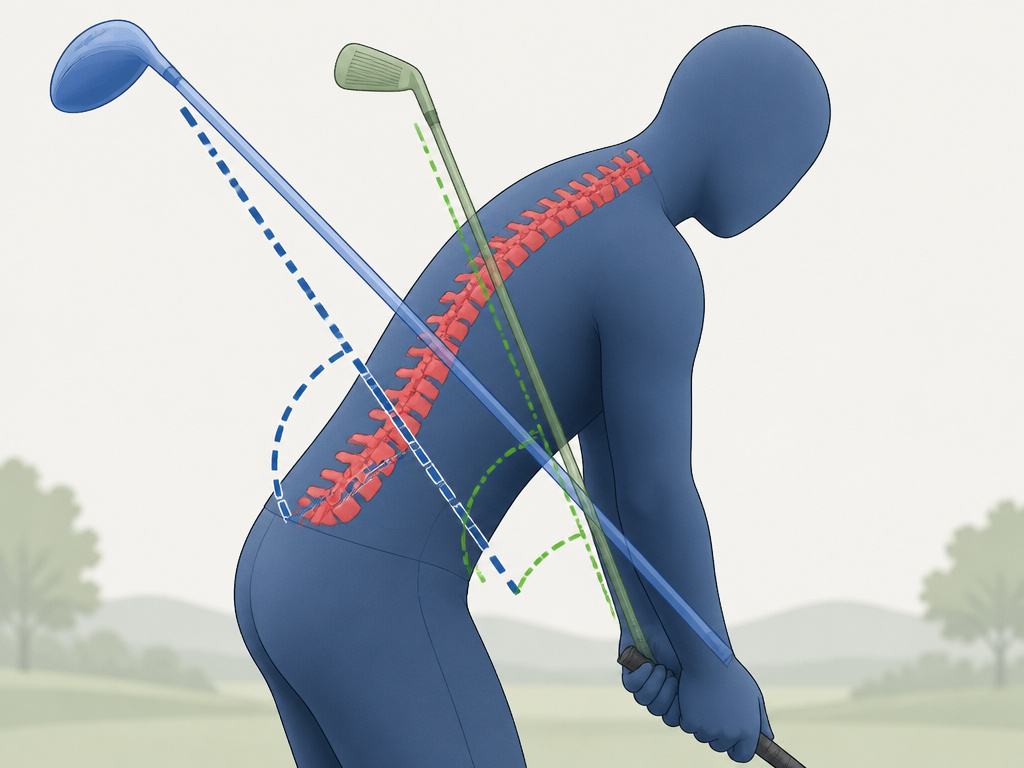
Your posture isn’t independent of your clubs. A 1999 study of 44 professional golfers measured trunk motion using a driver and a 7-iron. The differences were significant.
The shorter 7-iron demanded more trunk flexion at setup. During the swing, it produced greater maximum left-side bend and a higher maximum right-side-bending velocity. The shorter club places the ball closer to you, altering your geometry. To deliver the clubhead, your spine must accommodate more lateral motion.
This has two implications. First, if you have a history of back issues, be aware that your long irons and wedges may stress your spine differently than your driver. Second, it underscores the importance of a proper, dynamic fitting. A standard-length club that forces excessive bend is a long-term liability. The importance of lie angle fitting becomes clear here, a flat lie can force you to stand more upright, altering your natural spine tilt.
Building a Spine-Safe Swing: Assessment Before Instruction
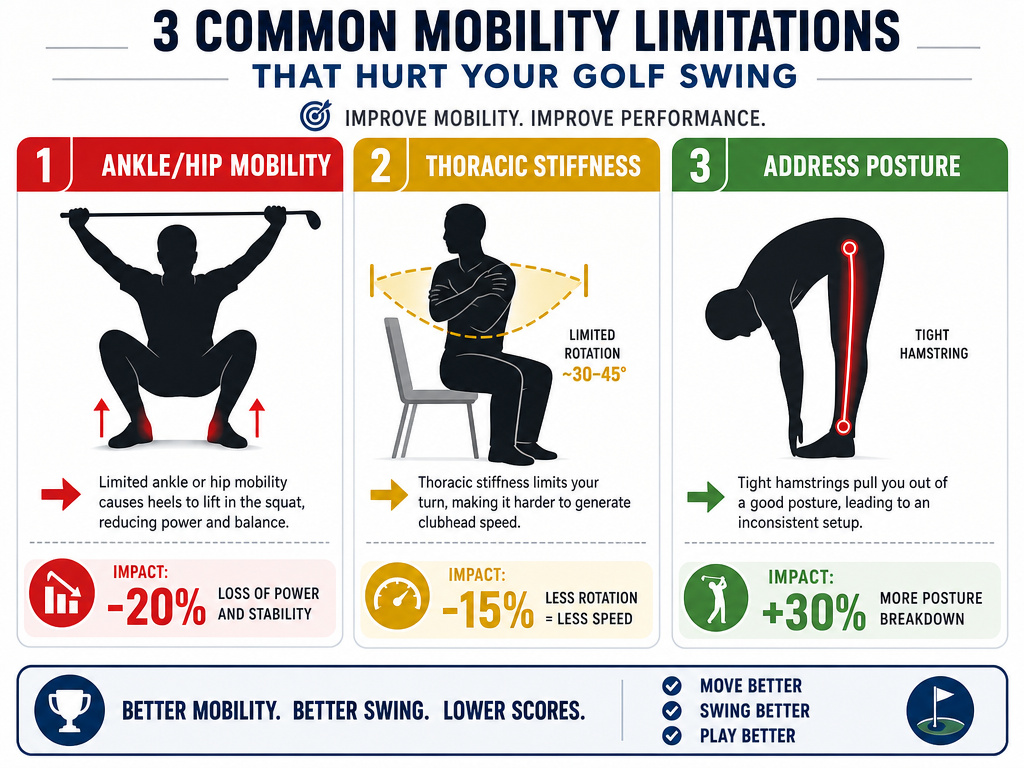
You can’t fix a biomechanical problem with a purely technical cue. The first step is a self-assessment. The TPI framework uses simple movement screens that correlate directly with swing faults.
- The Overhead Deep Squat: Hold a club overhead and squat as deep as you can. If your heels come up or your torso falls forward, you likely have ankle or hip mobility restrictions. This correlates with early extension.
- Seated Trunk Rotation: Sit in a chair, cross your arms, and rotate left and right. Limited rotation indicates thoracic spine stiffness, which often leads to reverse spine angle or swaying as you over-rotate your hips instead.
- Toe Touch: Can you touch your toes with straight legs? Hamstring tightness directly affects your ability to achieve and maintain a healthy forward bend at address.
Where this goes sideways: Skipping the assessment and drilling the swing fault. If you can’t rotate your torso 45 degrees seated, no amount of “turn more” advice will work. You’ll just sway or reverse pivot.
Address the physical limitation first. Improve your ankle mobility with calf stretches. Increase thoracic rotation with foam roller extensions. Then, and only then, layer in the swing drill. The PMC golf back pain rehabilitation review emphasizes this “corrective exercise” approach before technical changes.
The Modern vs. Classic Debate: A Spine Health Perspective
The “modern” swing emphasizes a large X-factor and a powerful, athletic finish. The “classic” swing, typified by golfers like Sam Snead, had a more upright plane and less dramatic separation.
The biomechanical trade-off is clear. The modern swing generates more clubhead speed. But the modern golf swing biomechanics study on the shortened one-plane swing noted it also reduces peak spinal compression forces. A one-plane swing tends to keep the arms more connected to the torso, which can reduce the sheer rotational torque on the lumbar spine.
The PMC review points out that the modern swing has higher activation of the erector spinae muscles. If those muscles are weak or fatigued, common in amateurs, the risk of strain goes up. A golfer with a history of back pain using a modern swing is likely to see it recur.
The hybrid approach may be the wisest: create coil and separation in the backswing (the power source), but focus on a quieter, more neutral finish that doesn’t demand your lower back arch like a bow. This balances performance and longevity.
Frequently Asked Questions
What is the correct spine angle in the golf swing?
The correct spine angle is the forward tilt you establish at address, typically between 30 to 40 degrees from vertical, depending on your build and the club. The critical part is maintaining that original tilt as your shoulders rotate around your spine during the backswing and downswing. It is not a rigid stick, but a stable rotational axis.
How do I stop losing my spine angle in the downswing?
Stopping early extension starts with a physical check. Test your hip and ankle mobility. If you pass, the technical fix involves feeling your trail hip work back and behind you in the early downswing, not toward the ball. Imagine staying in your posture as you rotate your pelvis open. Drills like the “wall drill” (keeping your butt against a wall during practice swings) can reinforce this feel.
Can bad posture cause a slice?
Absolutely. The most common link is early extension. As your hips thrust toward the ball, your body gets in the way of your arms. This often causes the club to get stuck behind you, leading to an open clubface and a weak slice. It can also cause a flying elbow as the right arm gets disconnected, further promoting an out-to-in path.
Does spine angle affect distance?
Yes, profoundly. A stable spine angle allows for efficient energy transfer. If you stand up (early extension), you lose the leverage created by your forward tilt. If you tilt sideways (reverse spine angle), you disrupt your coil. Both leaks rob power. Maintaining posture lets you deliver the stored energy from your coil directly into the ball.
What’s the difference between spine tilt and spine angle?
Spine angle refers to your forward bend from the hips (sagittal plane). Spine tilt refers to the lateral lean of your spine toward or away from the target (frontal plane). At address with a driver, you may have a slight spine tilt away from the target (right for a righty). Confusing the two, like adding lateral tilt when you only need rotation, leads to a reverse spine angle.
The Bottom Line
Golf posture is the foundational biomechanics that determine whether your swing is an engine or a wrecking ball, not about looking good in a photo. The data leaves little room for debate: specific faults like early extension and reverse spine angle are direct precursors to pain, and your body often shows warning signs, stiff ankles, poor rotation, long before the first twinge.
Chasing power at the expense of this foundation is a short-term trade. Build your swing from the ground up, respect the physical screens, and understand that a 7-iron asks more of your spine than a driver does. The goal is a repeatable motion that works for thousands of rounds, not just one season. Your back will thank you in ten years.
