
Golf Shaft Flex Explained: Why Your Stiff Label Is Useless
This post contains affiliate links. As an Amazon Associate, we earn from qualifying purchases.
This post contains affiliate links. As an Amazon Associate, we earn from qualifying purchases.
Golf shaft flex is a letter code (L, A, R, S, X) intended to describe how much a shaft bends. The problem is there is no industry standard, so one brand’s “stiff” can be another’s “regular,” covering a stiffness range of 38 Cycles Per Minute (CPM) – a spread of nearly four full flexes. Matching flex is less about swing speed and more about your transition tempo and where you release the club.
That 38-CPM spread means the label on your shaft is almost meaningless for predicting performance. A fitting based solely on swing speed and a flex letter is guesswork. Real matching requires understanding three deeper layers: the total bend profile, how your swing loads the shaft, and what you actually feel at impact.
What follows: the data that proves the label useless, the two swing moves that matter more than speed, and how to talk to a fitter so you stop buying the wrong shaft.
Key Takeaways
- A “Stiff” label can represent a 38-CPM stiffness range, equivalent to nearly four flex levels. The letter is a marketing category, not a precise measurement.
- Swing speed is a poor predictor of needed flex. Your transition aggressiveness and release point dictate how a shaft behaves more than how fast you swing.
- Shaft stiffness primarily influences dynamic loft and face angle at impact, not clubhead speed. A 2009 study found stiffness matching did not meaningfully increase speed.
- The bend profile, stiffness measured at seven points along the shaft, is the real map. Look for terms like “tip-stiff” or “soft-mid” instead of just “S-Flex.”
- Always test before you buy. Two golfers with identical swing speeds can need shafts two flex designations apart based on how they load the club.
What Does Golf Shaft Flex Actually Mean?
Flex is meant to indicate how much a shaft bends under the force of a swing. In a perfect world, L (Ladies) is the most flexible, bending easily for slower swings, and X (Extra Stiff) is the least flexible, resisting bend for high-speed, aggressive swings.
The world is not perfect.
Technical Snippet: Shaft stiffness is measured in Cycles Per Minute (CPM) by clamping the grip end, deflecting the tip, and counting oscillations. The industry convention states approximately 10 CPM equals one full flex designation (e.g., Regular to Stiff). However, manufacturers do not publish their CPM tolerances, and no governing body standardizes what CPM range corresponds to each letter.
The letter on your shaft is a suggestion from one company, based on their internal design goals. It is not a rule. This is why you can hit a “Regular” shaft from one brand and a “Stiff” from another and feel no difference, or feel a huge one.
Where this goes sideways: Choosing a shaft because a chart says your 95 mph swing speed needs a “Stiff.” That chart assumes all “Stiff” labels are equal. They are not. You might be playing a shaft that is, in reality, two flexes too stiff or too soft for how you actually move the club.
The 38-CPM Reality Check: Why Your Label Is Useless
Research from clubfitting experts reveals the staggering inconsistency. A shaft labeled “Stiff” can measure anywhere from 243 to 281 CPM. That’s a 38-CPM spread.
Since 10 CPM equals roughly one flex, that single “Stiff” label covers a range of nearly four full flexes. Your “Stiff” could be someone else’s “Regular.” It could also be their “X-Stiff.”
| Manufacturer’s “S-Flex” Shaft | Actual Measured CPM | Equivalent True Flex vs. Label |
|---|---|---|
| Shaft A | 243 CPM | Softer (Closer to Regular) |
| Shaft B | 260 CPM | On Label (True Stiff) |
| Shaft C | 275 CPM | Firmer (Closer to X-Stiff) |
| Shaft D | 281 CPM | Much Firmer (True X-Stiff) |
This isn’t a minor tolerance issue. It’s a fundamental breakdown in communication. The Wishon Golf Shaft Selector database shows five shafts all labeled ‘S-Flex’ representing an actual stiffness range of three full flexes, a swing speed difference of more than 30 mph.
The ball doesn’t read the sticker. It reacts to the actual stiffness you present at impact. Buying based on the letter is like ordering a medium t-shirt from ten different brands and expecting them all to fit.
Bend Profile: The Real Stiffness Map
If the flex letter is a bad nickname, the bend profile is the full legal name. Pioneered by club designer Tom Wishon, bend profiling measures stiffness at seven points along the shaft’s length, creating a stiffness curve.
This profile is often described in three sections: * Butt Section: Influences feel during the takeaway and transition. * Mid-Section: Influences feel during the downswing and loading. * Tip Section: Influences dynamic loft and face angle at impact.
This is where useful terms like “tip-stiff” or “soft-mid” come from. They tell you where the shaft is stiff, not just that it’s “stiff.”
A shaft with a stiff tip and softer mid-section might be labeled “low launch.” It resists bending near the head, which can de-loft the club at impact for a lower ball flight. But this only happens if your swing maintains enough lag to load that specific profile.
Two shafts can have the same overall flex letter but completely different bend profiles. One might be stiff in the butt and soft in the tip (high launch). Another might be soft in the butt and stiff in the tip (low launch). They will feel and perform differently for the same golfer.
This is why fitters have moved beyond the letter. They’re matching a bend profile to your swing’s signature.
The Shaft Flex Paradox: Why Swing Speed Fails
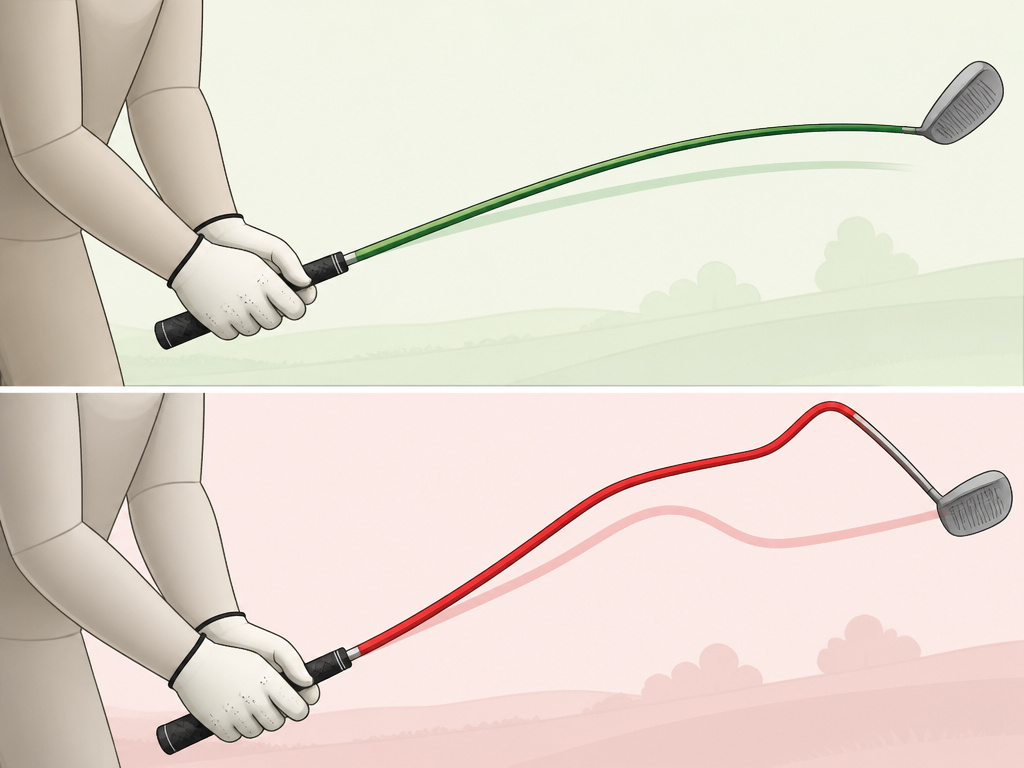
You have a 95 mph driver swing speed. Every chart says “Stiff.” So you buy a Stiff shaft. It feels terrible, and your shots are inconsistent.
This is the shaft flex paradox. Swing speed measures outcome, not process. It tells you how fast, not how.
Two critical swing moves determine the right profile more than speed does:
- Transition Aggressiveness: How violently you start the downswing. An aggressive, jerky transition creates a sudden peak load that can overpower a shaft that’s too soft, causing it to “kick” unpredictably.
- Release Point: When your wrists unhinge before impact. An early releaser straightens the shaft before impact, making bend profile less influential on trajectory. A late releaser maintains shaft deflection into impact, making the bend profile critical for controlling loft and face angle.
A golfer with a smooth transition and late release at 95 mph might need a softer, more active profile. A golfer with an aggressive transition and early release at the same speed might need a stiffer, more stable one. They could be two flex letters apart.
Common mistake: Using a shaft that’s too stiff for your transition. It feels boardy and dead. You can’t feel it load, so your timing gets off, and you start manipulating the club to square the face. Inconsistency follows.
What Shaft Flex Actually Changes (And What It Doesn’t)
A widespread belief is that a stiffer shaft creates more clubhead speed. The physics says otherwise. A 2009 study published in the Sports Engineering journal used a computer model to simulate swings with shafts of different stiffness.
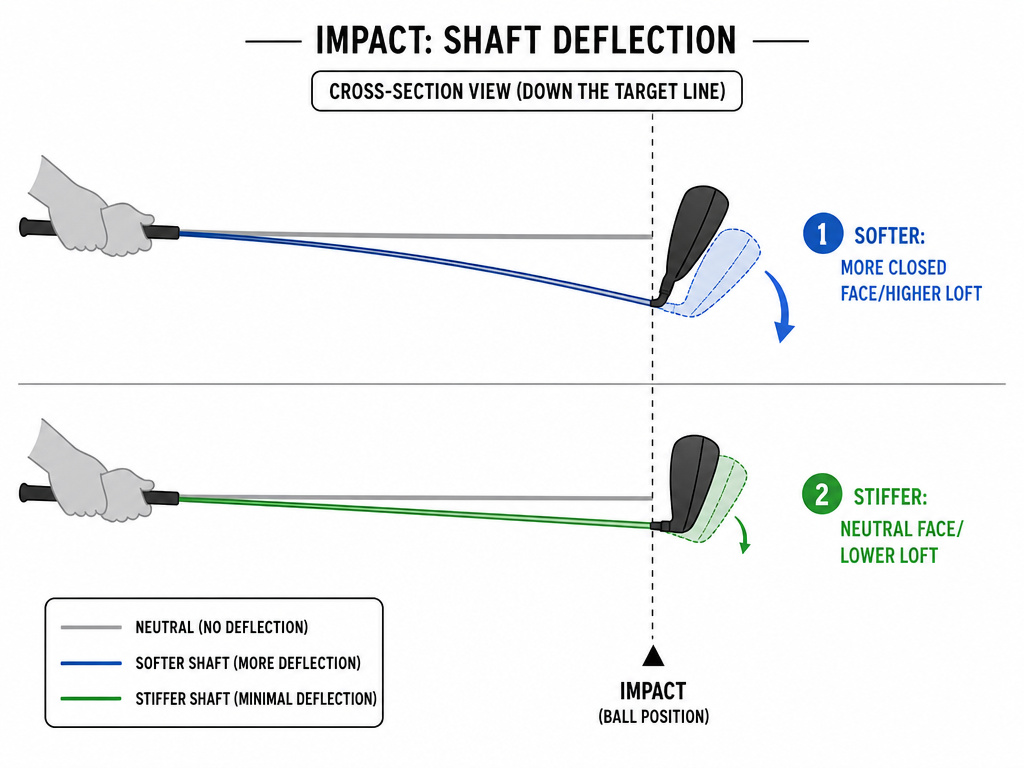
The finding? Shaft stiffness had no meaningful effect on increasing clubhead speed. Its primary effect was on clubhead orientation at impact, specifically, dynamic loft and face angle.
- Softer Flex: Can increase dynamic loft (higher launch) and promote a more closed face angle (helping a slice).
- Stiffer Flex: Can decrease dynamic loft (lower launch) and promote a more neutral or open face angle.
The shaft doesn’t power the ball. The engine is your swing. The shaft is the transmission, influencing how that power is delivered.
The part nobody mentions: The study also suggested that as swing speed increases, so does shaft deflection at impact. A faster swing bends any non-rigid shaft more, which means the effect on face angle and loft is greater for faster players, not smaller.
Torque and Kick Point: The Feel Factors
While bend profile is king for performance, two other specs influence feel.
Shaft Torque measures the shaft’s resistance to twisting around its axis. It’s measured in degrees. * Low Torque (1.0°–3.5°): Feels very stable, firm. Common in steel shafts and premium graphite for faster swingers. * High Torque (4.0°+): Feels softer, can seem to “twist” during loading. Can help golfers who struggle to feel the clubhead.
Modern engineering, like Fujikura’s Variable Torque Core, allows designers to place different torque values in different sections of the shaft. For most golfers, torque is a feel spec. Unless you have an extremely aggressive transition, you likely won’t twist a high-torque shaft into a hook all by itself.
Kick Point (or flex point) is the spot along the shaft that bends the most during the swing. It’s often simplified as: * Low Kick Point: Bends more toward the grip. Tends to promote higher launch. * High Kick Point: Bends more toward the tip. Tends to promote lower launch.
The effect is real but small, often a change of only 0.5° to 2° in launch angle. Its importance is again conditional on your release. An early releaser will negate almost any kick point effect.
How to Actually Choose the Right Flex
Forget the letter first. Start here.
- Know Your Numbers: Get your accurate driver swing speed from a launch monitor, not a guess. Note your typical shot shape and miss.
- Describe Your Swing Feel: Are you smooth or aggressive from the top? Do you feel like you “hit from the top” or have a distinct pause? Do you release the club early or hold your wrist angle late?
- Focus on Weight First: Shaft weight is often more important than flex. A weight that’s too heavy or light will wreck your timing before flex becomes an issue.
- Test, Don’t Assume: Hit several shafts with the same clubhead. Pay attention to center-face contact consistency, not just distance. The right shaft will feel stable but not dead, and it will help you find the center more often.
- Use the Letter as a Filter, Not an Answer: Start with the general flex category (R, S) based on speed as a very broad starting point, then immediately look at the specific bend profile recommendations from the fitter or manufacturer.
When you test, you’re not testing for “Stiff.” You’re testing for a specific bend profile in a specific weight that matches your transition and release. The Fujikura Ventus Black is legendary as a low-launch, tip-stiff option, but if your swing needs help launching the ball, it’s the wrong profile, regardless of its “S” or “X” label.
Frequently Asked Questions
What happens if my shaft is too stiff?
You’ll lose feel. The shaft feels boardy and unresponsive, making it hard to time your release. To square the face, you might over-swing or manipulate your hands, leading to inconsistent strikes, a loss of distance, and a tendency to miss to the right (for a right-handed golfer).
What happens if my shaft is too flexible?
The shaft can feel whippy and unstable, especially during an aggressive transition. It may kick unpredictably, causing inconsistent face angles at impact. This often leads to erratic shot dispersion, a loss of accuracy, and can exaggerate a hook if the shaft over-closes the face.
Can I have different flexes in my driver and irons?
Yes, and many golfers do. Because swing dynamics change with club length and loft, it’s common to fit driver flex and iron flex separately. Your driver shaft flex might be chosen for a specific launch condition, while your iron shafts are chosen primarily for consistency and feel on partial swings.
Do senior golfers always need Senior (A) flex?
No. While many senior golfers benefit from lighter, more flexible shafts to maintain clubhead speed, it’s not a rule. A senior with a smooth, efficient transition might still fit into a Regular flex, especially if they prioritize control over pure distance. Flex is about mechanics, not age.
Why do pro players use extra-stiff shafts?
They use shafts that match their exceptionally aggressive transitions and late releases. Their “X-Stiff” is chosen for maximum stability and control under enormous load and speed, not as a status symbol. The specific bend profile and weight are meticulously matched to their swing dynamics.
How does shaft flex affect ball flight?
Primarily through dynamic loft and face angle at impact. A softer flex can add loft and close the face, potentially raising launch and helping a slice. A stiffer flex can reduce loft and open the face, potentially lowering launch and exacerbating a slice. Understanding this interaction is key to controlling your shot shape and distance.
The Bottom Line
Golf shaft flex is not a ranking system. The right flex is the one you stop thinking about.
Chasing a stiffer shaft for more distance is a dead end, the physics doesn’t support it. Instead, chase the profile that gives you a stable, predictable feel from transition through impact. That feel leads to center-face contact. Center-face contact leads to consistency.
Spend your time and money on a quality fitting with a professional who has a wide array of shafts to test. Tell them about your transition, not just your swing speed. Test for dispersion, not just carry distance. When you find the shaft that makes your swing feel effortless and your misses manageable, you’ve found your flex. It doesn’t matter what letter is printed on it.
