
Understanding the Global Growth and Surge in Golf’s Popularity
This post contains affiliate links. As an Amazon Associate, we earn from qualifying purchases.
This post contains affiliate links. As an Amazon Associate, we earn from qualifying purchases.
The global growth of golf is accelerating, with 112.2 million adults and juniors now playing worldwide outside the USA and Mexico, adding 4.2 million new participants in a single year. The biggest driver is junior golf, which jumped by 3.2 million players to 47.1 million total. This boom is being powered by off-course formats, like simulators and adventure golf, which engaged 68.3 million people in 2025.
Strip it back. This isn’t a story of just more memberships at private clubs. The real engine is the game’s diversification: shorter, faster, cheaper, and more accessible experiences that bring new faces in. It’s about practical accessibility, not chasing the prestige of traditional 18-hole rounds. That’s where the future player base is being built right now.
What follows is a breakdown of the hard numbers: where the growth is, who’s driving it, and what it means for the game’s next decade.
Key Takeaways
- Junior participation is the fastest-growing segment globally, adding 3.2 million players in one year.
- Over 68 million people now engage with golf primarily off-course through simulators, driving ranges, and adventure golf.
- Asia leads in total adult golfers (26.2 million), while Europe has the most junior players (19.9 million).
- Registered golfers (club or federation members) grew to 8.7 million, a 16% increase since 2020, showing deeper, long-term commitment.
- The pandemic-era growth trend isn’t slowing; participation continues to accelerate beyond the 2020-2022 boom period.
The 4.2 Million Player Jump in 12 Months
Let’s be clear about this. The headline figure, 112.2 million total participants, is staggering. But it’s not uniform. When you pull the data from the official R&A Global Golf Participation 2025 report, you see three distinct gears turning at different speeds.
The R&A’s research distinguishes between “registered golfers” (club or federation members), “9&18 hole golfers” (anyone who’s played a full course), and “total participation” (which includes all off-course formats). This layered counting is why the 112.2 million figure can exceed simple sums.
Adult participation grew by 1 million to 65 million. That’s steady. The registered golfer count, the most committed segment, ticked up 2% to 8.7 million. Good signs. But the junior number is the one that changes the math: a 3.2 million leap to 47.1 million players under 18. That’s a 6% year-on-year growth rate, more than triple the adult rate. The kids aren’t just coming; they’re flooding in.
This mirrors a pattern I saw early in my own coaching. Beginners, especially younger ones, get overwhelmed by the complexity of a full 18-hole round. The etiquette, the time commitment, the sheer difficulty. But give them a fun, low-stakes environment, a simulator bay, a par-3 course, a driving range game, and they’re hooked. The global numbers now prove that instinct right. Good golf should feel less complicated the more you understand it, and these alternative formats are the simplest on-ramp ever built.
Asia Leads, Europe Fuels Junior Boom
Geography matters. The growth isn’t evenly distributed; it’s concentrated in specific regions that tell two different stories about the sport’s future. The 2025 data shows Asia as the undisputed leader in sheer volume of adult players, with 26.2 million. Europe follows with 20.6 million, and Canada holds a strong third with 7.1 million.
Flip the lens to juniors, and Europe takes the crown. With 19.9 million junior participants, it’s the clear epicenter of youth engagement. Asia has 9.7 million juniors, Africa 7.4 million, and Central & South America 4.5 million. This European junior dominance is crucial, it represents a massive pipeline of future adult players who are growing up with the game integrated into their culture.
| Region | Total Adult Golfers (2025) | Total Junior Golfers (2025) | Primary Growth Driver |
|---|---|---|---|
| Asia | 26.2 million | 9.7 million | Massive adult player base, strong professional tours |
| Europe | 20.6 million | 19.9 million | Unrivaled junior programs & accessible public courses |
| Canada | 7.1 million | Data not specified | Strong club culture & seasonal play |
| Africa | Data not specified | 7.4 million | Emerging junior development programs |
The lesson here is that the global growth of golf isn’t a single strategy. In Asia, it’s about catering to a massive, sport-hungry adult population. In Europe, it’s about capturing kids early. For equipment brands and course developers, this means different products and facilities for different continents. The one-size-fits-all American model of golf simply doesn’t apply, a mistake I’ve seen travelers make when expecting cart-only, pristine conditions on a windswept UK links.
Off-Course Golf: The Silent 68-Million Player Engine
Here’s the truth nobody sells. While we talk about “golf,” the largest single cohort in the global participation numbers isn’t playing on a traditional course at all. The R&A junior golf growth article notes that 68.3 million adults and juniors engaged primarily in off-course formats in 2025.
What counts as “off-course”? The official definitions are broad: * Indoor golf simulators (City Golf, Urban Golf) * Driving ranges (with or without tracker technology) * Adventure Golf (themed venues like Pirate Golf) * Pitch & Putt, Par-3 courses * Putting experiences * Even golf on school pitches
This is the practical, accessible face of the modern game. It’s cheaper, faster, and less intimidating. You don’t need a full set of golf clubs for teens or amateur golf irons to start; you might just need a rental 7-iron for 30 minutes at a screen. This segment is also where female participation is highest, making up 53% of “other format” adult golfers, a key statistic for growing the game inclusively.
Where this goes sideways: Dismissing simulator or range golf as “not real golf.” These formats are the primary gateway for millions of new players. Without them, the overall growth rate would stall within two years.
The surge validates what organizations like the National Golf Foundation have tracked in the U.S. For years. Their golf industry facts page shows a similar pattern: off-course engagement creates a “deep well of future prospects” for the traditional game. I favor straightforward drills players can actually stick with, and for a total beginner, hitting 50 balls in a simulator with instant feedback is a more effective drill than hacking around a 6,000-yard course feeling lost.
Registered Golfers: The 16% Commitment Deepens

Amidst the flood of new, casual participants, there’s a quieter, more significant trend: the number of registered golfers is climbing steadily. These are the players affiliated with a national federation or club, the core, committed base. That number grew from 8.4 to 8.7 million in 2025, marking a 16% total increase since 2020.
Why does this matter? Because it shows that the initial spike in interest during the pandemic wasn’t just a fluke. People aren’t just trying golf; they’re sticking with it and formally joining the sport’s ecosystem. This deeper commitment is the bedrock for long-term health. It means more consistent rounds played, more investment in equipment like versatile golf balls or a proper 14-club golf bag, and a greater likelihood they’ll introduce others to the game.
| Region | Registered Golfer Growth (2024-2025) | What It Signals |
|---|---|---|
| Central & South America | +20% (122K to 146K) | Explosive growth in emerging markets |
| Canada | +8% (550K to 593K) | Strong club culture retention |
| Africa | +6% (312K to 329K) | Developing golf infrastructure taking hold |
| Europe | +3% (4.7M to 4.9M) | Mature market sustaining steady growth |
This growth isn’t just in traditional strongholds. Look at Central & South America’s 20% jump in registered golfers. That’s not just more people swinging a club; it’s evidence of federations and facilities successfully converting casual interest into formal membership. It’s the sign of a market moving from nascent to established.
What’s Driving the Surge? Simplicity, Technology, and Strategy
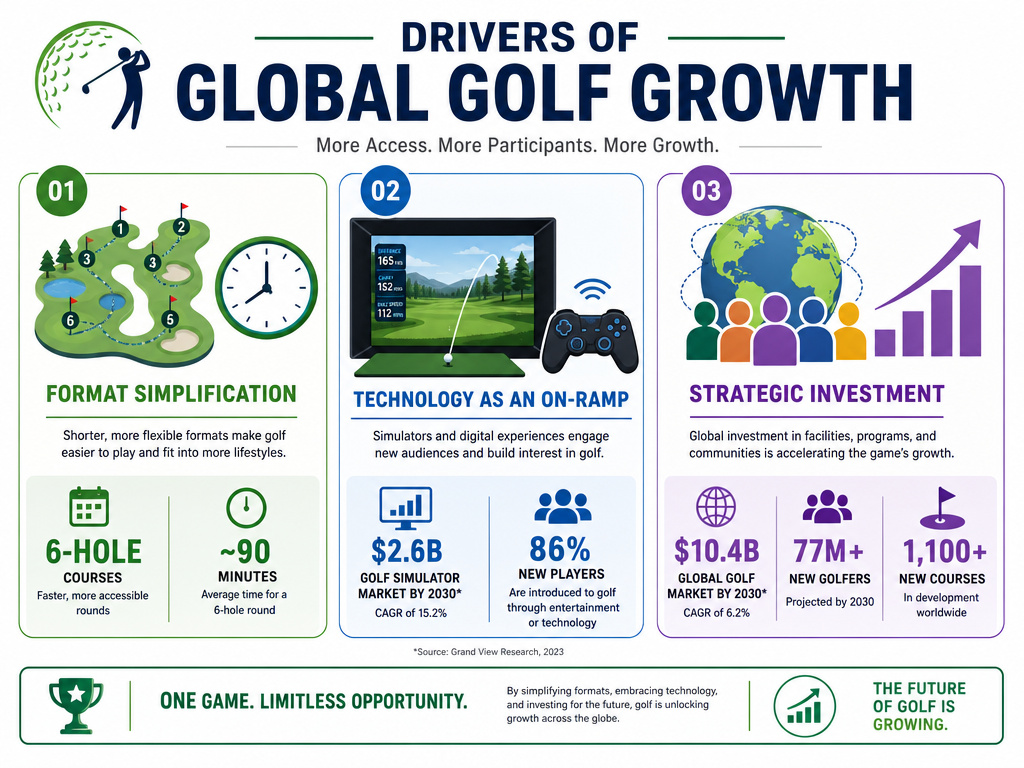
Ever wondered why golf is booming now, after years of being labeled stagnant or elitist? The answer isn’t one magic bullet. It’s a confluence of three factors that have lowered the barrier to entry.
First, format simplification. Six-hole loops, par-3 courses, and simulator bays offer a complete golf experience in under an hour, for a fraction of the cost. This directly appeals to time-poor urban populations and younger audiences.
Second, technology as an on-ramp. Gamified driving ranges and hyper-accurate simulators provide instant feedback and a fun, social experience. You don’t need to know the rules of golf to enjoy Topgolf or a simulator league. This tech also fuels equipment development, making forgiving irons and low compression balls better than ever, which keeps beginners from getting frustrated.
Third, concerted strategic investment. The R&A’s new five-year global strategy explicitly targets opening the sport through partnerships and focusing on women, juniors, and health. This aligns with the data. When you look at the 2024 golf participation PDF, you see the blueprint: support alternative formats, boost junior programs, and promote golf’s wellbeing benefits. It’s working.
The modern obsession with a “perfect” backswing position is harming more swings than it helps. The global growth story is the opposite: it’s about removing technical and logistical barriers first. Get people hitting the ball and having fun. The refinements, like choosing between 2-piece golf balls or 3-piece golf balls, come later.
Frequently Asked Questions
How many people play golf in the world?
Outside of the USA and Mexico, 112.2 million adults and juniors played golf in some form in 2025, according to The R&A’s global report. This includes everyone from traditional course players to simulator and driving range users.
Which country has the most golf players?
Asia has the highest total adult participation among R&A-affiliated regions, at 26%.2 million** golfers. Japan (11.4 million) and the Republic of Korea (8.7 million) are the largest individual markets. Europe has the highest number of junior players at 19.9 million.
Is golf growing or declining?
Golf is experiencing significant global growth. The sport added 4.2 million total participants from 2024 to 2025, continuing an acceleration that began before the COVID-19 pandemic. The most rapid growth is in junior participation, which jumped by 3.2 million (6%) in a single year.
What is driving the growth of golf?
Three main factors are driving growth: 1) Accessible off-course formats like simulators and adventure golf (68.3 million participants). 2) A massive surge in junior engagement (47.1 million total). 3) Strategic investment from governing bodies like The R&A to open the sport to new audiences through shorter, cheaper, and more social experiences.
What is the future of golf participation?
The future points towards a two-tier ecosystem. A large, casual participant base will engage primarily through off-course, tech-enabled formats. A smaller, committed core of registered golfers will continue to play traditional courses. The key for the industry’s health is creating smooth pathways for casual players to transition to the traditional game if they choose, often starting with more accessible gear like beginner golf clubs.
Before You Go
The data is unambiguous. Golf’s future is being written by juniors swinging clubs in simulators, on school pitches, and at adventure golf venues. The 4.2 million new participants in a year aren’t a anomaly; they’re the new normal. For anyone involved in the game, from a club professional to a traveler planning a golf trip, this changes the calculus.
Stop thinking of golf as only an 18-hole, five-hour pursuit. The growth, and the money, is in the shorter, faster, more social iterations. If you’re a facility owner, that might mean adding a simulator bay. If you’re a coach, it means designing programs for complete beginners that start on a putting green, not a driving range. If you’re a player, it means embracing these formats as legitimate ways to enjoy the game and introducing friends through them.
The final number to hold onto: 47.1 million juniors. That’s the talent pool, the future membership base, and the game’s insurance policy for the next fifty years. Everything else is commentary. The sport is opening up. The task now is to make sure it stays that way.
