
How to Hit a Stinger | The Low Shot That Beats the Wind
This post contains affiliate links. As an Amazon Associate, we earn from qualifying purchases.
This post contains affiliate links. As an Amazon Associate, we earn from qualifying purchases.
To hit a stinger, you need three things: a ball position back of center, a strong forward press of your hands at address, and a swing that rotates around your body with a abbreviated finish. This delofts the club, creates a penetrating ball flight, and gives you control when a high shot would get wrecked by wind.
The forward shaft lean is the non-negotiable. It’s the mechanism that turns your 7-iron into a 5-iron at impact, launching the ball low with a ton of spin. Get that wrong, and you’re just hitting a weak line drive that runs out of steam.
What follows: the exact setup that makes the lean automatic, the one-piece takeaway that keeps the clubhead low, and how to choose between a 4-iron or a hybrid for the shot Tiger Woods made famous. We’ll also cover when to use it, and when a standard punch shot is the smarter play.
Key Takeaways
- Position the ball 2-3 inches inside your left heel (for a right-handed golfer) and lean the club shaft noticeably toward the target at address.
- Make a compact, connected backswing focusing on shoulder rotation, not wrist hinge. The finish should be low and around your body, not high and over your shoulder.
- Use a 3-iron, 4-iron, or low-lofted hybrid. Attempting a stinger with a 7-iron or wedge adds too much spin and kills distance.
- The shot is for controlling trajectory into wind or under tree limbs. It is not a distance-maximizing shot.
- The most common mistake is trying to “help” the ball up, which adds loft and creates a high, weak balloon shot.
Why the Stinger Isn’t Just a Punch Shot
A standard punch shot is a reaction. You hood the face, choke down, and make a three-quarter swing to keep the ball under branches. It’s a defensive, distance-losing move.
A stinger is an offensive weapon. It’s a full-swing commitment with a delofted club, designed for maximum carry and a hot, running landing. The difference is in the impact conditions. A punch shot often has a descending blow with a slightly open face to mitigate curve. A stinger demands a forward shaft lean of several inches, compressing the ball against the turf with a square face.
The stinger’s low launch comes from forward shaft lean delofting the club at impact, not from swinging down steeply. Trying to hit down on it adds spin and kills the running rollout.
If you try to hit a stinger with the mindset of a punch shot, you’ll add loft and spin. The ball will climb, catch the wind, and fall short. The stinger is a different animal, it’s a powerful, penetrating line drive.
The Stinger Setup: Ball Position and Stance
Your setup dictates your impact. For a stinger, everything in your address position should promote a downward strike with your hands ahead of the ball.
First, club selection. This shot is for your longest irons or a driving iron. A 4-iron is the classic choice. The low loft of a 3 or 4-iron (18-24 degrees) is your starting point. Using a 7-iron (typically 30-34 degrees) defeats the purpose; even with perfect forward lean, you’re adding too much spin. A hybrid can work, but ensure it’s a low-lofted model (around 19 degrees) and you position the ball correctly to avoid the club’s inherent tendency to launch high.
Now, the stance. Play the ball 2-3 inches inside your left heel. For reference, a standard mid-iron shot has the ball off your left heel. This back position ensures you strike the ball just before the club’s low point.
| Setup Element | Stinger Specifics | Standard Iron Shot (for comparison) |
|---|---|---|
| Ball Position | 2-3 inches inside left heel | Directly off left heel |
| Stance Width | Slightly wider than shoulder-width | Shoulder-width |
| Weight Distribution | 60% on front foot | 50/50 or slight favor to front foot |
| Shaft Lean | Pronounced forward press, hands ahead of ball | Slight forward press or neutral |
Grip down about an inch on the club. This shortens the lever, increases control, and naturally encourages a more centered strike. Set about 60% of your weight on your front foot. This pre-sets the forward lean and prevents any backward sway during the swing.
Finally, and most critically, press your hands forward so they are well ahead of the ball at address. The club’s shaft should lean toward the target. This is not a subtle move. If you look down and your hands are over the ball, you’ve already failed. This preset is what makes the delofting at impact inevitable.
The Swing: It’s a Rotation, Not a Chop
The backswing for a stinger is compact and connected. The goal is to rotate your shoulders and core while keeping your arms in front of your chest. Think “one-piece takeaway.” A common error is overusing the wrists early, which creates a steep, choppy downswing.
Where this goes sideways: Lifting the club with your arms instead of turning your shoulders. This steepens the swing plane, and you’ll either hit it fat or add loft trying to compensate, producing a high, spinning shot.
Make a three-quarter length backswing. Your hands should finish around shoulder height, not ear height. This limits the amount of wrist hinge, which in turn controls the club’s loft through impact. Feel your left shoulder (for right-handers) turning under your chin. This rotation, not arm lift, is what powers the shot.
The downswing is where the magic happens, or where it falls apart. Start the downswing by rotating your hips toward the target. Your arms will follow. Do not cast the club or try to “scoop” the ball into the air. Your hands must lead the clubhead into impact, maintaining that forward shaft lean you set at address.
The feeling is of driving the back of the ball into the ground with the club’s leading edge. You are not trying to pick it clean.
The follow-through is the tell. A proper stinger finish is low and around your body. Your chest faces the target, but your hands finish around belt-high, not up by your ear. If your finish is high, you’ve released the club early and added loft. A abbreviated, rotational finish confirms you kept the clubhead behind your hands.
Stinger vs. Punch Shot: Choosing Your Weapon
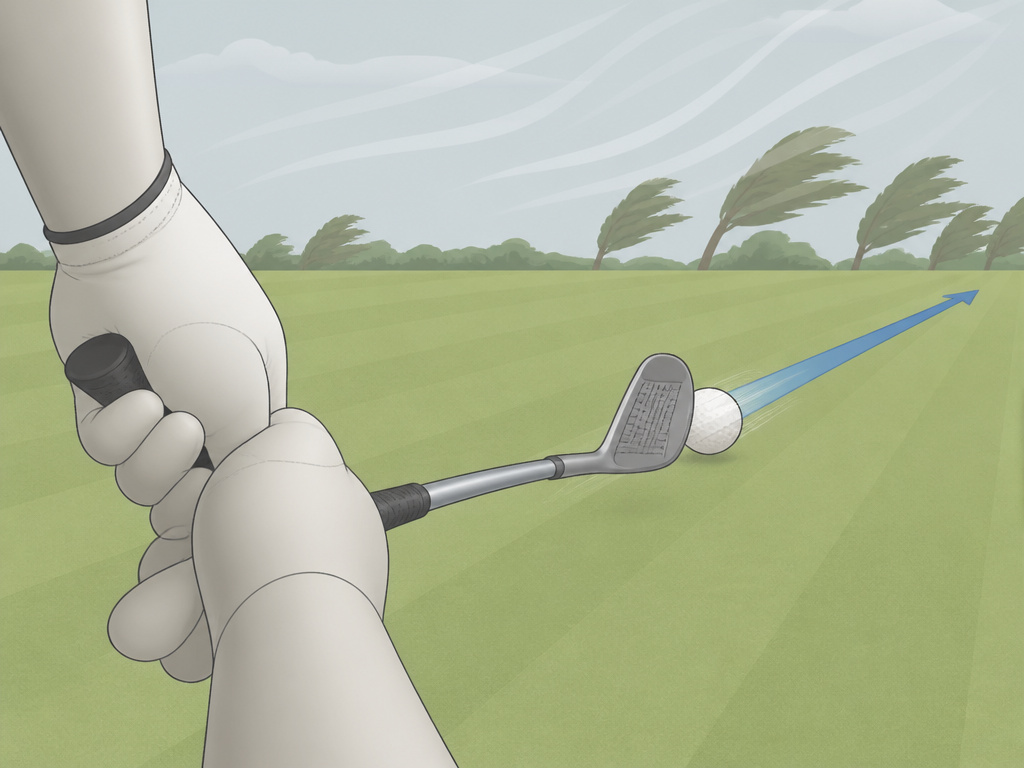
Knowing when to hit a stinger versus a standard punch shot saves strokes. They are tools for different jobs.
Use a stinger when you need maximum distance on a low trajectory. The classic scenario is a long par 4 or par 5 into a strong headwind. The stinger’s low spin and penetrating flight will carry far and run out. It’s also the play off the tee on a tight hole where a driver is too risky, but you still need 230+ yards of total distance.
Use a punch shot when your primary goal is trajectory control, not distance. Need to keep the ball under a tree limb from 150 yards out? That’s a punch shot with a 7-iron. The goal is to advance the ball safely, not to maximize yardage. The punch shot is a safer, more controlled version of the low shot.
| Situation | Recommended Shot | Why |
|---|---|---|
| 220-yard approach into a 20mph headwind | Stinger with 4-iron | Maximizes carry and provides a running landing into the wind. |
| 150-yard recovery from under pine trees | Punch shot with 7-iron | Prioritizes keeping the ball low over distance; easier to control. |
| Tight par 4 tee shot, trouble left and right | Stinger with driving iron | Provides long, straight distance with less curve than a driver. |
| Short-sided chip from rough, needing to run the ball | Punch shot (bump-and-run) | Uses the club’s loft to pop the ball out and let it run. |
Your choice of shot shape matters too. A stinger is typically hit with a slight draw (right-to-left for right-handers), as the closed clubface at impact promotes this flight. Trying to hit a stinger fade is advanced and requires meticulous face control. For most, stick with the natural draw flight.
Club Selection and Loft: The 4-Iron Rule

You cannot hit a true stinger with a high-lofted club. The physics won’t allow it. The stinger’s legendary flight, low launch, low spin, high speed, comes from marrying a low-lofted clubhead with a delofting strike.
The ideal clubs are your 3-iron, 4-iron, or a driving iron (often called a “utility iron”). These clubs have lofts between 18 and 24 degrees. With your forward shaft lean at impact, you might be delivering the club with effectively 12-18 degrees of loft. That’s how you get the bullet flight.
Trying to hit a stinger with a 7-iron is like trying to throw a knuckleball with a whiffle ball. The high spin will make it balloon, and you’ll lose all the penetrating power.
What about hybrids or fairway woods? It’s possible, but trickier. These clubs are designed to launch the ball high. To hit a low shot with them, you must position the ball even further back in your stance, almost off your right instep, and dramatically increase your forward shaft lean. For consistency, most golfers are better off mastering the stinger with a long iron first.
This is also where your general long iron technique is critical. If you struggle to make solid contact with a 4-iron on a normal shot, you won’t magically find it for a stinger. The stinger amplifies your standard strike.
Wind Strategy: Making the Stinger Your Best Friend
The stinger was born for windy conditions. It’s the ultimate wind strategy weapon. A 30 mph headwind might add two clubs to a normal high shot. For a stinger, it might add only half a club.
The key is understanding ball flight laws. Wind affects a ball most when it’s high in the air. A stinger spends very little time in the highest, windiest part of the atmosphere. It punches through the lower, often calmer, air. This not only reduces the wind’s effect on distance but also on direction. A crosswind will push a high shot significantly offline. A stinger will hold its line much better.
When playing into a strong headwind, club up. Take your 3-iron instead of your 4-iron. The goal is to make your normal, aggressive stinger swing. Do not try to swing harder; that disrupts rhythm. Let the club and the technique do the work. The wind will knock the ball down, but its low spin will ensure it still runs out upon landing.
Common Mistakes and How to Fix Them
Even with a good plan, a few errors can turn your stinger into a dud. Here are the big ones.
Mistake 1: Ball position too far forward. If the ball creeps toward your left heel, your low point moves behind it. You’ll either hit it fat, or you’ll have to stall your rotation and flip your hands to make contact, adding loft. The fix is a deliberate check: place an alignment rod on the ground perpendicular to your toes. Ensure the ball is at least two inches inside that rod.
Mistake 2: Casting from the top. This is the desire to “help it up.” You start the downswing by throwing your hands and the clubhead at the ball, losing all your forward shaft lean. The result is a high, short, spinning shot. The fix is to feel like your left wrist is bowed through impact, keeping the back of your hand facing the sky. Drills that place a headcover just outside and behind the ball can train you to swing from the inside without casting.
Mistake 3: Trying to kill it. The stinger is powerful because of compression and low spin, not raw speed. Swinging out of your shoes leads to loss of balance and inconsistent contact. Focus on a smooth, 80% effort swing with a solid rotation. The distance will come from the quality of the strike, not brute force.
Building consistent iron shots is the foundation. The stinger is a variation on a theme. If your standard iron contact is poor, the stinger will magnify those flaws.
Frequently Asked Questions
What club should I use to hit a stinger?
Use a 3-iron, 4-iron, or a low-lofted driving iron (18-22 degrees). These clubs have the inherent low loft needed to produce a penetrating flight when combined with forward shaft lean. Do not use a 7-iron or wedge.
How do I keep my stinger from going left?
Stinger naturally wants to draw due to the forward hand position and slightly closed face at impact. To straighten it out, ensure your clubface is square to your target line at address, not closed. Focus on rotating your body through impact without letting your hands over-rotate and close the face excessively.
Can I hit a stinger with a driver?
Yes, but it’s a different and very advanced shot. Tiger Woods’ famous “stinger” tee shot was often hit with a 2-iron or 3-wood. To do it with a driver, you need a low-lofted driver head (8-9 degrees), a severe forward press at address, and a sweeping strike. For most golfers, using a long iron is a more reliable and easier-to-learn method.
What’s the main difference between a stinger and a punch shot?
The stinger is a full-power, distance-maximizing shot with a long iron. The punch shot is a controlled, distance-reducing shot with a mid-to-short iron. The stinger uses a full body rotation and a full follow-through (albeit low). The punch shot uses a shorter, arms-dominated swing with a abbreviated finish.
Why does my stinger start low then balloon up?
This means you are adding dynamic loft at impact. You are likely starting with good forward shaft lean but then “releasing” or flipping your wrists to scoop the ball just before impact. Focus on keeping the back of your lead wrist flat and facing the target through the hitting zone. Imagine you are trying to hit the ball with the back of that hand.
The Bottom Line
The stinger is a commitment, not a trick. It requires trusting a delofted setup and a rotational swing to produce a ball flight that defies the wind. Start by rehearsing the address position: hands ahead, ball back, weight forward. Then make a smooth, connected swing and let the club do the work.
Remember, it’s a shot for your long irons. Grab your 4-iron, find a windy day, and practice hitting low lasers. Once you own it, you’ll have an answer for the toughest conditions the course can throw at you.
