
How to Maintain Distance as You Age: Proven Swing & Strategy Tips
This post contains affiliate links. As an Amazon Associate, we earn from qualifying purchases.
This post contains affiliate links. As an Amazon Associate, we earn from qualifying purchases.
To maintain distance as you age, you shift your focus from raw power to efficient, repeatable mechanics. This means adapting your swing for less flexibility, shortening the backswing, prioritizing a full body turn, and releasing the club earlier, while moving up to forward tees to keep approach shots manageable. The right equipment, like low-compression golf balls for seniors and forgiving game improvement irons, recovers lost yards without a swing overhaul.
The yardage you lose isn’t just about muscle. It’s about timing, perception, and the body’s natural recalibration of space and reaction speed. A 2024 study in Scientific Reports found that as we age, our preferred interpersonal distance with others actually decreases, we’re comfortable standing closer. On the road, federal guidelines recommend adding at least a 2-second perception-reaction time for older drivers at intersections. Your golf swing lives in that same gap: the space between deciding to start the downswing and the club actually arriving at the ball. That gap widens. Fighting it costs you everything.
What follows is not a list of power exercises. It’s a field manual for adaptation. The discussion includes the swing changes that preserve speed, the equipment that forgives late strikes, and the course management that turns perceived weakness into strategic strength. By the end, you’ll have a plan to not just maintain distance, but to maintain your score and your enjoyment of the game.
Key Takeaways
- Move up one tee box before you feel you have to; this preserves the intended challenge of the course and keeps your approach shots with scoring clubs.
- Shorten your backswing by 10-15% to maintain control and sequence; a shorter, faster lever is more efficient than a long, loose one you can’t time.
- Switch to a low-compression, high-launch golf ball like a Bridgestone e12 Contact or Callaway Supersoft; they compress more easily at slower swing speeds, adding 5-8 yards with your irons.
- Your downswing trigger must start earlier, think “left shoulder beginning to turn” as your arms reach the top, not after. This compensates for the slowed perception-reaction time.
- Spend 80% of your practice time on shots from 100 yards and in; saving strokes around the green offsets any distance lost off the tee.
The 2-Second Rule: Why Your Timing Changes
Forget swing speed for a minute. The first thing that erodes is your internal clock. In transportation design, the Federal Highway Administration recommends a perception-reaction time component of no less than 2 seconds for older drivers at intersections. That’s the time from seeing a hazard to physically moving your foot to the brake. It’s a built-in buffer for a slowing neurological process.
Your golf swing has the same delay. The signal from your brain to start your downswing takes slightly longer to reach your muscles. If your old trigger was the club reaching the top of the backswing, by the time you react now, the club is already falling behind you, forcing a rushed, out-of-sequence move. You either lunge with your upper body or cast with your hands. Both kill distance.
A 2024 study published in Scientific Reports involving 864 participants aged 3–89 found that interpersonal distance preferences, how close we stand to others, decline with age. The researchers used a “Stop Distance Paradigm,” measuring comfort in centimeters. This subconscious recalibration of space and timing mirrors the adjustment needed in your swing’s kinetic chain.
The fix isn’t to move faster. It’s to move sooner. You must pre-load the downswing trigger. As your arms are approaching the top of your backswing, your left shoulder should already be beginning its turn back toward the target. This isn’t a sway. It’s the initiation of your lower body leading, which creates the elastic stretch in your core that stores power. You’re closing the neurological gap before it opens.
Where this goes sideways: Waiting for a “full” backswing feel. If you wait until you feel a big stretch in your shoulders to start down, you’re already late. The club will overtake your body, your spine angle will rise, and you’ll hit thin, weak shots to the right. The feel is “shorter back, faster through,” not “longer back, harder through.”
| Old Trigger (Ages 30-50) | New Trigger (Ages 60+) | Result if You Keep the Old Trigger |
|---|---|---|
| Club reaches top of backswing | Hands at hip-high in backswing | Casting, loss of lag, weak slice |
| Feel a big shoulder stretch | Feel left knee starting to re-center | Upper body lunge, topped shot |
| Then start hips turning | Hips begin clearing as arms are still going back | Blocked shot right, no compression |
This one adjustment, starting the downswing earlier in the backswing arc, does more for maintaining clubhead speed than any strength training. It puts the sequence back in order. The technique vs strength debate isn’t a debate here. Technique wins every time as your physical margins shrink.
Swing Mechanics: Adapt, Don’t Rebuild
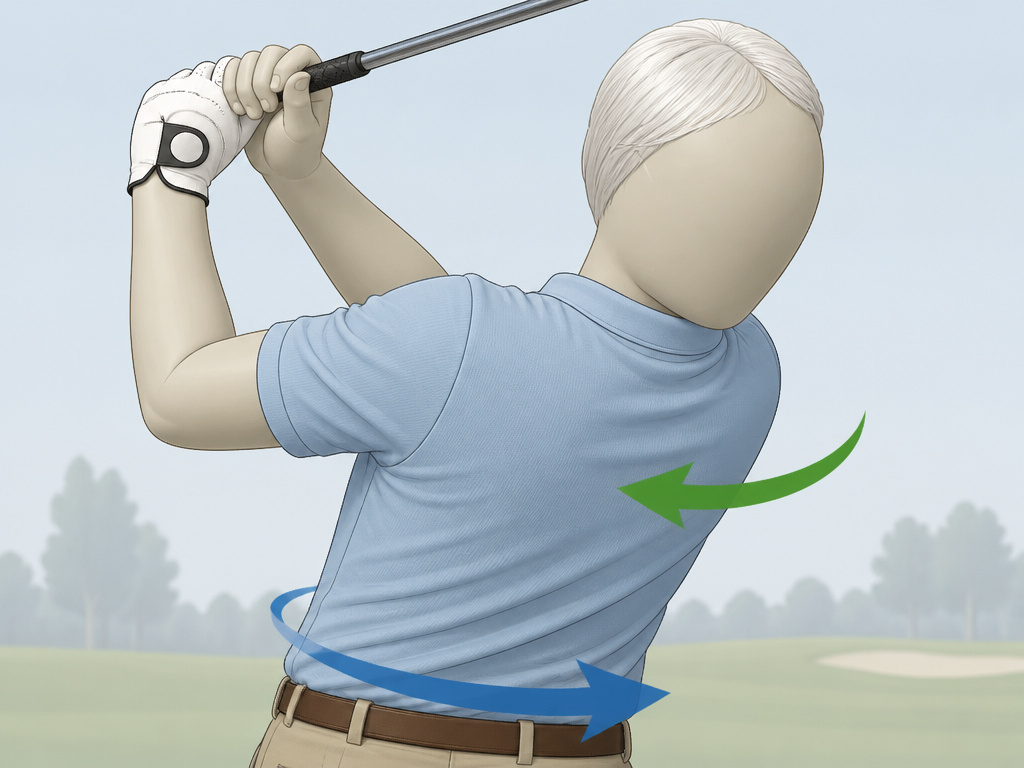
You don’t need a new swing. You need an edited version of your current one. The goal is to reduce the moving parts you can’t reliably control while maximizing the ones you still can. This is where most instruction fails seniors. It tries to add torque where flexibility is gone.
Let’s be clear about this. The typical advice to “keep your left arm straight” is often the enemy for a senior player. I had a student, a former college athlete now in his late 60s, who was struggling with a drastic loss of distance and a persistent slice. He was forcing that straight left arm, which locked his upper body and prevented any meaningful shoulder turn. His backswing was all arms. We allowed a slight, comfortable bend in his left elbow at the top. Instantly, his shoulders could turn 90 degrees. His hip turn increased. The club dropped into the slot on its own. He gained 15 yards of carry with his 7-iron in one session because he was finally using his body, not just his arms.
Strip it back. Your swing should have three adapted mechanics:
- A Shorter Backswing: Take the club back until your left shoulder is under your chin, not behind it. For most, this is a 10-15% reduction. A shorter lever is easier to control and accelerate. The power comes from the body’s turn through the ball, not the arm’s length going back.
- A Fuller Body Turn: Focus on turning your chest away from the target. Feel your back point at the target at the top. This coils the larger muscles of your torso. If you can’t turn your shoulders far, increase your hip turn. A bigger hip coil creates more stretch.
- An Earlier Release: Don’t try to “hold the lag” like a tour pro. With slower swing speeds, holding lag too long de-lofts the club and creates a steep, digging angle of attack. Allow the clubhead to release naturally just past your right hip on the downswing. This promotes a sweeping strike and higher launch, which is your friend for distance.
These aren’t compensations. They’re optimizations for your current physiology. A swing that relies on extreme flexibility is a fragile swing. A swing built on a stable turn and efficient sequencing is durable for decades. This principle is why game improvement clubs exist, they optimize for common impact flaws, just as these mechanics optimize for common physical changes.
Equipment: Let the Gear Do the Work
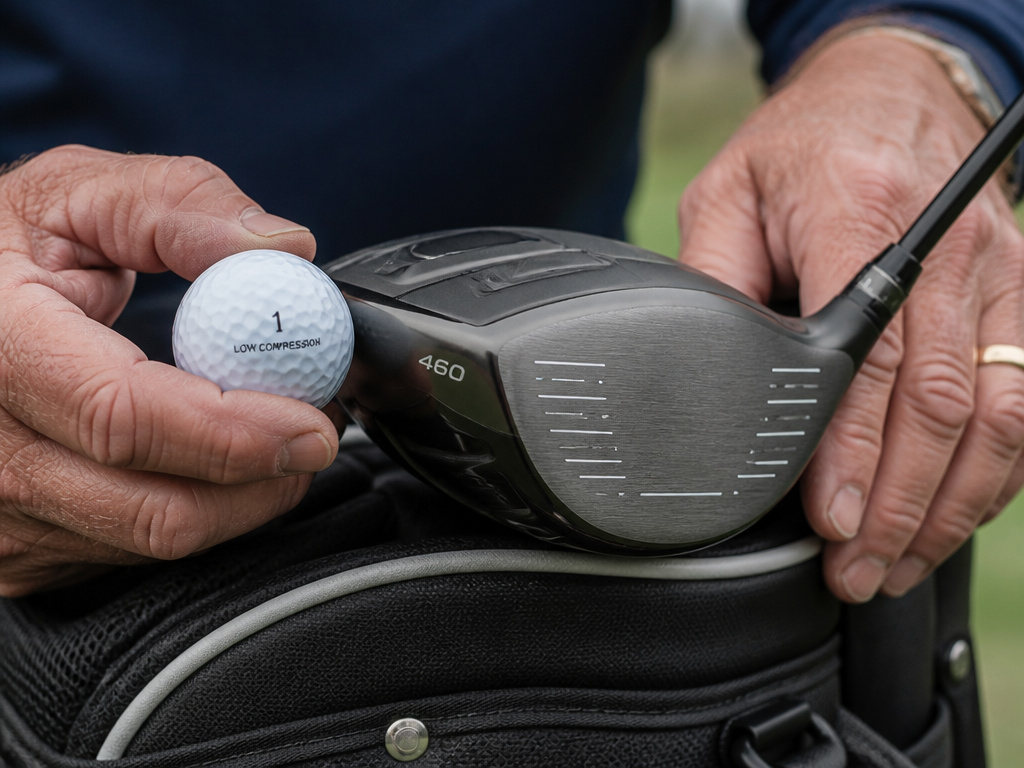
Trying to regain distance by swinging harder is a bankrupt strategy. Letting your equipment recover those yards for you is smart golf. This isn’t about buying a miracle; it’s about matching technology to your new reality. The right gear can add 5-10 yards per club without you changing a thing.
Your two most important equipment changes are the ball and the driver.
The Golf Ball: This is your biggest lever. Most seniors play a ball that is too hard for their swing speed. A high-compression tour ball (like a Pro V1x) needs about 105 mph driver speed to properly compress. If you’re below 90 mph, that ball feels like a rock and doesn’t launch. Switch to a low-compression ball (compression rating 70-80). The Callaway Supersoft, Titleist TruFeel, and Bridgestone golf balls for seniors like the e12 Contact are engineered for this. They compress dramatically on impact, creating more spring-like effect and higher launch with less spin. The result is more carry and more roll. It’s free distance in a box.
The Driver: Forget loft for a moment. Look for maximum forgiveness. That means a large clubhead (460cc) with a high Moment of Inertia (MOI). MOI is the club’s resistance to twisting on off-center hits. Higher MOI means less distance loss on toe and heel strikes. Brands like Ping (G430 Max), Callaway (Paradym X), and Cobra (Aerojet) excel here. Pair it with a lightweight, senior-flex shaft. The goal isn’t to work the ball. It’s to hit the center of the face as often as possible. A forgiving driver for amateurs is also a forgiving driver for seniors.
Common mistake: Ignoring iron specs. If your irons are 20 years old, the lofts are likely much weaker than modern sets. A new 7-iron might have the same loft as your old 6-iron. Newer game improvement irons also have weight low and deep in the clubhead, launching the ball higher with more stopping power. You’re not cheating; you’re using modern engineering.
| Equipment Piece | Priority Spec for Seniors | Why It Works | Sample Model |
|---|---|---|---|
| Golf Ball | Low Compression (70-80) | Compresses fully at slower speeds, maximizes energy transfer | Callaway Supersoft |
| Driver | High MOI, 10.5-12° Loft | Maintains ball speed on mishits, promotes optimal launch angle | Ping G430 Max |
| Irons | Strong Lofts, Low Center of Gravity | Creates higher launch with less effort, adds inherent distance | TaylorMade Stealth HD |
| Shafts | Lightweight Senior Flex | Allows faster swing speed with less perceived effort | Mitsubishi Chemical Kai’li Blue |
Spending money on a driver for amateurs with the right specs is a better investment than a dozen lessons trying to recapture a youthful move you physically can’t make. Good gear simplifies the game.
Course Strategy: Play Smart, Not Long
Your score doesn’t care how far you hit it. It cares how many times you hit it. The most effective way to “maintain distance” is to make the course shorter. This is essential, and it’s the step most players resist out of pride. Moving up a tee box is not surrender. It’s strategy.
The rule is simple: move up one tee box before you feel you have to. If you’re consistently hitting hybrids or fairway woods into par 4s, you’re on the wrong tees. The USGA’s guideline is that your average drive distance multiplied by 28 should equal the yardage you play. If you drive it 200 yards, play a course around 5,600 yards. This puts you in position to hit mid-irons into greens, which is where the scoring happens.
From there, your strategy shifts from power to placement.
- Par 5s are three-shot holes. Lay up to a full wedge distance (your 100-yard club). A full swing with a wedge is more accurate than a half-swing with a 9-iron. Take the big number out of play.
- Avoid hero shots. If you’re behind a tree, punch out. The penalty for a failed hero shot is two strokes. The penalty for a safe punch is maybe half a stroke.
- Aim for the fat part of the green. Middle of the green, every time. Tour pros do this when they’re out of position. Your goal is two putts, not a birdie putt from a tight pin.
- Practice with purpose. If you have two hours, spend 90 minutes on putting, chipping, and pitching. The other 30 minutes should be hitting tee shots with your 3-wood or hybrid to find a reliable fairway finder. Distance saved from the rough is distance earned.
This pragmatic approach is supported by broader safety guidelines, like those from the National Institute on Aging guide for older adults, which advises planning your route to avoid difficult maneuvers, like avoiding left turns in heavy traffic. In golf, that’s avoiding carries over water or risky shots from the trees. Smart course management is the ultimate distance equalizer.
Frequently Asked Questions
What is the biggest mistake seniors make trying to keep distance?
Trying to swing harder with their arms. This destroys sequence, leads to a steep angle of attack, and results in weak, high-spinning shots that fall out of the sky. Power in the golf swing for seniors comes from the ground up, using the legs to initiate the downswing and the torso to rotate through, not from yanking the handle with the hands.
Do I need “senior” flex shafts in all my clubs?
Not necessarily. Start with the driver, fairway woods, and hybrids. These are the longest clubs and benefit most from the easier loading and unloading of a softer shaft. Your irons might be fine with a regular flex, especially if you have a quicker tempo. The best answer is a professional fitting, but as a rule of thumb, if your driver swing speed is below 85 mph, senior flex is a good starting point.
Can exercises really help me regain distance?
They can help you maintain the distance you have, but rarely regain significant yards lost to aging. Focus on exercises that improve rotational mobility (like torso twists) and stability (like planks). These help you make an efficient, repeatable turn. Overspeed training with weighted clubs can help, but only if your swing mechanics are sound. Otherwise, you’re just ingraining a faster bad move.
How often should I change my golf ball type?
Whenever your swing speed changes noticeably, or at least once a season to test new models. Ball technology evolves. If you’ve lost 5-10 mph off your driver speed in the last few years, the ball you loved then is now working against you. Do a simple test: hit your current ball and a low-compression model with your 7-iron. Compare the feel, height, and carry. The difference is often immediate.
Is it worth getting fit for clubs as a senior?
It is the single best investment you can make. A fitter from a brand like Titleist or Ping will match shaft weight, flex, clubhead design, and loft to your specific swing characteristics. This ensures you’re not fighting your equipment. For example, they might add loft to your driver to optimize launch, or adjust your iron lie angles to account for a more upright swing plane. It maximizes the potential of every swing you have.
Before You Go
One rule most guides skip: if you haven’t moved up a tee box in over ten years, do it this weekend. Don’t debate it. The extra 300-400 yards you’re playing is the equivalent of adding two long par 3s to your round. It’s a tax on your enjoyment and your scorecard.
The quest to maintain distance isn’t about chasing your younger self. It’s about playing effective, enjoyable golf with the tools you have today. That means a shorter, quicker swing. It means a bag full of forgiving equipment that turns mishits into playable shots. It means a strategy that values position over power.
Good golf should feel less complicated the more you understand it. For the senior player, that understanding is simple: adapt your technique, upgrade your tools, and shorten the course. Do those three things, and you’ll find the distance you were worried about losing was never the most important part of the game to begin with. The score you keep is.
