
How to Practice Golf Without a Course | Proven Home Drills
This post contains affiliate links. As an Amazon Associate, we earn from qualifying purchases.
This post contains affiliate links. As an Amazon Associate, we earn from qualifying purchases.
To practice golf without a course, you focus on three pillars: skill-specific drills (putting, chipping, swing mechanics), using the right feedback tools (mats, nets, launch monitors), and incorporating mental rehearsal. A University of Limerick study found golfers who visualized making putts before attempting them outperformed those who only warmed up physically.
The mechanism behind that finding is what separates a useful home session from wasted time. Your brain’s motor cortex activates almost identically whether you physically perform an action or vividly imagine it. This is neural rehearsal.
What follows is a breakdown of the equipment that justifies its space, the drills that fix actual flaws, and the practice philosophy that prevents you from grinding bad habits deeper. You can build a repeatable swing in a ten-foot garage corner. You can sharpen your putting stroke on a three-foot mat. The constraint is a plan.
Key Takeaways
- A 2019 University of Limerick study proved that golfers who visualized successful putts before hitting them performed better than those who did a traditional warm-up.
- Practicing full swings without a ball, using tools like the Stack System, removes negative feedback and lets you focus purely on generating speed and clean mechanics.
- The most common home-practice failure is a cramped space that forces an unnatural, shortened swing, ingraining a flaw you’ll spend months unlearning.
- For meaningful feedback on full swings indoors, a basic launch monitor like the Garmin Approach R10 or impact spray like Dr. Scholl’s Foot Spray is non-negotiable.
- Your putting mat should have a ball-return feature. If retrieving the ball adds friction, you’ll stop practicing within two weeks.
The Science of Swinging Without a Ball
Most golfers think practice requires a ball and a target. The research says the opposite can be more effective.
A 2019 study from the University of Limerick had 44 golfers attempt 40 putts. Half were shown a video of skilled golfers making the putt and told to visualize themselves doing the same. That group outperformed the group that did a standard physical warm-up. Researcher Niall Ramsbottom noted the ability to imagine the feel of an action without performing it plays a key role in an exercise’s effectiveness.
This works because your brain doesn’t cleanly distinguish between a vividly imagined action and a real one. The same neural pathways fire. When you then step up to a real putt, your system has already logged a successful rep.
The principle extends to the full swing. Dr. Sasho Mackenzie, co-creator of the Stack System speed trainer, designs his aid specifically to be used without a ball.
“The biggest benefit is removing the abundance of negative feedback that occurs when hitting balls with maximum effort,” Mackenzie says. “With only the clubhead speed on the radar and how our swing felt as sources of feedback, we are free to learn movement patterns that generate max speed.”
When you hit a bad shot, your instinct is to make a quick, often flawed compensation. Swinging freely with a speed trainer or in slow motion in front of a mirror lets you ingrain the movement you want, not the Band-Aid you just applied.
Where this goes sideways: Only doing slow-motion or no-ball swings. The end goal is to hit a ball. Use these techniques to build a new pattern, then calibrate it by hitting real shots into a net with feedback. The transfer is the final, essential step.
How to Structure a No-Ball Session
- Warm-up with visualization. Close your eyes and rehearse the feeling of three perfect, smooth swings. Focus on tempo and balance.
- Perform slow-motion drills. Take your driver or a training aid like the SKLZ Gold Flex and rehearse your takeaway and transition at 25% speed. The goal is awareness, not power.
- Integrate speed. Using a speed trainer or just your club, make 10-15 swings focusing only on accelerating smoothly from the top. Forget direction.
- Calibrate with feedback. Hit 5-10 real balls into a net with impact spray on the face. Where is strike location? That tells you what the feel-work actually did.
This sequence moves from mental to physical, from slow to fast, from feel to result. It turns a small space into a productive lab.
Building Your Home Practice Arsenal
You don’t need a simulator. You need tools that give honest feedback and don’t create excuses. Every item should either fix a specific problem or provide a specific data point. Category nouns are useless here.
| Tool Category | Primary Job | Key Spec / Model to Look For |
|---|---|---|
| Putting Mat | Train stroke path & distance control | Ball-return mechanism, true roll surface, alignment aids. The Perfect Practice Putting Mat is the benchmark. |
| Hitting Net | Allow full swings with real balls | Durability at the strike zone, easy setup (<2 mins). The Rukket Pop-Up Golf Net or a Spornia SPG-7 for a more permanent setup. |
| Launch Monitor | Provide objective swing/ball data | Measured metrics (club speed, ball speed, launch angle). The Garmin Approach R10 offers this at an accessible tier. |
| Impact Feedback | Show where you strike the face | Dr. Scholl’s Foot Spray or impact tape. This is non-negotiable for net practice. |
| Safe Practice Balls | Allow swing work in tiny spaces | Realistic weight and flight. Almost Golf Balls are the standard for a reason. |
The table is a filter. If a product doesn’t serve one of these core jobs, skip it. A fancy gadget that measures your wrist hinge but doesn’t improve strike quality is a distraction.
Your first purchase should be a putting mat with a ball return. Why? Because consistency in practice depends on removing friction. If you have to walk three steps to retrieve your ball after every putt, your session length and focus will plummet. The Perfect Practice Putting Mat solves this. You can hit fifty putts in ten minutes without moving your feet.
For full swings, the net is your foundation. But a net alone is dangerous. Hitting balls blindly into a net reinforces your current strike pattern, good or bad. You must pair it with feedback.
Common mistake: Buying a net but skipping the impact spray. You’ll hit 100 balls thinking you’re pure, then wonder why your driver still slices on the course. The spray shows the truth in two swings.
The cheapest and most revealing tool is a can of Dr. Scholl’s Foot Spray. A light dusting on the clubface leaves a perfect mark where the ball struck. A pattern of heel strikes explains your slice. Low-face strikes explain your low bullets. This turns a net session from mindless beating into diagnostic work.
If you have the budget for one tech upgrade, a basic launch monitor like the Garmin Approach R10 is the multiplier. It gives you the “why” behind the strike. A heel strike with low club speed points to a swing path issue. A centered strike with low ball speed points to a delivery issue. Now your drills have a target.
Drills That Fix, Not Just Fill Time
Home drills must have a measurable outcome. “Swing smoother” isn’t a drill. “Make five swings in a row where the club taps the wall behind you at the top of the backswing” is.
Putting: The Gate Drill
You need two objects and six feet of space. 1. Place two books, shoes, or alignment sticks just wider than your putter head on your mat. 2. Set a ball in the middle. Your goal is to make a stroke without the putter head touching either gate. 3. Hit twenty putts. If you clip a gate, your path is drifting inside or outside.
The consequence of skipping it: You practice a wobbly, inconsistent path. On the course, you’ll miss left and right even when your read is perfect. This drill enforces a square, straight-back-straight-through stroke for short putts.
Full Swing: The Wall Drill
This fixes an overlong, loose backswing. You need a wall and a 7-iron. 1. Stand with your backside about a foot from a wall. 2. Take your normal backswing. The club should gently tap the wall at the top. 3. If you slam into it, your swing is too long. If you don’t touch it, you might be restricting.
Do this for ten slow reps. The wall gives you a physical checkpoint your body remembers. It’s the reason touring pros like Will Zalatoris do so much slow-motion work.
Chipping: The Towel Drill
This teaches you to strike the ball first, not the ground. You need a small towel and a wedge. 1. Lay a hand towel flat on your carpet or practice mat. 2. Place a ball on the towel. 3. Try to hit the ball without disturbing the towel. The goal is to pick the ball cleanly.
If you hit the towel first, you’re hitting behind the ball—the leading cause of fat chips. This drill forces a shallow, ball-first strike.
The Spatial Reality Check
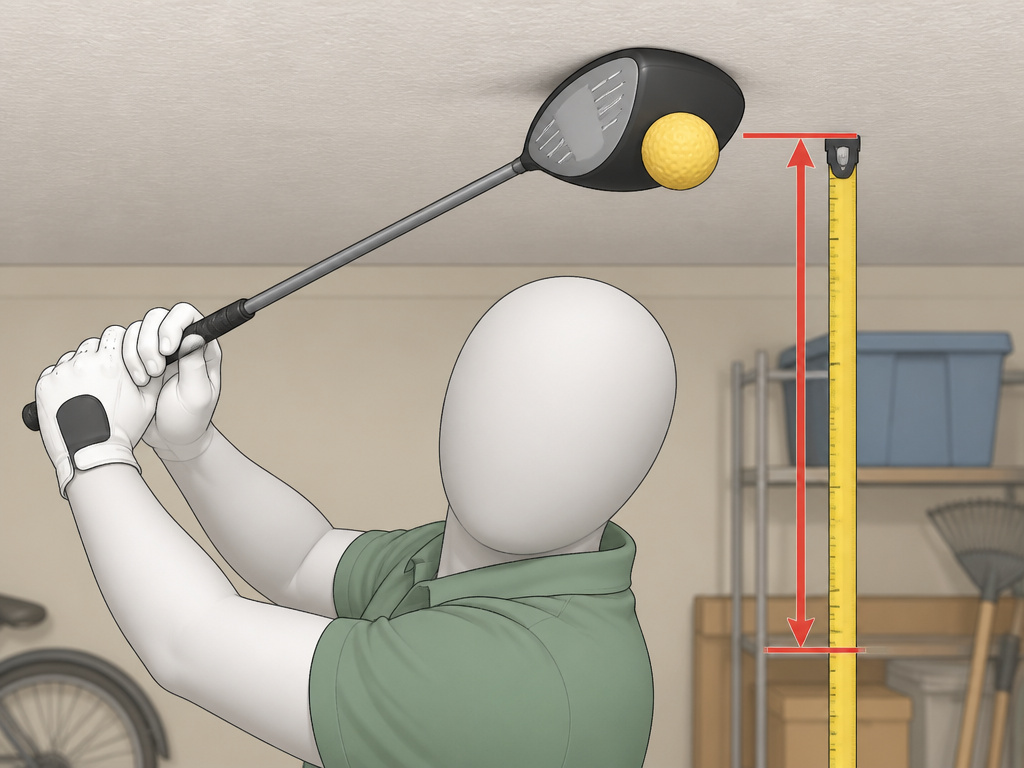
Your available space dictates your practice, not the other way around. Trying to force a drill that needs ten yards into a seven-yard garage is how you learn to hit a duck hook.
| Available Space | What’s Possible | What to Avoid |
|---|---|---|
| Small Room (≤ 10 ft) | Putting drills, slow-motion swing work, grip & posture checks in a mirror, flexibility exercises. | Any full-speed swing with a real club. Use foam balls or just a clubhead cover. |
| Garage / Basement (10-15 ft) | Full swings with foam or limited-flight balls into a net, chipping to a target, full putting mat. | Full drivers with real balls. The risk of a shank into drywall or your car is too high. |
| Backyard (15+ ft) | Full bag practice with real balls into a net, wedge distance control work, chip & run practice. | Neglecting a net for real shots. Even in a yard, you need a barrier to contain shots and focus on strike. |
Easy to miss: The ceiling height. A standard 8-foot garage ceiling is too low for a full driver swing. You’ll subconsciously shorten your swing arc, ruining your mechanics. For full swings, you need at least 10 feet of clear vertical space.
If your space is cramped, embrace the constraint. A SKLZ Gold Flex trainer or an Orange Whip is perfect for tempo and sequencing in a low ceiling area. You’re not practicing ball flight; you’re practicing the movement that creates it.
This is where foam golf balls like Almost Golf Balls earn their keep. They let you make a full, aggressive swing with a real club, giving you feedback on strike and club path through feel, while being safe for indoor use. They’re not for judging distance, but for judging contact.
From Practice to Performance
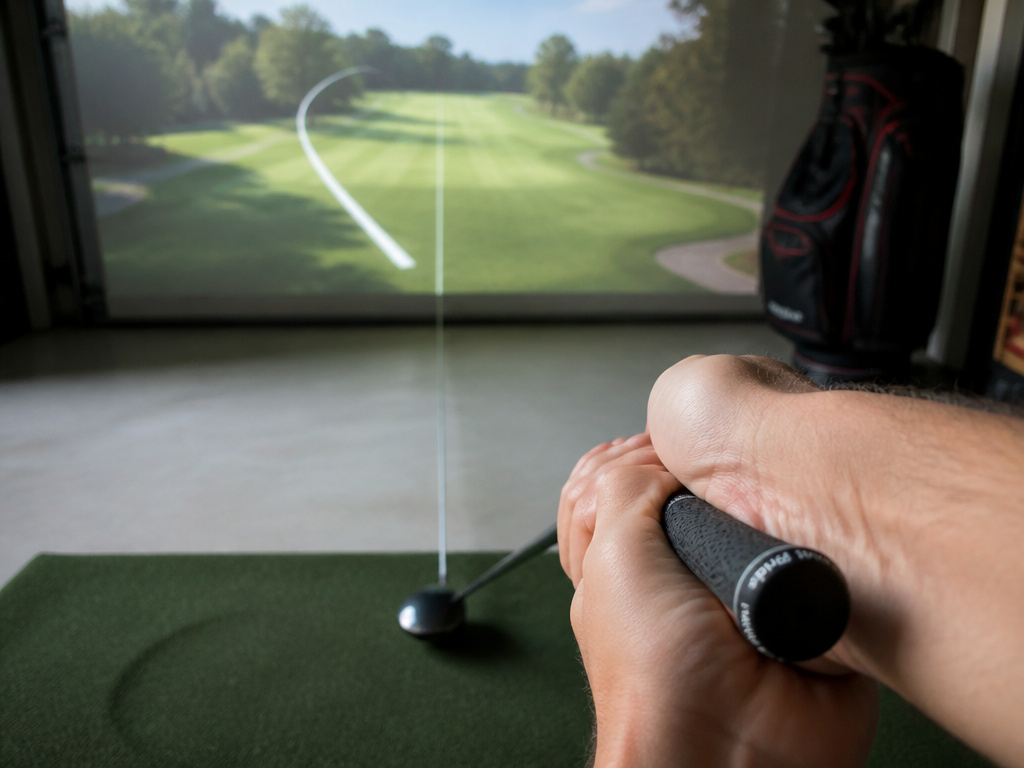
Home practice builds the engine. You still need to test it under load. The bridge between your garage and the first tee is deliberate strategy.
Your last step before any round should be a five-minute visualization session. Don’t just think “hit fairways.” Be specific. Rehearse the feeling of your first tee shot: the smooth takeaway, the crisp strike, the ball drawing gently down the left side. See the approach shot landing softly. This primes the neural pathways you’ve been building.
On the course, your home work shows up in trust. When you’ve hit 500 putts on a mat with a gate, you don’t second-guess your stroke on a three-footer. When you’ve felt a thousand centered strikes with impact spray, you can swing the driver with commitment.
The goal is to build a deeper, more reliable version of your swing that doesn’t need constant feedback to function. That’s how you practice golf without a course.
Frequently Asked Questions
What is the single most important piece of equipment for home practice?
Putting mat with a ball return. Consistency in practice is about removing friction. If you have to chase your ball, you’ll stop. The Perfect Practice Putting Mat or a similar model with an automatic return guarantees you’ll putt more often, which directly lowers scores.
Can you really increase swing speed at home?
Yes, with the right practice tools. The Stack System is built specifically for this. By removing the ball and focusing solely on radar-measured clubhead speed, you train your nervous system to recruit more muscle fibers faster. Gains of 5-10 mph in a few months are common with consistent training.
How do I know if I’m practicing correctly without a coach?
You need at least one source of objective feedback. For putting, use a gate drill to see path errors. For full swings, use Dr. Scholl’s Foot Spray on your clubface to see strike location. For swing mechanics, record your swing on your phone and compare it to a model you trust. Data beats feeling every time.
Is a launch monitor worth it for home practice?
Basic monitor like the Garmin Approach R10 is worth it if you have a net and want to understand ball flight and club data. It answers “why.” If you’re only doing putting and slow-motion work, it’s not essential. Start with impact spray and a phone camera; upgrade to a monitor when you’ve exhausted what they can tell you.
How long should a home practice session be?
Fifteen focused minutes is better than an hour of distracted beating balls. Structure short sessions: 5 minutes of putting gate drill, 5 minutes of slow-motion swing work, 5 minutes of physical training like forearm rotations. Daily short sessions create more improvement than one weekly marathon.
What’s the biggest mistake people make practicing at home?
They practice in a space that’s too small, forcing a compensation. Swinging a driver in an 8-foot ceiling room teaches you to chop down on the ball. Always match the drill to the space. If you can’t swing freely, work on something else—grip, posture, or putting.
The Bottom Line
You don’t need a course to build a better golf game. You need a putter, a six-foot mat, and a plan. The research from the University of Limerick isn’t a theory; it’s a blueprint. Your brain can rehearse a perfect swing just by imagining it clearly.
Spend your budget on feedback, not gadgets. A can of foot spray and a phone camera are more valuable than a dozen gimmicky trainers. Name your tools: the Perfect Practice Putting Mat for repetition, the Rukket Pop-Up Net for containment, the Garmin Approach R10 for data.
Then drill with purpose. The gate drill for putting. The wall drill for backswing length. The towel drill for clean chips. Every rep should have a pass/fail test.
The constraint was never the course. It was a clear method. Build that in your available space, and the scores will follow.
