
How to Stop Hitting Fat Shots | A Simple Swing Path Cure
This post contains affiliate links. As an Amazon Associate, we earn from qualifying purchases.
This post contains affiliate links. As an Amazon Associate, we earn from qualifying purchases.
To stop hitting fat shots, move your weight forward through impact. The club must bottom out after the ball, not before it. This requires a forward weight shift of 70/30 or 80/20 onto your lead side at impact, a descending angle of attack, and trusting the club’s loft to lift the ball.
Most advice tells you to stay down or keep your head still. That misses the physical root. The low point of your swing follows your center of mass. If your weight stays back, the club hits the ground first. The jarring thud and weak shot that follows is a direct consequence of a body that hasn’t moved toward the target.
What follows is a breakdown of the two types of fat shots, the exact weight shift pros use, and the drills that rewire the instinct to help the ball up. You’ll learn how to read your divots for diagnosis and why hitting down more is the real fix.
Key Takeaways
- Fat shots are a weight shift problem, not a swing path problem. The club bottoms out where your body’s center of mass is moving. Stay back, hit behind.
- Aim for a 70/30 weight distribution on your lead side at impact. This forward shift moves the low point of your swing ahead of the ball.
- Top players hit down with a 7-iron by about 4 degrees. A descending blow compresses the ball; the loft gets it airborne. Trying to scoop causes chunks.
- Diagnose by your divot. A divot that starts behind the ball means a backward low point. A deep, gouging divot in front of the ball means your angle is too steep.
- The fix feels wrong. You must feel like you’re driving the ball into the ground. Trust the process.
The #1 Cause of Fat Shots (And the Counterintutive Fix)
You’ve tried staying down. You’ve tried swinging easier. The chunk still happens. The real issue isn’t your posture or your effort. It’s a fundamental misunderstanding of how irons work.
Most golfers hit fat because they try to help the ball into the air. As you come into impact, you instinctively lean back, your weight stays on your trail side, and your right shoulder dips. This feels helpful. It feels like you’re lifting the ball. It’s the exact move that drives the clubhead into the turf before it reaches the ball.
The part nobody mentions: When your weight stays back, the low point of your swing moves back with it. The club must bottom out behind the ball. That’s the physics of the fat shot. The harder you try to lift, the worse the chunk gets.
The fix is counterintuitive. To stop hitting it fat, you need to hit down more. You need to move your weight forward and trust the loft to get the ball up. It feels like you’re driving the ball into the ground. That’s correct. Watch any PGA Tour pro hit an iron. Their divot is always in front of the ball. They hit down to make the ball go up. Your job is to let the club do its designed job.
| The Wrong Instinct | The Correct Move | Result if Ignored |
|---|---|---|
| Hanging back on trail side | Weight shifts forward (70/30 lead side) | Low point stays behind ball, consistent fat contact |
| Trying to scoop or lift | Hitting down with a descending blow | Club digs, ball comes out weak and short |
| Head moving down/right | Head stays steady or moves slightly forward | Inconsistent low point, fat/thin mix |
Diagnose Your Fat Shot: Backward vs. Too Deep
Not all fat shots are the same. Treating every chunk as identical leads to frustrated practice. You need to know which of two main types you’re hitting.
A backward low point fat shot happens when the bottom of your swing arc is behind the golf ball. The club strikes the ground first, then may bounce up and catch the ball thin. This often creates a maddening pattern of alternating fat and thin shots. Your body is likely moving away from the target or not moving forward enough.
A too-deep low point fat shot happens when the low point is actually ahead of the ball, but your club is attacking the ground at too steep an angle. You take a deep, gouging divot that starts after the ball, but the strike still feels heavy. You might hit some solid shots mixed with these heavy ones.
Your divot tells the truth. Look at it after your next few shots. * Divot starts behind the ball? You have a backward low point. Focus on weight shift. * Divot is a deep trench starting after the ball? You have a too-deep low point. Focus on shallowing your angle of attack. * A mix of fat and thin shots? Almost certainly a backward low point issue. Your body isn’t consistently moving forward.
Master the Two Non-Negotiable Fundamentals
Two physical specs separate a crisp iron strike from a fat one. Ignore them at your own peril.
1. The Impact Weight Distribution: 70/30
At the moment of impact, your weight must be predominantly on your lead side. Data from instructors like Eric Cogorno and analysis of elite ball-strikers points to a 70/30 or 80/20 distribution favoring the front foot. Starting at 50/50 is fine, but you must shift.
If your weight is 50/50 or, worse, favoring your trail side at impact, the low point of the swing stays behind the ball. Every time. This isn’t a feel. It’s a cause.
Where this goes sideways: Starting with too much weight on your trail foot. This makes a forward shift nearly impossible. You’re already leaning away from the target, so your only move is to lean further back. Set up with a slight favor to your lead side to make the correct move easier.
2. The 7-Iron Angle of Attack: -4°
How steep should you hit down? For a mid-iron, the benchmark is clear. Top players hit down with a 7-iron by about 4 degrees. This descending blow pinches the ball against the turf, creating compression and backspin. The club’s loft—not your body—launches it.
A neutral or upward attack angle with an iron is a recipe for thin or fat contact. You must deliver the clubhead on a downward path. This is why ball position matters. With a 7-iron, play the ball just forward of center in your stance. This allows room to hit down and through.
The Step-by-Step Fix: Drills That Rewire Instinct
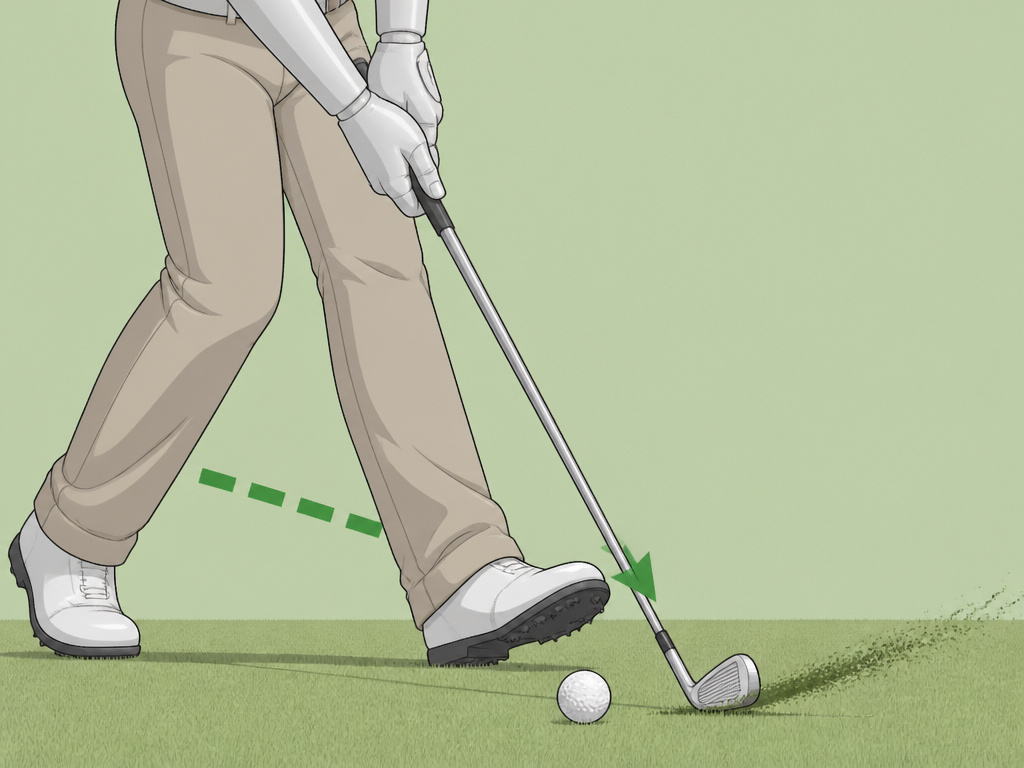
Theory is useless without a feel. These drills ingrain the correct movements.
Drill 1: The Step-Through (Fixes Backward Low Point)
This forces the weight shift your body is resisting. 1. Take your normal address. 2. Start your backswing and let your lead foot step toward your trail foot. 3. As you begin the downswing, step your lead foot back to its original position and swing through.
You are physically walking into the shot. This drill makes it impossible to hang back. The contact will feel startlingly solid. Do this ten times with a mid-iron, focusing on the sensation of your body moving toward the target.
Drill 2: The Scrape Drill (Fixes Too-Deep Low Point & Teaches Low Point Control)
This is about precision, not power. 1. Place a ball on a tee pushed almost entirely into the ground, or use a spray paint line on the turf. 2. Take your 7-iron and make slow, half-swings. 3. Your goal is to “scrape” the turf precisely after the ball or line, taking the shallowest possible divot.
Common mistake: Trying to take a divot. Don’t. Your goal is to brush the grass. This teaches you to control where the club bottoms out and to shallow your angle. If you dig, you’re too steep. Keep rehearsing until you can consistently scrape the turf after the ball.
Drill 3: The Forward Press Setup
Pre-set the impact position to make it automatic. 1. At address with your 7-iron, preset 60% of your weight on your lead foot. 2. Feel like you’re leaning toward the target. Your hands should be slightly ahead of the ball. 3. Make your swing, focusing on maintaining that forward lean through impact.
This removes the need for a dramatic shift during the swing. It simplifies the motion to a turn around a forward-leaning axis. The ball will come out lower and with more compression—a pure strike.
What Jack Nicklaus Says About Avoiding Fat Shots
Even the greats have focused on this fault. Jack Nicklaus highlighted two nuanced points that most amateurs get wrong.
First, he advised starting with the clubhead slightly off the ground at address. He believed grounding the club completely could set you up to take turf too early. Measure your distance, then hover it an inch above.
Second, he warned against exaggerated head movement. While he acknowledged many pros’ heads move slightly down and right, he cautioned amateurs to consciously avoid it. “Any accentuated motion will cause you to hit the ground before the ball,” he noted. Your head should be a stable center for your pivot, not an active participant diving toward the ball.
He also pointed out that fat shots often creep in when you try to manipulate your standard swing for a special shot—like trying to hit it extra high or soft. His advice? Learn one reliable, repeating swing. Adjust for different shots with grip, stance, or ball position, not by changing the swing itself.
Advanced Considerations: When the Basics Aren’t Enough
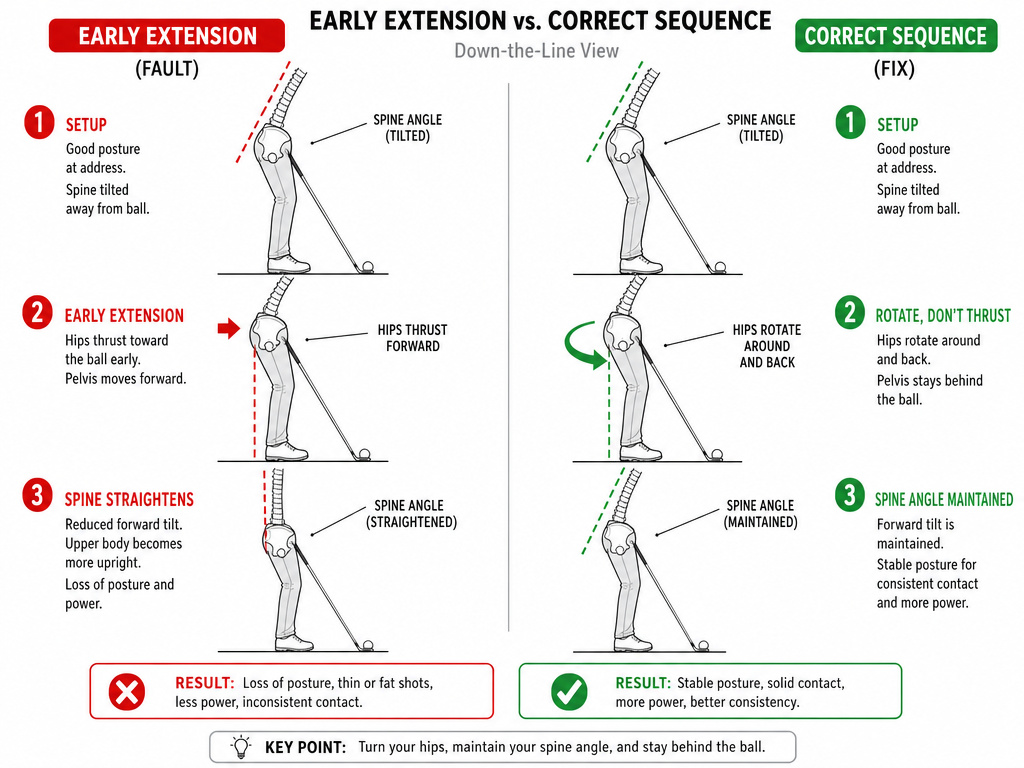
Sometimes the root cause is more subtle. If you’re still struggling after working on weight shift, check these two advanced faults.
Early Extension: This is when your hips thrust toward the ball in the downswing, standing you up. It causes your entire swing arc to rise, often resulting in a fat shot as you desperately try to reconnect with the ball. The fix is maintaining your spine angle and feeling like your hips work around rather than at the ball.
Arm Overrun: If your arms continue swinging back after your shoulders have stopped turning, you lose connection. The downswing becomes an arm-dominated lunge, destroying any chance of consistent low point control. Feel a one-piece takeaway where your shoulders lead, and stop your backswing when your shoulders stop turning.
Frequently Asked Questions
Why do I hit fat shots only with my irons?
Irons are designed for a descending strike. Your brain knows this subconsciously, but if you apply a driver or fairway wood swing (sweeping up) to an iron, you’ll either hit thin or fat as you try to “find” the bottom. The fix is committing to the downward hit with irons.
Can standing too far from the ball cause fat shots?
Yes. Reaching for the ball can cause you to stand up through impact (early extension) to maintain balance. This raises your swing arc and can cause you to hit behind it. Check your posture: you should be able to hang your arms freely from your shoulders, not reach.
How do I stop hitting fat shots under pressure?
Pressure amplifies your instinct to steer. You’ll likely freeze your body and swing with only your arms, guaranteeing a fat shot. Have one simple swing thought: “shift and turn.” Focus on initiating the downswing with your lead hip clearing toward the target. This gets your weight moving and lets your arms follow.
What’s the difference between a fat shot and a chunk?
They are the same thing. “Chunk” is just a colloquial term for a severe fat shot where the club digs deeply into the ground behind the ball.
Should I use more lofted clubs to fix fat shots?
This is a band-aid. A higher-lofted wedge is more forgiving of a slightly fat strike because the loft can still get the ball up. However, it reinforces the bad habit. It’s better to fix the weight shift with your scoring clubs, where clean contact is most critical.
The Bottom Line
Fat shots end when you stop fighting the club’s design. The iron is built to compress the ball downward. Your only job is to deliver it with your weight moving forward. Forget lifting. Forget staying perfectly still. Shift your center of mass toward the target, hit down, and let the loft do the work.
The next time you’re on the range, hit twenty shots with one thought: “lead side through.” The solid, clicking sensation of pure contact will rewrite your instincts faster than any mechanical tip. Go find that feeling.
