
Stop Overthinking Your Golf Swing With These Key Methods
This post contains affiliate links. As an Amazon Associate, we earn from qualifying purchases.
This post contains affiliate links. As an Amazon Associate, we earn from qualifying purchases.
To stop overthinking your golf swing, shift your focus from internal mechanics to external targets and feel. An 8-year study of expert golfers found the “right” thought depends on your personality, verbalizers need a quiet cue, visualizers need an image. The fix isn’t emptying your mind; it’s filling it with the shot, not the swing.
That personality split, verbalizer versus visualizer, explains why generic advice fails. One player’s anchor is another player’s distraction. The study showed high-verbal golfers’ performance dropped when swing thoughts were restricted, while highly visual players improved. Your brain’s wiring dictates your optimal mental strategy.
What follows: a breakdown of why pressure triggers overthinking, a personality check to find your mental style, and a three-step routine to lock your attention on the shot. We’ll use specifics from an 8-year academic study and quotes from PGA Tour winners to move past theory.
Key Takeaways
- Overthinking under pressure is a control response, not a knowledge problem. You’re trying to supervise an automatic motion.
- Your cognitive style (verbalizer or visualizer) and Working Memory Capacity determine whether a swing thought helps or hurts. There’s no universal rule.
- A pre-shot routine is a non-negotiable firewall. It must end with a single, simple feel or image, never a technical instruction.
- During a swing change, technical focus is necessary on the range but must be deliberately shelved on the course. You play golf, not golf swing.
- Tools like swing analyzers provide objective data off the course, reducing the need for subjective internal feedback during play.
Why Your Brain Betrays You Under Pressure
Pressure creates consequence. When a shot matters, your brain’s instinct is to seize control of a motion that usually runs on autopilot. You start inspecting grip, takeaway, and turn. This shift from external target to internal mechanics is the core of overthinking.
Where this goes sideways: Trying to “stop thinking” about your takeaway. The instruction itself becomes the thought you can’t escape, adding tension before you even move the club.
This isn’t a lack of skill. It’s a misdirection of attention. The better you understand your swing, the more raw material your mind has to over-engineer the solution mid-shot. The irony is thick. Research involving expert golfers (handicap <6) using 5 iron shots showed that under anxiety, players naturally increased their level of conscious swing thought. They were trying to protect the shot by supervising it, which often made things worse.
The task itself matters. A full driver swing has different perceptual demands than a three-foot putt. Overthinking a putt often involves monitoring face angle and stroke length, small, controllable elements that feel manageable. But that live supervision wrecks your pace and commitment every time.
The Three-Step Pre-Shot Routine That Shuts Down Noise
You need a consistent process that bridges the gap between decision and execution. This routine is your cognitive off-ramp. It moves you from analyst to athlete.
Step 1: Make All Calculations in One Definite Step. Stand behind the ball and solve the shot. Consider wind, lie, yardage, and trajectory. This is the only time for conscious analysis. Once you have a plan, the debate is over. Indecision here is the primary fuel for overthinking later.
Step 2: Visualize the Shot and Feel the Swing. Create a clear mental movie of the ball’s flight and its landing. Then, take a practice swing focused solely on reproducing the feel of that swing. Not the look, not the positions, the kinesthetic sensation. This switches your brain from visual/verbal processing to sensory motor planning.
Step 3: Step In, See the Target, and Trigger. Walk into your stance looking at the target, not the ball. Align your clubface. Take one last look at your target, quiet your mind with a single, pre-chosen cue (“smooth” or “tempo”), and pull the trigger. The cue is a feel, not a technical command.
Skipping Step 1 means you’ll be solving the shot over the ball. Skipping Step 2 means you have no feel to execute, so your mind fills the void with mechanics. Skipping Step 3 means you never fully disengage the analyst, and technical thoughts will flood back in.
It’s Not Your Fault: How Personality Dictates Your Swing Thoughts
The blanket advice to “have one simple swing thought” is incomplete. An 8-year study on effective swing thoughts revealed a critical variable: your cognitive personality. Researchers measured golfers as verbalizers or visualizers and tested their Working Memory Capacity (WMC).
| Cognitive Style | Reaction to Restricted Swing Thoughts | Implication for Practice |
|---|---|---|
| High Verbalizer | Performance declined. | Needs a quiet, feel-based cue (e.g., “tempo”). Analytical thoughts are destructive. |
| High Visualizer | Performance improved. | Benefits from a clear mental image (e.g., “draw around the tree”). |
| Low WMC | Performance worsened under pressure. | Must simplify drastically; complex thoughts overload the system. |
| High WMC | Performance remained stable. | Can handle a slightly more detailed cue if needed, but simplicity is still faster. |
The study’s finding contradicts old theories. It showed that a one-size-fits-all automaticity intervention, telling everyone to stop thinking, can wreck a verbalizer’s game. Your brain has a preferred processing channel. Fighting it is a mistake.
This is where understanding golf swing biomechanics off the course pays dividends. If you know the objective mechanics of an efficient swing, you can trust your training and avoid real-time analysis. The work is done.
The Learning vs. Playing Mindset: When to Think Technically
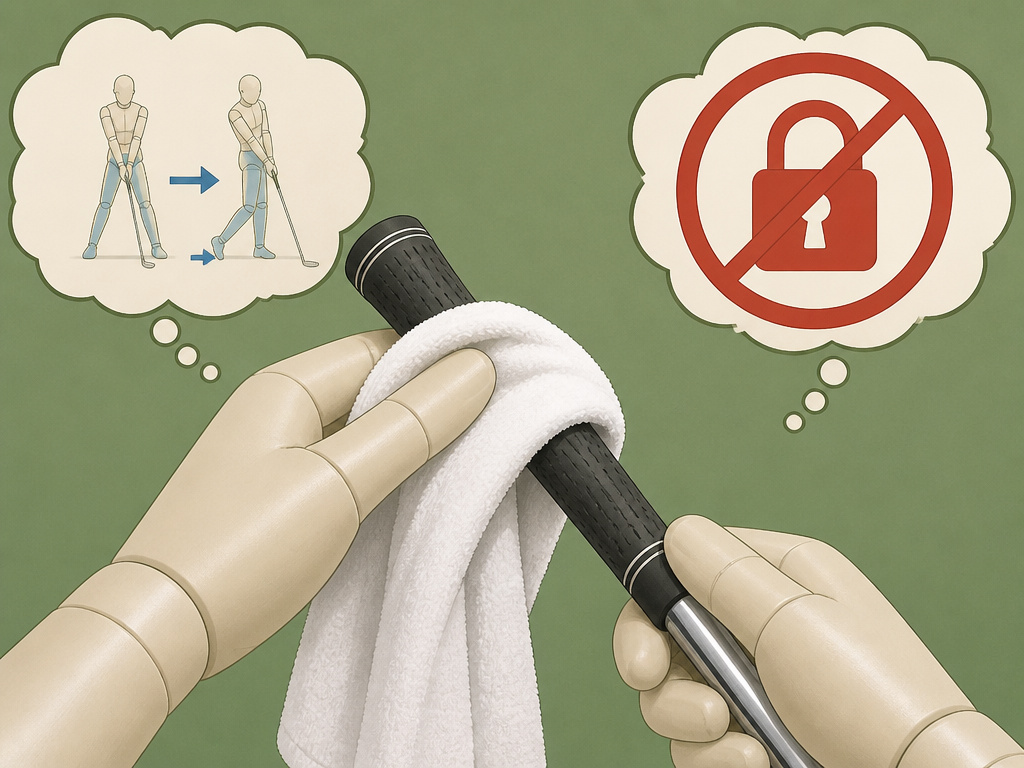
There is a time for swing thoughts: during practice, when you are actively making a change. The range is your laboratory. The course is your exam hall. Confusing the two is the most common strategic error committed by diligent golfers.
When you’re ingraining a new movement pattern, like improving your weight shift or kinematic sequence, technical focus is essential. You might use drills, mirrors, or trainers like the Orange Whip to build the new feel. This is “playing golf swing.”
The moment you step onto the first tee, that mindset must be deliberately locked away. Your goal shifts to scoring. Now you are “playing golf.” This means committing to your shot, regardless of whether the new move feels fully baked. As one pro noted, they are “seldom not undergoing a change and see the process as constant evolution.” The skill is compartmentalization.
Easy to miss: The transition from range to course. Build a physical ritual, like wiping your grips or taking three deep breaths, that signals to your brain, “Practice is over. Now we play.”
Tools to Externalize Feedback and Quiet Your Mind
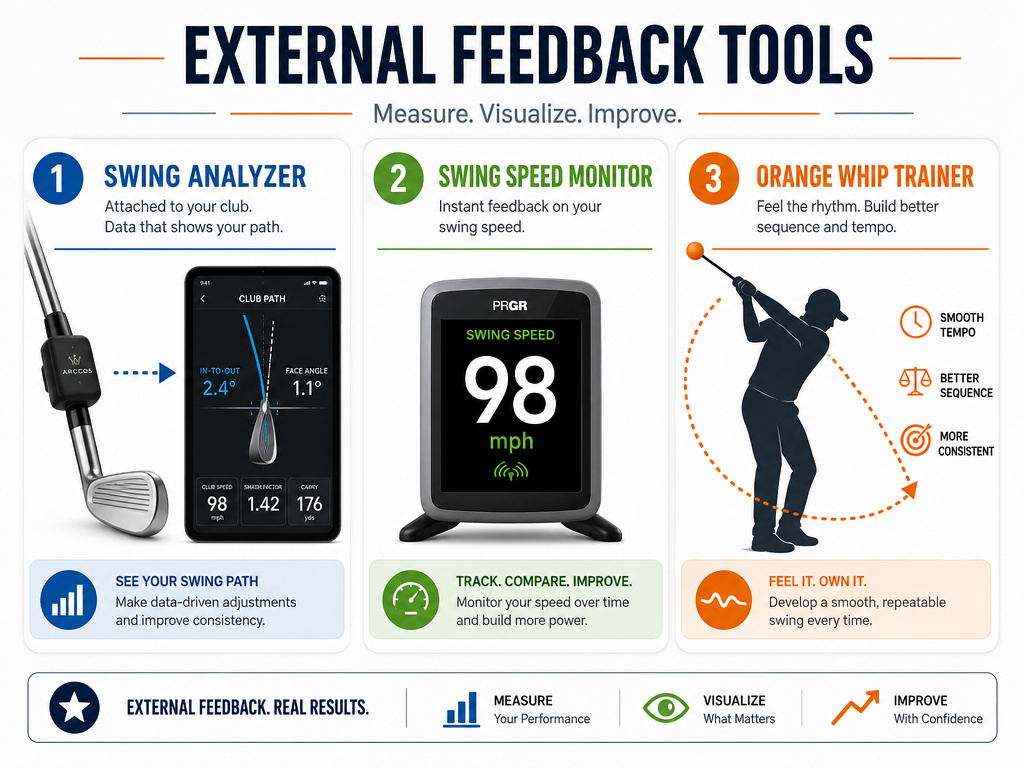
If you’re prone to overthinking, you likely rely too much on internal feedback (“Did my elbow bend? Did I turn enough?”). Modern tools provide objective, external feedback, giving your analytical mind something concrete to process off the course so it can rest on it.
| Tool Type | What It Does | How It Fights Overthinking |
|---|---|---|
| Swing Analyzers (e.g., Arccos, SwingU) | Tracks club path, face angle, tempo. | Provides data for practice sessions, removing guesswork and the need for internal diagnosis during play. |
| Swing Speed Monitors (e.g., PRGR, FlightScope) | Measures clubhead speed. | Gives a concrete number to chase on the range, focusing effort away from subjective feel. |
| Swing Trainers (e.g., Orange Whip, SmartBall) | Promotes specific feels and sequences. | Builds muscle memory for rhythm and timing or body rotation so the correct move becomes automatic. |
These devices are for practice, not play. Their value is in building trust. After a session with a swing analyzer, you have proof of your path. That proof lets you step onto the course and simply react.
What the Pros Do When the Pressure Is On
PGA Tour players feel the same urge to overthink. Their solutions are brutally simple because complexity fails under tension.
Wyndham Clark, setting a course record at Pebble Beach, kept his approach simplistic: see the shot, feel the swing, hit it. Adam Long, before his winning shot at the 2019 American Express, knew overthinking was the enemy. His thought: “I’ve got to be an athlete about it and somehow will this towards the hole.” He focused on an outcome, not a mechanics.
Their routines are airtight. Jack Nicklaus was famed for coming to a complete stop behind the ball to get a clear picture. That moment of stillness is a cognitive reset. It’s the pause that prevents the noise from rushing in.
These players aren’t avoiding thought. They are structuring it. They do their analysis, make a committed decision, and then use their routine to shift into athletic execution. This is the model.
Frequently Asked Questions
Can overthinking cause the yips?
Yes, absolutely. Overthinking is a form of mental interference where conscious thoughts disrupt automatic motor programs. When you stand over a short putt mentally rehearsing a worst-case scenario, you’re sending conflicting signals to your body. This “freeze” can manifest as the yips, a sudden, involuntary movement. The fix is a routine that ends with a focus on target or pace, not stroke mechanics.
Is it bad to have any swing thoughts?
No. The goal isn’t an empty mind; it’s a quietly focused one. The 8-year study showed the utility of a swing thought depends on your personality and the shot’s demands. For most players, a single, feel-based cue (“smooth” or “tempo”) or a clear visual target is beneficial. The problem is having multiple, technical, or conflicting thoughts.
How do I know if I’m a verbalizer or a visualizer?
Think about how you learn best. Do you prefer written or spoken instructions (verbalizer), or do you need to see a diagram or demonstration (visualizer)? On the course, do you talk yourself through shots, or do you see shapes and trajectories? Your GolfPsych Profile can give a formal score, but self-awareness is a start. Verbalizers often struggle more with “quiet eye” techniques.
What if I’m in the middle of a swing change?
This is the hardest time to avoid overthinking. The key is strict compartmentalization. On the range, think technically. Use drills and swing trainers to ingrain the new move. On the course, your only job is to commit to the shot in front of you, using your old swing if necessary. Accept that scores might suffer temporarily while the change beds in. Playing golf and changing your swing are two different projects.
Before You Go
Overthinking your swing is a control problem, not a knowledge problem. The solution isn’t less thought, but better-directed attention. Your pre-shot routine is your primary tool, use it to move decisively from analyst to athlete.
Remember the personality rule: what works for your playing partner might wreck your game. Find your cue, a word, a feel, an image, and practice trusting it. Use technology off the course to answer your analytical questions, so you don’t need to ask them over the ball.
The game is played out there, toward the target. Your job is to get the mechanics right in practice, then let them go.
