
Explore Scotland’s Iconic Links Courses & The 92 True Links
This post contains affiliate links. As an Amazon Associate, we earn from qualifying purchases.
This post contains affiliate links. As an Amazon Associate, we earn from qualifying purchases.
The iconic links courses of Scotland are the 92 true seaside layouts built on sandy, windblown soil, land of little agricultural value historically reserved for common use. This terrain of dunes, fine-bladed grasses, and constant wind created the strategic, ground-based game of golf. The Old Course at St Andrews is the prototype, but destinations like Royal Dornoch, Muirfield, and Carnoustie each refine the formula with their own brutal charm.
That number, 92, is the first thing to grasp. Only 17% of Scotland’s golf courses are true links. Another 5% are coastal hybrids. The rest are parkland or moorland. This scarcity isn’t an accident; it’s geology. True links soil is sandy, free-draining, and sits on a base of ancient marine deposits. It’s land that was, for centuries, considered worthless for farming but perfect for a chasing a featherie ball.
What follows is a breakdown of what makes these places singular: the dirt under your feet, the wind in your face, and the history in every hump and hollow. By the end, you’ll know why a links isn’t just a course by the sea, and which legendary layouts actually deliver on the pilgrimage promise.
Key Takeaways
- Only 92 of Scotland’s 550+ courses are true links, defined by sandy soil formed from ancient coastlines.
- The playing surface is firm, fast, and dominated by fine-bladed fescue and bents, demanding a ground-game strategy.
- Wind is the chief architect; it changes daily, making course knowledge and creativity more valuable than pure power.
- Historic common-use rights, like the 1552 St Andrews Links Charter, protected these lands for golf when other games were banned.
- The classic links experience is about embracing unpredictability, bounces are part of the game, not a flaw in the design.
What Defines a True Links Course?
Forget the postcard. A true links course isn’t just a golf hole with an ocean view. It’s a specific geological and ecological system. The term “links” comes from the Old English hlinc, meaning a ridge or rising ground, and originally described the barren, sandy strips between the sea and arable farmland.
True links soil is sandy and because of the lack of moisture, the grass tends to have short blades with long roots. The grass in the rough is often wispy long grass which makes play very difficult even in a good lie. Links courses drain well and provide a very firm golfing surface all year round.
This isn’t just a description of turf; it’s the foundation of the game. The sandy subsoil provides instant drainage, so the ball runs. You don’t fly it to a target; you land it short and let it chase. The fine-bladed fescue grasses offer little cushion, so a pure strike feels crisp but a mishit stings. This firmness is why links golf rewards the ground game, the bump-and-run, the low stinger, the putter from 50 yards out.
The ecological sequence is also specific. Moving inland from the beach, you typically find: 1. The Shore & Foredunes: Unplayable, dynamic sand. 2. The “Golf Links”: The main playing corridors on stabilised dunes (the “links” proper). 3. Inland Pasture: The former farmland that often marks the inland boundary of the course.
This precise environment is rare. According to the Scottish Golf History Society explanation, only 92 courses in Scotland qualify. When you’re planning a golf trip to Scotland, understanding this distinction separates the authentic pilgrimage from a coastal resort round.
| Characteristic | True Links | Coastal / “Links-Style” |
|---|---|---|
| Soil Foundation | Sandy, derived from marine deposits | May be clay or soil over rock, with imported sand |
| Drainage | Natural, instant. Plays firm even after rain. | Often requires artificial systems. Can get soft. |
| Primary Grasses | Fine-bladed fescues & bents | May include ryegrass or other lush, irrigated grasses |
| Playing Strategy | Demands ground game, creativity, use of slopes | Often rewards aerial target golf, even in wind |
| Year-Round Play | Yes. Surface consistency is its hallmark. | Possibly closed or waterlogged in winter. |
The Unforgiving Terrain & Strategic Demands
Links golf is a negotiation with the land. The architect’s hand is lighter here; the real designer was the last Ice Age. Your round is shaped by three relentless forces: the wind, the turf, and the natural contours of the dunes.
Wind is the chief strategist. It doesn’t just make the ball curve; it changes the entire character of a hole. A downwind par-5 becomes reachable in two, but the green, designed to receive a long iron, is now holding a wedge that will spin off. Into the wind, that same hole demands three precise wood shots. The skill isn’t hitting a stock shot, but manufacturing one, keeping the ball under the gale, hitting a cut that holds its line, or playing a runner that skips through.
The turf tells its own story. A links fairway isn’t a uniform carpet. It’s a patchwork of tight lies, wispy grass, and bare dirt. The sound of a well-struck iron is a quiet click, not a deep thud. You feel the strike in your hands, and a thin shot sends a painful vibration right up the shaft. The rough is a different beast: knee-high fescue that grabs your clubhead or dense gorse that swallows a ball whole. Recovery is rarely about heroism; it’s about pragmatism, chipping out sideways to a spot where you can advance it.
This is where most modern golfers, raised on soft, irrigated parkland courses, get lost. They try to force a high, spinning game onto a landscape that rejects it. Good links golf feels less complicated the more you understand it. It’s about practical decisions, not chasing the latest tip for more height.
Where this goes sideways: Trying to carry every hazard. On a links, a deep bunker 30 yards short of the green isn’t meant to be flown; it’s meant to be avoided by a running approach that skirts its left side. Fly the ball at the flag and miss, and you’re in a pot bunker with a vertical face. Play the ground and miss, and you have a long putt or a simple chip. One strategy loses strokes; the other manages the course.
A Legacy Forged in Common Law & Sheep
The story of Scotland’s links isn’t just about geology; it’s about legal history. These courses exist today because, for centuries, this “waste ground” was common land. The 1552 St Andrews Links Charter is a landmark document, explicitly decreeing the right of the townspeople to use the links for golf, football, and grazing, a right that was fiercely defended.
This common-use tradition is why the Old Course is a public resource, not a private club. It’s why the history of golf is so deeply democratic in Scotland. When the game was banned by royal decree in the 15th century (to encourage archery practice), golfers could retreat to the remote links, out of sight of authorities. The land itself provided sanctuary.
The early maintenance crew? Sheep and rabbits. Before mechanical mowers, grazing animals kept the grass short enough to play, especially in winter. This is why traditional links season runs through the colder months, the turf was at its best. The land’s agricultural worthlessness was golf’s great fortune. It created a preserved, natural stadium that evolved with the game, not against it.
You can still see echoes of this history. The shared, double greens on the Old Course? They maximized playable space on limited land. The lack of defined “rough” between some holes? That’s the old grazing land. Playing a links style course is a walk through a living cultural landscape, a fact recognized by designations like the St Andrews Links’ GDL00344 listing on the Inventory of Gardens and Designed Landscapes. For more on this, the Parks & Gardens historic site record provides detailed context.
The Iconic Roster: From Prototype to Perfection
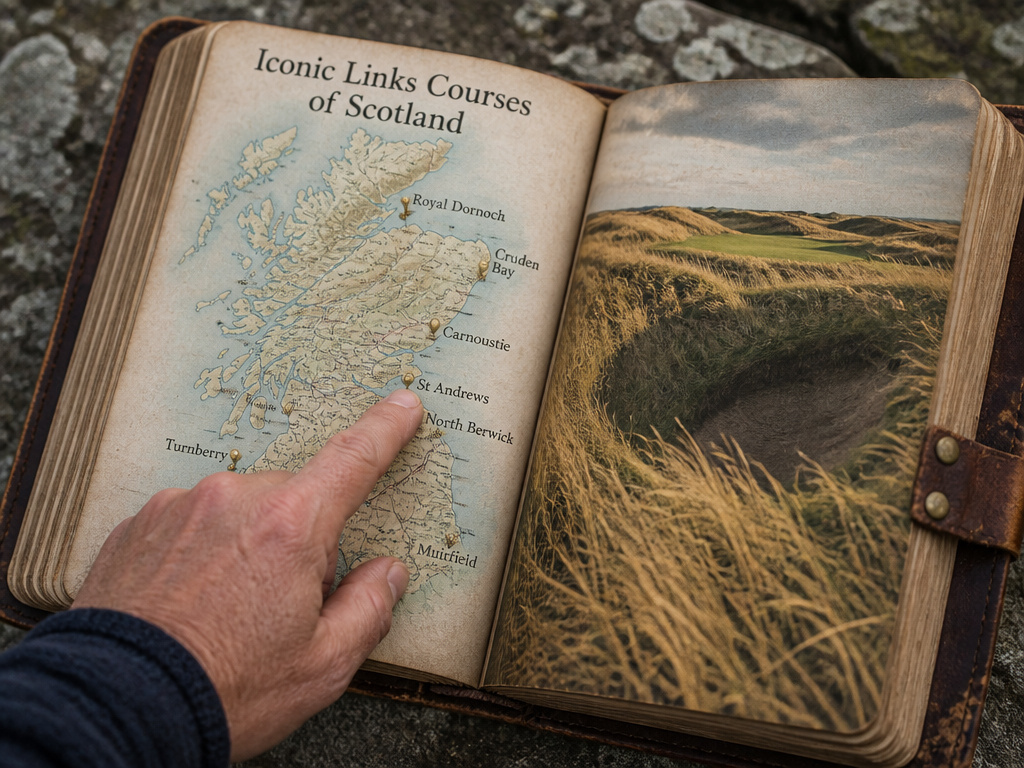
Every true links has its own personality, forged by its specific stretch of coast. These aren’t just bucket list courses; they are the chapters in the story of the game.
St Andrews (The Old Course) – The Prototype
The grandparent of them all. It looks flat on TV, but the ground is a rumpled blanket of humps, hollows, and hidden slopes. Strategy is everything. The double greens are vast, and the correct angle of approach is often more critical than distance. Playing it is a rite of passage, less about your score and more about solving its ancient, quirky puzzles.
Royal Dornoch – The Sublime Isolation
A three-hour drive north of Inverness, Dornoch feels like a pilgrimage’s end. The raised greens, built on natural dune plateaus, demand precise approach shots. The silence is broken only by the wind and birdsong. It’s remote, pure, and many connoisseurs’ number one. Its influence on Golden Age architecture in America is profound.
Muirfield – The Strategic Crucible
Home to The Honourable Company of Edinburgh Golfers, Muirfield is a thinking player’s links. Its unique clockwise front nine and counter-clockwise back nine mean you face the wind from a different direction on every hole. It’s less about dramatic dunes and more about impeccable, strategic design. It’s also famously private, making a start here a coveted achievement.
Carnoustie – The Brutal Test
Nicknamed “The Monster,” Carnoustie’s Championship course is the toughest Open venue. Its defense isn’t beauty but relentless, fair difficulty. The Barry Burn snakes across the closing holes, waiting to punish any lapse in concentration. It’s a brutal, honest examination where par is a glorious score.
The Ayrshire Coast Trio (Turnberry, Royal Troon, Prestwick)
This stretch of southwest Scotland is a concentration of greatness. Turnberry’s Ailsa Course is breathtakingly scenic, with the iconic lighthouse. Royal Troon offers the ultimate short-hole test with the “Postage Stamp” 8th. Prestwick, the original Open venue, is a charming, eccentric museum piece of blind shots and quirky hazards.
Other essential names include North Berwick (with its stone walls and famous “Redan” par-3), Kingsbarns (a modern masterpiece that feels ancient), and newer entries like Trump International Aberdeen, which carved a dramatic course through massive dunes. Each offers a different lens on the characteristics of links courses.
How to Actually Play (and Enjoy) a Links
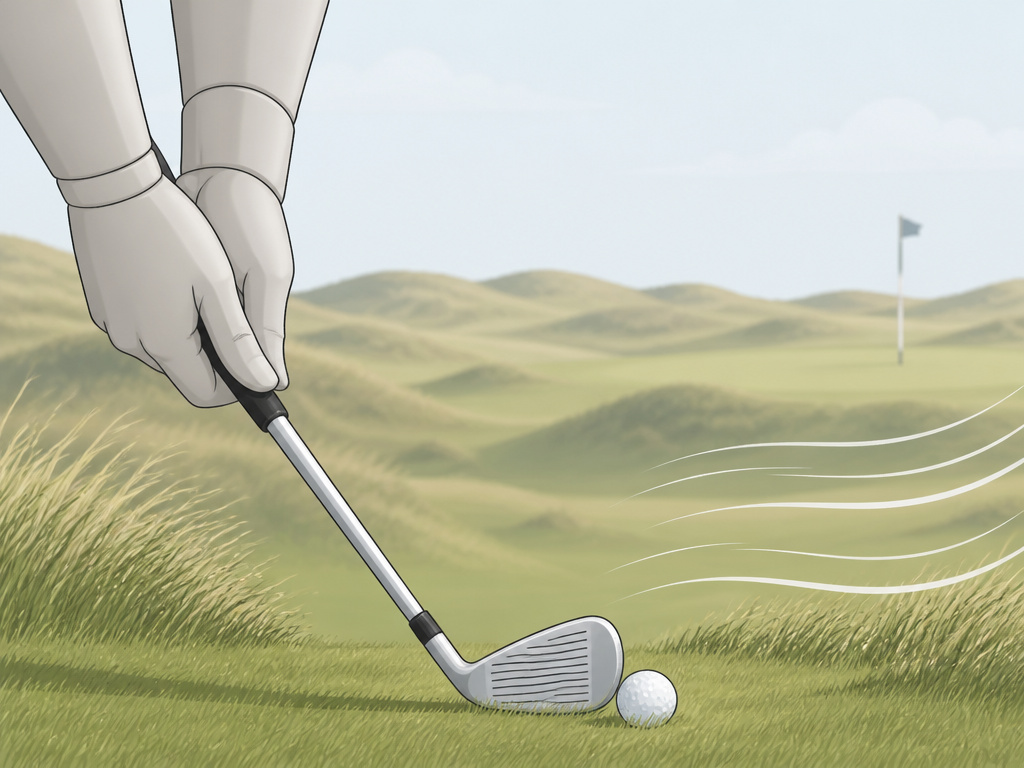
Arriving with your normal game is a recipe for frustration. To enjoy a links, you must adapt your expectations and your technique.
First, leave the high ball flight at home. Practice punch shots, knockdowns, and the bump-and-run. A 7-iron from 100 yards, hit with a three-quarter swing that stays below the wind, is a more valuable weapon than a full-swing wedge. Mastering these techniques for wind is essential.
Second, use your eyes during your practice round. Don’t just laser the flag. Walk up to the green to see where the slopes are. Find the collection areas. Identify the firm, brown patches of fairway that will give you extra run. The course tells you how to play it; you just have to listen.
Third, embrace the putter from off the green. From 30 yards out with a tight lie, a putter is often the safest, most consistent choice. The ball will bounce and trundle, but it won’t blade over the green or chunk into a bunker.
Common mistake: Getting angry at a “bad bounce.” On a links, there are no bad bounces, only unexpected ones. The ground is meant to be used. If your ball kicks 40 yards left off a slope into trouble, the mistake was likely the shot that put it on that slope, not the slope itself.
I learned this watching a client who had never taken a lesson. We were on a windswept practice ground, and he was fighting a slice. I set up a simple alignment stick on the ground. He watched his reflection in a car window, not the stick. In three swings, he’d straightened it out. He wasn’t thinking about mechanics; he was seeing the problem and letting his body react. Links golf rewards that kind of intuitive, reactive play. It’s about seeing the shot the land offers, not forcing the one you want.
Planning Your Links Pilgrimage
A trip to play these iconic links courses of Scotland requires more than booking tee times. It’s a logistical and strategic endeavor.
Geography is Key: Group courses by region to minimize drive times. The major clusters are: * St Andrews & Fife: Old Course, New, Jubilee, Kingsbarns, Carnoustie (nearby). * Ayrshire & the Southwest: Turnberry, Royal Troon, Prestwick, Western Gailes. * The Highlands: Royal Dornoch, Castle Stuart, Nairn. * The East Coast (Edinburgh/Lothians): Muirfield, North Berwick, Gullane.
The Tee Time Lottery: For the Old Course, you must enter the daily ballot 48 hours in advance or show up for the singles queue. For ultra-private clubs like Muirfield, you’ll need an introduction from a member or to book a guaranteed tee time through an authorized tour operator, which often includes a mandatory meal in the clubhouse.
What to Pack: Waterproofs (even in summer), layers for wind, shoes with good ankle support for dunes, and a glove for rainy days. Bring more golf balls than you think you’ll need. The rough eats them.
Mindset Adjustment: Your scores will likely be higher. That’s okay. The goal is the experience, the walk, the history, the battle with the elements. Celebrate the brilliant recovery, the putt that navigated three slopes, the par that felt like a birdie. It’s a different game.
Frequently Asked Questions
How many true links courses are there in Scotland?
There are 92 true links courses in Scotland, representing just 17% of the country’s total courses. This count is based on the strict geological and ecological definition of sandy, wind-formed land between sea and farmland.
What is the most famous links course in Scotland?
The Old Course at St Andrews is the most famous and influential links course in the world. As the common-ground prototype where the game’s standard 18-hole format evolved, it holds a unique status in golf history and hosts The Open Championship more than any other venue.
Can the public play the famous Scottish links courses?
Yes, most are publicly accessible, but access varies. The St Andrews Old Course uses a ballot and daily queue. Many classic links like Royal Dornoch, North Berwick, and Carnoustie are straightforward to book. A handful, like Muirfield, are private but allow visitor play on certain days, often through advanced booking or with a member’s introduction.
Why is links golf so different?
Links golf is different due to its firm, sandy turf and constant wind. The ball runs on the ground, demanding a low, running game and creative shot-making instead of high, aerial target golf. The weather and natural landforms are integral parts of the challenge, making each round unique.
What should I practice before a links golf trip?
Practice low-trajectory shots, bump-and-run chips, and putting from well off the green. Learn to hit a stable, penetrating ball flight with your irons and fairway woods. Most importantly, work on your mental game, patience and adaptability are the most important clubs in your bag on a links.
The Bottom Line
Scotland’s iconic links are a finite resource, 92 stretches of sacred, sandy ground where the game’s soul lives. Playing them isn’t about conquering them; it’s about understanding a language written in wind, turf, and contour. The trip will change your relationship with golf. You’ll stop looking for perfect conditions and start seeing the beauty in the battle.
One rule for the journey: if you find yourself in a fairway bunker, don’t try to be a hero. Take your medicine, wedge out sideways, and live to fight another hole. The links always wins the war of attrition. Your job is to savor the skirmishes, from the perfect drive on a firm fairway to the 30-foot putt that somehow, against all logic, finds the bottom of the cup. That’s the magic no famous championship courses in America can replicate. It’s the original, and it’s waiting.
