
Analyzing Jon Rahm’s Power and Technique: Hip Turn & Swing
This post contains affiliate links. As an Amazon Associate, we earn from qualifying purchases.
This post contains affiliate links. As an Amazon Associate, we earn from qualifying purchases.
Jon Rahm’s power and technique stem from a 30-degree hip turn, half the tour average, and a backswing that reaches parallel in 0.41 seconds, forcing elite power generation from his wrists and core instead of rotation. His swing is a direct adaptation to a congenital club foot that limits his right ankle mobility, making it a masterclass in building technique around physical reality, not an ideal model.
That 30-degree number is a structural limit that defines everything else. When your hips can’t turn past that point, the textbook long, flowing backswing is off the table.The swing you build from there has to find power somewhere else, and Rahm’s solution rewires the conventional kinetic chain.
What follows is a breakdown of the three layers: the physical constraint (the club foot and 30-degree turn), the mechanical adaptation (the short, fast snatch and the bowed wrist), and the power sources (wrist, core, shoulder) that deliver his 120-mph clubhead speed. This is about understanding how a world-class athlete builds a winning move from scratch.
Key Takeaways
- Rahm’s right leg is half an inch shorter with limited ankle mobility from a club foot, restricting his hip turn to just 30 degrees (PGA Tour average: ~45 degrees).
- He compensates with an extremely fast backswing, taking 0.41 seconds to get the shaft parallel, and a severely bowed lead wrist to shallow the club.
- Titleist Performance Institute data ranks his power generation as: 1. Wrist, 2. Core, 3. Shoulder, a complete inversion of the typical “big muscle” model.
- His technique is a case study in optimizing around a physical limitation, not forcing a “perfect” model. Trying to copy his wrist action without his hypermobile joints leads to inconsistency.
- The practical lesson is to identify your own mobility limits and build a repeatable swing around them, rather than chasing a flexibility you don’t have.
The Foundation: A Physical Constraint, Not a Choice
Jon Rahm’s swing doesn’t start with a thought. It starts with a right ankle that can’t fully dorsiflex.
He was born with a club right foot. Doctors casted his leg from the knee down within twenty minutes of his birth, and he returned for weekly treatments. The result is a right leg about half an inch shorter than his left, with severe limitations in ankle mobility. This is a structural, congenital limit.
“I didn’t take a full swing because my right ankle doesn’t have the mobility or stability to take it,” Rahm said. “If I take a full swing to parallel, it might create more speed, but I have no stability. My ankle just can’t take it.”
That missing ankle mobility directly caps his hip turn on the backswing. He can’t properly shift weight into his trail side and coil against it. According to Titleist Performance Institute (TPI) data collected by his coach Dave Phillips, Rahm turns his hips approximately 30 degrees on the backswing.
How Does Jon Rahm’s Hip Turn Compare to the Tour Average?
The tour average for hip turn is closer to 45 degrees. That 15-degree gap is the entire reason his backswing looks abbreviated. His body hits its anatomical stop sign halfway through what a typical pro would consider a full coil.
| Player / Group | Hip Turn (Backswing) | Primary Power Source |
|---|---|---|
| Jon Rahm | ~30 degrees | Wrist & Core |
| PGA Tour Average | ~45 degrees | Core & Ground Force |
| Amateur Average | Often over-rotates | Arms & Hands |
This is a parameter he’s built his entire swing around. Trying to “fix” his hip turn would be like asking a pitcher with a unique arm slot to throw over the top, you’d ruin the one thing that works.
The Mechanical Adaptation: Short, Fast, and Bowed
With his hips stopped at 30 degrees, Rahm’s swing has to generate speed and power in a much shorter window. His solution is a two-part move: extreme speed going back and an extreme wrist position at the top.
The Short, Fast Backswing
Forget “low and slow.” Rahm’s takeaway is a controlled snatch. TPI timing data reveals how drastic this is: * Shaft Parallel: Rahm takes 0.41 seconds to get the shaft parallel to the ground. The average amateur takes about 0.75 seconds. * Top of Backswing: He reaches the top of his backswing in 0.70 seconds total.
He’s moving the club into position almost twice as fast as a weekend player. This speed builds momentum early, so he doesn’t have to rely on a long, drawn-out coil to store energy. The feel is aggressive, but it’s a disciplined aggression, the club stays in front of his body because if it didn’t, the whole sequence would fall apart.
The Bowed Lead Wrist and Hypermobile Joints
At the top of his short swing, Rahm’s lead wrist is severely bowed (flexed). The clubface is shut, pointing almost at the ground. This looks like a hook machine to most instructors, but for Rahm, it’s the key to power and a shallow angle of attack.
Where this goes sideways: Trying to copy Rahm’s bowed wrist without his specific joint mobility. He describes his wrists as “hypermobile.” This natural flexibility lets him get into that extreme position without strain. A player with stiff wrists forcing that bow will likely lose all clubface control.
This wrist position does two critical jobs. First, it pre-sets the club in a “delivered” state, so he doesn’t have to rotate his forearms aggressively on the downswing, his body can just unwind. Second, it helps shallow the club. From that bowed position, the natural path of the downswing drops the club inside, promoting the powerful, high fade he prefers with his driver.
Power Generation: Wrist, Core, Shoulder
So where does the 120-mph clubhead speed and 307-yard average drive come from if not from a big hip turn? According to TPI co-founder Dr. Greg Rose, Rahm’s power generation follows a unique hierarchy.
Dr. Rose ranks Rahm’s power sources as: 1. Wrist 2. Core 3. Shoulder
This flips the conventional model on its head. Most instruction emphasizes ground force, then core, then arms. Rahm’s number one power source is his wrist joint’s ability to load and unload with incredible speed and force.
The Kinetic Chain in Action
His downswing is a masterpiece of sequencing within this constraint. He starts shifting pressure to his lead side before he finishes his backswing. This early transition means his lower body is already moving forward as his upper body completes the backswing, creating a powerful stretch between his hips and shoulders.
“I can’t stress enough how important it is to use your big muscles to unwind from the top and through impact,” Rahm has said. He’s talking about his core and shoulders. He rotates around a stable spine with tremendous speed, pulling the club through with his left side. The final release is that hypermobile wrist snapping through impact.
The feel isn’t of swinging his arms. It’s of his body rotating hard left and his arms being pulled along for the ride. Any time he thinks about actively moving his hands, he says his power “goes kaput.”
What Amateurs Can (and Can’t) Learn from Rahm
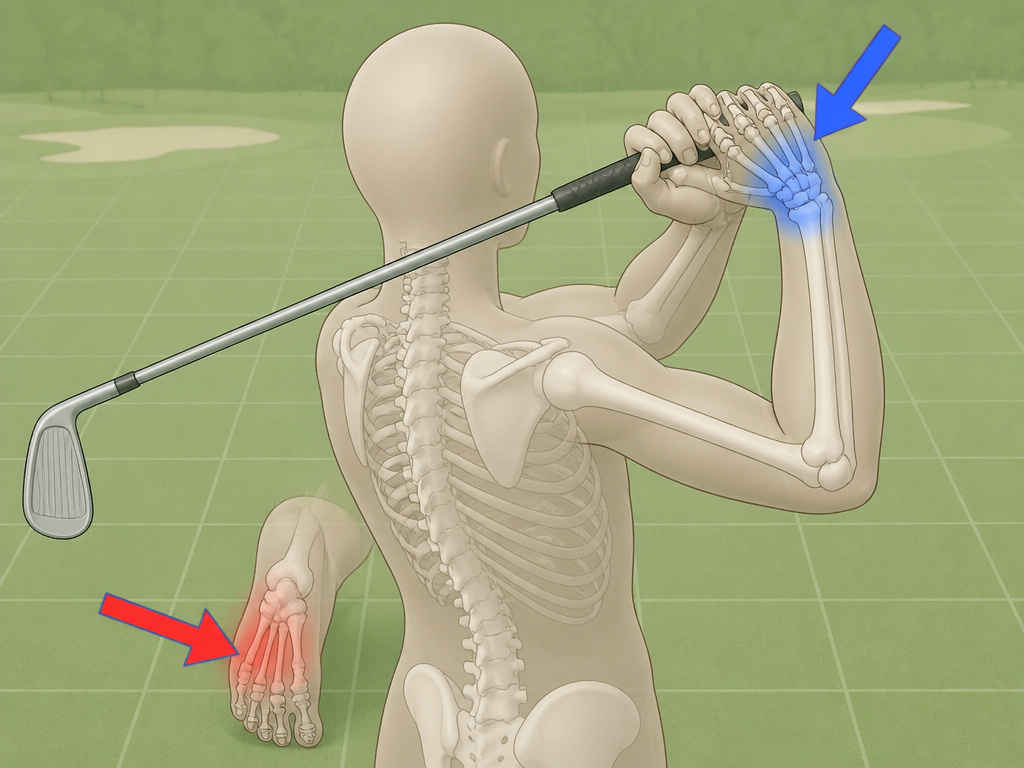 Rahm’s swing is a fascinating biomechanical study, but it’s a terrible template. Trying to directly copy his short backswing or bowed wrist is a recipe for disaster if you don’t share his specific physical traits, namely, his hypermobile wrists and his ankle-limited hip turn.
I once tried to teach a complex, wrist-heavy shot shape to a beginner who just wanted to hit the ball straight. It wasted the lesson. We spent 45 minutes on a feel he couldn’t replicate, when a simple grip change and stance adjustment would have given him the straighter ball flight he actually wanted. The moral applies here: don’t chase a pro’s solution to a problem you don’t have.
The Real Takeaway: Build Around Your Body
Rahm’s coach, Dave Phillips, didn’t try to force a textbook swing onto an atypical body. They identified the constraint (the ankle) and built a technically sound, powerful motion that worked within it.
“If he tried to have a long swing like Dustin Johnson, he would probably come out of his posture,” Phillips noted. So they didn’t try.
For you, the process is the same: 1. Identify your limit. Is it tight shoulders? Poor hip mobility? A stiff lower back? Be honest. 2. Stop fighting it. If you can’t turn your shoulders 90 degrees, stop trying. You’ll only sway or come out of posture. 3. Find your power elsewhere. If your turn is limited like Rahm’s, you might need to focus on a faster arm swing or better wrist hinge. If you lack wrist mobility, you’ll need to generate more speed from your core rotation and proper weight shift.
Good golf should feel less complicated the more you understand it. Understanding Rahm’s swing simplifies one thing: technique is not one-size-fits-all. Your best swing is the one that works reliably with the body you have today.
The Equipment Question
 Rahm’s technique influences his equipment choices, particularly in creating his preferred high, low-spin fade. While he uses tailored tour gear, amateurs can learn from the principles.
A player who struggles with generating clubhead speed might benefit from the forgiveness of a modern 3-wood off the tee, rather than forcing a driver. Those looking for Rahm-like stopping power into greens without his elite spin control might find a 60-degree wedge essential. For most recreational players, building a consistent game starts with finding the right best amateur golf clubs that offer forgiveness on mishits, which are far more common than Rahm’s.
His power through the bag also highlights the utility of hybrids. A 4-hybrid or 5-hybrid can be easier to launch and control than the equivalent long iron, making it a smarter choice for players who don’t have Rahm’s strength and strike consistency.
Frequently Asked Questions
Is Jon Rahm’s short backswing a disadvantage?
No, it’s a necessary adaptation that he has turned into an advantage. His backswing is short because his right ankle mobility prevents a fuller hip turn. By making his backswing fast and efficient, he maintains posture and consistency, which are more valuable than a longer, less controlled swing.
Can I increase my power by copying Rahm’s bowed wrist?
Almost certainly not. Rahm has naturally hypermobile joints that allow this extreme position. For most players, forcing a bowed wrist leads to a shut clubface and hooks, or a complete loss of power as they tense up trying to hold the position. Power comes from sequence and speed, not a static position at the top.
How does Rahm hit it so far with such a short swing?
He generates elite speed from his wrists and core rotation, sequenced perfectly. His downswing starts with his lower body before his backswing finishes, creating a powerful kinetic chain. The short swing is a byproduct of his hip turn limit, not the reason for his distance; the distance comes from how explosively he uses the mobility he does have.
What is the main lesson from Jon Rahm’s golf swing?
The main lesson is to build your swing around your body’s unique strengths and limitations, not an idealized model. Work with what you have. If you’re inflexible, don’t chase a huge shoulder turn, focus on a compact, connected motion you can repeat. A repeatable swing built on your reality will always beat an inconsistent swing built on a fantasy.
The Bottom Line
Jon Rahm’s power and technique analysis reveals a swing built from the ground up around a physical fact. The 30-degree hip turn, the 0.41-second backswing, the wrist-driven power, they’re all connected solutions to the same structural problem.
For you, the actionable insight is in the process. Find your own “30-degree limit.” It might be in your shoulders, your hips, or your back.Then, like Rahm and his coach did, stop seeing it as a flaw to be fixed. See it as a design parameter. Build your swing’s reliability and power within that fence. That’s how you move from chasing tips to owning a game.
The clubs you choose should support that philosophy. Whether it’s forgiving amateur irons or easy-to-hit hybrids like a 7-hybrid, equipment should make your inherent motion more effective, not force you into a different one. That’s the real secret behind any elite player’s bag, and it’s the same logic that built Jon Rahm’s swing.
