
Your Golf Swing Starts Here: The Essential One Piece Takeaway
This post contains affiliate links. As an Amazon Associate, we earn from qualifying purchases.
This post contains affiliate links. As an Amazon Associate, we earn from qualifying purchases.
A one piece takeaway in golf means the chest, arms, and club start the swing together as a single connected unit for the first foot of motion. The goal is a synchronized start where the body turns the club back, not the hands, keeping the clubface stable and building width. This connection must hold until the shaft is parallel to the ground, the position coaches call P2.
That “single unit” phrase is what most golfers get wrong. They lock up, trying to keep everything rigid from address to the top. The reality is more subtle. A true one-piece move is about the sequence of initiation, not a frozen posture. It’s the difference between a yanked, narrow backswing and one that builds power effortlessly.
What follows breaks down the real mechanics, the non-negotiable P2 checkpoint, and a three-week plan to groove it. You’ll also see where the standard advice fails golfers with limited mobility, and why fixing your takeaway often solves swing faults that appear much later.
Key Takeaways
- The “one-piece” feel only applies for the first 12–18 inches of the backswing, until the shaft reaches parallel (P2). Trying to maintain it longer creates a stiff, flat swing.
- A correct takeaway is initiated by the torso turning, not the hands pulling. The club should move because your body turns, not because your arms push it.
- The primary checkpoint is P2: shaft parallel to the target line, clubface matching your spine angle (roughly toe-up), hands in front of the chest, and the address triangle intact.
- Pulling the club inside is the most common fault, often caused by standing too close, closed shoulders, or tight grip pressure, fix the setup before drilling the takeaway.
- Golfers with restricted upper-back mobility may need to adapt with an earlier wrist hinge; a shorter, connected backswing beats a longer, disconnected one every time.
What is a One-Piece Takeaway?
Forget the image of a stiff, robotic move. A one-piece takeaway is a principle of connection and sequence, not about locking your joints. The chest, arms, and club start back together, moving at the same speed for roughly the first foot of motion.The club moves because the torso turns, not because the hands yank it away.
A true one-piece takeaway keeps the chest, arms, and club moving together so the clubface stays stable and the swing stays organized. This synchronized start only applies until the shaft is parallel to the ground (P2); after that, the wrists must hinge naturally.
The magic happens in the first 18 inches. Get this part right, and the rest of the backswing often organizes itself. Get it wrong, and every subsequent position becomes a compensation. The goal is to control the first variable: clubface orientation. A face that rolls open or shut immediately forces a recovery move later, which is where slices and hooks are born.
Where this goes sideways: Trying to keep the “one-piece” feel all the way to the top. This creates a stiff, all-arms swing with no wrist hinge, resulting in a flat backswing and a complete loss of power. The connection stops at P2.
Why the One-Piece Takeaway Works (The Why-Layer)
It works because it enforces good physics from the very first millisecond. When the body leads, three critical things happen automatically.
First, it creates width. By initiating with the torso and keeping the hands passive, your arms are pushed away from your body. This maintains a wide radius in your swing arc. A wider arc means the clubhead has to travel a longer path in the same amount of time, which translates directly to more clubhead speed with less effort. It’s why a short, wide swing often hits the ball farther than a long, narrow one.
Second, it keeps the club on plane. Most off-plane backswings are off-plane from the very first inch. A connected, torso-driven start naturally guides the club along the proper inclined plane. You don’t have to steer it.
Third, it establishes the correct sequence: big muscles first. The downswing’s power comes from the ground up, with the big muscles leading and the small ones following. Starting the backswing with the torso sets that same pattern in reverse. If you start back with your hands, you’ll almost certainly start down with them too, which is the classic over-the-top move.
How to Execute a One-Piece Takeaway: The P2 Checkpoint
Every good takeaway is judged at P2, the moment the clubshaft is parallel to the ground and around hip height. This is your only objective feedback point before the swing gets too fast to see. Ignore feel here; film it.
| Checkpoint at P2 | What It Looks Like | What Goes Wrong |
|---|---|---|
| Shaft Direction | Points parallel to your target line. | Points across your toes (too inside) or out toward the ball (too outside). |
| Clubface Angle | Matches your spine angle (roughly toe-up). | Faces the sky (shut) or the ground (open). |
| Hand Position | Remain in front of the chest, not behind the trail hip. | Hands get “stuck” behind the body as the club is pulled inside. |
| Triangle Integrity | The triangle formed by your arms and shoulders at address is still intact. | The lead arm collapses or the elbows separate, breaking the connection. |
To hit this position, your thought should be “turn your back to the target,” not “swing the club back.” A small forward press or knee kick can help initiate the movement without snatching. The takeaway should be smooth, not artificially slow. An artificially slow start often causes a jerky, rushed transition at the top.
Common mistake: Rolling the forearms early. This opens the clubface and pulls the club sharply inside. From there, the club has to be lifted steeply, leading to a disconnected top position and an over-the-top downswing. If your clubhead disappears behind your hands by P2, you’ve done this.
Drills to Train a Better Takeaway
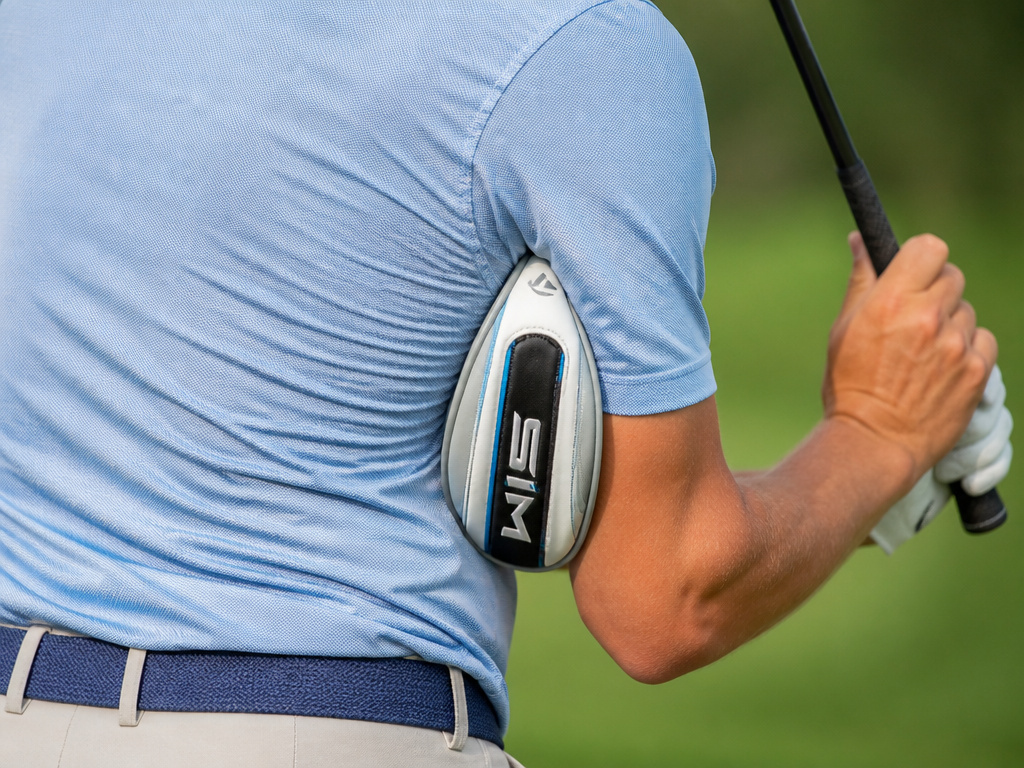
Theory is useless without a way to feel it. These drills create the physical constraints that force a proper one-piece sequence.
The Headcover Connection Drill
Tuck a headcover under your lead armpit (left armpit for right-handed golfers). Make slow backswings to the P2 position. If the headcover drops, your lead arm has separated from your chest, you’ve lost connection. This is the classic drill for a reason. It gives instant, tangible feedback on the arm-chest relationship that’s at the core of the one-piece move.
The Alignment Stick Guide
Lay an alignment stick on the ground parallel to your target line, just outside your ball line. During slow-motion rehearsals, focus on having the clubhead track just above that stick for the first 18 inches. This gives a visual reference to combat the instinct to pull the club inside. It turns an abstract “on-plane” idea into something you can see.
The Towel Drill (Advanced Connection)
For a deeper feel, place a rolled towel under both armpits. This connects both arms to the torso, promoting a truly unified turn. It feels restrictive at first, which is the point. It prevents independent arm run-off and teaches you to create width with your turn, not your arm swing.
Worth knowing before you start: These are slow-motion, feel-building drills. Hit balls with them only after the movement is ingrained at slow speed. Trying to add power while learning a new pattern guarantees a relapse into old habits.
One-Piece vs. Early Hinge: Adapting for Your Body
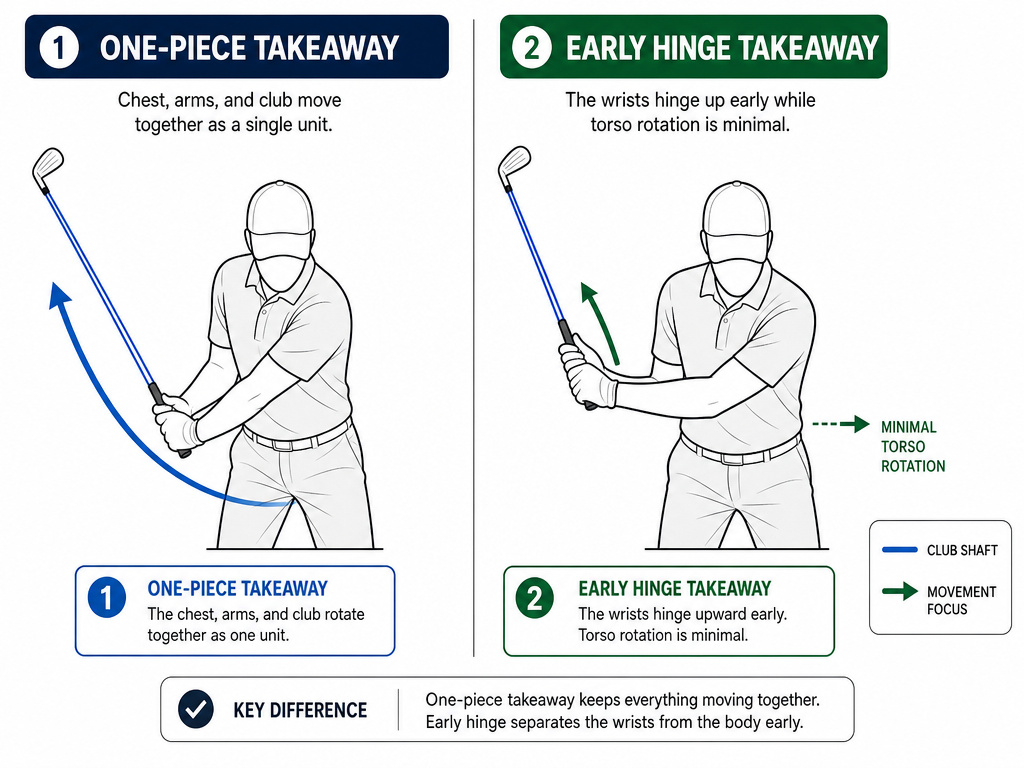
The one-piece takeaway is a method that assumes you have reasonable mobility in your thoracic spine (upper back), not a universal law. For many senior golfers or players with restricted rotation, forcing a one-piece move can create more problems than it solves.
| Takeaway Style | Best For | Key Feel | Potential Drawback |
|---|---|---|---|
| One-Piece | Golfers with good flexibility and a full turn. | Chest, arms, club move together; wrists passive early. | Can feel restrictive and lead to a lack of width if rotation is limited. |
| Early Wrist Hinge | Players with restricted rotation who need to generate speed with less turn. | Wrists set the club earlier, creating a steeper, more compact swing. | Can lead to a narrow arc and over-reliance on hand speed if overdone. |
If you can’t make a full shoulder turn without straining, an earlier hinge might serve you better. It allows you to set the club in a shorter motion, using wrist action to compensate for limited turn. The key is to pick one style and commit. Drifting between a one-piece feel and an early hinge from shot to shot is a prime cause of inconsistent strike.
This is where understanding your own backswing sequence is critical. Knowing how your body naturally wants to move can help you choose the right takeaway model.
Common Faults and Their Hidden Causes
Most takeaway errors are symptoms, not the root disease. Fixing the takeaway drill without addressing the underlying cause is like putting a bandage on a broken arm.
- Pulling the Club Inside: This is often caused by standing too close to the ball. If your arms are crowded at address, they have nowhere to go but inside. Check your distance first, it’s the most common hidden culprit. Other causes include a ball position too far back, closed shoulders at address, or grip pressure that’s too tight.
- Losing Connection: The arms swing independently of the chest from the start. This usually traces back to a misunderstanding of the “one-piece” concept, leading to active, tense arms instead of passive ones carried by the turn.
- Rolling the Face Open: Excessive forearm rotation in the first move. A small amount is natural, but an active twist is a death sentence for face control.
Often, the best “takeaway drill” is no takeaway drill at all. It’s a setup check. An alignment stick across your shoulders and feet can reveal a closed stance you never felt. Fixing that can clean up the inside path instantly.
Many of these persistent issues stem from common swing errors that are repeated as gospel. Questioning the basics is the first step to fixing them.
A Three-Week Plan to Groove Your Takeaway
Building a new motor pattern takes focused, patient work. This plan prioritizes quality of repetition over mindless ball-beating.
Week 1: Position Without Pressure
- Task: Rehearse the takeaway to P2 and stop. Do this 50 times a day, without a ball.
- Tool: Use a mirror or film every few reps. Compare your P2 to the four checkpoints in the table above. The goal is to build the correct position without any anxiety about hitting a ball.
Week 2: Add Connection, Then Contact
- Task: Perform the headcover drill. Hit half-swings and three-quarter shots with the headcover tucked in place.
- Focus: If the headcover drops, you disconnected. Start over. The ball flight is irrelevant this week; the connection is everything.
Week 3: Integrate and Trust
- Task: Hit full swings, but only think about the first 18 inches. Film your first few swings to verify your P2 matches Week 1.
- Goal: After verification, hit shots without any conscious takeaway thought. If you have to think about it on the course, it’s not yet grooved. This is when tools like swing analyzers can provide the objective feedback you need to trust the change.
Frequently Asked Questions
Does the one-piece takeaway apply to chipping and putting?
Yes, arguably more so. The stroke is so short that the takeaway is most of the motion. In putting, the one-piece principle is essential: shoulders rock, wrists stay passive. Active hands in a putting stroke are the biggest cause of inconsistent speed control. For chips, a connected takeaway ensures a consistent low point. Most thinned or chunked chips come from the wrists breaking down immediately.
I have a strong grip. Can I still use a one-piece takeaway?
Absolutely. Grip strength affects the appearance of the clubface at P2, not the connection. With a strong grip, the face will look more “shut” (toe more toward the sky) at P2, which is normal and correct for that grip. Don’t try to rotate it to look “toe-up” if that’s not your baseline.
Why does my takeaway feel exaggerated but look correct on video?
Because feel is not real, especially for parts of the swing you can’t see. A takeaway that feels dramatically outside is often just neutral. This gap between feel and reality is why filming your swing, even with a phone, is non-negotiable for improvement. What feels like a massive change is usually a minor adjustment.
How does this relate to one-plane or two-plane swing techniques?
The one-piece takeaway is a component that feeds into both. It’s about the initial connection, which is vital for the consistency of a one-plane swing and provides a stable base for the more arm-driven two-plane swing. A good takeaway simplifies whichever overall technique you use.
The Bottom Line
Stop thinking of the one-piece takeaway as a rigid rule. It’s a tool for synchronization. Its job is to get your clubface, swing path, and body sequence talking to each other from the very start.
Work in order. Check your setup first, standing too close will pull the club inside no matter how perfect your drill. Rehearse to P2 without a ball until it looks right on video. Then add a headcover, then add balls, then add speed.
And be honest about your body. If you lack the turn, an earlier wrist hinge isn’t a failure; it’s a smart adaptation. A shorter, connected backswing will always outperform a longer, disconnected one. The goal is a repeatable, powerful move that starts with eighteen inches of quiet intention, not a textbook picture.
