
Master Repairing Divots and Pitch Marks for Course Health
This post contains affiliate links. As an Amazon Associate, we earn from qualifying purchases.
This post contains affiliate links. As an Amazon Associate, we earn from qualifying purchases.
Repairing divots and pitch marks correctly requires matching three things: the right tool, the proper technique, and an understanding of the turf’s recovery timeline. A properly repaired ball mark on creeping bentgrass heals in 16 to 21 days. An improperly repaired mark needs more than 38 days, leaving a scar on the green for an extra two weeks.
That recovery gap is the whole game. It’s not about aesthetics. A green with lingering damage pushes putts offline and frustrates every player behind you. The difference between a quick heal and a long scar comes down to a specific hand motion and knowing when to replace turf versus when to just add seed.
What follows is the breakdown of tools, the step-by-step fix that superintendents actually use, and the one rule change that lets you repair almost any damage on the green. You’ll also see why fall divots are a special case and what most televised pros get wrong.
Key Takeaways
- A twist-and-up motion around the crater’s edge repairs a pitch mark without tearing roots; pulling straight up kills the turf.
- Ball marks repaired properly heal in 16–21 days; improper technique more than doubles recovery time to over 38 days.
- On fairways, replace a divot if the turf and soil are intact; if it’s shattered, use a sand-and-seed mix.
- Fall divots without seed can take 10 months to recover; mixes with Chewings fescue seed cut that to 3–4 weeks.
- Under USGA Rule 13.1c(2), you can repair almost any damage on the putting green except aeration holes and natural wear.
The Right Tool for the Job
Your tool choice changes the repair’s speed and the turf’s final surface quality. It’s not about having a fancy gadget. It’s about matching the tool’s physical action to the grass’s growth pattern.
The classic divot repair tool with two metal prongs is the default. Studies call this the traditional tool (TT), and it’s about 3 cm long. When used correctly—inserting the prongs at an angle and twisting—it works. The Greenfix Wizard is a newer design with a different head shape. One 2005 comparison found ball marks repaired with it recovered about four days faster than those fixed with a traditional tool. But the same study noted the Greenfix could leave a slightly uneven surface for the first few days.
The Common Mistake: Digging the tool in vertically and levering straight up. This is the move you see on TV. It pulls and severs the grass roots, which is why those repairs often die and leave a brown spot.
You don’t need a specialized tool. A standard wooden golf tee works. So does a car key or a pencil. Mark Patterson, a superintendent quoted in a Golf.com guide, says the technique matters more than the implement. The Pebble Beach Golf Links staff even uses a custom tool: an ice pick on one end and a half-inch hollow tine on the other for precise work.
For fairways, you need a divot mix. The best mixes for fall repair include Chewings fescue seed. Research in the International Turfgrass Society journal shows that without this seed, a fall divot on Kentucky bluegrass might not reach 50% cover for over ten months. With the seed, it heals in three to four weeks.
| Tool / Material | Best Use | Key Limitation |
|---|---|---|
| Traditional Fork Tool | General pitch mark repair | Requires proper angle to avoid root tear |
| Greenfix Wizard | Faster recovery on bentgrass | Can create temporary surface unevenness |
| Wooden Golf Tee | Emergency repair | Less leverage for large marks |
| Sand & Seed Mix (with Chewings fescue) | Fall fairway divots | Ineffective without seed in dormant season |
The Step-by-Step Fix (And What Breaks It)
The technique is a single motion repeated around a circle. Get it wrong, and you add weeks to the healing process.
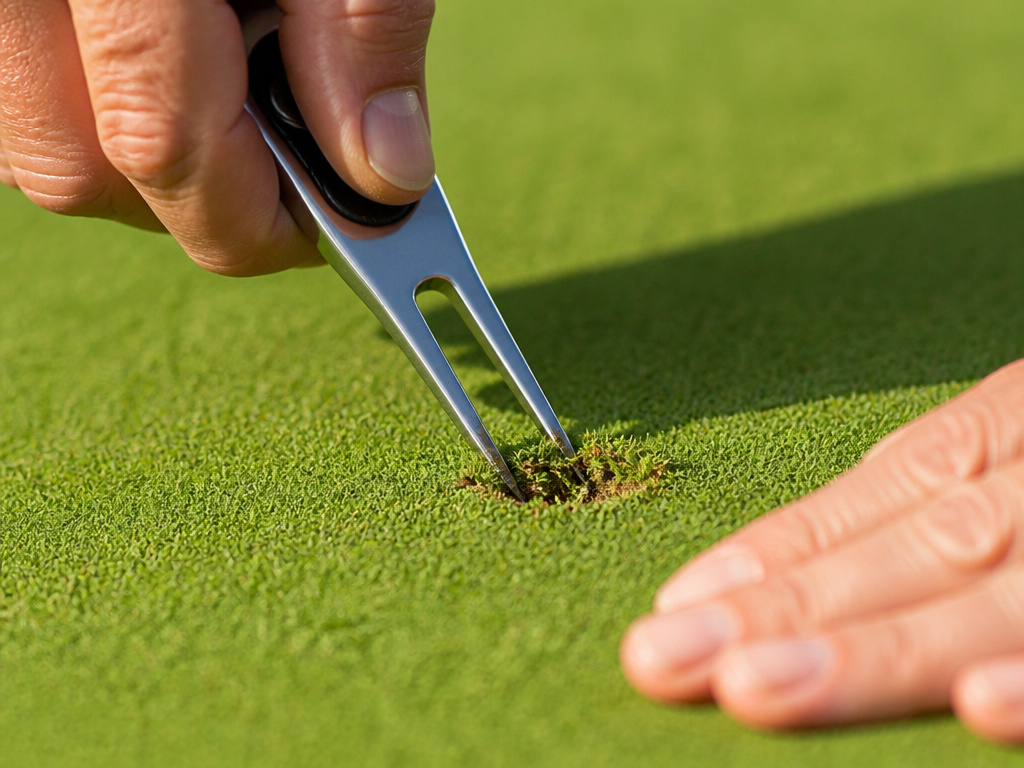
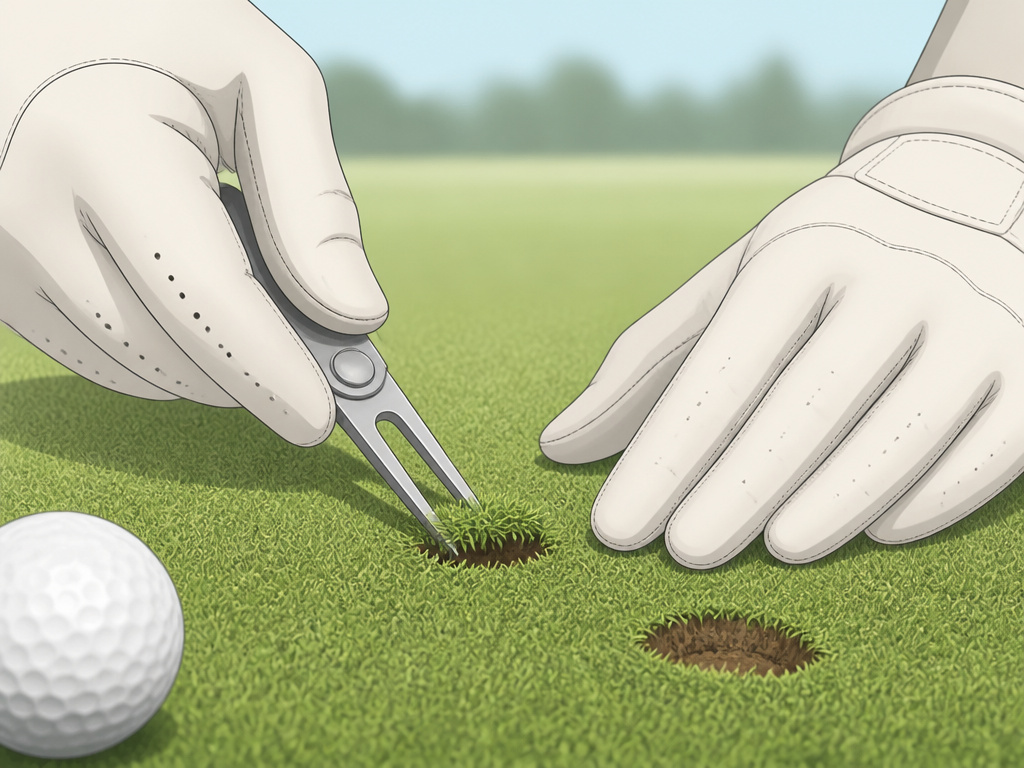
Step 1: Insert at the edge. Place your tool’s prongs into the grass on the high side of the crater, where the turf is pushed up. The angle should be about 45 degrees, pointing toward the center of the depression. Stabbing straight down is the first error.
Step 2: Twist and lift. Use a gentle “twist-and-up” motion to pull the surrounding turf toward the center. You’re coaxing the displaced grass back into place, not excavating. If you hear a tearing sound, you’re pulling too hard.
Step 3: Work the circle. Move around the pitch mark, repeating the insert-and-twist. Do this three or four times until the crater is filled and the surface is level.
Step 4: Tamp gently. Use your putter’s sole to lightly tap down any raised tufts. Don’t smash it flat. You want firm soil contact for the roots, not compacted dirt.
Skip step two’ twist, and you’re just digging. The 2005 conference abstract from Kansas State is blunt: improper use of a traditional tool resulted in the poorest surface quality and recovery times exceeding 38 days. Proper use cut that to 21 days or less.
I’ve watched players repair a mark, walk away, and see the center pop back up like a bad mattress button. That’s the sign of a vertical pull. The roots are torn, and the turf has no anchor. It browns out within a week.
Fairway Divots: Replace or Fill?
A fairway divot is a different injury. The force of a club takes a full chunk of turf and soil. Your response depends on the chunk’s condition.
Replace the divot if the piece is intact. Find the divot chunk. If the grass and soil are still holding together, place it back in the hole. Step on it firmly to ensure root-to-soil contact. This is the fastest path to recovery.
Fill the hole if the divot is shattered. When the chunk disintegrates, use the sand-and-seed mix provided on the course. Pour the mix into the hole until it’s slightly mounded above the surrounding turf. Do not tamp it down. The mix will settle with rain and mowing.
The USGA’s “repair or replace” guidance hinges on this intact-versus-shattered distinction. Filling a shattered divot with mix is better than trying to puzzle together broken pieces.
Why does the mix work? It protects the exposed soil, prevents erosion, and gives new grass a medium to grow. The seed in the mix is critical, especially as seasons change.
The Seasonal Trap
A divot repaired in late fall faces winter dormancy. A study on Kentucky bluegrass tees found that divots filled with a standard mix (no seed) in the fall took 280 days or more to reach 50% turf cover. The grass simply couldn’t establish before winter halted growth.
The same study found that adding Chewings fescue seed to the mix changed everything. Fall divots with this seed reached acceptable cover in 21 to 28 days. The fescue establishes quickly and survives the cold, giving the bluegrass a nurse crop until spring.
| Season | Action | Recovery to 50% Turf Cover |
|---|---|---|
| Summer | Unrepaired Divot | ~70 days |
| Summer | Filled with Sand/Seed Mix | ~84 days |
| Fall | Filled with Mix (No Seed) | ≥280 days (Unacceptable) |
| Fall | Filled with Mix (With Chewings Fescue Seed) | 21–28 days (Acceptable) |
What You’re Allowed to Fix Now
 The rules used to be restrictive. You could only fix ball marks and old hole plugs on the green. Not anymore.
USGA Rule 13.1c(2) was a major modernization. Now, on the putting green, you can repair almost any damage. This includes spike marks, shoe damage, scrapes from flagsticks, and animal footprints. The goal is to let you restore the green’s surface for a fair putt.
You cannot repair natural imperfections like weeds, bare spots from disease, or normal wear. Aeration holes are also off-limits. But if the damage is man-made or incidental, your divot repair tool is your ticket to a smoother roll.
This rule change shifts the mindset. You’re not just fixing your own mess. You’re actively improving the green for everyone in your group and the groups that follow. It turns repair from a chore into a core part of golf course etiquette.
Why Repair More Than One?
 This is the simplest way to improve a course and your pace of play. You create a few pitch marks per round. The average foursome might create a dozen.
Fix yours, then fix one or two others. While your partner is lining up a putt, look for an old, unrepaired mark nearby and fix it. A pitch shot that lands on a scarred green is harder to control. A putt rolling over a dead spot wobbles.
Leaving the course better than you found it isn’t a platitude. It’s a direct investment in the quality of your own next shot and the experience of every player behind you. Superintendents notice the groups that do this. The course conditions improve for everyone.
Where this goes sideways: Assuming the maintenance crew will fix it later. They mow, water, and fertilize. They cannot hand-repair hundreds of daily ball marks. That’s the player’s job.
Frequently Asked Questions
What’s the fastest way to repair a pitch mark?
Insert your tool at a 45-degree angle on the high side of the depression. Use a “twist-and-up” motion to pull surrounding turf toward the center. Work around the mark, then tamp gently. This method, per turf studies, leads to complete recovery in as little as 16 days.
Can I use a golf tee to fix a ball mark?
Yes. A wooden golf tee is an acceptable tool. Use the same technique: insert the tee’s point at an angle into the grass surrounding the crater and twist to pull the turf inward. The tee’s sharp point can work well for smaller marks.
How long does it take for a repaired divot to heal?
Healing time depends on the season, grass type, and repair quality. A properly repaired ball mark on bentgrass heals in 16–21 days. A fairway divot filled with a quality sand-and-seed mix in the growing season might show grass in 3–4 weeks. Fall divots without seed can take over 10 months.
What is the new rule about repairing damage on the green?
Under USGA Rule 13.1c(2), you may repair almost any damage on the putting green, including spike marks, shoe damage, and scrapes. You cannot repair aeration holes, natural imperfections, or wear from normal play. This rule empowers players to improve the surface before putting.
Why did my repaired pitch mark turn brown?
It turned brown because the roots were torn during repair. The most common cause is inserting the tool vertically and pulling straight up. This severs the grass plants from their root system. The turf dies from lack of water and nutrient uptake, leaving a dead spot that must recover from the edges.
The Bottom Line
Repairing divots and pitch marks is a mechanical skill with a biological timer. The right twist of a tool saves the green two weeks of healing. Replacing a clean divot is always faster than waiting for seed to grow. And now, the rules let you fix the spike mark that’s in your line.
Keep a divot repair tool in your pocket. Use the twist, not the lift. Fill shattered divots with the provided mix. If you’re playing in the fall, hope the course uses a mix with Chewings fescue seed. Do that, and you’ve done your part. The course stays better for your next round, and the one after that.
