
How Shaft Weight Impacts Swing Speed | A Data-Driven Guide
This post contains affiliate links. As an Amazon Associate, we earn from qualifying purchases.
This post contains affiliate links. As an Amazon Associate, we earn from qualifying purchases.
The shaft weight and swing speed relationship is real but skill-dependent. For a 7-iron, a 77g shaft produced higher clubhead and ball speeds than a 114g shaft in a 2024 study. Low-handicap golfers gained more total distance from lighter shafts, while high-handicap players saw less benefit. Shaft weight does not alter fundamental swing mechanics or weight shift patterns.
That speed gain from a lighter shaft is the easy part. The harder question is whether that extra mile-per-hour actually translates to more yards for you, or if it just amplifies your existing swing flaws. The research points to a split: better players convert weight savings into controlled power; higher handicaps often leak that energy into inconsistent contact.
What follows: the exact numbers from the latest iron study, why your handicap changes the equation, and where the old rule of thumb about swing weight falls short. By the end, you’ll know whether chasing a lighter shaft is your next move or a distraction.
Key Takeaways
- A 77g 7-iron shaft generated significantly higher clubhead and ball speed than a 114g shaft in controlled testing. The 98g shaft sat in the middle.
- Low-handicap golfers (around a 4 index) gained meaningful total distance with the lightest shaft. High-handicap golfers (around a 29 index) saw less consistent distance gains.
- Shaft weight did not change golfers’ swing kinematics, things like torso rotation or weight shift stayed the same regardless of the club in their hands.
- The concept of swing weight (a club’s balance point) is not a reliable predictor of clubhead speed, according to other research.
- For drivers, the relationship is murkier; some studies show golfers don’t adjust predictably to added mass, making iron data a cleaner starting point.
What the 2024 Iron Shaft Study Actually Found
Forget generic advice. A study published in Frontiers in Bioengineering and Biotechnology in 2024 put specific numbers on the table. Researchers fitted golfers with three different 7-iron shafts: a light N.S. PRO Zelos 7 (77g), a medium N.S. PRO 950 GH (98g), and a heavy N.S. PRO Modus 3 120 (114g). Every other variable, the PING G425 clubhead, shaft length, flex, and grip, was locked down.
The results were clear on speed. The lightweight shaft won.
The 77g shaft produced a significantly higher clubhead speed than the 114g shaft. The 98g and 114g shafts produced significantly higher ball speeds than the 114g shaft. This held true across both skill levels tested.
This wasn’t a tiny margin. The data shows a direct, measurable effect: less mass to swing through the hitting zone lets the club move faster, which smashes the ball harder. It’s basic physics, finally confirmed with golf clubs in a lab.
But speed is only one piece. The study also tracked whether a lighter club made people swing differently. It did not. Maximum torso rotation, wrist hinge, and weight shift patterns remained statistically identical across all three shafts. The golfers simply swung their normal swing, just a bit faster with the lighter tool.
| Shaft Weight | Avg. Clubhead Speed | Avg. Ball Speed | Key Takeaway |
|---|---|---|---|
| 77g (Light) | Highest | Highest | Delivers the most speed. |
| 98g (Medium) | Middle | Middle | A common compromise weight. |
| 114g (Heavy) | Lowest | Lowest | May feel more stable but costs speed. |
That last point is critical. A lighter shaft isn’t asking you to learn a new move. It’s leveraging the swing you already have. If your mechanics are sound, you get free speed. If they’re not, you get the same flaws, just faster.
The Skill-Level Split That Changes Everything
Here’s where the simple story gets complicated. The speed boost from a light shaft doesn’t translate into extra yards equally for everyone. The same 2024 study revealed a stark divide based on handicap.
Low-handicap golfers (averaging a 4.3 index) didn’t just hit the ball faster with the 77g shaft; they hit it farther. Their total distance was significantly longer with the light shaft versus the heavy one. For them, the extra speed converted directly into performance.
High-handicap golfers (averaging a 29.1 index) also saw a ball speed bump, but their total distance gains were inconsistent and not statistically significant. The extra clubhead speed often resulted in less efficient impact, think slightly off-center hits, so the ball didn’t carry as far as the speed numbers might suggest.
Where this goes sideways: Assuming a lighter shaft is an automatic distance fix. For a high-handicap player, that new speed can magnify strike inconsistencies, turning potential gain into scattered results.
Why the split? It comes down to swing control and delivery. A better player has the mechanics to channel that extra speed into the center of the face, launch it at an efficient angle, and control spin. The study noted the low-handicap group had significantly greater upper torso rotation and a larger X-factor (the separation between shoulders and hips), giving them a more powerful, repeatable engine to begin with.
For a fitting, this means the question isn’t just “Are you fast or slow?” It’s “Can you use speed well?” If you’re fighting a slice or hitting it all over the face, solving those issues will net you more yards than any shaft-weight tweak. A heavier shaft might even help by slowing things down and promoting tempo.
Shaft Weight vs. Swing Weight: Untangling the Confusion
You’ll hear “swing weight” thrown around in every fitting bay. It’s not the same thing. Total shaft weight is a measure of pure mass, usually in grams. Swing weight is a measure of a club’s balance point, how heavy the head feels relative to the grip. It’s expressed on an alphanumeric scale like D2 or C9.
A critical piece of research noted that swing weight, while related to feel, shows no correlation with dynamic clubhead speed. You can have two clubs with the same swing weight (D2) but wildly different total weights, one with a 55g shaft, one with a 75g shaft. The lighter total weight club will almost always be easier to swing fast, regardless of their matching swing weight codes.
“Swing-weight is not a good predictor of clubhead speed and shows no correlation with dynamic performance.”
This is why telling your fitter you want a “D2 feel” isn’t enough. You need to talk about the actual heft of the club in your hands. Do you prefer something you can whip through easily, or something you can feel throughout the swing to guide your tempo? That’s a total weight conversation, not just a swing weight one.
Many modern fitting systems, like Titleist’s SureFit or TaylorMade’s, let adjusters change head weight to fine-tune swing weight independently. This means you can pick a 65g shaft for speed, then add a 4-gram weight to the head to get the D2 feel you like, without sabotaging the speed benefit of the lighter shaft.
Why Driver Data Is a Murkier Picture
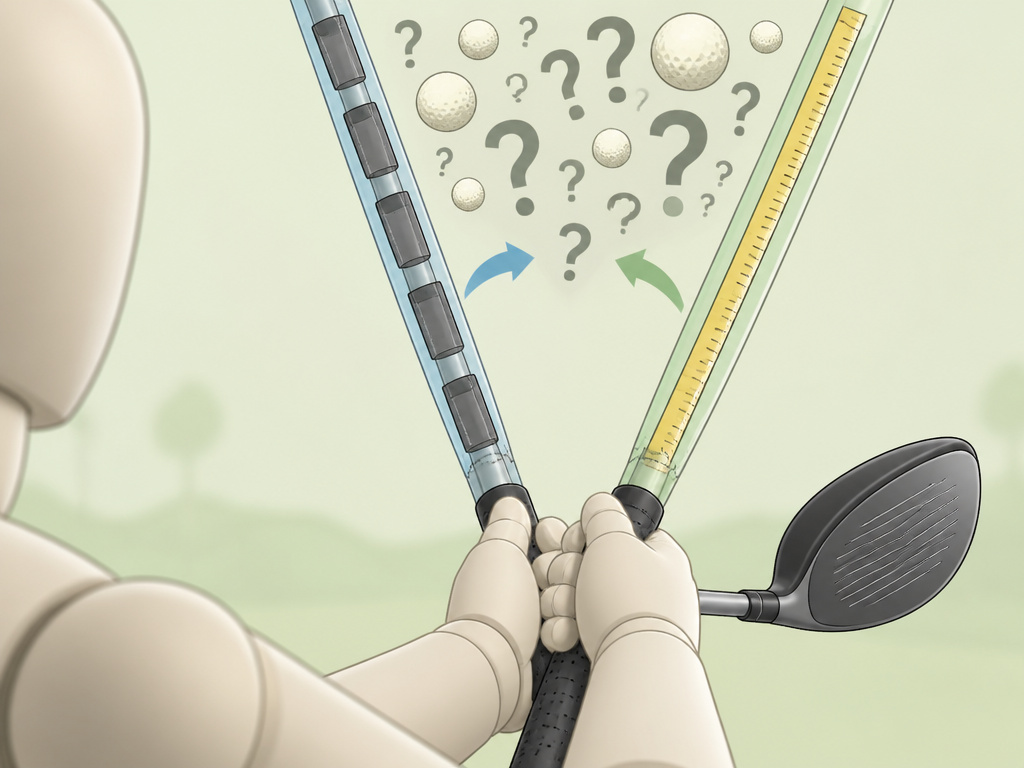
The clean iron data doesn’t directly translate to the big stick. Studies on driver shaft weight have produced conflicting, less predictable results.
One often-cited study from 2012 had golfers hit drivers with an extra 22 grams added. The outcome was all over the map: ten golfers showed no change in speed, one lost 1.4%, and one actually gained 3%. The researchers’ conclusion was that “golfers do not respond to changes in club mass in a mechanically predictable way.”
Another complication is length. Driver shafts are longer, and many studies on weight also involved varying lengths, making it impossible to isolate the weight variable. As one paper noted, it’s the combination of mass and length that influences outcomes like spin, which ultimately affects total distance.
| Club Type | Weight Effect | Predictability | Primary Influence |
|---|---|---|---|
| Iron (e.g., 7-iron) | Clear speed gain with less weight. | High. Lighter = faster. | Pure mass. Shorter length reduces variables. |
| Driver | Inconsistent speed change. | Low. Golfer response varies. | Combination of mass, length, and player adaptation. |
The practical takeaway? Use your iron fitting as the foundation. If you clearly perform better with a 95g iron shaft over a 115g one, that’s a strong signal. Your driver shaft weight should be in the same relative category (e.g., 60-65g if your irons are light), but be prepared for the final driver spec to be influenced more by launch, spin, and that elusive feel.
How to Find Your Ideal Shaft Weight (A Fitting Guide)
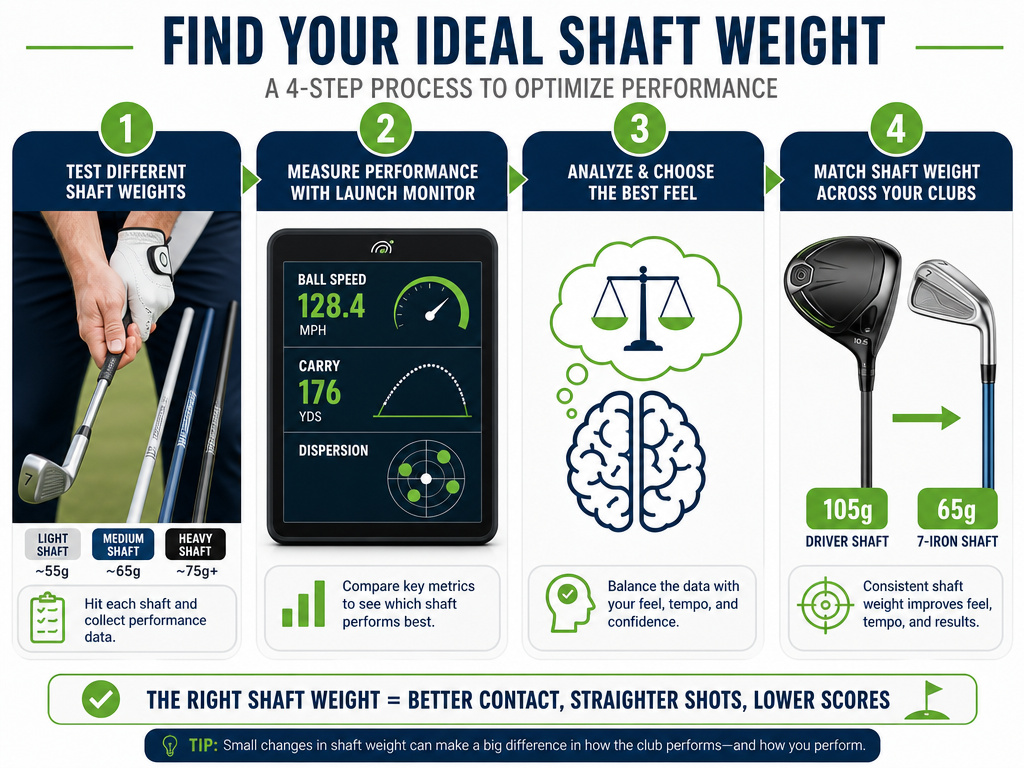
You need to hit balls. Guessing based on your swing speed or handicap alone will leave performance on the table. Follow this sequence during a fitting session with a launch monitor.
- Start With Irons, Not Driver. Use a 6 or 7-iron. The data is clearer, and the swing is more repeatable. Try three shafts: one in the light range (sub-100g for steel), a middle weight (~105-110g), and a heavier option (115g+).
- Look Beyond Peak Speed. Watch the launch monitor for ball speed, carry distance consistency, and dispersion. Does the light shaft give you more speed but wider misses? Does the heavy shaft tighten your pattern but cost 5 yards?
- Assess Feel Honestly. After a few shots, ask yourself: Does the club feel like it’s swinging itself, or do I have to manipulate it? A weight that promotes your natural swing tempo is worth more than a theoretical speed gain you can’t control.
- Validate With Longer Clubs. Once you have an iron weight, test a driver shaft in a corresponding weight class. A rough guideline: if your iron shaft is 105g, look at 65-70g driver shafts. Let ball flight, not just speed, guide the final choice.
Common mistake: Chasing the lightest possible shaft because it shows the highest clubhead speed on one shot. Consistency over ten shots matters more.
What if you can’t get a full fitting? Pay attention to the stock specs in your current set. Most off-the-rack steel iron shafts are in the 105-120g range. If those always felt sluggish, a drop to the 95-100g category (like a KBS TGI or Nippon N.S. PRO 950) could be transformative. If you’ve always fought control, a step up to a 120g+ shaft (like a Project X Rifle or Dynamic Gold) might be the stability you need.
Frequently Asked Questions
Does a lighter golf shaft increase swing speed?
Yes, a lighter shaft can increase clubhead speed, particularly with irons. A 2024 study found a 77g 7-iron shaft produced higher clubhead speed than a 114g shaft. However, this speed boost is more consistently converted into extra distance by low-handicap golfers with efficient swings.
What is the best shaft weight for a slow swing speed?
There’s no single “best” weight. While a lighter shaft can help generate more speed, a too-light shaft can disrupt tempo and timing. Players with slower swings often benefit from a mid-weight shaft (around 95-105g for irons) that offers a balance of manageable heft and speed potential. A proper fitting is essential.
Is a heavier shaft more accurate?
Not universally. A heavier shaft can promote a smoother swing tempo for some players, which can lead to more consistent contact. However, if the weight forces a player to manipulate the club or slows them down excessively, it can hurt accuracy. Control comes from a weight you can swing consistently, not necessarily the heaviest one.
How does shaft weight affect driver distance?
The effect is less predictable than with irons. While lighter driver shafts can increase speed, the relationship is complicated by shaft length and individual swing adaptation. The key is finding the weight that allows you to deliver the clubhead squarely at the center of the face with optimal launch and spin for your swing.
Should my driver and iron shafts weigh the same?
No. Driver shafts are typically 30-50 grams lighter than iron shafts. This accounts for the longer length and different swing dynamics. A common pairing is a 65-70g driver shaft with 105-115g iron shafts. The weights should feel proportionate and promote a consistent rhythm through your bag.
The Bottom Line
The link between shaft weight and swing speed is real, measurable, and most relevant to your irons. A lighter shaft acts as a lever, helping you move the club faster if your mechanics can handle it. For a good ball-striker, that means more distance. For someone still building a repeatable swing, it might just mean more speed without more control.
Your handicap isn’t just a number for tournaments; it’s a filter for this exact equipment decision. Use the data from the 77g, 98g, and 114g study as a starting point, not a finish line. Then get on a launch monitor and let your own ball flight, the carry distance, the dispersion, the feel, make the final call. The right weight is the one you stop thinking about after the first swing.
