
A Complete Guide to Swing Weight in Golf and Its Importance
This post contains affiliate links. As an Amazon Associate, we earn from qualifying purchases.
This post contains affiliate links. As an Amazon Associate, we earn from qualifying purchases.
Swing weight in golf is a measurement of torque, specifically how much a club wants to rotate around a point 14 inches from the grip end. It’s expressed on a scale from A0 (lightest) to G9 (heaviest), with common men’s clubs around D1-D3. One swing weight point equals 50 gram-inches of torque, and changing the clubhead weight by just 2 grams moves the swing weight by one full point.
That 2-gram spec is where theory meets the grip. A penny weighs about 2.5 grams. The difference between a D2 and D3 iron, a change most better players can feel in their tempo, is less than the weight of a single coin taped to the clubhead.
The rest of this guide walks through the mechanics behind that number, why your body responds to it more than your brain does, and how fitters use it, or ignore it, to build a set that swings with one rhythm.
Key Takeaways
- Swing weight measures feel, not total weight. Two clubs can weigh the same but have drastically different swing weights based on weight distribution.
- The standard is a 14-inch fulcrum scale. One swing weight point equals 50 gram-inches of torque, with D-0 representing 6050 gram-inches.
- 2 grams of head weight changes swing weight by one point. Half an inch of length changes it by approximately 3 points.
- Most players can’t feel a 1-point difference. A 2-3 point shift is the minimum perceptible threshold for altering swing tempo.
- Consistency across a set is the primary goal, not chasing a specific number like D2. Your ideal swing weight is found through trial, not theory.
What Swing Weight Actually Measures (It’s Torque)
Forget “how heavy the club feels.” That’s the outcome, not the mechanism. Swing weight is a precise, if archaic, engineering measurement: it’s the torque the club’s mass exerts around a fixed pivot point.
The industry-standard pivot is 14 inches from the butt end of the grip. Imagine balancing a club on a knife-edge at that spot. How much does the head-end want to drop? That rotational force is the swing weight, quantified in units of torque.
A “swingweight point” is defined as 50 gram-inches of torque. The common baseline D-0 corresponds to 6050 gram-inches. This means the club’s mass distribution creates a torque equivalent to 6050 grams acting one inch from the fulcrum, or 50 grams acting 121 inches away.
The scale runs from A0 (lightest) to G9 (heaviest). You’ll never see a G9 in the wild, it’s a theoretical maximum. The useful range for players is between about C5 and E0.
This torque measurement isolates the heft or head-weight feel during the swing. It explains why a driver and a wedge can have the same swing weight despite the driver being longer and heavier overall. Their mass is distributed to create the same rotational force about that 14-inch point.
Why does this 14-inch fulcrum exist? It dates back to the 1940s and the work of clubmaking pioneer Ralph Maltby. The distance was chosen to approximate where the top hand applies pressure during the swing. It’s arbitrary, but it became the universal standard, which is what matters for consistency.
How Is Swing Weight Measured?
You need a swing weight scale. Professional models from Mitchell Golf or similar are the tools used in every serious club-building shop. They are simple devices: a fulcrum at the 14-inch mark, a sliding weight, and a marked scale.
The process is straightforward: 1. Place the club’s grip butt against the fixed stop. 2. Let the club balance on the fulcrum. 3. Slide the movable weight until the club balances level. 4. Read the letter-number combination (e.g., D2) from the scale.
Where this goes sideways: Trying to calculate it from component specs without measuring. As noted on Tutelman.com, the equations are approximations. A 0.1-ounce (3-gram) error in component weight or a 1/4-inch error in estimating the center of gravity leads to a miscalculation of more than one swing weight point. Even experienced builders are sometimes surprised by the final measurement after assembly.
| Component Change | Approximate Swing Weight Change | Why It Matters |
|---|---|---|
| Add 2 grams to clubhead | Increases +1 point | The most direct way to adjust feel. Lead tape is the field fix. |
| Shorten shaft by 0.5 inches | Decreases ~3 points | Cutting a shaft without adding head weight makes the club feel drastically lighter. |
| Install a heavier grip (+5g) | Decreases -1 point | Adding weight in the hands counterbalances the head, reducing head feel. |
| Change to a lighter shaft (per 20g uncut) | Increases +1 point | Lighter shaft weight shifts the balance point toward the head. |
The scale doesn’t lie, but your perception might. This leads to the biggest misconception in club fitting.
The D2 Myth: Why the Number Isn’t Sacred
Walk into any club forum and you’ll find players obsessing over achieving a perfect D2 swing weight across their entire bag. This is a fool’s errand.
Most golfers cannot feel a one-point difference. As a veteran club fitter quoted in Golf.com put it, “I can’t feel the difference between D1 and D2. And I do this for a living.” The perceptible threshold for most is two to three points. Your body senses a change in swing tempo before your brain registers a change in “heaviness.”
Common mistake: Chasing a printed swing weight spec instead of the right feel. If you flush shots with a D1 6-iron and a D3 7-iron, the numbers are irrelevant. Performance trumps the scale.
During a proper, brand-agnostic fitting, you’ll hit clubs with a wide range of swing weights. You’ll be swapping heads, shafts, and grips, each change alters the swing weight. You didn’t notice the number jumping around. You noticed which combo felt stable, launched well, and produced a solid strike. That’s the feedback that matters.
The real value of the swing weight scale is replication, not prescription. It’s the tool a builder uses to ensure the 5-iron you loved in the fitting bay feels identical to the 5-iron that arrives in your bag. It’s for consistency, not optimization.
Swing Weight Ranges and What They Feel Like
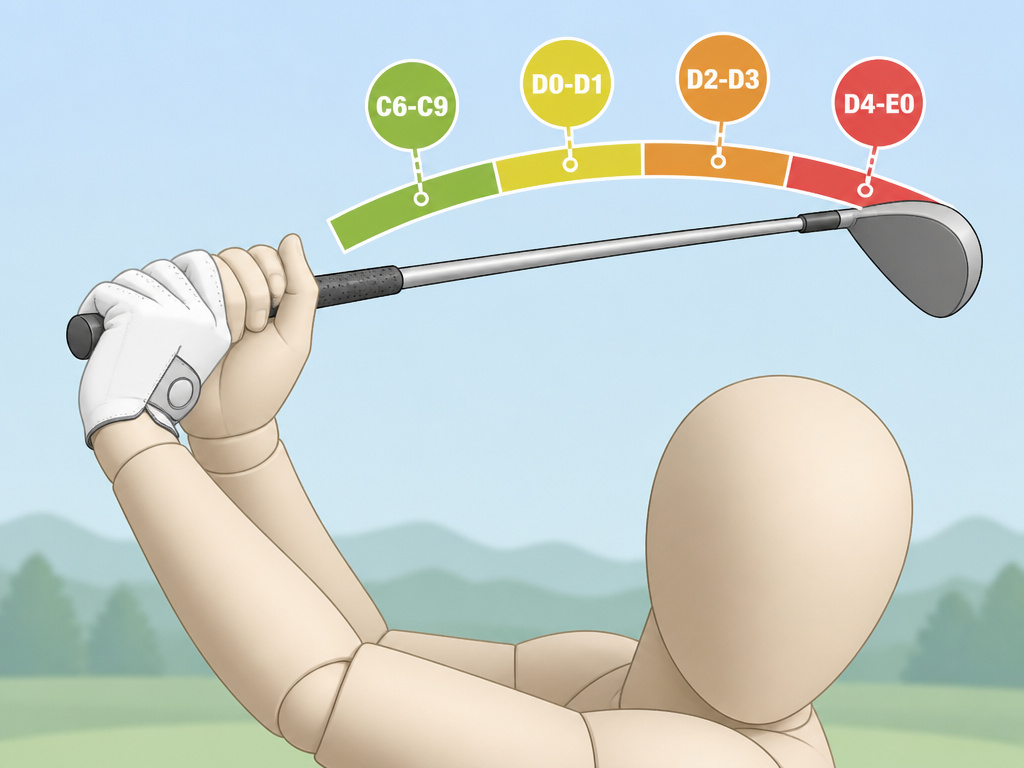
While D2 isn’t magic, the alphanumeric scale communicates a real spectrum of feel. Here’s what different ranges typically deliver, based on common fitting guidelines from sources like Mitchell Golf and PXG.
| Swing Weight Range | Typical Feel & Player Profile | Common Use |
|---|---|---|
| C6-C9 | Very light head feel. Promotes a faster, handsier swing tempo. Can feel “whippy.” | Standard for many off-the-rack women’s clubs. Seniors or players with very slow, deliberate transitions. |
| D0-D1 | Light, fast feel. Head is present but not dominant. Encourages clubhead speed. | Players with quick transitions who need to feel the club release easily. Some game-improvement irons. |
| D2-D3 | The “standard” zone. Clear, balanced head feel. Offers feedback and stability. | The most common range for men’s off-the-rack clubs. The sweet spot for most mid-handicappers seeking a controlled tempo. |
| D4-E0 | Heavy, deliberate feel. Head weight is very pronounced, slowing the swing down. | Preferred by many better players and tour pros for irons and wedges. Aids players who rush their transition from the top. |
The off-the-rack baseline: If you buy a standard men’s driver or iron set off the shelf, it will likely measure between D1 and D3. A standard women’s set will usually fall between C5 and C7. Companies like PXG use these as starting points in their custom build pods before fine-tuning for the individual.
Your ideal spot on this table isn’t determined by your handicap. It’s determined by your personal tempo and how you load the club in transition. A player with a long, smooth backswing and a deliberate change of direction might prefer D4. A player with a short, quick backswing might get better results at D0.
How to Change Swing Weight (And Why You Would)
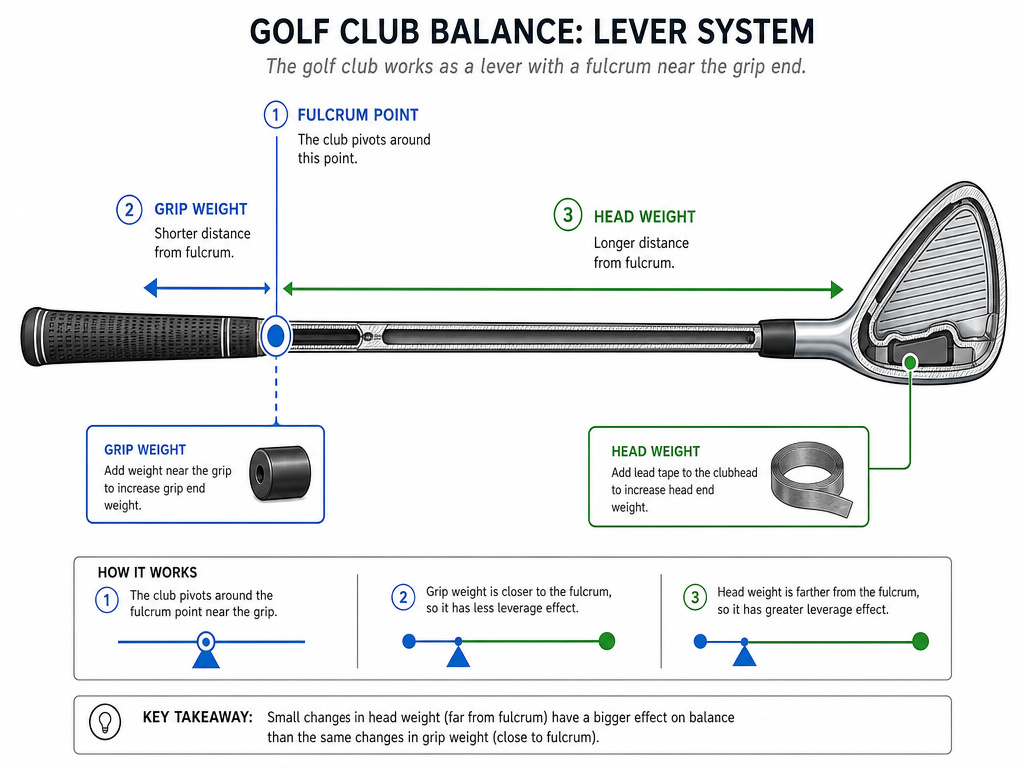
You adjust swing weight by altering the club’s balance point. Remember the torque equation: weight multiplied by distance from the fulcrum. Changes at the head (far from the fulcrum) have a massive impact. Changes at the grip (near the fulcrum) have a smaller, counterbalancing effect.
To Increase Swing Weight (Make the Head Feel Heavier):
- Add head weight: 2 grams = +1 point. Use lead tape, a weighted swing trainer sleeve, or change adjustable weights. This is the most effective method.
- Lengthen the shaft: +0.5 inches = +3 points. Longer lever, more torque.
- Install a lighter grip: -5 grams = +1 point. Less counterweight lets the head feel dominate.
- Use a lighter shaft model: A raw shaft 20 grams lighter adds about 1 point.
To Decrease Swing Weight (Make the Head Feel Lighter):
- Shorten the shaft: -0.5 inches = -3 points. The most dramatic change.
- Install a heavier grip: +5 grams = -1 point. Adds counterbalance.
- Use a heavier shaft model: A raw shaft 20 grams heavier subtracts about 1 point.
- Reduce head weight: Drilling material out (rare) or using lighter adjustable weights.
The part nobody mentions: Changing your golf grip from a standard 50g model to a midsize 66g model can drop swing weight by over 3 points. The club you were fit for will no longer feel like the same club. Always weigh your grips if you’re changing them.
The goal of these adjustments is set matching. You want your 4-iron through lob wedge to swing with the same rhythm so your weight shift and timing remain consistent. If you’re adding length to your clubs for height, you must add head weight to maintain swing weight. If you’re cutting them down, you’ll need to add significant weight back to the head.
Swing Weight vs. MOI Matching: A Builder’s Choice
Swing weight matching is the traditional method: every club in the set is built to the same letter-number value (e.g., all D2). But there’s a competing philosophy: MOI (Moment of Inertia) Matching.
MOI measures a club’s resistance to rotation during the swing, a dynamic, not static, property. A set matched for MOI will have progressive swing weights: the longer clubs will have a slightly lower swing weight than the shorter clubs.
Why? As club length increases, the head’s effective mass feels different due to the longer lever. MOI matching accounts for this to make each club feel like it has the same resistance to swinging.
| Matching Method | What It Does | Best For |
|---|---|---|
| Swing Weight Matching | Sets all clubs to balance at the same point on the 14″ scale. | Players with a variable ball position (ball moves forward for longer clubs). Simpler, more common. |
| MOI Matching | Sets all clubs to have the same resistance to rotation during the swing. | Players with a consistent ball position for all full swings. Can feel more uniformly “heavy” to swing. |
The data from Tutelman.com suggests a practical rule: for MOI matching, swing weight should decrease by about 1.3 points for every inch the club gets longer. So a MOI-matched set might have a 37″ 9-iron at D4 and a 40″ 6-iron at D1.
Most recreational players are fine with swing weight matching. MOI matching is a refinement pursued by advanced players and dedicated club builders. The takeaway is this: if your clubs have slightly different swing weights but all feel right, you might have accidentally stumbled into a good MOI match.
Frequently Asked Questions
What is a good swing weight for a beginner?
Don’t worry about it. Start with standard off-the-rack clubs, which are designed to be in a playable range (C9-D2 for men, C5-C7 for women). As you develop a consistent swing and tempo, a fitter can then use swing weight as a tuning tool. Chasing a specific number as a beginner is a distraction from fundamentals like golf swing tempo and a balanced finish.
Can I measure swing weight at home without a scale?
You can approximate it with a precise gram scale, a ruler, and a fulcrum, but it’s cumbersome and error-prone. The calculation requires finding the club’s total weight and center of gravity. For the cost of a few dozen golf balls, you can buy an economy swing weight scale. For reliable, repeatable results, the proper tool is worth it.
Does swing weight affect distance?
Indirectly, yes. The right swing weight for your tempo promotes centered contact. A center strike delivers more ball speed and efficient energy transfer than a toe or heel strike. An excessively heavy swing weight can slow your clubhead speed; an excessively light one can make you lose control and strike it poorly. Optimal distance comes from the right combination of speed and contact, which the correct heft encourages.
How does swing weight relate to total club weight?
They are independent specs. Total weight is the sum of all components (head, shaft, grip). Swing weight is the balance of that weight. You can have a heavy total weight with a light swing weight (heavy shaft and grip, light head) or a light total weight with a heavy swing weight (light shaft, heavy head). Your shaft weight is a major driver of total weight, while head weight drives swing weight.
Should my driver and wedges have the same swing weight?
Usually not. Most players benefit from slightly heavier swing weights in their wedges (D4-E0) for more feel and control on partial shots, and a standard or slightly lighter swing weight in the driver (D0-D3) to promote speed. Consistency within a category (all irons, all wedges) is more important than consistency across the entire bag.
Before You Go
Swing weight is a tool, not a trophy. It exists to quantify the intangible feel of a golf club so that feel can be replicated across a set. The number on the scale. D0, D2, D4, is a means to an end, not the end itself.
The real goal is a set where every club swings with the same familiar rhythm, supporting your natural weight transfer in the swing and kinematic sequence. That consistency breeds better strikes. So if you’re tinkering, start with lead tape and ball flight, not a calculator. Let the results guide you, and use the scale to lock in what works. Your perfect swing weight is the one you stop thinking about.
