
Mastering Spin Rate and Launch Angle for Better Golf Shots
This post contains affiliate links. As an Amazon Associate, we earn from qualifying purchases.
This post contains affiliate links. As an Amazon Associate, we earn from qualifying purchases.
Spin rate and launch angle in golf are the two measurable outputs of impact that define a shot’s trajectory and distance. Spin rate is the speed of the ball’s rotation in revolutions per minute (RPM), creating lift and stability. Launch angle is the vertical angle at which the ball leaves the clubface. For a driver, the USGA’s conformance test uses a launch angle of 10° and a spin rate of 2,520 RPM at 120 mph clubhead speed. Your optimal combination depends on your clubhead speed and impact quality.
These two numbers are not independent. They are the direct product of your swing mechanics, your equipment’s specs, and the quality of contact. Changing one almost always changes the other. The goal is not to chase maximums, but to find the specific pairing that maximizes carry distance for your unique speed.
What follows is a breakdown of the physics, the governing body standards that define the limits of equipment, and the practical adjustments you can make, from loft settings to ball selection, to move your numbers toward your ideal window.
Key Takeaways
- Ball speed is king, but spin and launch are its advisors. Speed determines potential distance; spin and launch determine how efficiently that speed is converted into carry.
- Optimal spin decreases as clubhead speed increases. A slower swing needs more spin to stay airborne; a faster swing needs less spin to avoid ballooning.
- The USGA/R&A test for driver distance uses 10° launch and 2,520 RPM spin. This is the standardized benchmark, but it’s not necessarily optimal for every player.
- Impact location on the face is the biggest amateur variable. A strike just above the center reduces spin dramatically; a low strike increases it.
- There is a “plateau region” where tweaking spin or launch yields almost no distance gain. Once you’re in the right window, focus shifts to accuracy and consistency.
What Are Spin Rate and Launch Angle?
Spin rate and launch angle are the primary launch conditions measured by modern launch monitor technology. They are the initial conditions of your golf shot’s flight path, set in the microseconds of impact.
Spin rate is measured in revolutions per minute (RPM). Backspin creates lift, keeping the ball in the air. Too little spin and the ball falls out of the sky; too much and it balloons, losing distance. Sidespin, a component of total spin, dictates the ball’s curvature left or right.
Launch angle is measured in degrees relative to the ground. It’s the initial direction of the ball’s center of mass. It is not the same as the club’s dynamic loft at impact, though they are closely related. A higher launch sends the ball on a higher arc.
The technical snippet: Launch conditions are the set of measurable parameters that define a golf shot’s initial flight state. The five key parameters are ball speed, vertical launch angle, spin rate, horizontal azimuth direction, and spin axis inclination. Ball speed is the primary determinant of potential distance, while launch angle and spin rate determine the efficiency of that energy transfer into carry distance.
These metrics are why a practice session with a launch monitor is transformative. You move from guessing based on ball flight to making data-driven adjustments.
The Physics of Launch: How They Work Together
The relationship is a trade-off, not a solo act. Imagine throwing a football. A flat, low throw (low launch) with a tight spiral (high spin) goes far and straight. A wobbly, high-arcing throw loses energy. Golf works on similar principles.
Spin creates lift via the Magnus effect. As the ball rotates, air moves faster over the top, creating lower pressure that lifts the ball. Launch angle sets the initial trajectory. The combination dictates the apex height and descent angle.
Why-layer: A higher launch angle gives the ball more time in the air to benefit from lift, but it also exposes it to drag for longer. A higher spin rate increases lift, but also increases drag. The optimization problem is finding the point where increased lift outweighs the penalty of increased drag for your specific ball speed. This is precisely what the USGA and R&A’s algorithm solves for in their conformance testing.
The most critical factor linking them is impact location. Hitting the ball above the center of gravity on the driver face, a “high-toe” strike, decreases spin and can increase launch. Hitting low on the face increases spin and decreases launch. This is the primary reason amateurs often have mismatched numbers.
Optimal Values and PGA TOUR Averages
There is no single magic number. Your ideal spin rate and launch angle are a function of your clubhead speed. The governing bodies provide a fixed benchmark, while PGA TOUR data shows what elite speed looks like in practice.
| Source / Context | Clubhead Speed | Launch Angle | Spin Rate | Purpose |
|---|---|---|---|---|
| USGA/R&A Test Standard | 120 mph | 10° | 2,520 RPM | Conformance testing for all golf balls. The control condition. |
| PGA TOUR Average (2019) | 114.1 mph | 9.9° | 2,637 RPM | Actual on-course average from tour players. |
| Faster Swing Reference | 112 mph | 11.2° | 2,685 RPM | Example from a launch monitor data guide for maximizing carry. |
| Slower Swing Reference | 94 mph | 14° | 2,628 RPM | Example for players with moderate speed needing more lift. |
The PGA TOUR averages reveal a trend: as average clubhead speed increased from 2007 to 2019, launch angle slightly decreased and spin rate dropped significantly. Faster players optimize for lower spin to prevent ballooning.
Where this goes sideways: Chasing the PGA TOUR average of 9.9° launch if your clubhead speed is 95 mph. You will not generate enough ball speed to carry that low launch, resulting in a loss of 20+ yards of carry. Match the launch condition to your speed, not the pro’s.
For most amateur men with driver speeds between 85-100 mph, a launch angle of 13-16° with spin between 2,200-2,800 RPM is a strong target window. Higher launch compensates for lower speed.
How to Adjust Your Spin and Launch
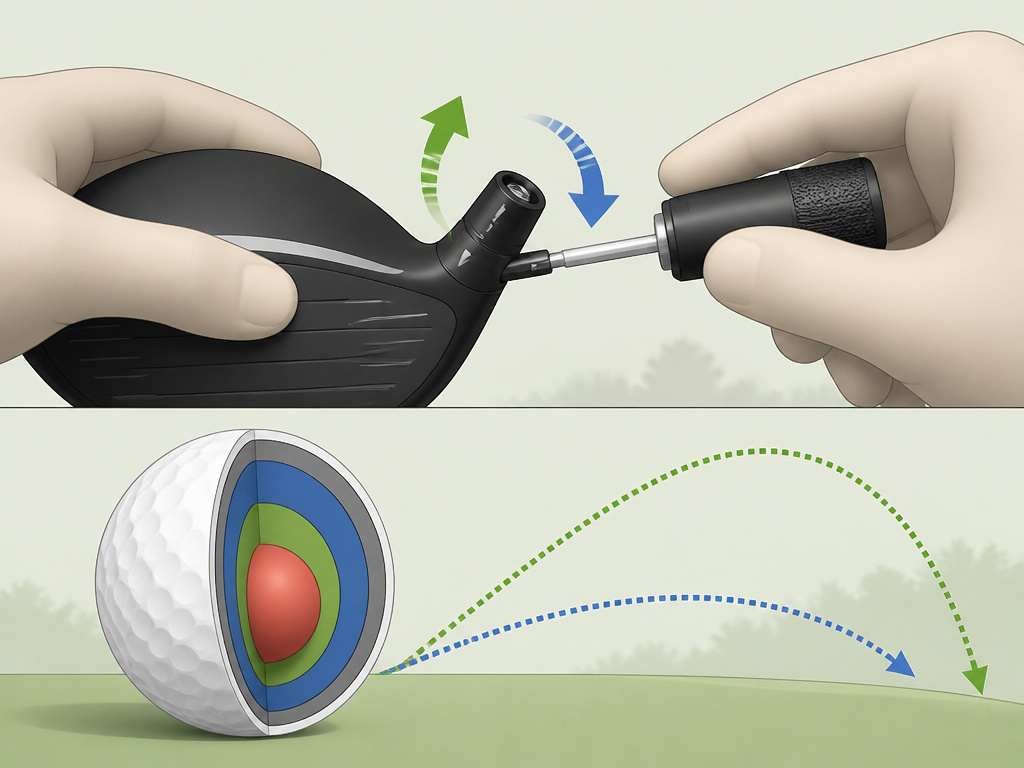
You have four primary levers: equipment, setup, swing mechanics, and impact location. Start with the easiest adjustments first.
-
Change Your Equipment (Easiest)
- Driver Loft: This is the biggest dial. Increasing loft increases launch angle and usually adds some spin. Decreasing loft does the opposite. Don’t guess, use a launch monitor for swing improvement to test settings.
- Golf Ball: The choice between low spin vs high spin balls is real. A recommended low spin golf ball like the Titleist AVX can reduce driver spin by 200-300 RPM versus a best high spin ball like a Titleist Pro V1x.
- Shaft: A stiffer or lower-launch shaft can slightly lower launch and spin, but its effect is smaller than loft or ball choice for most players.
-
Adjust Your Setup
- Tee Height: Teeing the ball higher encourages a slightly upward angle of attack, promoting higher launch and often slightly lower spin (if struck well).
- Ball Position: Moving the ball forward in your stance can facilitate a more upward strike.
-
Modify Swing Mechanics (Hardest)
- Angle of Attack: Swinging more upward on the driver increases launch and can decrease spin if impact remains centered. This is a fundamental change.
- Dynamic Loft: The amount of loft you deliver at impact. A more hands-forward, delofted position lowers launch and spin.
-
Improve Impact Location (The Game-Changer) Consistently striking the ball just above the center of the face is the most effective way to lower spin and optimize launch. Use foot spray on your clubface during practice. This one fix often solves more than equipment tweaks.
Common mistake: Buying a new low-spin driver head when your spin is high due to low-face strikes. The $500 driver can’t fix a strike pattern issue that a $5 can of foot spray can identify. Face impact is the first check.
The Plateau Region and the Limits of Optimization
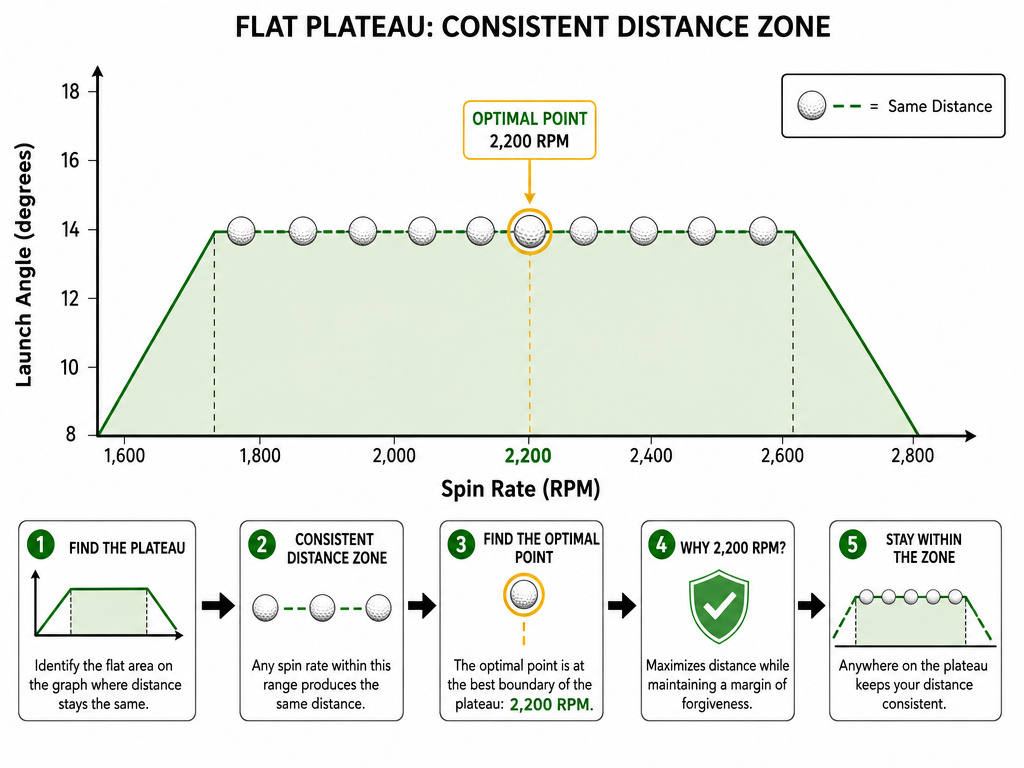
A fascinating finding from the USGA and R&A’s algorithmic research is the “plateau region.” For many golf balls, there is a range of spin and launch combinations that produce nearly identical total distance, sometimes within a 0.13-yard difference.
This means that once you are in the correct general window (e.g., 14° launch, 2,400 RPM spin), obsessing over fine-tuning from 2,400 to 2,350 RPM may yield no measurable gain. The algorithm found optimal spin was often on the boundary of the test constraint at 2,200 RPM.
The takeaway: Don’t become a slave to the numbers. Use them to get into the right neighborhood. Once you’re there, shift your focus to dispersion, accuracy, and strike consistency. The last 1% of distance optimization matters far less than eliminating the penalty of a mis-hit.
Spin and Launch by Club: Driver vs. Irons vs. Wedges
The principles are the same, but the goals change dramatically through the bag. You don’t want a 7-iron to fly like a driver.
| Club Type | Primary Goal | Typical Launch | Typical Spin | Key Adjuster |
|---|---|---|---|---|
| Driver | Maximize carry + roll | 10° – 16° | 2,000 – 3,000 RPM | Loft, strike point, ball choice |
| Mid-Iron | Consistent carry distance | 14° – 20° | 5,000 – 7,000 RPM | Club loft, angle of attack |
| Wedge | Maximize stopping power | 25° – 35° | 9,000 – 11,000+ RPM | Groove condition, cover material, strike |
For irons, sufficient spin is critical for holding greens. A Golf Science Journal peer-reviewed study on driver loft confirms that higher static loft directly increases spin rate, a principle that applies through the bag.
For wedges, spin is everything. It’s generated from friction between the grooved face and the ball’s soft cover. Fresh grooves on a wedge model designed for maximum spin like a Titleist Vokey SM10 are essential for short-game control. This is a different world from driver optimization.
Frequently Asked Questions
What is a good spin rate for a driver?
Good driver spin rate is between 2,000 and 3,000 RPM for most players. The ideal spot depends on your clubhead speed. If you swing under 95 mph, aim for the higher end of that range (2,600-3,000 RPM). If you swing over 105 mph, target the lower end (2,000-2,500 RPM). The goal is enough spin to create lift, but not so much that the ball balloons.
Does higher loft increase spin?
Yes, generally. Increasing static club loft will increase both launch angle and spin rate, all else being equal. This is true for drivers, irons, and wedges. However, dynamic loft delivered at impact and the quality of strike can modify this relationship. A higher-lofted driver hit low on the face can still produce very high spin.
How do I lower my driver spin rate?
First, check your impact location with foot spray. Low strikes are the most common cause of high spin. Next, try a lower-lofted driver setting. Then, consider a golf ball designed to reduce spin. Finally, work on a slightly upward angle of attack with a centered or slightly high-face strike. Equipment changes are easier than swing changes.
What’s more important, launch angle or spin rate?
They are a package deal, but launch angle is often the easier variable to correct for immediate gains, especially for slower swing speeds. A player with 90 mph speed using a 7.5° driver will struggle to launch the ball effectively, regardless of spin. Get the launch into an acceptable window for your speed first, then fine-tune the spin.
Why do my launch monitor numbers differ from the “optimal” charts?
Optimal charts assume perfect, centered contact. Your real-world numbers include your unique strike pattern, angle of attack, and delivery. Furthermore, different launch monitor models can measure spin and launch with slight variations. Use the charts as a directional guide, not an absolute standard. Your best numbers are the ones that produce your longest, most consistent shots on the course.
Before You Go
Spin rate and launch angle are the language of modern shot optimization. They translate the feel of your swing into actionable data. Start by understanding your baseline numbers using any available monitor. Identify if you’re in the right neighborhood for your speed.
Remember the hierarchy: ball speed first, then strike quality, then launch conditions. A well-struck shot with mediocre numbers will always beat a mis-hit with perfect numbers. Use equipment tweaks, loft, ball, tee height, to nudge your figures. Once you’re in the plateau region, stop chasing decimal points and start hitting fairways.
For most players, that means a driver loft that actually fits their swing speed, a ball choice that matches their priority (distance vs. Control), and a relentless focus on finding the center of the face. The rest is fine-tuning.
