
Beginner Golf Clubs: What You Need for Your First 7-Club Bag
This post contains affiliate links. As an Amazon Associate, we earn from qualifying purchases.
This post contains affiliate links. As an Amazon Associate, we earn from qualifying purchases.
Beginners need 7 clubs: a driver (10.5–12° loft), one fairway wood (17–18° loft), one hybrid, three irons (7, 8, 9), a sand wedge (54–56°), and a putter. This half-set covers every shot, simplifies learning, and follows the USGA rule that allows a maximum of 14 clubs but sets no minimum. Buying a full 14-club set immediately is the most common and expensive beginner mistake.
That 7-club number isn’t a guess. It’s the outcome of watching hundreds of new players struggle with bags full of tools they can’t use. The physics are simple: a beginner’s swing speed and strike pattern change weekly. A club that fits you in March will be wrong by June, and carrying a 3-iron you can’t launch does nothing but add weight and frustration.
What follows is the framework I use with every new student. We’ll break down the seven clubs, the exact specs to look for, and the one purchase that saves you more money than any other. By the end, you’ll know how to build a bag that supports your swing instead of fighting it.
Key Takeaways
- Carry 7–9 clubs maximum in your first year. A half-set reduces decision paralysis and lets you master a repeatable swing with fewer variables.
- Loft is your best friend. Seek a driver with 10.5–12°, a fairway wood with at least 17°, and a sand wedge between 54–56°. Low-loft clubs punish slow swing speeds.
- Skip long irons (3,4,5) entirely. Replace them with a hybrid or a higher-lofted fairway wood (like a 7-wood). The wider sole gets the ball airborne from any lie.
- Buy a used, modern cavity-back iron set. Technology from the last 5–7 years offers massive forgiveness for a fraction of the price of new clubs.
- Do not get a custom club fitting until you break 100 consistently. Your swing isn’t stable enough yet, and the fitting specs will be obsolete within 90 days.
The 7 Essential Clubs for Your First Year
Forget the 14-club maximum. That’s a ceiling for experts, not a starting line for you. Your goal is to cover four jobs: tee shots, long advances from the fairway, medium-distance approaches, and shots around the green. Seven clubs do that cleanly.
A beginner’s 7-club set includes: Driver (10.5–12°), Fairway Wood (17–18°), Hybrid (21–22°), 7-Iron, 8-Iron, 9-Iron, Sand Wedge (54–56°), and a Putter. This configuration prioritizes high loft and forgiveness over completeness, providing manageable distance gaps of 15-25 yards between clubs.
Driver (10.5–12° of loft)
Look for the loft number stamped on the sole or in the spec sheet. This is essential. A 10.5–12° driver launches the ball higher with your slower swing speed, which means more carry and less time spent hunting balls in the rough. Many beginners buy 9° drivers because they look “pro.” The ball comes out low, dies quickly, and the round becomes a slog. The sound of a well-struck driver with enough loft is a solid thwack, not a weak tink.
One Fairway Wood (17–18° loft)
This is your “get out of trouble” club for long shots off the deck. The key spec is length: don’t buy one longer than 42 inches. A longer shaft is harder to control, and you’ll top the ball more often than you pure it. This club should feel like an extension of your driver swing, just shorter and more manageable.
One Hybrid (21–22° loft)
This club replaces the 4 or 5-iron you can’t hit. A hybrid has a wide, weighted sole that glides through grass and rough, popping the ball up even on a mediocre strike. The feel is distinct—a soft thud as it brushes the turf, not the harsh dig of an iron hitting fat. If you only add one club to your bag, make it this.
7, 8, and 9-Irons
Start your iron set here. These shorter, higher-lofted irons are exponentially easier to hit than a 3, 4, or 5-iron. You’ll use the 7-iron from 120-145 yards, the 8 from 110-130, and the 9 from 90-120. Having just three irons forces you to learn how to hit partial shots—a skill that will lower your scores faster than any new club.
Sand Wedge (54–56° loft)
You need one club for sand and thick grass around the green. A 54–56° sand wedge has enough loft to get the ball up and out without requiring perfect technique. Avoid lob wedges (58°+); they are less forgiving and unnecessary until you can consistently make clean contact with your sand wedge.
Putter
Any putter that feels balanced in your hands and lets you roll the ball end-over-end is the right one. Expensive milled faces won’t help if your speed control is off. Spend 10 minutes in the store rolling balls; the one that produces the most consistent roll is your winner.
Complete Set vs. Building Your Own Bag
This is the first big financial decision. A pre-packaged complete beginner set like the Callaway Strata or Wilson Profile SGI gives you a matched set of 9-11 clubs, a bag, and headcovers for one price. Building your own bag means buying individual clubs, new or used.
| Approach | Best For | Biggest Risk |
|---|---|---|
| Complete Beginner Set | The absolute newcomer who wants simplicity and guaranteed loft gapping. | Quality ceiling. You’ll outgrow the components in 1-2 years if you play regularly. |
| Building a Used Bag | The value-conscious learner willing to research. Saves 40-60% over new. | Gapping errors. A random 7-iron and 9-iron from different sets might go the same distance. |
| Building a New Bag | The committed player with a budget who plans to keep clubs for 5+ years. | High upfront cost for clubs you may not need yet (like a 3-wood or lob wedge). |
I recommend a complete set for 80% of true beginners. It removes analysis paralysis. The clubs are designed to work together, and the bag is included. It’s the fastest route from the store to the course. Our guide to the best complete sets for beginners breaks down the top options.
If you’re handy and patient, building a used bag is brilliant. Focus on cavity-back irons from major brands (Ping, Callaway, TaylorMade) made in the last 7 years. Check grips for wear and shafts for cracks. This path gets you better quality clubs for less money, which is why we maintain a list of the best entry-level golf clubs available on the secondary market.
The Specs That Actually Matter (And the Ones to Ignore)
Marketing sells buzzwords. Performance comes from a few printed numbers.
Shaft Flex: Regular, Not Stiff
Unless you consistently swing a driver over 95 mph, you need a regular flex shaft. A stiff flex won’t bend properly during your swing, robbing you of distance and making it harder to square the face. Most starter clubs for beginners come with regular flex for this exact reason.
Iron Type: Cavity-Back, Not Blades
Common mistake: Buying blades because a pro uses them. A blade’s sweet spot is the size of a dime; a cavity-back’s is the size of a quarter. On a mishit, the blade loses 30% more distance and sprays wildly offline. The cavity-back keeps the ball in play.
Club Length: Standard, Unless You’re Far From Average
If you’re between 5’7″ and 6’2″, standard length clubs are fine. Don’t pay for a fitting yet. If you’re outside that range, look for “Tall” or “Petite” specific sets. Proper length ensures you can maintain posture; clubs that are too long cause chunks, too short cause thins.
Grip Size: Standard, Unless Your Hands Are XL
Again, keep it simple. Standard grips fit most men and women. If you have very large hands, a midsize grip can help quiet your wrists. But this is a year-two adjustment, not a day-one necessity.
What Not to Buy (Yet)
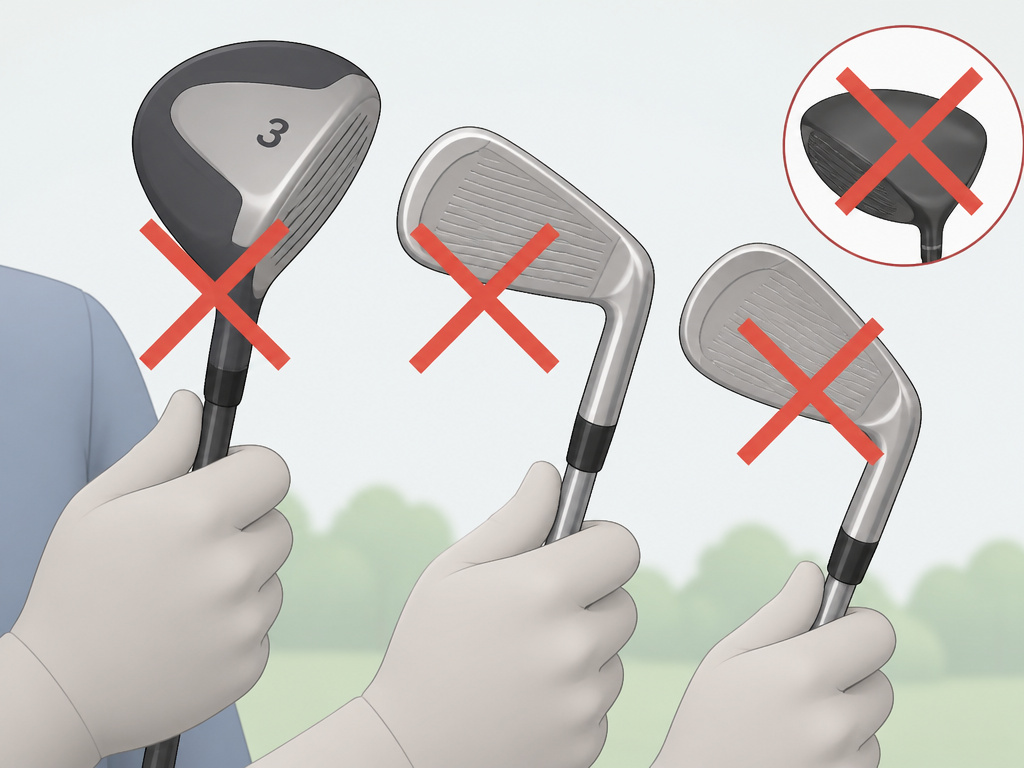 Your budget and bag space are limited. These clubs actively hurt a beginner’s game.
3-Wood (Below 15° Loft)
A low-lofted 3-wood (13-15°) is one of the hardest clubs in golf to hit off the ground. You lack the swing speed and precise strike needed. It will become a tee-shot-only club, duplicating your driver.
Long Irons (3, 4, 5-Iron)
The clubhead is small, the loft is low, and the margin for error is tiny. Even good players struggle with these. This is why hybrids exist. If your best hybrid clubs for beginners list is bookmarked, you’re on the right track.
Lob Wedge (58° or 60°)
This club requires a precise, shallow strike to be effective. In a beginner’s hands, it leads to skulled shots over the green or fat chunks that go three feet. Master your sand wedge first.
The “Tour” Driver
Any driver marketed with “low-spin,” “tour-preferred,” or “workability” is designed for elite swing speeds. It will be less forgiving and have less loft than you need. Stick to game-improvement models.
When and How to Add More Clubs
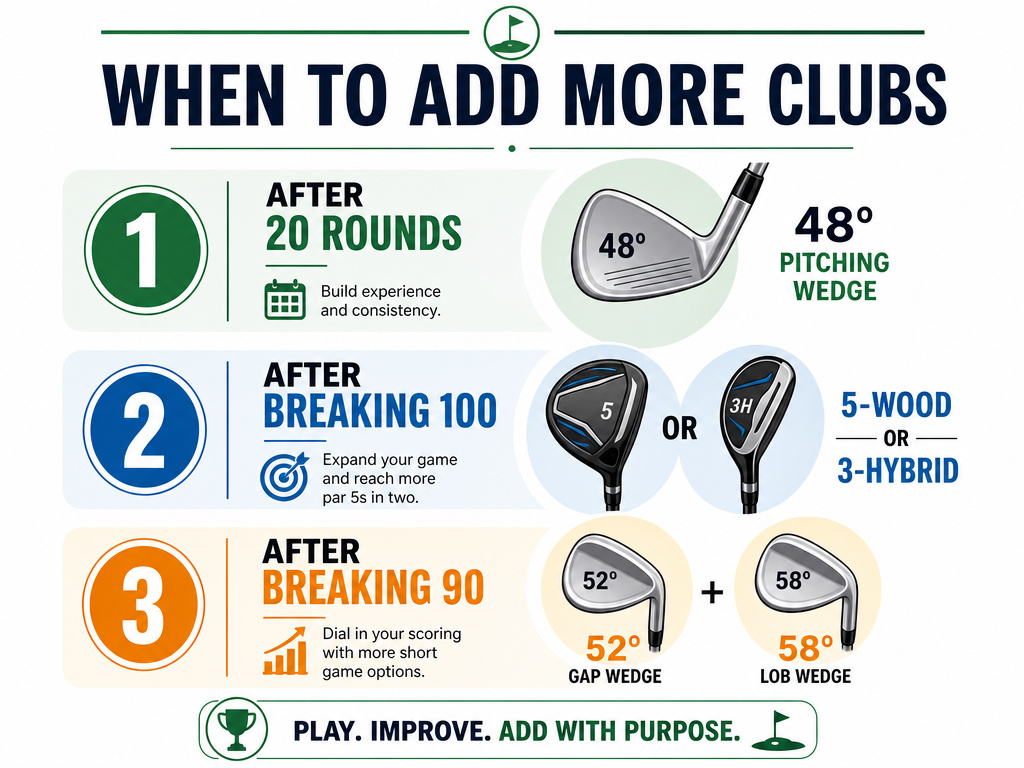 You don’t need 14 clubs today. You will need them eventually. Add clubs based on real gaps you discover on the course, not a theoretical checklist.
- After 20 Rounds: Add a Pitching Wedge (48°). This fills the gap between your 9-iron and sand wedge, giving you a more comfortable full-swing club for 80-100 yard shots.
- After Breaking 100: Add a 5-Wood or 3-Hybrid. By now, your swing is more consistent. This club gives you another option for long par-3s or second shots on par-5s.
- After Breaking 90: Consider a Gap Wedge (52°) and finally, a 3-Wood or Lob Wedge (58°). Your game now has the nuance to use them.
This gradual approach ensures every club in your bag has a purpose you understand. It also spreads out the cost. For a deeper look at this progression, our article on the best game-improvement clubs maps out the upgrades.
A Note on Men’s vs. Women’s Clubs
The differences are practical, not just cosmetic. Women’s sets typically have lighter overall weight, more flexible shafts, and shorter lengths to suit generally slower swing speeds and shorter stature. However, there’s no rule. A strong, tall woman might fit into a men’s “senior flex” set, and a shorter man with a slow swing might fit into a women’s set.
The best advice is to swing both. Pay attention to which feels easier to swing smoothly and which produces a better ball flight. Don’t get hung up on the label. The right fit is what gets the ball in the air consistently. We have specific guides for best women’s beginner clubs and best men’s beginner clubs if you want to start your search in the right aisle.
Frequently Asked Questions
Can I start with just 5 clubs?
Absolutely. A driver, 7-iron, 9-iron, sand wedge, and putter is a legitimate starting point. You’ll learn creativity and make-do, which are valuable skills. Many par-3 courses are perfect for this ultra-minimalist setup.
Are used clubs a good idea for beginners?
Yes, but with a caveat. Buy used modern game-improvement clubs (last 5-7 years). Avoid used blades or persimmon woods. Check grips for wear and shafts for cracks. A used set of forgiving golf clubs from a reputable brand is often the smartest first purchase.
Should a beginner get fitted for clubs?
No. Not a full, custom fitting. Your swing is changing too rapidly. A basic “static fitting” for height and hand size to get the right general length and shaft flex is sufficient. Save the detailed fitting for when you have a repeatable swing, usually after you can regularly break 100.
What’s more important, clubs or lessons?
Lessons, 100%. The best golf clubs for beginners won’t fix a flawed swing. Invest in a few group lessons to learn grip, posture, and basics. A good swing with mediocre clubs will always beat a bad swing with the most expensive equipment.
Do I need a special golf ball?
Don’t overthink it. Start with a low-compression, two-piece ball like a Callaway Warbird or a Srixon Soft Feel. They are durable, affordable, and designed for slower swing speeds. Save the premium urethane balls for later. Our rundown of the best golf balls for beginners has more specifics.
Before You Go
The biggest trap isn’t buying bad clubs—it’s buying too many clubs too soon. A bag cluttered with long irons and lob wedges you fear is a bag that makes golf feel complicated. Start with seven. Master them. Let your on-course experience, not a magazine ad, tell you what to add next.
I learned this the hard way trying to teach a complex shot to a player who just wanted to make contact. We spent a whole lesson on a draw he couldn’t use, and he left more confused than when he started. Strip it back. Good golf starts with a simple bag and a golf practice routine for beginners built around repetition, not magic. Your first set isn’t your last set. It’s just the right set for right now.
