
What Is a Driving Range & How to Use It: A Complete Guide
This post contains affiliate links. As an Amazon Associate, we earn from qualifying purchases.
This post contains affiliate links. As an Amazon Associate, we earn from qualifying purchases.
A driving range is a golf practice facility where you hit balls from designated bays into an open field with targets. To use it effectively, you need a clear plan: start with a short warm-up, work on one specific skill for no more than 45 minutes, and finish with a realistic game-simulation drill. The average outdoor range is 330 yards long, and hitting bays are typically 10 to 12 feet wide.
That length and width are the physical constraints that shape every practice session. A 200-yard range restricts driver use; a 12-foot bay dictates how much you can move.Your plan has to fit inside those lines.
What follows breaks down the facility itself, the unspoken rules that keep it functional, and the practice framework that turns bucket after bucket into actual improvement. We’ll strip it back to the mechanics of a session with a launch monitor.
Key Takeaways
- The standard outdoor driving range is 330 yards long with bays 10–12 feet wide, hitting a driver on a shorter range is unsafe and often prohibited.
- Limit focused practice on any one task to 45 minutes. After that, mental fatigue degrades your technique and you start ingraining mistakes.
- Range balls are limited-flight and harder than game balls, expect your 7-iron to carry 5-10 yards shorter than on the course.
- Mats are an advantage for beginners. They force a cleaner strike, sit the ball higher for easier contact, and provide consistent alignment aids.
- Your session must have a clear finish line. End by simulating three holes on the course, not by mindlessly hitting your last 20 balls.
The 330-Yard Layout & How to Use It
A driving range is an engineered practice environment. The average length, drawn from lighting design data by Access Fixtures, is 330 yards.Bays are spaced 10 to 12 feet apart. These numbers tell you what you can and cannot do.
A standard outdoor golf driving range measures approximately 330 yards in length from the hitting line to the back perimeter. Individual hitting bays or stations are typically 10 to 12 feet wide, providing adequate space for a full swing while maintaining safety and efficient land use. The field contains distance markers and target greens at intervals such as 50, 100, 150, 200, and 250 yards.
If you’re on a range that caps at 200 yards, leave the driver in the bag. The restricted length is a safety feature, not a challenge. The bay width is your operating theater. Set your bag at the back, align your body parallel to the left edge, and you’ve instantly created a repeatable setup station. That’s using the facility, not just occupying it.
The field itself is your feedback loop. Those colored flags are your distance benchmarks. A real practice session uses them to answer one question: how far does this club go today, with this swing?Don’t guess. Use the markers.
| Range Feature | What It Tells You | Common Misread |
|---|---|---|
| 150-Yard Flag | Your mid-iron carry distance. | Assuming it’s your “total” distance including roll. |
| Artificial Mat | A perfectly level, consistent lie. | Thinking fat shots off mats don’t count. |
| Bay Divider | Your swing path boundary. | Letting your follow-through cross into the next bay. |
| Range Picker Cart | The facility is live and collecting. | A target for amusement. |
Range Balls, Mats, and the Tools of Practice
The equipment provided changes the game. Literally. Range balls are built for durability, not performance. They have harder cores and tougher covers, and most are designed as limited-flight balls. The result is less spin and shorter carry. If your 7-iron flies 150 yards with a Pro V1, expect 140-145 yards with a range ball.
That’s not a flaw. It’s a filter. Distance control with range balls is about relative consistency, not absolute numbers. If you’re hitting your wedge 10 yards short of the 100-yard flag every time, your swing is repeating. That’s the win.
Where this goes sideways: Treating range distance as course distance. You’ll under-club on every approach shot. Note the gap for your key clubs and add the difference on the course.
Mats are the other great filter. Beginners often see them as a poor substitute for grass. I see them as a superior teacher for a new player. A mat doesn’t forgive a fat strike, you feel the jarring thud instantly. It presents the ball consistently higher, promoting cleaner contact. The rectangular shape is a built-in alignment tool. For building fundamentals, a good driving range mat is a better investment than a bucket of balls.
The Unwritten Code: Range Etiquette
The rules of golf don’t apply here, but the rules of shared space do. This is about respect and safety.
First, the range picker is not a target. The cage protects the operator, but your line shot is a distraction at best and harassment at worst. Second, your music stays in your ears. What’s motivation for you is noise pollution for the player in the next bay trying to focus. Use headphones.
Watch your angles. If you’re in a left-side bay, aim at left-side targets. Firing across the entire field at a right-side flag is how people get nervous, and how stray balls happen. Give the player next to you room. A crowded range feels tight, but if you both set up using your bay’s width, there’s plenty of space.
Finally, manage your mess. Don’t dump the entire bucket. Take 10-15 balls, hit them, then retrieve the next batch. Scattered balls are a tripping hazard and they signal you’re not paying attention. When you’re done, if you borrowed a shag bag for your own practice, collect your balls neatly.
Warm-Up vs. Practice: The Critical Split
 Most golfers waste their range time because they blend these two goals. They are different activities with different protocols. Jim Murphy, a GOLF Magazine Top 100 instructor, draws the line clearly.
A warm-up is physical preparation. It’s not for fixing your slice. You’re loosening muscles, establishing rhythm, and getting a feel for the day. Murphy’s template: 4-5 shots with a wedge, then a short iron, a mid-iron, a hybrid, and finally a driver or two. A small bucket is plenty. You’re done when your body feels ready, not when your swing looks perfect.
Practice is cognitive work. It’s where you diagnose and drill. This is where the 45-minute rule comes from. Murphy states that working on any single task longer than that leads to mental and physical fatigue. Diminishing returns set in, and you start reinforcing errors. Your brain checks out before your body does.
Here’s a practice structure that works: 1. Identify (5 min): What’s the one thing you’re fixing? Not three things. One. 2. Drill (25 min): Use exaggerated, slow-motion reps. Feedback is everything. 3. Integrate (15 min): Hit normal shots, focusing only on the feel of the change. 4. Stop.
I learned this the hard way early in my teaching. I once leaned too hard on a fancy alignment app during a lesson. The student became so locked on the screen data that his natural rhythm disintegrated. We spent the next 30 minutes just getting back to his baseline tempo. The tool overrode the feel. Good golf should feel less complicated the more you understand it.
Building a Session That Transfers to the Course
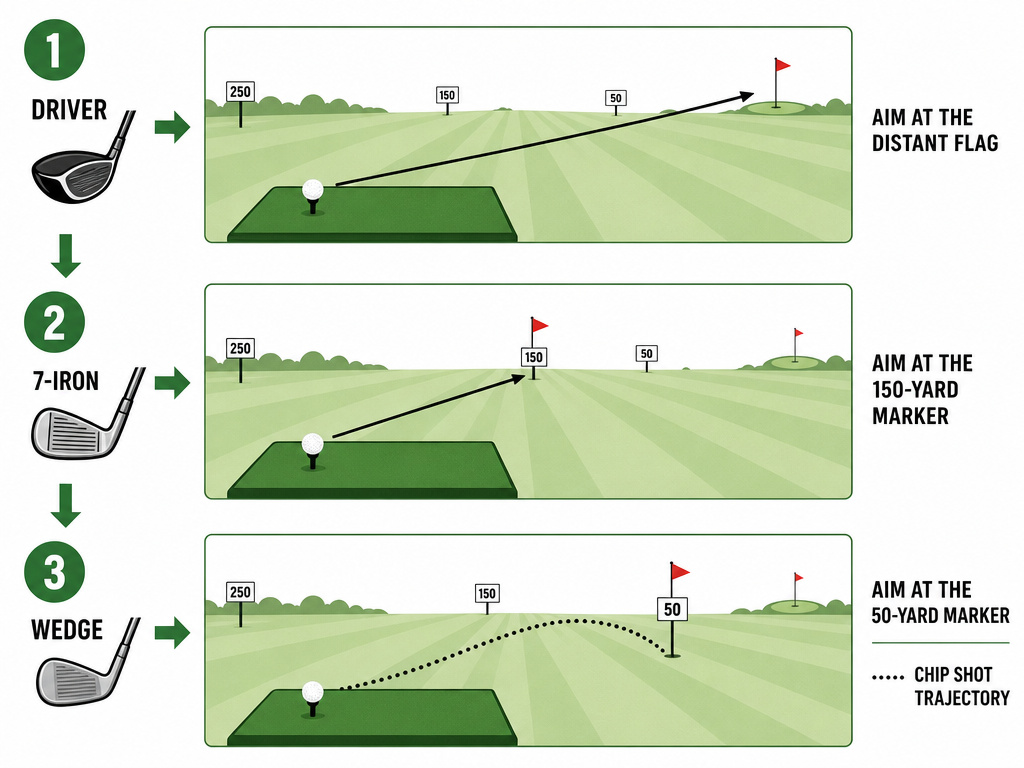 Mindlessly bashing a driver is the opposite of practice. It’s rehearsal for a skill you’ll rarely need. On the course, you hit your driver maybe 14 times. You hit wedges and putts over 50 times. Your practice plan should reflect that.
Start with the scoring clubs. Hit 20 balls with your sand wedge and pitching wedge, focusing on distance control and trajectory. Then move to your mid-irons. Use the range markers to build a reliable carry distance for your 7-iron and 5-iron. This is your foundation.
Only then should you touch your driver. And when you do, have a target. Don’t just “hit it far.” Pick a flag at 250 yards and try to land your ball in a 30-yard wide zone in front of it. That’s a fairway.
Common mistake: Ending a session by hitting your best club until you pure it. You’re finishing on a high note, but you’re not learning anything. You’re just confirming what you already do well.
End by playing the course. Simulate three holes: Driver, then 7-iron to the 150 flag. Pretend you missed the green. Hit a chip shot with your wedge to the 50-yard marker. That sequence, long game, approach, short game, is what actually lowers your score. It bridges the gap between the range’s isolation and the course’s demands. For a full weekly framework, a solid golf practice routine for beginners builds this in from the start.
Frequently Asked Questions
What’s the difference between a driving range and a golf course?
Driving range is for isolated repetition. You hit the same club multiple times toward a field. A golf course is for applied execution. You hit one shot with each club while navigating hazards, wind, and pressure. The range is the laboratory; the course is the exam. You need both, but they train different skills.
Can I use my own golf balls at the driving range?
Almost always, no. Ranges provide specially designed range balls for consistency, safety, and to protect their ball-collection equipment. Your premium ball could damage a mower or get mixed into their inventory. Using their balls is a condition of using their facility.
How many balls should I hit in a practice session?
It’s not about the ball count; it’s about the quality of focus. A focused 45-minute session with 70 balls is far more valuable than two hours of mindlessly hitting 200 balls. Once your concentration wanes, you’re done. Pack up. Better to leave wanting more than to stay and ingrain bad habits.
Are mats bad for your golf game?
For beginners, mats are beneficial. They provide a perfect lie every time, which builds confidence and encourages a ball-first strike. The potential downside is masking a slightly fat shot, the club can bounce into the ball. The fix is to listen and feel. A pure strike off a mat is quiet and solid. A fat strike is a loud, jarring thud. Pay attention to the feedback.
What is Topgolf?
Topgolf is an entertainment-driven driving range. It uses microchipped balls and targets for point-scoring games. The atmosphere is social, with food, music, and multi-level bays. It’s fantastic for fun and introducing new people to golf, but the shorter field (215-240 yards) and game-focused format make it less effective for serious technical practice than a traditional range.
The Bottom Line
A driving range is a tool. Like any tool, its value depends on how you use it. The golfer who shows up with a plan, respects the space, and understands the limits of range balls and mats is the one who walks away better.
Strip it back. Your goal is to leave with one swing thought that works and one concrete distance you can trust. Everything else is just exercise.The next time you go, spend the first five minutes reviewing that one thing from your last session. That’s how progress stacks up.
Com/best-golf-driving-nets/) or practice mats, master the public facility. Its constraints, the 330 yards, the shared bays, the limited-flight balls, will teach you more about adaptable, practical golf than a perfect private studio ever could.
