
Guide to Stableford Scoring: What It Is & How to Play
This post contains affiliate links. As an Amazon Associate, we earn from qualifying purchases.
Stableford scoring is a points-based golf format where you earn points on each hole by comparing your net score (gross score minus handicap strokes) to a fixed target, usually par. The standard point system awards 0 points for net double bogey or worse, 1 for net bogey, 2 for net par, 3 for net birdie, 4 for net eagle, and so on. You stop playing a hole once you reach net double bogey, and the player with the highest total points wins.
That “net double bogey” cutoff is the entire game. It’s not a suggestion—it’s the rule that lets you pick up your ball and move on. This changes how you approach a bad hole and directly addresses the two biggest complaints in amateur golf: slow play and the demoralizing effect of one disaster hole wrecking an entire round.
What follows is the full breakdown: the standard point table, exactly how your handicap strokes are applied using the course’s stroke index, the professional Modified Stableford variant, and the real-world strategy shift this format demands.
Key Takeaways
- You pick up your ball on a hole once your score reaches net double bogey; continuing is pointless and slows everyone down.
- Your handicap strokes are applied by stroke index, meaning you get shots on the hardest holes first, which directly changes your point target on those holes.
- A score of 36 points means you played to your handicap; tournament winners often score 40+.
- In professional Modified Stableford (like the Barracuda Championship), the point values are radically different to encourage aggressive, high-risk play.
- The format is mathematically equivalent to stroke play with a maximum score per hole, which is why some low-handicappers feel it favors higher handicappers.
The Standard Stableford Point System
Forget counting total strokes. Your card tracks points. The fixed target for comparison is typically par for the hole, adjusted by any handicap strokes you receive.
The linear scoring version of Stableford is mathematically equivalent to traditional stroke play but with the maximum score for each hole capped at a double bogey.
This is the core reference table. Bookmark it.
| Net Score Relative to Par | Points Awarded |
|---|---|
| Double Bogey or Worse | 0 |
| Bogey | 1 |
| Par | 2 |
| Birdie | 3 |
| Eagle | 4 |
| Albatross / Double Eagle | 5 |
The “net” part is critical. If you have a handicap stroke on a par-4, your par is effectively a 5. Making a gross 5 (one over par) gives you a net 4, which is net par, worth 2 points.
Where this goes sideways: Not knowing when to stop. The moment your score on a hole reaches net double bogey, you earn zero points. Any further strokes are wasted time. If you’re lying 5 on a par-4 where you get a stroke, your net score is 6—that’s net double bogey. Pick it up.
How Handicaps Adjust Your Target Score
Your playing handicap doesn’t give you a blanket discount. It allocates strokes hole-by-hole based on the stroke index printed on the scorecard. The stroke index ranks each hole from 1 (hardest) to 18 (easiest) for handicap purposes.
A player with a playing handicap of 12 gets one stroke deducted from their gross score on the 12 holes with stroke indexes 1 through 12. On the six easiest holes (indexes 13-18), they play off scratch.
Common mistake: Thinking a “bogey” is always worth 1 point. If you get a stroke on a par-4, a gross bogey (5) becomes a net par (4). That’s 2 points, not 1. The point value is tied to the net result, not the gross number.
This system is why understanding basic golf scoring terms like par, birdie, and bogey is non-negotiable. You’re constantly doing a quick mental conversion: gross score minus strokes equals net score, then net score to points.
For high handicappers, it gets more detailed. A 28-handicapper gets two strokes on the ten hardest holes (stroke index 1-10) and one stroke on the remaining eight. You must know your personal stroke allocation before you tee off. This is where a clear golf scorecard is essential for tracking.
Stableford vs. Stroke Play: The Strategic Shift
The formats demand different mindsets. In stroke play, every stroke counts equally toward a cumulative total. A quadruple bogey is a catastrophic four-stroke penalty you carry for the entire round.
In Stableford, that quadruple bogey is just zero points. It’s a blank. The next hole is a fresh start with the same point potential as the first tee. This psychological reset is the format’s greatest strength.
| Aspect | Stableford | Stroke Play |
|---|---|---|
| Goal | Highest point total | Lowest stroke total |
| Bad Hole Impact | Caps at 0 points; no lingering penalty | Penalty strokes accumulate in total |
| Pace of Play | Faster (players pick up at net double bogey) | Slower (players must finish every hole) |
| Mindset | Aggressive recovery after a bad hole | Risk-averse, protective of total score |
| Common Use | Club competitions, casual rounds | Most professional tournaments, club championships |
The strategic shift is immediate. On a hole where you’ve topped your drive into the bushes, the stroke-play instinct is to grind for a heroic recovery to minimize damage. The Stableford instinct is to assess: “Can I still make net bogey for a point?” If the answer is no, the smart play is to take an unplayable lie, add a penalty stroke, and get the ball back in play quickly. If even net bogey is out of reach, you pick up. You save energy and time for the holes where you can still score points.
Modified Stableford in Professional Golf

Very few pro events use this format, but when they do, they use Modified Stableford. The point values are changed to dramatically reward aggressive play and punish conservatism. The Barracuda Championship on the PGA Tour is the prime example.
Its scoring system is: * Double Bogey or Worse: -2 points * Bogey: -1 point * Par: 0 points * Birdie: 2 points * Eagle: 5 points * Albatross: 8 points
Notice the stakes. Par gets you nothing. A bogey actively hurts you. The only way to climb the leaderboard is to make birdies and eagles. This turns par-5s into must-attack holes and makes players take on pins they’d usually avoid. It’s a format designed for television excitement, where a player can make an 8-point swing on one hole. It’s a world away from the steady, risk-averse golf rules that usually govern pro play.
Why Club Golfers Love It (And Why Some Don’t)
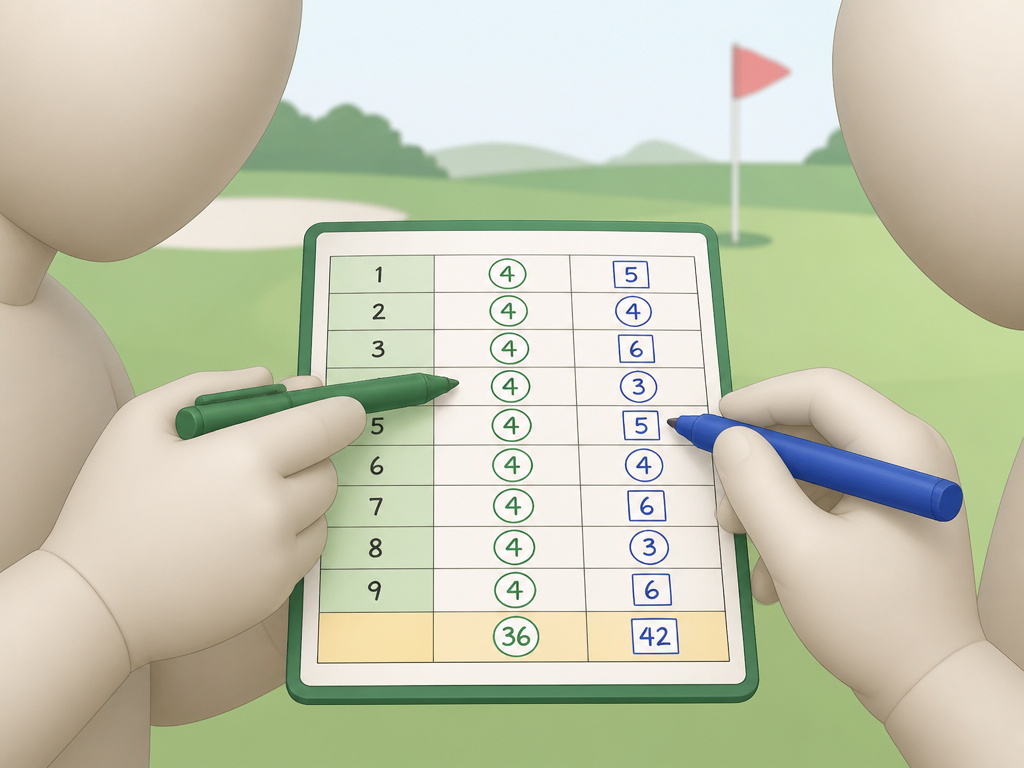
For the average amateur, Stableford is a gift. It solves practical problems. A blow-up hole doesn’t ruin your day or your group’s pace. You can post a competitive score even with a few disasters. As the Wikipedia page on Stableford notes, it was invented by Dr. Frank Stableford specifically to increase the pleasure of the “humble club golfer” and prevent them from giving up after a bad start.
The flip side is the perception it “rewards mediocrity.” A low-handicap golfer shooting a solid even-par round scores 36 points. A higher-handicapper having a great day relative to their ability can score 40 or 42 points. In a combined-field tournament, the higher-handicapper often wins. This can frustrate skilled players who feel their consistent, low-stroke play is undervalued compared to a volatile, high-point day from a higher handicap.
The short version: It’s a different game. It measures performance relative to personal potential, not absolute skill. Winning requires maximizing your own opportunities, not just beating the course.
Frequently Asked Questions
What is a good Stableford score?
Score of 36 points means you played exactly to your handicap. Scores in the mid-30s are solid. Anything 40 or above is an excellent round and will likely place you high in a club competition. The winner often has 42+ points.
Do you have to finish every hole in Stableford?
No. You must stop playing a hole once your score reaches net double bogey, as you can earn zero points. You can also pick up if your playing partners have already holed out and you cannot beat their score for the hole in a competition, but the net double bogey rule is the key one.
How do I mark a Stableford scorecard?
You write down your gross score for each hole you complete. Then, using the stroke index, you calculate your net score and the corresponding points. Most club scorecards have a “Points” column. Simply fill in the point value for each hole and total them at the end. Using a golf glossary can help decode any unfamiliar terms on the card.
Can you get negative points in Stableford?
In the standard system, no. The lowest score per hole is zero. In the professional Modified Stableford system, yes—bogeys and double bogeys deduct points. This is detailed in the USGA Rule 21 official rules for other forms of play.
What happens if I break a rule in Stableford?
You apply the standard rules for penalty strokes, which add to your gross score. You then calculate your net score and points with the penalty included. For specific serious breaches that would cause disqualification in stroke play, Stableford typically assigns zero points for the hole instead, as per The R&A other play forms documentation.
Is Stableford good for beginners?
Yes, it’s excellent. It reduces frustration, speeds up play, and lets you practice scoring on holes that are going well without being punished into finishing every single bad hole. It’s a more enjoyable introduction to competitive golf than straight stroke play.
Before You Go
Stableford isn’t a gimmick. It’s a pragmatic scoring system built for the reality of amateur golf. It acknowledges that bad holes happen and removes their power to wreck an entire round. The strategy is simple: know your stroke allocation, internalize the point table, and have the discipline to pick up when a hole is lost. This focus on maximizing point opportunities, rather than minimizing disaster, creates a faster, more positive round. Whether you love it or think it rewards the wrong things, it’s a format that has kept club competitions vibrant for nearly a century. Grab a scorecard, apply your handicap, and start counting points instead of strokes.
