
When to Use a Hybrid Around the Green for Better Chipping
This post contains affiliate links. As an Amazon Associate, we earn from qualifying purchases.
This post contains affiliate links. As an Amazon Associate, we earn from qualifying purchases.
Use a hybrid around the green for a low, running chip shot when the ball sits in light rough or a tight fairway lie with no obstacle to carry. The club’s 17- to 27-degree loft and smooth sole help it glide over grass, letting you use a simple putting stroke for consistent contact and roll. This shot is most effective for golfers with swing speeds under 100 mph, where the hybrid’s forward center of gravity provides stable launch instead of the destructive hooks seen on tour.
That loft range is the key. It’s just enough to pop the ball over the first few inches of cabbage but not so much that it flies high and stops dead. You’re trading air time for ground time, which is almost always the safer play from off the fringe.
What follows is a breakdown of the three conditions that make the hybrid chip the smart choice, the mechanics behind why it works (and when it fails), and the putting-style technique that makes it repeatable. We’ll also look at why you should ignore what you see in Rory McIlroy’s bag and instead watch what Nelly Korda does.
Key Takeaways
- The hybrid chip is a bump-and-run alternative best for light rough or tight lies where you need to carry only a short patch of grass before the ball can roll.
- Your swing speed decides if a hybrid is a forgiving tool or a liability. Golfers under 100 mph (closer to LPGA Tour averages) benefit most; speeds over 100 mph (PGA Tour range) amplify its hook bias.
- Use a standard putting grip and stroke. The club’s design does the work, don’t help it.
- Avoid this shot from deep rough, sand, or any lie where the ball must fly high and stop quickly. That’s a job for a wedge.
- The decline of hybrids among elite male players is a lesson in equipment physics, not a verdict on the club’s usefulness for everyday golfers.
The Three Lies Where a Hybrid Chip Saves Strokes
This shot isn’t a universal fix. It solves three specific problems around the green where a wedge is risky and a putter is useless.
First is the fringe-rough lie. Your ball is just off the putting surface, settled down a bit in the first cut. A putter will snag. A wedge requires a precise, descending blow you might not trust. The hybrid’s wide sole skims over the top, lifting the ball onto the green so it can start rolling.
Second is the tight fairway lie with a lot of green to work with. From 10-20 yards off the surface on short grass, the hybrid eliminates the threat of chunking or blading a wedge. You’re essentially putting from a distance.
Common mistake: Using a hybrid from deep rough. The clubhead will slide under the ball, causing a flub that travels a few feet. If the grass is above the ball’s equator, use a wedge.
Third is the slightly uphill lie just off the green. The hybrid’s built-in loft helps launch the ball up the slope with minimal effort, while its roll-heavy nature means it won’t race away if you hit it a bit firm.
| Lie Condition | Why a Hybrid Works | Risk with a Wedge |
|---|---|---|
| Light Rough / Fringe | Sole glides; loft clears grass | Snagging, inconsistent contact |
| Tight Fairway (long run) | Eliminates fat/thin shots; promotes predictable roll | Bladed shot over the green; chunked shot short |
| Uphill Lie | Loft assists elevation; roll maintains control | Requires a perfect lofted strike to stop near the hole |
If you have to carry a bunker or a water hazard, put the hybrid away. That’s a different shot.
Why Your Swing Speed is the Deciding Factor
The research on tour usage tells the real story. On the PGA Tour, hybrids are nearly extinct. Among the world’s top 20 male players, you might find two in their bags total. They prefer high-lofted fairway woods or utility irons.
The reason is physics, not opinion. A hybrid has a forward center of gravity (CG) due to its shallow front-to-back profile.
A PGA Tour player swinging a hybrid north of 100 mph experiences amplified offline dispersion. The forward CG can turn a slight draw into a destructive hook that’s hard to control. Conversely, a 7-wood’s larger footprint projects the CG further back, creating superior stability at high speeds.
Now, flip to the LPGA Tour. Here, hybrids are common. Nelly Korda and Lydia Ko often carry them. The average LPGA driver swing speed is around 96 mph, and hybrid speed is closer to 87 mph.
At that velocity, the forward CG isn’t a volatility amplifier, it’s a launch helper. It gets the ball up easily for players who can’t generate towering height with a long iron. This is the critical insight for recreational players.
Most amateur male golfers have swing speeds much closer to LPGA Tour pros than to PGA Tour pros. If you’re not swinging a hybrid over 100 mph, you likely won’t fight the hook bias the elites do. For you, the hybrid is a forgiving tool that simplifies long shots and short game shots alike.
The Hybrid Putting Stroke: A Step-by-Step Guide
The technique works because it’s simple. You are putting, just with a longer, lofted club. Complexity is the enemy.
- Grip Down and Use Your Putting Grip. Choke down to where the club feels like your putter’s length. This improves control and helps you stand closer to the ball. Use your standard putting grip, no need to strengthen or weaken it.
- Set Up in Your Putting Posture. Ball position is center or slightly forward. Your eyes should be over or just inside the ball. Let the hybrid’s heel rise off the ground naturally; it’s designed to do that.
- Make a Smooth, Pendulum Stroke. Your goal is to brush the grass, not take a divot. The hybrid’s sole will prevent digging. Keep grip pressure light and accelerate gently through impact.
- Expect a Low Launch with Plenty of Roll. The ball will come out lower than a wedge shot and run out like a putt. Judge the speed as you would a long putt, accounting for green slope.
Skipping the grip-down step is the most common error. Using the full length of the hybrid makes the stroke long and unwieldy, destroying any feel for distance. The shot becomes a stab.
Where this goes sideways: Trying to help the ball into the air with a wristy scoop. The hybrid has the loft built in. A scoop adds backspin and inconsistency, often leading to a thin shot. Trust the club.
Practice this stroke from the fringe for ten minutes. The feeling of the club gliding is the feedback you want.
Hybrid vs. Wedge vs. Putter: Choosing Your Weapon
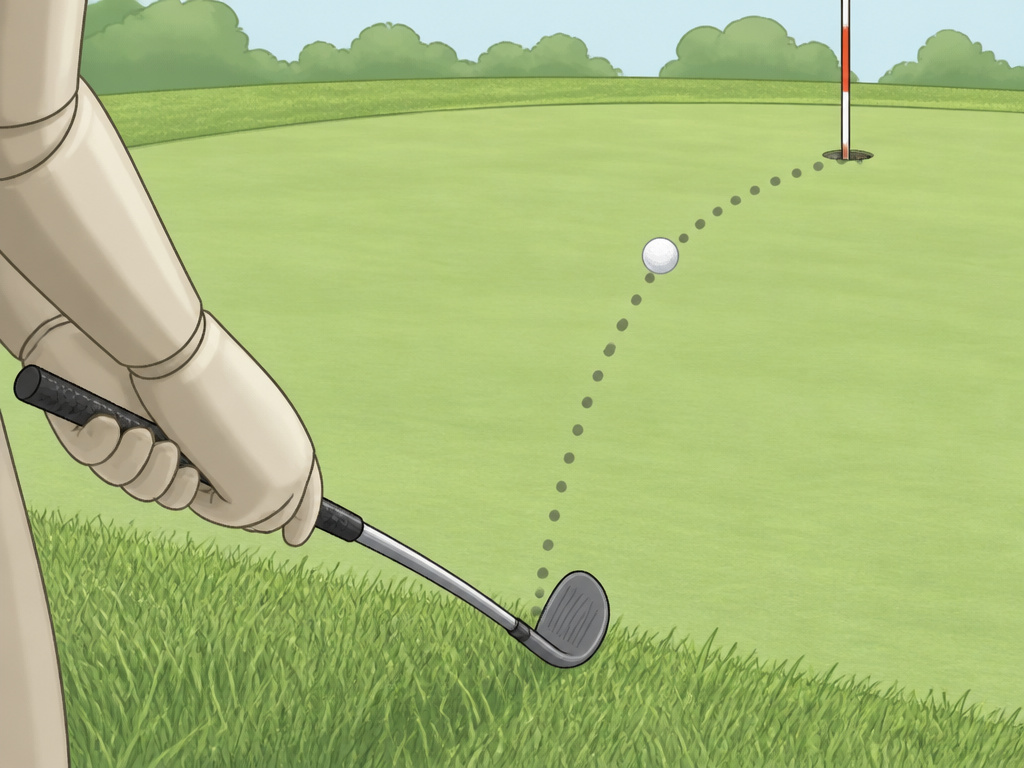 This is a decision tree, not a coin toss. Each club has a specific job based on lie, required trajectory, and the amount of green you have to work with.
| Club | Best For | Trajectory | When It’s Wrong |
|---|---|---|---|
| Hybrid | Light rough, tight lies, uphill chips, maximum roll | Low launch, high roll | Deep rough, carries over hazards, fast downhill chips |
| Wedge | Carrying obstacles, stopping the ball quickly, any lie with grass behind the ball | High launch, low roll | Tight lies (risk of blade), long rolling chips |
| Putter | Any time the ball is on the green or the fringe is very short and smooth | Ground-level roll | Any grass that will impede the clubface |
The hybrid shines as a specialist for the bump and run. It’s more forgiving than a 7-iron for that shot because its sole won’t dig. If your standard chipping technique with a wedge is unreliable from iffy lies, the hybrid is a fantastic safety valve.
It is not, however, a replacement for learning proper wedge selection. It’s one more option in your short-game toolkit.
Why Elite Male Golfers Are Ditching Hybrids (And Why You Shouldn’t)
 The trend is clear at the highest level. Since around 2014, with the rise of refined utility irons like the Titleist T250U, the hybrid’s spot in the pro bag has dwindled. For a player like Scottie Scheffler, a utility iron offers a similar launch with a more compact profile and workable shape.
For them, the hybrid’s forgiveness is a trade-off. The larger clubhead and forward CG that help amateurs are a source of unpredictability at their speed. A slight miss hits the gear effect more pronouncedly, spinning the ball offline.
Russell Henley is a rare exception, a top-ten player who routinely carries a hybrid. His smoother, controlled swing tempo likely manages the CG dynamics better than a player with a more aggressive transition.
This tour trend is a fascinating equipment lesson, but it’s poor advice for most golfers watching at home. Your game is different. Your swing speeds are different. Your need for forgiveness is greater.
When considering the role of a hybrid in your bag, look to LPGA WITB (What’s In The Bag) features, not PGA Tour ones. The game they play, prioritizing consistency, height, and forgiveness over raw workability, is far more relevant to your own.
Practicing the Hybrid Chip: Drills for Confidence
You need to build trust that this shot is easier than it looks. Start on the practice chipping green.
The Gate Drill: Place two tees in the ground just wider than your hybrid head, creating a gate a foot in front of your ball. Practice making strokes where the clubhead passes through the gate without touching the tees. This teaches you the low, brushing path.
The Three-Ball Drill: Place one ball on the fringe, one in the first cut of rough, and one on a tight fairway lie. Hit each to the same hole using only your hybrid. This trains you to adjust for the slight resistance change in each lie while maintaining the same stroke.
Distance Control Ladder: Pick a hole and try to hit hybrid chips that finish 3 feet short, 6 feet short, and 9 feet short. Don’t aim at the hole; aim for a distance. This develops the feel for how far back your stroke needs to be for different lengths.
After a short session, this shot will feel less like a trick and more like a standard part of your short game strokes gained strategy. It’s a shot that saves par.
Frequently Asked Questions
Can you use a hybrid out of a bunker?
No. The hybrid’s wide, smooth sole is designed to glide, not dig. In a bunker, you need a wedge to cut through the sand under the ball. A hybrid will bounce into the ball’s equator, causing a skull shot over the green or a complete whiff.
What loft hybrid is best for chipping?
Hybrid in the 21- to 27-degree range (typically a 4- or 5-hybrid) is ideal. This provides enough lift to clear the rough but keeps the trajectory low for ample roll. A lower-lofted hybrid (like a 2-hybrid) may not get the ball up quickly enough from a fluffy lie.
Is a hybrid chip legal under the rules of golf?
Absolutely. The Rules of Golf allow you to use any club for any shot. There is no restriction against using a hybrid around the green. Your choice of club is always a matter of strategy, not legality.
Why does my hybrid chip sometimes go left?
Hook with a hybrid chip usually means you are using your full swing hands, not your putting stroke. You’re likely adding wrist hinge or rotating the clubface closed through impact. Go back to the grip-down, pendulum motion. Let the loft do the work.
Should high-handicappers use this shot?
Yes, it’s highly recommended. The hybrid chip simplifies contact, which is the biggest hurdle for high-handicappers around the green. It removes the fear of chunking or blading the ball, making it a reliable forgiving hybrid club option. It’s one of the fastest ways to improve your up-and-down percentage.
The Bottom Line
The hybrid around the green is a tactical shortcut. It turns a difficult wedge shot into a simple putting stroke for a specific set of lies. Ignore its fading popularity on the PGA Tour, that’s a story about physics at 115 mph, not about your game. For the majority of golfers, adding this shot is a clear net gain. It provides a safe, repeatable way to navigate the tricky ground between the fringe and the green, turning potential three-putt scenarios into easy tap-ins. Keep it simple, trust the loft, and let the ball roll.
