
Driver vs Fairway Wood vs Hybrid vs Iron: Key Differences
This post contains affiliate links. As an Amazon Associate, we earn from qualifying purchases.
This post contains affiliate links. As an Amazon Associate, we earn from qualifying purchases.
Choosing between a driver, fairway wood, hybrid, and iron isn’t about picking a favorite club. It’s about matching four distinct tools to the specific demands of distance, launch, lie, and your own swing. The driver is for maximum distance off a tee. The fairway wood is for high-launching distance from the fairway or tee. The hybrid is for versatile forgiveness from various lies. The iron is for precision and a penetrating ball flight.
That split defines the top of your bag. Get it wrong, and you carry dead weight while facing shots your remaining clubs can’t handle. A recent robot test by Golf Digest using Ping G440 clubs revealed a critical insight: for an 85 mph swing speed, a steeper attack angle with a 4-iron gained over five yards of carry simply by dropping spin by 400 rpm. That’s not a small tweak, it’s a different club choice.
What follows is a breakdown of the physics, the data-driven decisions, and the common mistakes that cost strokes. We’ll move past the generic advice and into the specifics that change club selection from a guess into a strategy.
Key Takeaways
- Swing speed dictates viability. A driver needs at least 85 mph to be effective; an 18-degree hybrid becomes unreliable below 80 mph, often producing a shallow, rolling shot that won’t hold a green.
- Descent angle is the deciding metric. You need a landing angle of 40-45 degrees to stop a ball on the green. Fairway woods and hybrids create this; long irons often do not unless you have high swing speed.
- The “hybrid from rough” rule is flawed. Data from Shot Scope on over 80 million shots shows both 15-handicap and scratch golfers actually have a lower mishit percentage with a fairway wood from the rough than with a hybrid.
- Shaft specifications matter mechanically. Most fairway woods use a .335 tip diameter shaft, while most hybrids use a .370 tip. This affects shaft options, feel, and how the clubhead releases through impact.
- Center of Gravity (CG) location predicts flight. A fairway wood’s CG is deepest and lowest, promoting high launch. An iron’s CG is closest to the face, producing a lower, piercing trajectory. The hybrid sits in between.
The Core Design Differences (And Why They Matter)
This isn’t about looks. The physical design of each club type dictates its job. Confuse them, and you’re trying to screw in a nail with a wrench.
A fairway wood’s center of gravity is furthest from the face, an iron’s is closest, and a hybrid’s splits the difference. This CG placement is the primary engine behind launch angle, spin, and forgiveness.
Start with the head. A driver is the largest, designed for maximum ball speed and forgiveness on a tee shot. A fairway wood, like a Callaway Quantum Max 7-wood, has a smaller, shallower head than a driver but a deeper face than a hybrid. It’s built to be swept off the turf or a tee peg. A hybrid head is compact, designed to cut through rough and resist twisting. An iron head is a solid blade of precision, offering the least forgiveness but the most workability.
The shaft length drops as you move down the line. Longer shafts, like the driver’s, create higher potential clubhead speed but demand more control. The shorter hybrid shaft offers more manageability, which is why many find it easier to hit than a long iron of the same loft.
Then there’s the hidden spec: the shaft tip diameter. Most fairway woods use a .335 tip diameter. Most hybrids use a .370 tip. If you’re ever reshafting or building a custom club, this is the difference between a part that fits and one that doesn’t. The .370 tip on a hybrid also contributes to a stiffer feel in the hosel, moving the club’s balance point closer to that of an iron.
When to Use a Driver, Fairway Wood, Hybrid, or Iron
Forget the club number. The shot you face tells you what to hit.
Use the Driver exclusively off a tee when you need maximum distance and have a wide landing area. Its low loft and large head make it inefficient and inconsistent from the fairway. It’s a specialist.
Use a Fairway Wood (like a 3-wood or 5-wood) from the tee on tight par-4s or par-5s where accuracy is premium, or from a good lie in the fairway when you need long-distance carry to a green. Its design promotes a high launch, which is necessary for holding par-5s in two. For more on picking the right loft, our guide on the 3 wood vs 5 wood breaks down the versatility trade-off.
Use a Hybrid when you need a high, soft-landing shot from a variety of lies. This includes light rough, fairway bunkers, or a tight fairway lie where a long iron would be difficult. It’s your rescue club. However, don’t assume it’s magic from deep junk, data says otherwise. If you’re in the market for one, start your search with our reviews of the best hybrid clubs available.
Use a Long Iron or Driving Iron in three specific scenarios: off the tee on a firm, windy day where a low, running shot is an advantage; when you have a perfect fairway lie and need a penetrating trajectory; or if you are a high-speed player who launches every club high and needs to bring the ball flight down. See our picks for the best driving iron for low handicappers.
Where this goes sideways: Reaching for a hybrid automatically from the rough. Shot Scope data shows a 15-handicapper will mishit 30% of hybrids from the rough versus 26% with a fairway wood. The hybrid encourages overconfidence in terrible lies.
Performance by the Numbers: Launch, Spin, and Distance
Loft is just the starting point. Two clubs with the same loft can produce wildly different results based on their design.
| Club Type (at ~21° loft) | Typical Launch Angle | Typical Spin Rate | Best For | Common Mistake |
|---|---|---|---|---|
| 7-Wood | High (14-16°) | High (4000-5000 rpm) | High launch from fairway, soft landing | Using from deep rough where head can get stuck |
| 4-Hybrid | Mid-High (12-14°) | Mid-High (3500-4500 rpm) | Versatile launch from various lies | Assuming it replaces an iron with the same number (loft is key) |
| 4-Iron | Mid (10-12°) | Mid (3000-4000 rpm) | Penetrating trajectory, wind play | Using with low swing speed (<80 mph), resulting in no carry |
The robot test data is clear. For a player with an 85 mph swing speed, delivering a steeper blow with a 4-iron dropped spin significantly and added yards. But that same player might lack the speed to launch a 4-iron high enough to hold a green. That’s the gap a hybrid fills, it provides that steeper-angle benefit with a design that launches higher inherently.
The descent angle is your final judge. To stop a ball on the green from 200 yards out, you need it coming down at roughly 45 degrees. A fairway wood or hybrid will get you there. A long iron, unless struck perfectly with high speed, will come in at 35-40 degrees and run through the green. This is why understanding your own driver and iron setup is foundational, ball position changes launch.
The Swing Speed Threshold

Your clubhead speed is the governor on this entire system. It determines not just how far you hit each club, but whether you should even carry it.
| Swing Speed | Driver | Fairway Wood (3W/5W) | Hybrid (3H/4H) | Long Iron (3/4) |
|---|---|---|---|---|
| < 80 mph | Ineffective; lacks carry distance | 5-wood or 7-wood is best option for launch | 4-hybrid or higher loft (26°+) needed | Avoid; cannot generate sufficient height or spin |
| 80-95 mph | Effective; standard gapping | 3-wood for tee, 5-wood for fairway is ideal mix | The sweet spot; hybrids will outperform long irons | 4-iron may work; 3-iron is difficult |
| > 95 mph | Maximized distance | Can game lower-lofted woods (3-wood, strong 5-wood) | Optional; can choose hybrids or irons based on preference | Full set of long irons is viable and often preferred |
The threshold is stark. If your driver swing speed is below 85 mph, your primary goal with the clubs at the top of your bag should be achieving launch and stopping power, not raw distance. This often means a 5-wood is a better fit than a 3-wood, and a 5-hybrid is essential.
The part nobody mentions: An 18-degree hybrid is nearly useless for a player with an 80 mph swing speed. The ball speed is too low to create a high enough launch or a steep enough descent angle. The ball will land hot and roll out, making distance control and holding greens impossible.
For players in that 80-95 mph range, the majority of amateur golfers, the hybrid is the king of versatility. It corrects for the most common amateur flaw: a steeper, more descending attack angle. The hybrid’s design rewards that strike pattern better than a fairway wood or a long iron.
Building Your Optimal Bag Setup
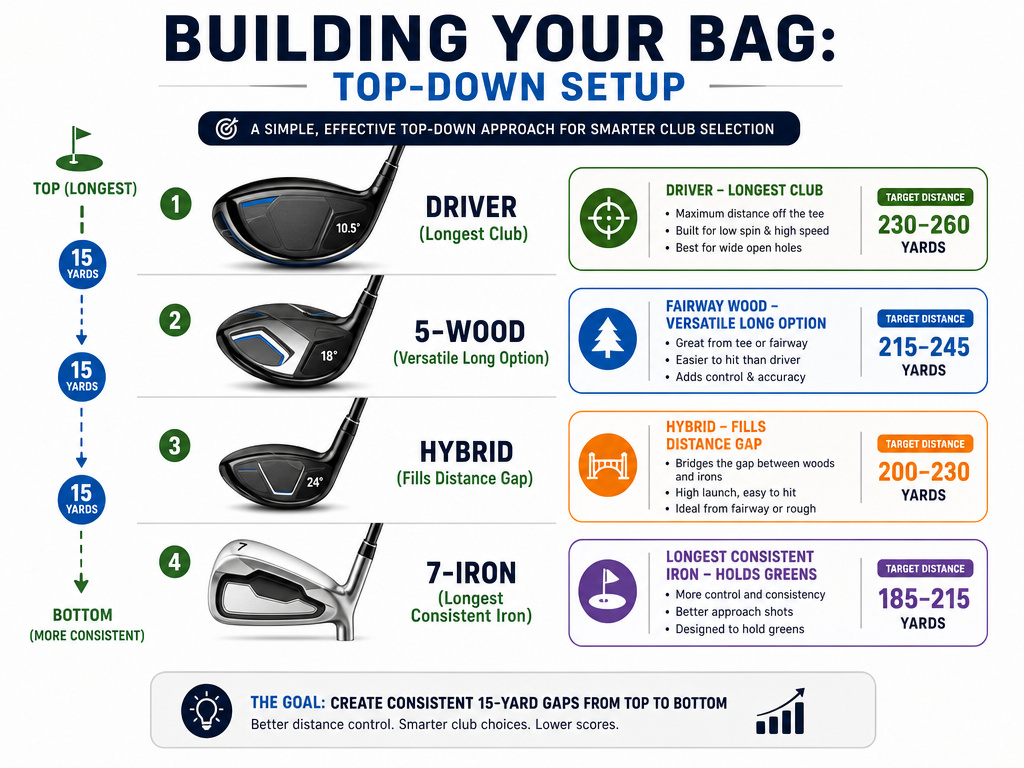
You have 14 clubs. Wasting one on a club you can’t hit or that duplicates another’s distance is a strategic error. Let’s build from the top down.
- Driver. This is non-negotiable for almost every bag. It’s your longest club.
- Fairway Wood Slot. Pick one or two. If you struggle with a 3-wood, a 5-wood is almost always a better, more versatile choice. It’s easier to launch and often goes just as far due to better contact. For a deep dive on the best options, our fairway wood reviews can help.
- The Hybrid/Iron Decision. This is your most important choice. Don’t look at the number on the sole. Look at your gapping on a launch monitor.
- Hit your 5-wood. Note the carry distance.
- Hit your 5-iron. Note the carry distance.
- The club(s) that fill that gap are what you need. It might be a single 3-hybrid, or it might be a 4-hybrid and a 5-hybrid. The goal is consistent 12-15 yard gaps.
- Iron Set Starting Point. Your longest iron should be the one you can hit consistently high enough to hold a green. For many, this is a 6- or 7-iron. Everything longer than that should be a hybrid. Explore different iron set reviews to find a set that starts at the right long-iron for you.
- The Driving Iron Wild Card. This replaces a hybrid or fairway wood, not an iron in your set. It’s for the player who needs a low, running tee shot on firm courses or in high wind. It’s a specialist, not a daily driver.
The logic is simple. Cover your distances with the clubs that give you the most predictable, playable result. For most golfers, that means hybrids fill the gap between the fairway wood and the mid-irons. The debate over hybrid irons versus traditional sets is really about how far down the bag this principle should extend.
Frequently Asked Questions
What club replaces a 3-iron?
3-iron typically has 19-21 degrees of loft. The direct replacement is a 3-hybrid or a 5-wood, but the choice depends on your needs. The 5-wood will launch higher and land softer. The 3-hybrid will offer a more penetrating flight and better performance from rough. You must test both.
Can I use a hybrid instead of a 5-wood?
Yes, but understand the trade-off. A 5-wood (usually 18-21°) will generally launch higher, spin more, and land softer than a hybrid of the same loft. The hybrid will be easier to hit from poor lies and offer a more controlled flight. For some players, the hybrid is a smarter, more versatile choice than a 5-wood.
Why do pros use driving irons instead of hybrids?
Professional golfers have the high clubhead speed (often 105+ mph with a 6-iron) and precise strike needed to launch a driving iron high enough for it to be effective. They also often play in windy conditions or on firm courses where the low, penetrating flight of a driving iron is a significant advantage. They use it as a specialist tool, not a full replacement for hybrids.
How does a mini-driver fit into this comparison?
mini driver is a niche club that sits between a driver and a 3-wood. It has a smaller head than a driver (around 250cc) but more loft, offering more control and better performance from the fairway than a driver, while providing more distance than a standard 3-wood. It’s for the player who struggles with a 460cc driver but wants more off-the-tee distance than a fairway wood provides.
My hybrid and 4-iron go the same distance. What should I do?
This is a common gaping problem. First, verify the lofts, they are likely very similar. You only need one. Choose the club you are more confident with, the one that produces a more consistent ball flight, and the one that performs better from your most common lie (fairway vs rough). Then, adjust the loft of the other club or replace it with a club that fills the actual distance gap in your bag.
Before You Go
The driver, fairway wood, hybrid, and iron are a toolkit. You wouldn’t use a sledgehammer to hang a picture. Don’t use a driver from the rough or a 3-iron from a fairway bunker.
The modern bag is built for forgiveness and specific outcomes. Let the data guide you. If your swing speed is under 95 mph, hybrids are almost certainly your friends. If you fight a high ball flight in the wind, a driving iron has a place. Your final setup should be the one that gives you a confident, repeatable shot for every yardage and lie you regularly face. That’s how you turn the top of your bag from a liability into an asset.
