
Golf Grip Pressure | The 3-4/10 Fix That Adds 8.3 Yards
This post contains affiliate links. As an Amazon Associate, we earn from qualifying purchases.
Hold a golf club at a 3 or 4 out of 10 pressure for full shots. This is the optimal range identified in a 12-golfer study, which found that reducing pressure from the typical 7/10 to 3/10 added an average of 8.3 yards of carry with a 7-iron. Grip pressure should be secure but not tense, allowing your wrists to hinge freely and your forearms to stay relaxed.
That number – 3 to 4 out of 10 – is the result of a structured test with an EMG pressure sensor. The study quantified what every good player feels: a death grip locks your forearms, shortens your backswing arc, and steals clubhead speed before the club even moves.The 8.3-yard gain comes from releasing that built-in brake.
What follows is the breakdown of that study, the physics of why tension costs you distance, and the three-second drill that resets your pressure before every shot. You’ll also learn why your pressure likely drifts upward after the 10th hole, how to adjust for chipping and putting, and the one sensor technology that shows you the data in real time.
Key Takeaways
- The correct golf grip pressure for full swings is 3–4 on a scale of 1–10, where 1 is barely holding the club and 10 is a maximum squeeze.
- A 12-golfer study found that moving from a common 7/10 pressure down to 3/10 added an average of 8.3 yards of 7-iron carry without any swing change.
- Golfers over 40 are particularly prone to over-gripping due to reduced hand sensitivity, arthritis compensation, and adrenaline spikes on pressure shots.
- For chipping and putting, pressure should be slightly higher at 4–5/10 to stabilize the clubface for precision without killing feel.
- The last three fingers of your lead hand should provide the primary support, not your palms or thumbs.
What Is the Correct Golf Grip Pressure? (The 3-4/10 Rule)
Forget “hold it like a baby bird.” That Sam Snead quote is poetic but useless for calibration. The correct golf grip pressure is a 3 or 4 on a scale of 1 to 10.
This isn’t an opinion. A 12-golfer study using an EMG pressure sensor embedded in a glove measured the effects. When participants were asked to grip “comfortably,” they averaged 7.3 out of 10 – 2.7 times higher than the optimal range. Consciously reducing pressure to the 3–4 range added an average of 8.3 yards of carry with a 7-iron. Dispersion tightened by 22%.
The optimal pressure range of 3–4/10 produces the highest clubhead speed by allowing full, unrestricted wrist hinge. Forearm muscle activation at 9/10 pressure is 34% higher than at 3/10, which physically blocks the wrist joint and shortens the swing arc.
At 3/10, your hands feel secure. The club won’t twist, but your forearms are soft. You can waggle the club freely. If someone tried to pull it from your hands, they could with a firm tug – that’s the test. If you can resist them completely, you’re in the 7+ range and leaving distance on the table.
This principle applies whether you use a Vardon grip or an interlocking style. Pressure is separate from placement.
Why Most Amateurs Grip at a 7 (And Feel Nothing Wrong)
You don’t feel the tension because it’s your normal. The study’s “comfortable” 7.3 average proves that. Three age-related factors make this worse after 40.
First, reduced proprioception. The nerve receptors in your hands become less sensitive, so you lose the fine-tuned ability to judge force. You think you’re at a 5, but your hands are at a 7.
Second, arthritis compensation. Finger or wrist pain triggers an instinctive tightening response. Your brain reads joint pain as instability and adds grip force to “protect” it. This is why finding the right grip size is critical – a thicker grip can reduce this compensatory squeeze.
Third, adrenaline. On the first tee or a tight drive, cortisol spikes. This causes involuntary muscle activation, including in your hands and forearms. The shots where you need the most freedom are when you grip the hardest.
| Grip Pressure (1-10) | Avg 7-Iron Carry | Avg Dispersion | What It Feels Like |
|---|---|---|---|
| 3-4 (Optimal) | 183.4 yds | 12.1 ft | Secure, relaxed forearms, free wrist hinge |
| 5-6 (Moderate) | 179.1 yds | 14.8 ft | Firm, slight forearm tension, controlled |
| 7-8 (Too Tight) | 175.8 yds | 18.3 ft | Tense, locked wrists, rigid swing |
| 9-10 (Maxed Out) | 171.2 yds | 22.6 ft | White-knuckle, painful, no feel |
The Physics: How Grip Pressure Steals Your Distance
The distance loss is simple mechanics. A tight grip creates tension that travels up your forearms into your shoulders.This tension reduces your wrist hinge range of motion.
Your wrists are the primary speed multiplier in the swing, like the middle of a whip. Grip the whip’s handle with both fists, and the wave can’t travel through to snap the tip. Hold it loosely, and the energy transfers fully.
A 2019 study in Applied Sciences on hand-arm vibration quantified this. It found that a medium grip force (0.044 MPa of pressure) resulted in the lowest vibration and fastest damping of shock after impact. Weak and strong grips both produced higher, longer-lasting vibrations in the hands.
Common mistake: Squeezing at the top of the backswing. This is where pressure spikes for most amateurs, shortening the arc just as the club should be fully loaded. If you feel a “clench” at the top, you’ve already lost speed.
The EMG data from the 12-golfer study showed that at 9/10 pressure, forearm muscle activation was 34% higher than at 3/10. This activation physically prevents the wrists from fully cocking. The result is an estimated 12–15 degree reduction in your backswing arc. Less arc means less time and space for the clubhead to accelerate. You’ve put a governor on your engine.
This is also why your proper stance matters. If you’re off-balance, your hands will instinctively grip tighter to regain control, starting the destructive chain of tension before you even take the club back.
The Pre-Shot Calibration Drill That Takes 3 Seconds
You can’t just think “be looser.” You need a physical routine to recalibrate your hands before every full swing. This drill takes three seconds and works immediately.
- Squeeze to 8/10. Grip the club and consciously tighten until you feel definite tension in both forearms. This is your reference for “too tight.”
- Release to 4/10. Ease off until the tension is roughly halved. Your hands should still feel secure on the club, but your forearms should feel noticeably looser.
- Perform a single slow waggle. If your wrists hinge freely and the clubhead feels heavy, your pressure is correct. If the club feels rigid, release a bit more.
- Hold that tension through the swing. Your goal is to not increase pressure from this point at address all the way to the top of the backswing.
Incorporate this into your pre-shot routine. The muscle memory builds fast. For accelerated feedback, dedicated grip trainers can provide real-time pressure readings.
Lead Hand vs. Trail Hand: Where the Pressure Actually Lives

Your hands have different jobs. Your lead hand (left for right-handed players) controls the clubface and is the primary force producer. Your trail hand adds speed and guidance.
- Lead Hand Pressure: Should be concentrated in the last three fingers (pinky, ring, middle). These fingers provide stability and control. The thumb and index finger form a light “trigger” grip, adding guidance without pressure.
- Trail Hand Pressure: Should be lighter, focused in the middle two fingers. The trail hand’s palm should feel like it’s covering the lead thumb, not squeezing it. A study measuring vibratory dose found the trail hand undergoes a 13.6% higher vibration load than the lead hand at impact – extra tension here exacerbates that shock.
Where this goes sideways: Adding trail-hand pressure from the top of the downswing. Data from The Golf Lab’s SensorGrips study shows slicers add far too much trail-hand pressure as they start down, shoving the club outside the ideal path. Pros do the opposite – they ease grip pressure in this segment.
If you fight a slice, focus on the feel of your trail hand “letting go” or relaxing as you change direction from backswing to downswing. This allows the club to fall behind you, promoting an inside path.
Does Grip Pressure Change for Short Game and Putting?
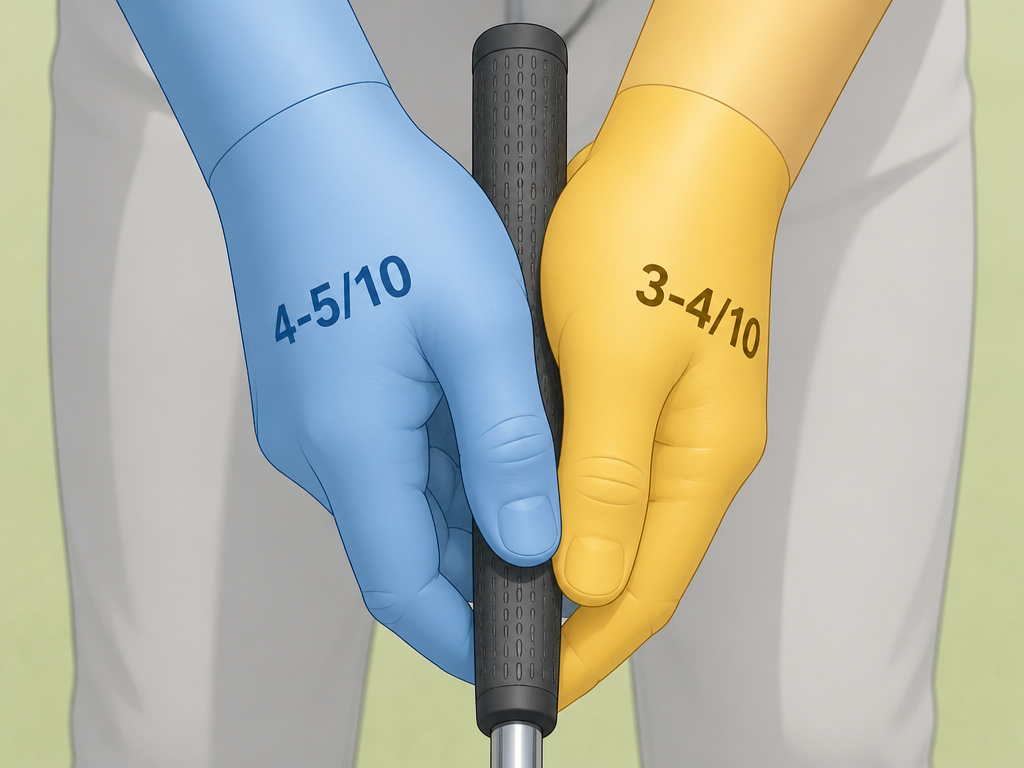
Yes, and the adjustment surprises most golfers. For chipping and putting, optimal pressure moves slightly higher to 4–5 out of 10.
The reason is control, not power. Short game shots require precise face angle at impact. A slightly firmer grip reduces the micro-rotations in your hands that cause pushes and pulls on short putts or thin chips.
The mistake is applying full-swing “baby bird” logic to your putter. A death grip kills all feel. At 4–5/10, you should still feel the putter head’s weight and be able to maintain a smooth stroke. This is where the quality of your golf grips or a specialized putter grip can aid consistency.
For bunker shots and flop shots, revert to your full-swing 3–4/10 pressure. These shots require wrist hinge and release, and tension is the enemy.
Tools and Tech That Give You Real Feedback
Feeling pressure is hard. Technology makes it visible.
- HackMotion: This wearable sensor measures wrist angles in real time. When your grip is too tight, you’ll see spikes in wrist extension or flexion, showing how pressure directly disrupts your clubface control.
- SensorGrips/EMG Gloves: Used in the cited studies, these have thin-film force sensors that map your pressure point-by-point. They’re the gold standard for seeing your personal “grip signature.”
- Training Aids: Simple tools like the GripTec Trainer or Orange Whip have built-in feedback mechanisms that force you to hold at a specific tension to use them correctly.
While tech is great for diagnosis, the goal is to develop your own feel. Use these tools for a range session or two to identify your default pressure, then practice the calibration drill until it becomes automatic. Pair this with a high-traction grip for sweaty hands if moisture is causing you to over-squeeze for security.
Frequently Asked Questions
How hard should you hold a driver compared to an iron?
Your driver grip pressure should be the same as your iron pressure: 3–4/10. The longer club and intent to swing hard often cause pressure to creep up to 6 or 7. Consciously apply the calibration drill before driver swings. The goal is powerful, not forced.
Can the wrong grip pressure cause a slice?
Absolutely. As The Golf Lab’s data showed, slicers consistently add too much trail-hand pressure from the top of the downswing. This pushes the club outside the ideal plane, creating an out-to-in path. Fixing grip pressure is often more effective than trying to change your swing path directly.
Does a strong or weak grip change the pressure?
No. Grip orientation (strong vs. Weak) is about hand placement. The ideal 3–4/10 pressure applies regardless. A player with a strong grip can still hold too tightly, and a player with a weak grip can hold too loosely. Pressure and position are separate levers.
How often should I check my grip pressure?
Check it before every full swing as part of your pre-shot routine using the calibration drill. Pressure has a tendency to drift upward during a round, especially under fatigue or stress. The 12-golfer study found self-reported pressure increased by an average of 1.8 points from the 1st to the 18th hole.
Will lighter grip pressure make me lose control?
It feels that way at first, but the data says the opposite. The study showed dispersion (side-to-side shot spread) decreased by 22% at optimal 3/10 pressure compared to 7/10. A secure-but-relaxed grip allows your body to rotate the clubface naturally, leading to more consistent contact, not less.
The Bottom Line
Stop guessing. Hold the club at a 3 or 4 out of 10 for every full swing. That specific number comes from measured data, not old sayings. It’s the difference between forcing the swing and letting it happen.
The 8.The 3 yards you gain comes from releasing the brake you didn’t know you were applying. Use the three-second squeeze-and-release drill before every shot, focus the pressure in your lead hand’s last three fingers, and understand that a slightly firmer 4–5/10 touch is better for putting.Your hands aren’t just connecting you to the club; they’re the valve controlling your power. Keep it open.
