
How to Hit Over a Tree Every Time: The 3-Second Method
This post contains affiliate links. As an Amazon Associate, we earn from qualifying purchases.
This post contains affiliate links. As an Amazon Associate, we earn from qualifying purchases.
To hit over a tree, you need two numbers: the height of the obstacle and the distance to your target. Choose a club with enough loft to launch the ball at least 10-15 feet above the tree’s top, play the ball forward in your stance, and make a full, committed swing. The most common failure is decelerating through impact, which kills trajectory and sends the ball into the trunk.
The “10-15 feet above” clause is the margin that accounts for spin and wind. A ball launched exactly at the tree’s height has no buffer; a gust or a high-spin shot that balloons can still catch a branch. That buffer is the difference between a successful recovery and a penalty stroke.
What follows is the system: how to measure the real obstacle, how to select the club that actually gets the ball up, the setup adjustments that add loft without manipulation, and the one swing thought that prevents the fatal deceleration. By the end, you’ll have a repeatable 3-second pre-shot routine for any tree you face.
Key Takeaways
- Measure twice, swing once. Use a rangefinder to get the exact height of the tree and the distance to your landing area. Guessing is how you hit the trunk.
- Loft is your friend, but only if you trust it. Reaching for less loft to “smash” it over is the instinct that fails. A 60-degree wedge launched fully will always fly higher than a choked-down 9-iron you’re trying to help up.
- Ball position dictates trajectory. For maximum height, play the ball off your front instep. This automatically adds loft and promotes a steeper, ascending strike.
- Accelerate through the grass. The swing must be aggressive through impact. Any hesitation or attempt to “scoop” kills clubhead speed and results in a low, weak shot.
- Commit to the shot you picked. Indecision is the real enemy. Once you select your club and spot, rehearse the feel and execute without second-guessing.
The Two Numbers That Decide Everything
Forget the flag for a moment. Your first job is to get two precise measurements: the vertical height you must clear and the horizontal distance you need to carry.
The part nobody mentions: You aren’t measuring to the flag. You’re measuring to a safe landing zone past the tree. If the tree is 50 yards away and 30 feet tall, you need a shot that carries 55 yards and peaks at 45 feet. That 5-yard buffer is your margin for error.
A laser rangefinder with slope compensation is the best tool here. Shoot the top of the tree, then shoot the ground where you want the ball to land. The height reading gives you your clearance target. The carry distance tells you which club in your bag can feasibly hit that target with the required height.
If you don’t have a rangefinder, use a course marker and basic math. A standard 30-foot pine tree is about 10 yards tall. Pace off the distance from your ball to the base of the tree, then to your target. That gives you a workable estimate.
| Club | Typical Max Height (ft) | Best For Clearing… | Risk If Loft Is Insufficient |
|---|---|---|---|
| 60° Lob Wedge | 80-100+ | Tall, close trees (20-60 yd carries) | Can come up short if you don’t commit to a full swing. |
| 56° Sand Wedge | 70-85 | Medium trees (50-80 yd carries) | May not have enough peak height for trees over 40ft. |
| 52° Gap Wedge | 60-75 | Lower trees, longer carries (70-100 yds) | The borderline club; mis-hits won’t get up. |
| Pitching Wedge / 9-Iron | 50-65 | Only very low obstructions (100+ yds) | Almost always the wrong choice. Lacks the launch angle. |
This table isn’t a suggestion. It’s physics. A Titleist Vokey SM10 lob wedge is designed to launch the ball at a 45-degree angle or higher. A 9-iron’s designed launch is closer to 30 degrees. You cannot argue with the numbers. When in doubt, take more loft.
Club Selection: It’s Not About the Yardage
You look at the gap wedge and think, “That’s my 100-yard club.” For a standard shot to a green, you’re right. For hitting over a tree, that mental yardage is useless. You must think in terms of launch window and peak height.
A Callaway Jaws Raw 60-degree wedge, struck cleanly, will send the ball on a steep parabola. It might only travel 70 yards total, but it will spend 50 of those yards above 30 feet. That’s the resource you’re buying. You’re trading total distance for vertical space.
Where this goes sideways: Choosing a club that could reach the flag if you hit it perfectly, but doesn’t have the loft to clear the tree if you don’t. This is how a slightly thin Ping Glide 4.0 gap wedge finds the top branches when a full lob wedge would have sailed over.
The data doesn’t lie. Modern launch monitors like TrackMan or Foresight GCQuad show that for a 50-yard carry over a 30-foot tree, you need a launch angle of at least 50 degrees and a spin rate above 9,000 RPM to stop the ball quickly. Only your highest-lofted wedges produce those numbers. Your middle irons cannot.
The Setup: Your Stance is a Trigger
Once the club is in your hand, your body must be arranged to promote the high, soft shot you need. This isn’t about swinging differently; it’s about setting up so your normal swing produces a different result.
- Widen your stance slightly. This lowers your center of gravity and creates a stable base. You’re not making a big turn; you’re making a controlled, vertical swing.
- Play the ball forward. Position it off the instep of your front foot. This ensures the clubhead is still ascending when it makes contact, adding loft and creating a higher launch.
- Open your stance and clubface. Align your body slightly left of the target (for a right-handed golfer). Then, open the clubface a few degrees so it points at the target. This adds even more effective loft.
- Weight stays centered. Avoid leaning back onto your rear foot to “help it up.” This leads to a fat or scooped shot. Your weight should be 50/50 or even slightly forward at address.
- Choke down for control. Grip down about an inch on the handle. This gives you better feel and control for the shorter, more aggressive swing you’re about to make.
Each of these adjustments has a mechanical job. The ball position and open face add loft. The wide stance and centered weight prevent swaying. The choked-down grip improves strike quality. Skip one, and you’re adding variables back into a shot that needs simplicity.
The Swing: Accelerate Through the Grass
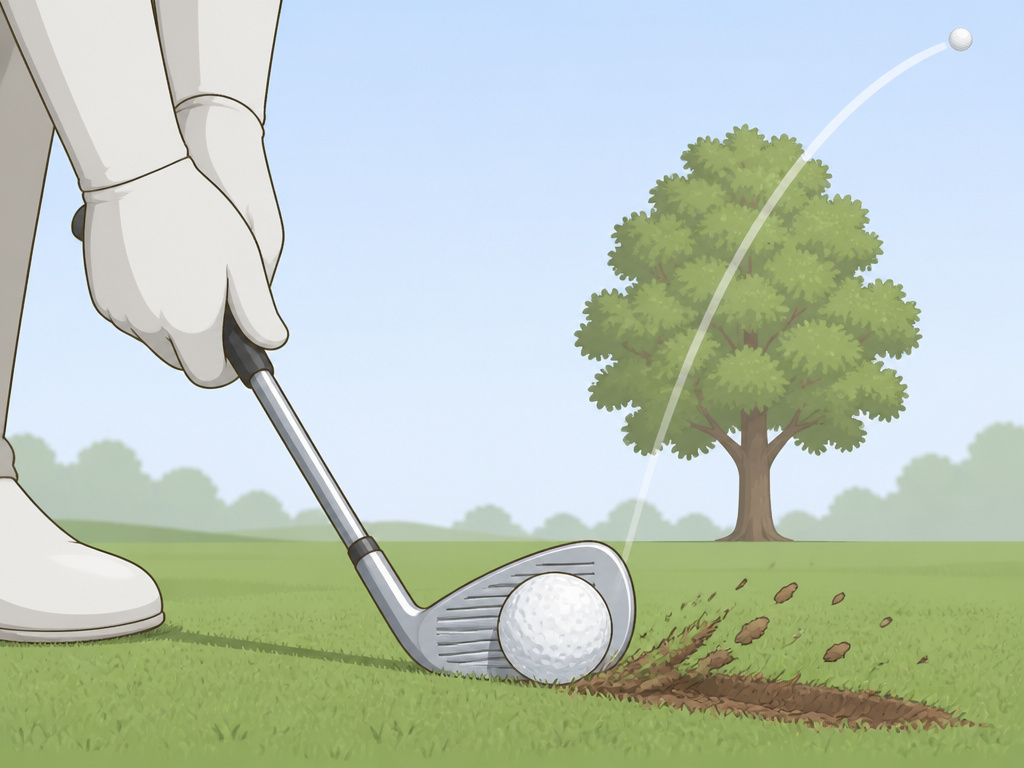
The swing thought is simple: “Low and slow back, accelerate through.” Any other thought invites disaster.
Common mistake: Trying to lift the ball by scooping with your hands or slowing down through impact. The club’s loft does the lifting. Your job is to deliver the clubhead with speed and a crisp strike.
Take the club back smoothly, keeping your hands low and your tempo controlled. Your backswing should feel almost lazy. The power comes on the downswing. From the top, initiate the downswing with your lower body and aggressively shift your weight forward. Your arms and hands should feel like they are chasing the ball down the target line.
You must hit the ball, then the turf. The divot should start after the ball. A clean, ball-first contact is non-negotiable for generating spin and a penetrating trajectory that still climbs. If you hit the ground first, the shot is dead.
This is where amateurs bail. They see the tree and subconsciously slow the clubhead, fearing a sky-high shot. That deceleration is what produces the low, weak smack into the trunk. Trust the loft. Commit to the speed. The low stinger shot is for a different problem; here, height is the entire goal.
When Not to Go Over (And What to Do Instead)
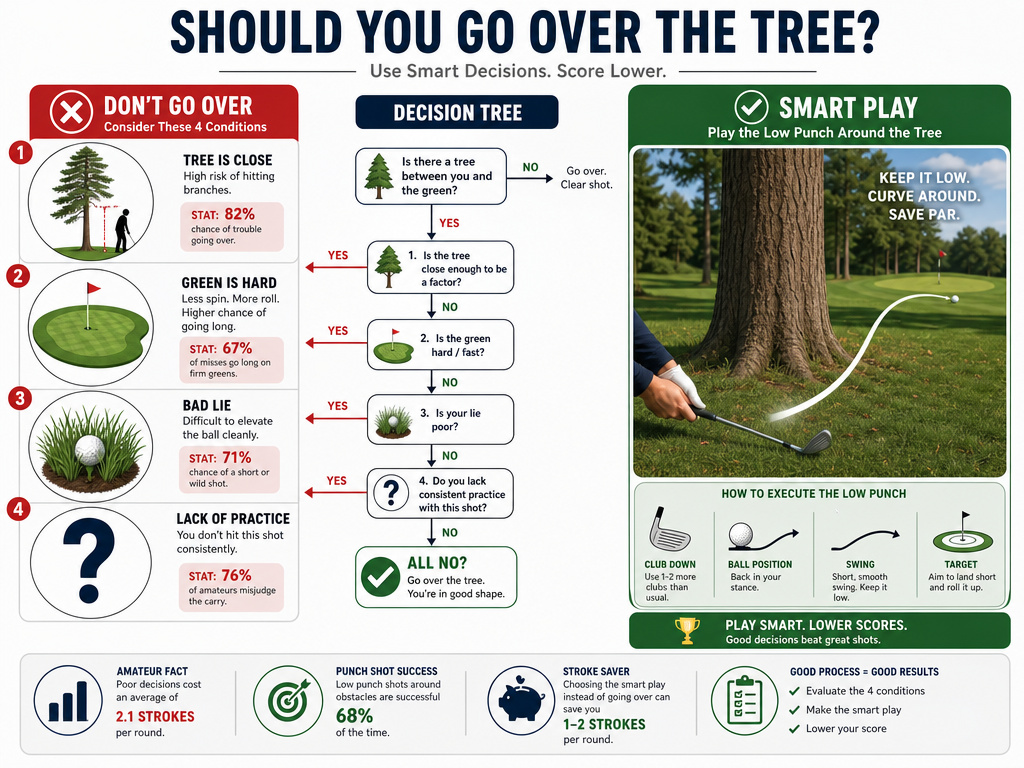
The heroic shot isn’t always the smart shot. Knowing when to lay up or go around is a mark of course management, not cowardice.
Don’t go over if:
- The tree is too tall and too close. If you need a 70-degree launch angle to clear it, physics is against you. Even a high flop shot has limits.
- The green is hard and fast with trouble behind. A high, soft landing shot is hard to control. If you miss the green long, you might be in a worse spot.
- You have a poor lie. Bare dirt, deep rough, or a downhill lie rob you of the clean contact you need. From a downhill lie, the ball will naturally come out lower.
- You haven’t practiced the shot. If you’ve never hit a 60-yard lob wedge over a house, don’t try it in a tournament.
In these cases, your best move is often to punch shot out sideways back to the fairway. Take your medicine, advance the ball safely, and try to save par with your next shot. The how to shape a draw or how to shape a fade are skills for bending the ball around an obstacle, which is often a higher-percentage play if you have the room.
| Situation | Smart Play | Why It’s Better |
|---|---|---|
| Dense, tall tree directly in line | Punch out to fairway | Guarantees a full shot into the green. |
| Tree to one side, open to the other | Intentional fade or draw | Uses the ground and is easier to control than a vertical shot. |
| Bad lie (buried, downhill) | Chip out safely | Ensures clean contact and avoids a double-hit disaster. |
| High wind | Low knockdown | Wind murders high shots; keep it under the gusts. |
How to Practice the “Over-a-Tree” Shot
You can’t learn this shot on the course. You need a controlled environment where failure has no consequences.
- Find a driving range with targets. Use the 50-yard or 75-yard marker as your “landing zone.” Visualize a tree at 30 yards out.
- Start with your highest lofted wedge. Hit ten shots trying to get the ball to land softly on the target. Focus solely on the feeling of accelerating through impact and the sound of a crisp strike.
- Introduce a physical obstacle. Some ranges have practice nets or poles. If yours doesn’t bring an alignment stick, hold it vertically in the ground at a specific distance. Aim to clear it.
- Use technology. If you have access to a launch monitor, note your launch angles and peak heights. Work on achieving a consistent 50+ degree launch with your lob wedge.
- Practice the pre-shot routine. Step off the distance (in your mind), pick your spot, rehearse the swing, and execute. Do this until the process is automatic.
This kind of focused practice builds the muscle memory and, more importantly, the confidence you need to pull the shot off when it counts. It turns a desperate gamble into a calculated part of your reliable iron play arsenal.
Frequently Asked Questions
What’s the best club to hit over a 50-foot tree?
The lob wedge (58 or 60 degrees) is almost always the answer. It provides the necessary launch angle to clear extreme heights on a shorter carry. No other club in your bag is designed to launch the ball that steeply. Trying to force a gap wedge or pitching wedge to do it requires a perfect, high-risk strike.
How far back in my stance should I play the ball?
You shouldn’t. For maximum height, play the ball forward—off your front instep. Playing it back de-lofts the club and promotes a lower, penetrating flight, which is the opposite of what you need. The forward position helps you strike the ball on the upswing.
Why do I keep hitting the tree even with a wedge?
Two reasons: deceleration and poor strike. If you slow down your swing through impact, you lose clubhead speed and the ball doesn’t get up. If you hit the ground before the ball (a fat shot), all the energy is lost into the turf. The fix is to commit to an aggressive, accelerating swing and focus on hitting the ball first.
Can I use this technique from the rough?
Yes, but it’s much harder. The grass will grab the clubhead and reduce spin, causing a “flyer” that goes lower and farther than expected. You need to account for this by taking more club (maybe a sand wedge instead of a lob wedge) and swinging even more aggressively to get through the grass. A shot from a downhill lie in the rough is one of the hardest shots in golf; often, going around is wiser.
How do I stop being scared of the tree?
Practice and process. Fear comes from uncertainty. When you have a practiced routine—measure, select, setup, commit—you replace fear with procedure. On the course, once you’ve made your decision, look only at your landing spot, not the tree. Your brain will follow your eyes. Visualize the ball soaring over, not crashing into.
The Bottom Line
Hitting over a tree isn’t a magic trick. It’s applied physics and committed execution. You need the right loft, a setup that promotes height, and a swing that accelerates through the ball. The data from your shot-tracking system like Shot Scope or Arccos Caddie will prove that the high-lofted wedge is the percentage play more often than your instincts suggest.
The next time you’re behind a tree, run the three-second check: Height? Distance? Lie? If the numbers say lob wedge, pull it without hesitation. Set up for height, swing with conviction, and watch it clear. That single shot can turn a bogey into a par and change the entire momentum of your round. Now you have the system. Go use it.
