
Par 3 or Executive Course? Deciding the Best Fit for You
This post contains affiliate links. As an Amazon Associate, we earn from qualifying purchases.
This post contains affiliate links. As an Amazon Associate, we earn from qualifying purchases.
A par 3 course is a short layout where every hole is a par 3, typically 9 holes with an average length under 150 yards. An executive course is a longer short course that mixes par 3 and par 4 holes (sometimes a par 5), usually spanning 18 holes and designed for a quicker full round. The real difference isn’t just length, it’s the intended experience, the clubs you’ll use, and the specific golfer each one serves.
Most golfers use the terms interchangeably, and that’s where the confusion starts. One is built for a fast, focused practice session or a social hour. The other is engineered to compress a full 18-hole round into two hours while still demanding strategic decisions. Your choice changes which clubs stay in the bag, how you manage your game, and what you walk away having practiced.
What follows is a breakdown of specs, design intent, and real-world examples. You’ll see the data from famous layouts, understand why architects build them, and get a clear guide on which course type matches your current game.
Key Takeaways
- An executive course is almost always 18 holes and includes par 4s, while a par 3 course is usually 9 holes of nothing but par 3s.
- The average par 3 hole on a dedicated course is 115 yards; an executive course’s par 4s can stretch beyond 300 yards, forcing the use of every club.
- Par 3 courses target short-game practice and beginners. Executive courses are for players who want a full round’s strategic test in half the time.
- Your score on a par 3 course doesn’t translate to a handicap. Your score on a rated executive course often does.
- Choosing wrong means either getting bored with no challenge or getting frustrated because you brought the wrong tools.
The Core Difference: Par 3 Course vs Executive Course Defined
Forget the vague descriptions. The distinction is in the numbers and the official designations. A par 3 course has a total par of 27 for 9 holes or 54 for 18 holes, every single hole is a par 3. An executive course has a total par between 58 and 62 for 18 holes, blending par 3s and par 4s to create a shortened but complete round.
The yardage gap is the first tangible clue. Look at the post-2023 renovation specs for the most famous par 3 course in the world. The Augusta National Par-3 Course stretches 1,055 yards over 9 holes, with an average hole length of 117 yards. Its longest hole is 155 yards. Now, look at a modern executive course like The Nest at Sandhill Crane. Designed by Nicklaus Design, it’s an 18-hole par 54 layout that measures just over 3,000 yards from the back tees. Its longest hole is a 256-yard par 4. That’s a 100-yard difference on a single hole compared to Augusta’s longest.
A par 3 course tests your iron play and putting on a small, precise scale. An executive course tests your ability to play a complete round, tee shot, approach, chip, putt, on a condensed battlefield.
This structural difference directly shapes the golf course architecture. A par 3 course fits into tight, unused parcels of land (Bandon Preserve was built on 22 acres between two big courses). An executive course needs more room to accommodate those longer par 4s and the strategic landing areas that make them interesting.
Par 3 Course: The Short-Game Laboratory
Every shot is a scoring opportunity. You’re never more than a wedge or short iron from the green, which means the margin for error is tiny. The greens are often small and well-guarded, making accuracy paramount. This is where you learn distance control with your wedges, how to flight a mid-iron, and how to read subtle breaks on the green.
The experience is fast and social. You can play 9 holes in under an hour and a half, often carrying just a few clubs. It’s the perfect environment for beginners to learn the flow of the game without the intimidation of 450-yard par 4s. It’s also where seasoned players sharpen the part of the game that saves strokes. According to 2025 Shot Scope data, the average amateur hits the green only 40% of the time from 100-150 yards. A par 3 course is built to improve that exact statistic.
Executive Course: The Condensed Championship Test
Here, you need your whole bag. A round on a good executive course like Hamilton Farm’s Hickory Course or Threetops Par-3 will force you to hit driver, fairway woods, long irons, and every wedge. The design incorporates the full principles of golf course design, doglegs, risk-reward choices, and varied green complexes, but on a smaller footprint.
The goal is to offer the cognitive load of a full 18-hole round in a fraction of the time. You still have to plot your way around, manage trouble, and recover from mistakes. It’s ideal for the player short on time who still wants a satisfying strategic challenge, or for the mid-handicapper looking to build on-course strategy without the physical fatigue of a 6,500-yard slog.
| Feature | Par 3 Course | Executive Course |
|---|---|---|
| Typical Length | 9 holes, 1,000–1,500 yards | 18 holes, 2,800–3,500 yards |
| Hole Composition | All Par 3s | Mix of Par 3s & Par 4s (sometimes a Par 5) |
| Average Hole Length | 110–140 yards | 150–250 yards |
| Primary Focus | Iron play, wedges, putting | Full-round strategy, club selection |
| Time for 18 Holes | 1.5 – 2 hours | 2.5 – 3.5 hours |
| Best For | Beginners, short-game practice, quick social rounds | Time-pressed golfers, full-round practice, course management |
Who Each Course Is For (And Who It’s Not)
Matching the course type to your goals saves frustration. Putting a high-handicapper on a long, tricky executive course too soon can reinforce bad habits. Putting a low-handicapper on a basic par 3 course might offer zero challenge.
Choose a Par 3 Course If…
- You are new to the game. The shorter distances are less intimidating. You can focus on making contact and learning golf scoring basics (par, bogey, double) without losing a dozen balls.
- Your short game is a weakness. You get 9 or 18 green-side chances in a row. There’s no better way to grind on wedge distance control and putting.
- You have less than 90 minutes. A quick loop at a place like Lake St. Clair Metropark Par 3 Course is a legitimate golf fix.
- You’re playing with kids or non-golfers. The pace is faster, the walking is easier, and the atmosphere is generally more relaxed.
Where this goes sideways: Using a par 3 course to “test your driver.” You won’t hit it, and if you try, you’ll fly over everything and learn nothing. That’s not its job.
I learned this the hard way in my early teaching days. I once tried to use a complex swing-tracking app that spit out twenty data points for a beginner. It paralyzed him. He focused on the numbers, not the feel. I stopped using it. A par 3 course is the opposite of that app, it strips away complexity and gives you one simple task: get the ball on the green. Good golf comes from simpler, repeatable movements, and that’s where these courses excel.
Choose an Executive Course If…
- You want a full round’s worth of strategy in half the time. You’ll face legitimate club selection dilemmas, do you take driver over the corner? Can you hold this green with a 4-iron?
- You’re preparing for a trip to a championship course. It’s the best simulation for managing your game under a time constraint and making consecutive smart decisions.
- Your long game needs on-course reps. You’ll hit your driver and fairway woods in situations that matter, which range practice can’t replicate.
- You care about posting a score for your handicap. Most executive courses have a USGA course rating and slope, so your rounds count.
The executive course is a test of efficiency. It asks if you can translate range work to the course and make smart choices quickly. For a deep dive on managing longer layouts, our guide on course strategy for high handicappers offers a solid framework that applies directly to executive course play.
Design Intent and Real-World Examples
Architects don’t build these by accident. A par 3 course is a deliberate practice ground or a charming add-on. An executive course is a deliberate alternative to the modern 7,000-yard beast.
Par 3 as Showcase and Social Hub: Threetops Par-3 in Michigan is carved into a mountainside with dramatic elevation drops. It’s ranked the #1 par-3 course in America not because it’s easy, but because it’s breathtaking and fun. It’s a “golf experience,” not just a practice area. The new trend, highlighted in a Forbes article on par-3 course innovation, is toward sustainable designs like Tobacco Road’s synthetic-turf “Matchbox” that require no irrigation.
Executive as Strategic Simulator: The Nest at Sandhill Crane is the perfect example. Architect Chad Goetz of Nicklaus Design created holes ranging from 100 to 256 yards. During a review round, a player reported using 10 of the 12 clubs between his driver and putter. That’s the design goal, to force you to think through your entire bag. It’s a championship course mentality scaled down.
| Course Name | Type | Holes | Total Yardage | Key Design Feature |
|---|---|---|---|---|
| Augusta National Par-3 | Par 3 | 9 | 1,055 yd | Iconic, manicured perfection for the Masters contest. |
| Threetops at Treetops | Par 3 | 9 | 1,435 yd | Dramatic elevation changes, ranked #1 in U.S. |
| The Nest at Sandhill Crane | Executive | 18 | ~3,000 yd | Full bag test, designed by Nicklaus Design. |
| Bandon Preserve | Par 3 | 13 | – | Built on unused land, pure fun and scenery. |
| Hamilton Farm Hickory | Executive | 18 | – | Elite private golf clubs amenity that complements a main course. |
The public vs private courses dynamic plays in here too. Many private clubs build elite executive courses (like Hamilton Farm) as a premium amenity for members wanting a quick game. Public facilities are increasingly adding quality par 3 or executive layouts to attract beginners and time-starved players, expanding access to the game.
Making the Choice: A Simple Decision Matrix
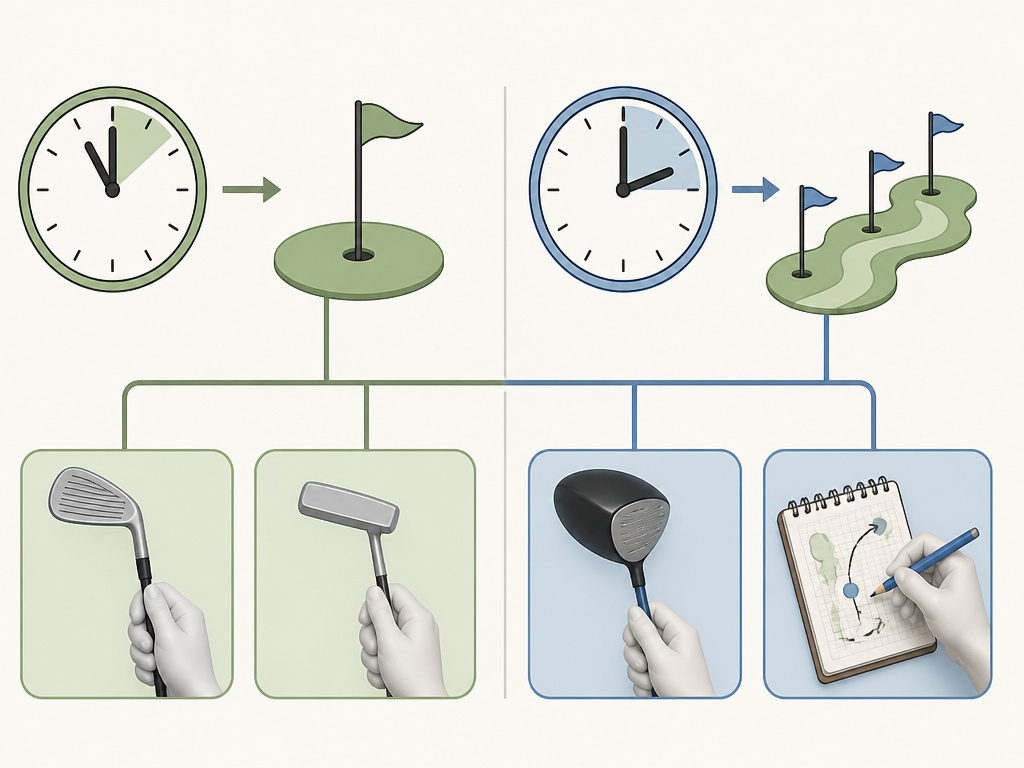 Stop overthinking it. Your next step is based on two things: your available time and your current golf goal.
Answer these two questions: 1. How much time do I have? Under 2 hours = Par 3 Course. 2.5 to 3.5 hours = Executive Course. 2. What do I want to work on? Pure short game (irons, wedges, putting) = Par 3 Course. Full-round management (driving, strategy, recovery) = Executive Course.
If you’re a beginner, the path is linear. Start on the par 3 course until you can get around without major frustration. Then, graduate to the executive course to learn how to piece a full score together. This is a better progression than jumping straight to a 6,800-yard public golf courses monster and getting discouraged.
For the experienced player, use them as specific training tools. Is your proximity to the hole from 130 yards poor? Book a week of evenings on the par 3. Struggling with on-course decision making? Play the executive course and force yourself to write down a club selection plan before every shot.
And remember gear. There’s no need for a full 14-club staff bag on a par 3. A lightweight golf bag for short courses with 6-8 clubs is perfect. For an executive course, you’ll want your full arsenal, so choose your bag accordingly.
Frequently Asked Questions
Can I post a score from a par 3 course for my handicap?
Generally, no. Most par 3 courses do not have an official USGA course and slope rating, which is required for posting. Executive courses are far more likely to be rated. Always check the scorecard or with the pro shop to be sure.
Are executive courses easier than regular courses?
Not necessarily. They are shorter, but good executive courses defend par with small greens, tight angles, and strategic hazards. The challenge is condensed, not removed. Your score relative to par might be better, but the mental test can be just as demanding.
What clubs should I bring to a par 3 course?
Putter, a sand wedge, a pitching wedge, and 2-3 mid-to-short irons (e.g., 9-iron, 8-iron, 7-iron) will cover almost every shot. Many regulars use a lightweight Sunday bag with just 5-6 clubs total.
Do professionals play on these types of courses?
Yes, but for different reasons. Pros use par 3 courses for focused wedge practice and putting drills. The Masters Par-3 Contest is the most famous example. Executive courses are sometimes used for junior championships or as a fun, relaxed alternative during practice weeks. The strategic principles of golf course architecture are still present and can be studied on these shorter layouts.
Is an executive course the same as a “pitch and putt”?
No. A pitch and putt is even shorter, often with holes under 100 yards where you only need a wedge and a putter. An executive course requires full shots, including drives and long irons on the par 4s. Understanding these scoring terms and course types helps set the right expectations.
The Bottom Line
Stop confusing the two. A par 3 course is your short-game clinic, fast, focused, and forgiving off the tee. An executive course is your compressed championship test, strategic, full-bag, and a legitimate round of golf.
Your move is simple. If you have an afternoon to kill and want to work on your 120-yard approach, head to the par 3. If you need to practice playing actual golf but only have a slim window before dinner, book a tee time on the executive course. This isn’t about one being better than the other. It’s about using the right tool for the job you have today.
I favor straightforward routines players can actually stick with. Making a clear choice between these two course types is one of them. It turns a vague “let’s play golf” into a specific, productive session that actually moves your game forward.
