
How to Use Course Rating and Slope Rating – Golf Explained
This post contains affiliate links. As an Amazon Associate, we earn from qualifying purchases.
This post contains affiliate links. As an Amazon Associate, we earn from qualifying purchases.
Course Rating and Slope Rating are the USGA’s official difficulty metrics for a golf course. The Course Rating is the expected score for a scratch golfer, expressed to one decimal point (e.g., 72.4). The Slope Rating measures the relative difficulty for a bogey golfer compared to a scratch golfer, calculated from the difference between the Bogey Rating and the Course Rating, with a standard value of 113. These ratings allow your Handicap Index to convert into a Course Handicap, creating a fair game across any course.
Most golfers see these numbers on a scorecard and guess higher means harder. That guess is wrong about half the time. The real story is in the gap between two ratings you never see, the scratch rating and the bogey rating, and ten specific obstacles measured from two different landing zones on every single hole.
What follows: the exact yardage formulas, the ten obstacles raters measure, the strict re-rating schedule clubs must follow, and the one 22-yard measurement error that changes everything.
Key Takeaways
- Slope Rating is relative, not absolute. A high Slope Rating (e.g., 140) doesn’t mean a course is brutally hard for everyone. It means the course is relatively harder for a bogey golfer than for a scratch golfer.
- A 22-yard mistake changes the rating. An error of just 22 yards in total course length alters the USGA Course Rating by 0.1 strokes for men. Accurate measurement is non-negotiable.
- Ratings expire. A new course must be re-rated within 5 years. After that, ratings are only valid for 10 years before a mandatory re-rating. Playing off a decade-old rating is like using an old map.
- Altitude changes the math. Courses at or above 2,000 feet have their effective playing length reduced because the ball flies farther. The posted yardage isn’t the rated yardage.
- Ten obstacles are measured twice. Rating teams evaluate ten specific obstacle factors on each hole, once from the scratch golfer’s landing zone and once from the bogey golfer’s. This dual evaluation is what generates the Slope Rating.
The Core Concepts: Scratch, Bogey, and the 113 Standard
Forget “par.” The USGA’s system ignores it. The entire World Handicap System is built on two fictional benchmark players: the scratch golfer and the bogey golfer.
The scratch golfer is a tournament-caliber amateur. By the official rating methodology, he drives the ball 250 yards total (230 in the air, 20 yards of roll) and can reach a 470-yard hole in two shots. The bogey golfer, defined as having a Course Handicap of about 20, drives it 200 yards total. He can reach a 370-yard hole in two.
The Course Rating is the expected score for that scratch golfer. If a course from the back tees has a Course Rating of 74.2, it means our scratch benchmark is expected to shoot about 74. The Bogey Rating is the same expected score for the bogey golfer, but this number is rarely published.
The Slope Rating is born from the difference between these two numbers. The standard Slope Rating is 113. This number represents a course where the bogey golfer finds it equally more difficult as the scratch golfer. A Slope Rating of 135 means the course is relatively much harder for the bogey player. A Slope of 95 means it’s relatively easier for him.
Where this goes sideways: Assuming a high Slope Rating means a tough course for you. If you’re a low-handicap player, a high-Slope course might actually play closer to its Course Rating for you, while a high-handicap friend struggles massively. The rating split tells the tale.
What’s the Difference Between Course Rating and Slope Rating?
Think of Course Rating as the baseline difficulty. Slope Rating is the differential multiplier.
| Aspect | Course Rating | Slope Rating |
|---|---|---|
| Represents | Difficulty for a scratch golfer (expected score) | Relative difficulty for a bogey golfer vs. A scratch golfer |
| Standard Value | None; varies by course and tee | 113 |
| Calculation Input | Effective playing length + obstacle values (scratch) | Difference between Bogey Rating and Course Rating |
| What it tells you | “How many strokes will a great player take here?” | “How much harder does this course get for an average player?” |
| Used to calculate | Playing Handicap (with Slope) | Course Handicap (from Handicap Index) |
Course Rating is an absolute measure. Slope Rating is a relativity index. They work together to translate your portable Handicap Index into the specific number of strokes you get on that particular day, on that particular set of tees.
How a Course Gets Its Official Numbers
This isn’t a guess. It’s a forensic audit conducted by an Authorized Association like Golf Canada or the SCGA. A trained team spends a day on site following the detailed rating procedures to the letter. The club has no say in the final numbers and must accept them to use the World Handicap System calculations.
The process has two pillars: playing length and obstacles.
First, they find the “Effective Playing Length.” The scorecard yardage is just a start. The team applies corrections for: * Roll: Hard, dry fairways add length; soft, lush fairways subtract it. * Elevation: Every significant uphill or downhill shot is adjusted. * Doglegs/Forced Lay-ups: If the hole’s design prevents a direct shot, the effective length is longer. * Prevailing Wind: Consistent strong wind is factored in. * Altitude: As noted, courses above 2,000 feet get a reduction.
This gives them a Scratch Effective Length and a Bogey Effective Length. These go into precise formulas:
- Scratch Yardage Rating (Men): (Scratch Effective Length / 220) + 40.9
- Bogey Yardage Rating (Men): (Bogey Effective Length / 160) + 50.7
Then, they evaluate ten Obstacle Factors on each hole. For both the scratch and bogey landing zones, they assign a value from 0 (non-existent) to 10 (extreme) for: 1. Topography 2. Fairway width 3. Green Target difficulty 4. Recoverability and Rough 5. Bunkers (like the various different types of golf bunkers) 6. Crossing Obstacles (water, canyons) 7. Lateral Obstacles 8. Trees 9. Green Surface (incorporating factors like green speed) 10. Psychology (visual intimidation)
The team measures the distance from the center of the fairway to the nearest tree, bunker, or hazard line. They do this for the scratch golfer’s 250-yard landing zone and again for the bogey golfer’s 200-yard zone. The same meticulous process repeats for the approach shot and around the green.
The Yardage Rating and the Obstacle Values are summed to create the final Course Rating and Bogey Rating. The Slope Rating is then locked in with this formula: (Bogey Rating – Course Rating) x 5.381 (for men).
Why the Specifics Matter: Precision, Expiration, and Edge Cases
The system’s fairness depends on ruthless precision. The USGA Handicap Manual Section 13 states that an error of 22 yards in total course length changes the Course Rating by 0.1 strokes for men. For a bogey rating, the margin is even tighter. A club that remeasures its own tees incorrectly can skew every handicap posted there.
Ratings also have a shelf life. The official rating manual mandates that a new course must be re-rated within five years of its opening. Mature courses must be re-rated at least every ten years. A tree grows, a bunker deteriorates, a fairway narrows. The rating must reflect the course as it is, not as it was.
Common mistake: Comparing scores between a freshly rated course and one nearing its 10-year re-rating deadline. The older rating may no longer reflect current course conditions, giving players an inaccurate Course Handicap.
Some conditions trigger special adjustments: * Altitude: The ball flies farther. The rated length is shorter than the measured length. * Extreme Ground Conditions: During a drought, the roll factor can dramatically increase effective length. * Temporary Conditions: If a course has temporary tees or greens, the Authorized Association may issue temporary ratings or declare scores non-acceptable for handicap.
This rigorous approach ensures that whether you’re playing a classic championship course or a local public courses, the system is comparing apples to apples.
How to Use These Numbers When You Play
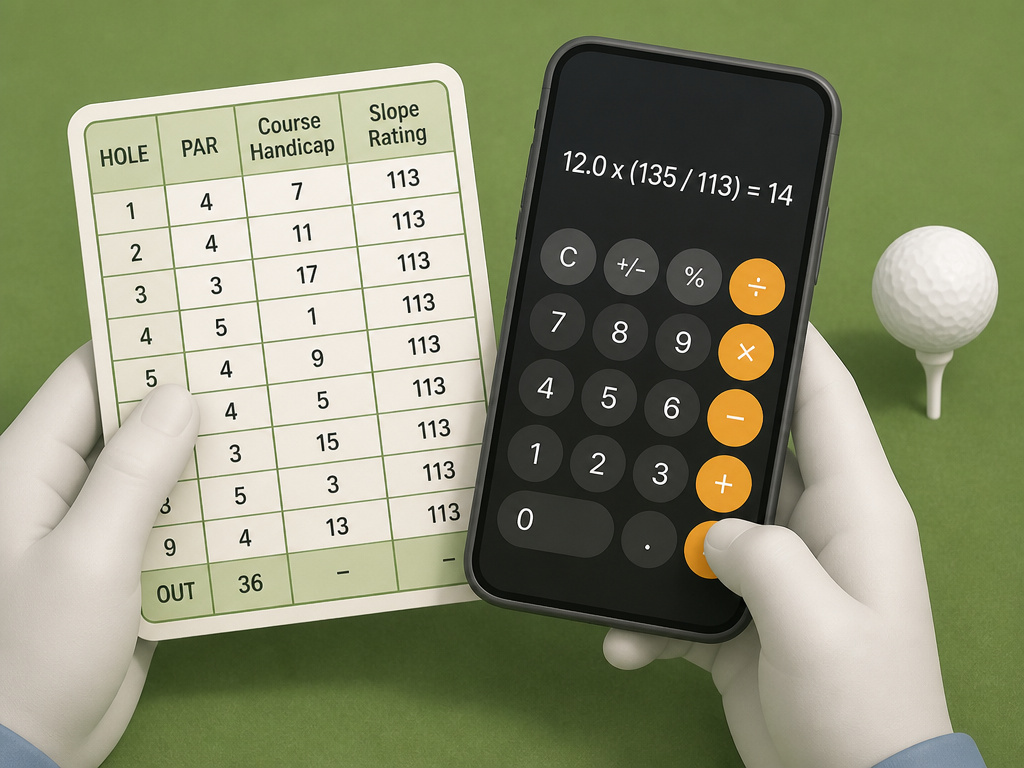
You don’t need to do the math. Your golf club’s handicap software or a handicap calculator does it. But you should know what the output means.
Your Handicap Index is your potential ability, portable anywhere. When you head to a course, you use that course’s Slope Rating to convert your Index into a Course Handicap, the actual number of strokes you get that day.
The formula is: Handicap Index x (Slope Rating / 113).
Here’s what that looks like for a player with a 12.0 Index:
| Course Slope Rating | Calculation | Course Handicap |
|---|---|---|
| 113 (Standard) | 12.0 x (113 / 113) | 12 |
| 135 (More Difficult) | 12.0 x (135 / 113) | 14 |
| 95 (Less Difficult) | 12.0 x (95 / 113) | 10 |
On the high-Slope course, our 12-index player gets 14 strokes. On the low-Slope course, they only get 10. This adjustment is the entire point, it levels the field. It acknowledges that the 12-index player will need more help on the course that disproportionately punishes their mistakes.
When selecting tees, use the Course Rating as your guide. If you typically shoot around 90, look for a set of tees where the Course Rating is around 72. That gives you a realistic target (shoot about 18 over the rating). Trying to play from tees with a 74.2 Rating when you’re a 90s shooter is a recipe for a long, frustrating day, regardless of the Slope.
Frequently Asked Questions
What does a Slope Rating of 130 mean?
Slope Rating of 130 means the course is significantly more difficult for a bogey golfer than for a scratch golfer, relative to the standard course (Slope 113). For every 13 strokes above the Course Rating a scratch player might shoot, a bogey player might shoot 15 strokes above their own benchmark. It’s a signal that the course’s defenses, tight drives, penal hazards, tough recoveries, are positioned right where the average player will find them.
Can a Course Rating be lower than par?
Absolutely, and it often is. Par is a arbitrary number for a hole (3, 4, or 5). Course Rating is a precise prediction of a scratch golfer’s score. On a short, open course with few hazards, a scratch player might be expected to average 69.5 on a par-72 layout. That Course Rating (69.5) is 2.5 strokes lower than par. The design principles of a course directly influence this gap.
Why is the standard Slope Rating 113?
The number 113 is a mathematical constant chosen to make the formulas work cleanly. It represents the slope of the regression line in the original data set used to create the system. Think of it as the “neutral” setting. A course with a Slope of 113 presents the same relative challenge to both scratch and bogey golfers. There’s no special meaning to the number itself; it’s the baseline from which all other Slopes deviate.
Do longer courses always have higher Slope Ratings?
Not always. Length increases the Course Rating, which often increases the Bogey Rating, which can increase the Slope. However, if the extra length on a course comes on holes where bogey golfers are already laying up or where hazards are out of their reach, the relative difficulty might not change. The Slope Rating could stay the same or even drop from the middle to back tees if the new challenges only impact longer hitters.
How do I find the Course and Slope Rating for a course?
Check the scorecard first. Most clubs print them there. Your next stop should be the official Golf Canada Score Centre or your regional golf association’s website. These databases hold the most current, official ratings. If the scorecard and website disagree, the online database is almost always correct, scorecards take time and money to reprint after a re-rating.
The Bottom Line
Course Rating and Slope Rating aren’t just decoration on a scorecard. They are the engineered foundation of golf’s fairness. The Course Rating tells you the test’s baseline difficulty. The Slope Rating tells you how much that test changes for different skill levels.
Look at these numbers before you play. A high Course Rating warns of a long, stern challenge. A high Slope Rating warns of specific, strategic punishments that will magnify your mistakes. Understanding this turns two obscure digits into a strategic tool. You’ll know why you got 14 strokes instead of 12, and you’ll know which holes to respect.
The system works because it’s specific, measured, and updated. It accounts for altitude, wind, and where the trees actually are. That precision is what lets you take your game from your home public courses to a top-tier course and still have a fair match. Trust the numbers. They’ve done the math.
