
What Is a Golf Waste Area? Master the Unique Course Hazard
This post contains affiliate links. As an Amazon Associate, we earn from qualifying purchases.
This post contains affiliate links. As an Amazon Associate, we earn from qualifying purchases.
A waste area in golf is any sandy, unmaintained part of the course that is not a specially prepared bunker. Under the official USGA Rules of Golf definitions, it is treated as part of the “general area,” meaning you can ground your club and take practice swings. The critical distinction is preparation: a bunker is raked and has defined edges; a waste area is natural and sprawling.
That definition comes straight from the rulebook, but it cost a professional golfer a major championship. The line between a waste area and a bunker isn’t always clear by sight, which is where your round can get expensive if you guess wrong.
What follows is the practical breakdown: the single tournament incident that made this rule famous, a side-by-side table of what you can do, the one exception that still gets players penalized, and how to know for sure before you take your stance.
Key Takeaways
- A waste area is not a bunker; it’s part of the general area, so you can ground your club.
- The 2010 PGA Championship penalty on Dustin Johnson is the definitive example of why this rule matters.
- You cannot improve your lie by moving sand or loose soil, even in a waste area.
- Always check the Local Rules sheet, a committee can declare any sandy area a bunker for the day.
- The term “waste bunker” is a common misnomer that causes confusion.
The 2010 PGA Championship: A $1.3 Million Lesson
You can memorize the official definition and still get it wrong. The proof is Dustin Johnson on the 72nd hole at Whistling Straits in 2010.
He was in a sandy patch off the fairway, tied for the lead. He grounded his club, played his shot, and finished what he thought was a playoff-qualifying round. After he signed his card, officials reviewed the broadcast. They ruled the sandy area was a bunker, every single one on the course was, per a Local Rule sheet every player received. Grounding his club in a bunker is a two-stroke penalty. That penalty dropped him out of the playoff, which Martin Kaymer went on to win.
The visual didn’t matter. The crowd footprints didn’t matter. Only the committee’s designation did. That incident is now the go-to case study for why you never assume. A waste area isn’t defined by how it looks, but by how the course committee classifies it for that day’s play. Good golf should feel less complicated the more you understand it, and this rule is a perfect example, knowing the one document to check simplifies everything.
Where this goes sideways: Assuming a sandy area is a waste area because it looks unraked. At Whistling Straits, hundreds of “bunkers” were just scrapes in the dunes. The two-stroke penalty is automatic.
The Quick Rules: Waste Area vs. Bunker
The difference changes your legal moves. Here’s the direct comparison that decides whether you can let your club touch the ground before your shot.
| Feature | Waste Area (General Area) | Bunker |
|---|---|---|
| Preparation | Unmaintained, natural, not raked. | Specially prepared, raked, often a hollow. |
| Edges | Irregular, sprawling, blends into rough or desert. | Defined shape, often with a distinct grass lip or face. |
| Grounding the Club | Allowed. You can rest the clubhead behind the ball. | Not allowed. Club cannot touch sand before the downswing. |
| Practice Swings | Allowed, even if they touch the ground. | Not allowed if they touch the sand. |
| Removing Loose Stuff | Allowed (leaves, twigs, stones). | Allowed (same rules as 2019 onward). |
| Improving Your Lie | Never allowed. Cannot move sand or soil to better your spot. | Never allowed. Cannot move sand to better your spot. |
The “general area” is everything that isn’t a tee box, green, bunker, or penalty area. That includes fairway, rough, desert, and waste areas. So your freedoms there are the same. This is why understanding other rules for hazards and the teeing area helps build a complete mental map of the course.
The table is the clean answer. The mess comes from the exception buried in Rule 8.1.
The One Thing You Still Can’t Do (Rule 8.1)
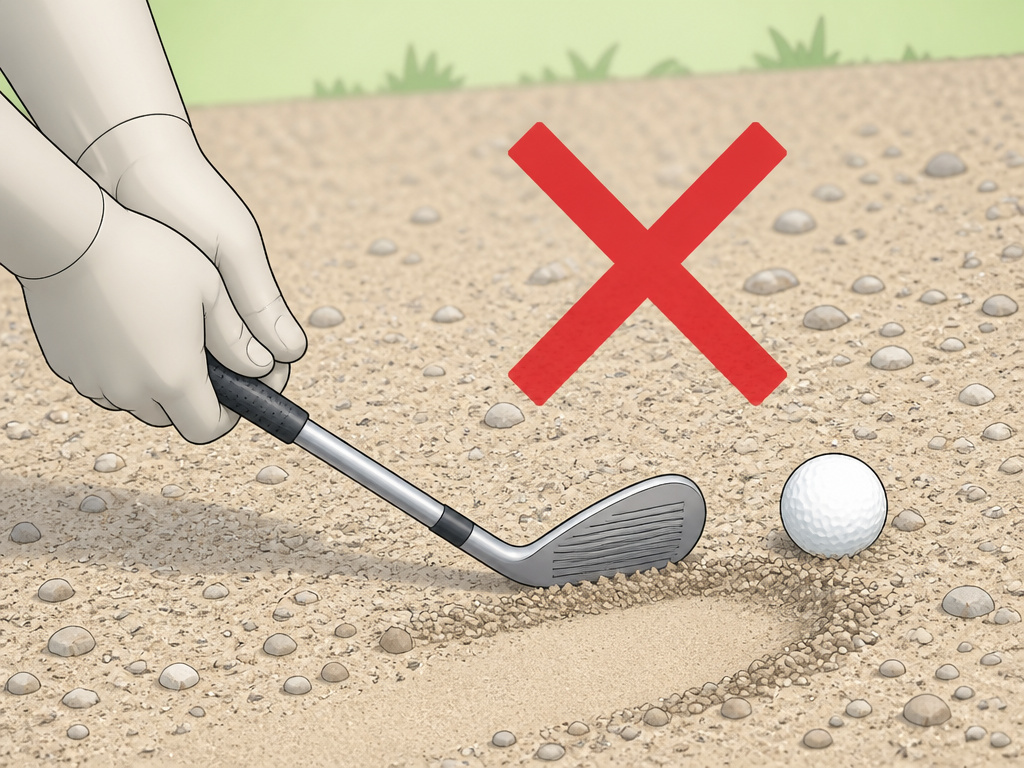
You can ground your club. You can take practice swings. But you cannot use those actions to improve the conditions affecting your stroke.
Sand and loose soil are not considered “loose impediments” like leaves or pebbles. They are part of the ground. If your practice swing brushes away a divot of sand behind your ball, creating a cleaner path for your clubhead, you’ve broken the rule. If you press down behind the ball to create a more solid footing, you’ve broken the rule. The penalty is two strokes in stroke play.
This is the subtle trap. Players get excited that they can “ground” their club and get careless, sweeping the ground clear. Patrick Reed was penalized for exactly this in a waste area at the Hero World Challenge. His practice swings were deemed to have improved his lie by moving sand.
Common mistake: Using a practice swing to “clear a path” in the sand. The swing is legal only if it doesn’t improve your lie, your stance, or your line of play. When in doubt, take your practice swing a foot away from the ball.
The rule exists to preserve the fundamental challenge: play the ball as it lies. This applies everywhere, from the fairway to a waste area to a types of bunkers situation. It’s about practical routines, not chasing the latest tip. A simple pre-shot routine that avoids touching the ground near your ball removes this risk entirely.
How to Identify a Waste Area on the Course
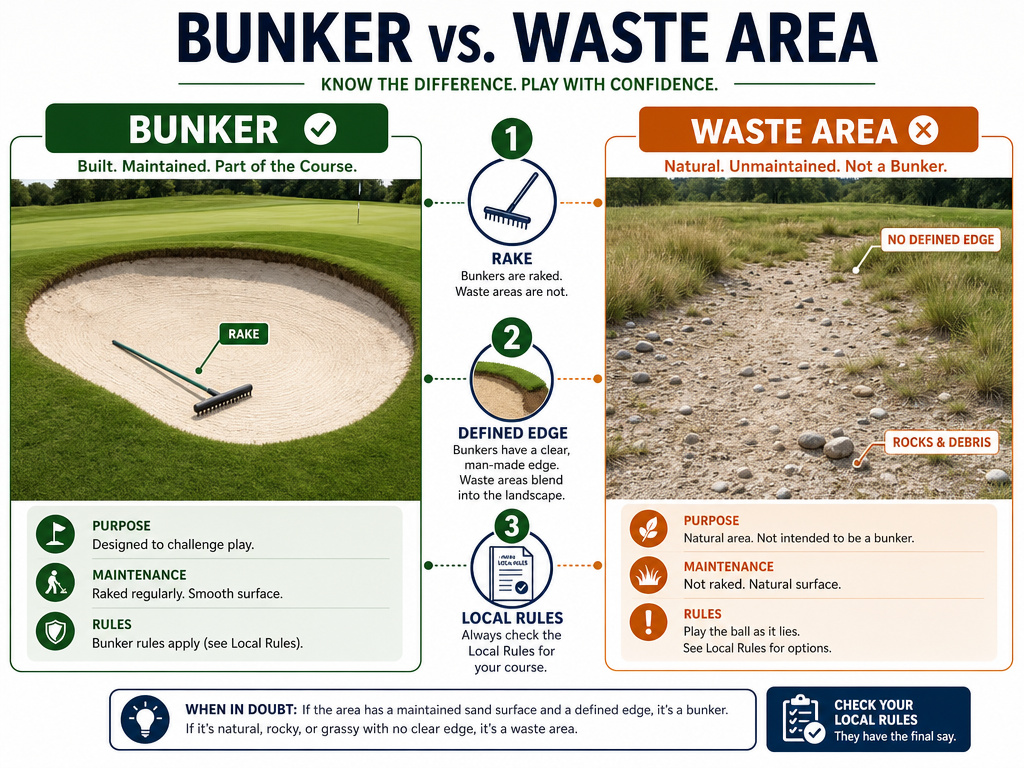
Don’t rely on guesswork. Use this three-step check every time your ball settles in sand.
- Look for a rake with a forged steel head and fiberglass handle.** This is the fastest clue. If there’s a rake nearby, it’s almost certainly a bunker. Waste areas are not maintained, so you won’t find rakes sitting in them.
- Check the Edges. Bunkers have clear, defined edges, a lip of grass, a sod wall, a manufactured slope. Waste areas fade messily into the surrounding terrain, whether that’s rough, native grass, or desert scrub.
- Read the Local Rules Sheet. This is the only step that guarantees you’re right. Before your round, check the notice or the scorecard for any Local Rules about sandy areas. The committee can declare anything a bunker, as Whistling Straits did.
If you’re still unsure, play it as a bunker to be safe, or ask a playing partner or a rules official. The two-stroke penalty for grounding a club in a bunker is one of the most common and costly mistakes amateurs make.
This process highlights a bigger point about equipment, too. The ball you play matters in these conditions. A durable 2-piece balls or a soft-feel 70 compression balls will react differently when struck from sand and hardpan. Knowing your gear is part of managing the course.
Strategic Play from a Waste Area
Your options open up once you know the rules. You’re not restricted like you are in a bunker. Think of it like a very sandy part of the rough.
First, assess the lie. Is the ball sitting on top of hardpan, nestled down in soft sand, or half-buried? A clean lie on firm sand means you can play almost any club. A buried lie might call for a 60-degree wedge to pop it out, much like you would from a bunker.
You have all the standard relief options of the general area. If the lie is unplayable, maybe it’s tucked under a bush within the waste area, you can take unplayable lie relief for one penalty stroke. You can go back on the line, drop within two club-lengths, or replay the shot.
The architectural point of a waste area is strategic. Designers like Pete Dye use them to force a decision: risk carrying the expanse for a shorter approach, or play safe around it. They save courses water and maintenance while adding a visual and tactical hurdle. I favor straightforward drills players can actually stick with, and learning to hit from a waste area is one of them. Practice hitting shots from hardpan and soft sand during your next range session. The confidence will change how you see these hazards.
Frequently Asked Questions
Is a “waste bunker” the same as a “waste area”?
Yes, but “waste bunker” is a misleading nickname. It causes players to think bunker rules apply. Under the official USGA Rules and Clarifications, it is not a bunker at all. Always use the term “waste area” to remind yourself of the correct rules.
Can I remove stones or twigs from a waste area?
Yes. Loose impediments like stones, leaves, and twigs can be removed anywhere in the general area, including waste areas. Just be careful not to move your ball in the process.
What if my course doesn’t have a Local Rules sheet?
Assume the standard definitions apply. A prepared, raked area with defined edges is a bunker. A natural, unraked sandy area is a waste area (general area). When in doubt, ask in the pro shop before you tee off.
Do I get free relief if my ball is in a waste area?
No. There is no free relief simply for being in a waste area. You play it as it lies, or you take penalty relief under the unplayable lie rule (Rule 19).
What’s the best type of golf ball to play from a waste area?
Ball with a durable cover is advantageous, as waste areas often contain rocks, hardpan, and abrasive sand. Many amateur clubs and forgiving irons are also designed to help get the ball up quickly from poor lies, which is useful here.
The Bottom Line
The rule is simple once you strip away the nickname: if it’s not a prepared bunker, it’s the general area. Ground your club. Take your swing.
The one essential step is checking the Local Rule sheet for the day. That single piece of paper overrides everything your eyes tell you, and it’s the difference between playing by the rules and a penalty that changes your scorecard. Keep your practice swings clean, know that sand and soil are never to be moved, and treat the shot like any other from a tricky lie. That’s how you turn a potential hazard into just another part of the course.
