
What is the DP World Tour? Guide to the Global Golf Series
This post contains affiliate links. As an Amazon Associate, we earn from qualifying purchases.
The DP World Tour is the primary men’s professional golf tour for Europe, sanctioned to operate across Europe, Africa, and Asia. It was rebranded from the European Tour in 2022 through a long-term title partnership with the global logistics company DP World. The tour features a global schedule of over 40 events, culminating in the season-ending DP World Tour Championship in Dubai, and serves as a key pathway to the PGA Tour through an official partnership.
That global footprint is what sets it apart. While the PGA Tour dominates North America, the DP World Tour’s identity is built on international variety, moving players and infrastructure across dozens of countries each season. This creates a distinct test of adaptability and logistics that shapes the tour’s character.
What follows breaks down the tour’s structure, its high-stakes partnership with DP World, and how its unique schedule and qualification system work. You’ll see where it fits in the professional golf ecosystem and why a win here can be a ticket to the world’s top stage.
Key Takeaways
- The DP World Tour is the evolution of the European Tour, renamed in 2022 after a landmark title sponsorship deal with logistics giant DP World.
- Its schedule is truly global, with over 40 tournaments across 25+ countries, structured into “Global Swings” and culminating in the DP World Tour Championship in Dubai.
- A strategic alliance with the PGA Tour allows the top 10 finishers on the DP World Tour’s season-long points list to earn PGA Tour cards for the following season.
- The tour includes premium “Rolex Series” events with larger prize funds and attracts a mix of European stars and international talent.
- It is often confused with the animated series Total Drama World Tour, but the two are completely unrelated.
The DP World Tour: A Quick Overview
The DP World Tour is not a new circuit. It’s the modern face of the historic European Tour, which was founded in 1972. The name change for the 2022 season marked the tour’s 50th anniversary and signaled a new era of financial stability and global ambition, backed by DP World’s title partnership. This isn’t a minor sponsorship; it’s a detailed deal that extends to 2035 and designates DP World as both the Title Partner and the Official Logistics Partner.
The DP World Tour operates as the primary men’s professional golf tour for Europe, Africa, and Asia. Sanctioned by the International Federation of PGA Tours, its season comprises over 40 official tournaments in more than 25 countries. The tour’s structure includes five premium Rolex Series events and a season-ending championship in Dubai, with a total prize fund exceeding $140 million.
Think of it as the premier league of golf for the Eastern Hemisphere. While the PGA Tour is the goal for many, the DP World Tour is often the proving ground. Its events range from historic national opens in Scotland, Spain, and South Africa to newer tournaments in the Middle East and Asia. This variety means a player might face links winds one week and desert heat the next—a test of versatility that defines a true world-class golfer.
How the DP World Tour Works: Schedule and Structure
The tour’s calendar is its most distinctive feature. Forget a simple chronological list; the modern DP World Tour season is a journey divided into chapters. The 2026 schedule, for example, is built around five ‘Global Swings’, a ‘Back 9’ series, and the ‘DP World Tour Play-Offs’. This format is designed to create narrative momentum and ensure competitive relevance throughout the year.
Each “Global Swing” focuses on a geographic region, grouping tournaments together to minimize travel. Winning a tournament within a Swing earns you a spot in that Swing’s finale, a high-purse event with extra points on offer. It’s a structure that rewards consistency within a bloc and creates mini-dramas alongside the overall season race.
The heart of the schedule are the Rolex Series events. These are the tour’s flagship tournaments, with elevated prize funds of $9-10 million and stronger fields. They include staples like the Genesis Scottish Open (co-sanctioned with the PGA Tour) and the BMW PGA Championship at Wentworth. Performance in these events heavily influences a player’s standing on the season-long Race to Dubai points list.
| Tournament Tier | Prize Fund Range | Key Examples | Points Weight |
|---|---|---|---|
| Rolex Series | $9M – $10M+ | Genesis Scottish Open, BMW PGA Championship | Highest |
| Standard Event | $2M – $3M | Porsche European Open, Italian Open | Standard |
| Co-sanctioned Event | Varies | Barbasol Championship (with PGA Tour) | Shared |
| DP World Tour Championship | $10M | Season Finale, Dubai | Decisive |
The season builds toward the DP World Tour Championship in Dubai. Only the top 50 players on the Race to Dubai points list qualify. It’s a no-cut, limited-field event where the winner takes home the largest prize of the season and the player who tops the final points list is crowned the Race to Dubai champion.
The DP World Partnership: More Than a Name
DP World isn’t just a company that bought naming rights. It’s a global logistics leader that moves over 10% of the world’s trade. This partnership is a case of operational synergy. Running a golf tour across 25 countries is, as the tour itself notes, a “remarkably complex supply chain problem.”
Player equipment must be flown from Sweden to Singapore. Temporary grandstands, scoring towers, and hospitality suites need to arrive on time in South Africa. The partnership provides the tour with a direct line to the logistics expertise required to pull this off smoothly. For DP World, the tour is a massive, moving billboard that showcases its core capability: connecting global markets.
The financial commitment is equally serious. The deal, extended through 2035, guarantees a minimum prize fund of $2 million for every standard event and helped push the tour’s total prize money past the $200 million mark for the first time in 2022. This financial muscle is crucial for retaining talent and competing with the lucrative offers from tours like the LIV Golf league.
Pathways and Qualification: How Players Get There
Getting a DP World Tour card is the dream for thousands of professional golfers. The primary route is through the Qualifying School (Q-School), a grueling, multi-stage elimination tournament held at the end of each season. A small number of cards are awarded to the top finishers.
However, the most stable path is via the Challenge Tour, the DP World Tour’s official developmental circuit. The top 20 players on the Challenge Tour’s season-long rankings graduate to the main tour, mirroring the relationship between the Korn Ferry Tour and the PGA Tour.
Once on tour, players must perform to keep their status. They need to earn enough Race to Dubai points to finish inside the top 110 on the season-ending list to retain full playing privileges for the following year. It’s a relentless pressure cooker.
Where this goes sideways: A player focusing only on making cuts to retain their card. Playing conservatively might keep you inside the top 110, but it won’t earn enough points to reach the top 10—the only spot that matters for a PGA Tour card. The mindset for survival is different from the mindset for promotion.
The most dramatic qualification story is now the PGA Tour card pathway. Through the strategic alliance between the tours, the top 10 players on the DP World Tour’s final Race to Dubai points list (who are not already exempt) earn PGA Tour membership for the next season. This has changed the DP World Tour into a direct feeder system, making every tournament down the stretch a high-stakes audition for the world’s biggest stage.
DP World Tour vs. Other Major Tours
It’s easy to lump all pro tours together, but the differences are stark. Understanding them shows where the DP World Tour’s unique value lies.
The PGA Tour is the financial and media powerhouse, based predominantly in the United States. Its average prize funds are higher, and its events offer more OWGR points, which is why the top 10 DP World Tour players eagerly take their cards. The DP World Tour offers something different: global experience, varied playing conditions, and for many international players, a more accessible first step onto the world stage.
The LIV Golf league exists in a separate ecosystem. It’s a closed, team-based format with guaranteed money and 54-hole no-cut events. While LIV has poached stars from both the PGA and DP World Tours, the latter has felt the impact on field depth for some events. The DP World Tour’s response has been to strengthen its alliance with the PGA Tour and emphasize its meritocratic, traditional pathway.
The LPGA Tour is the premier circuit for women’s golf and operates completely independently. While both are “world tours,” their schedules, structures, and qualification systems have no direct overlap, though they share the challenge of global logistics.
Common Questions and Confusions
A surprising amount of search traffic for “DP World Tour” comes from fans of a Canadian cartoon. Let’s clear that up first.
Is the DP World Tour related to Total Drama World Tour?
No. This is a persistent mix-up due to identical names. The Wikipedia entry on Total Drama details an animated parody of reality competition shows. The DP World Tour is a real professional sports league. They share nothing but a name.
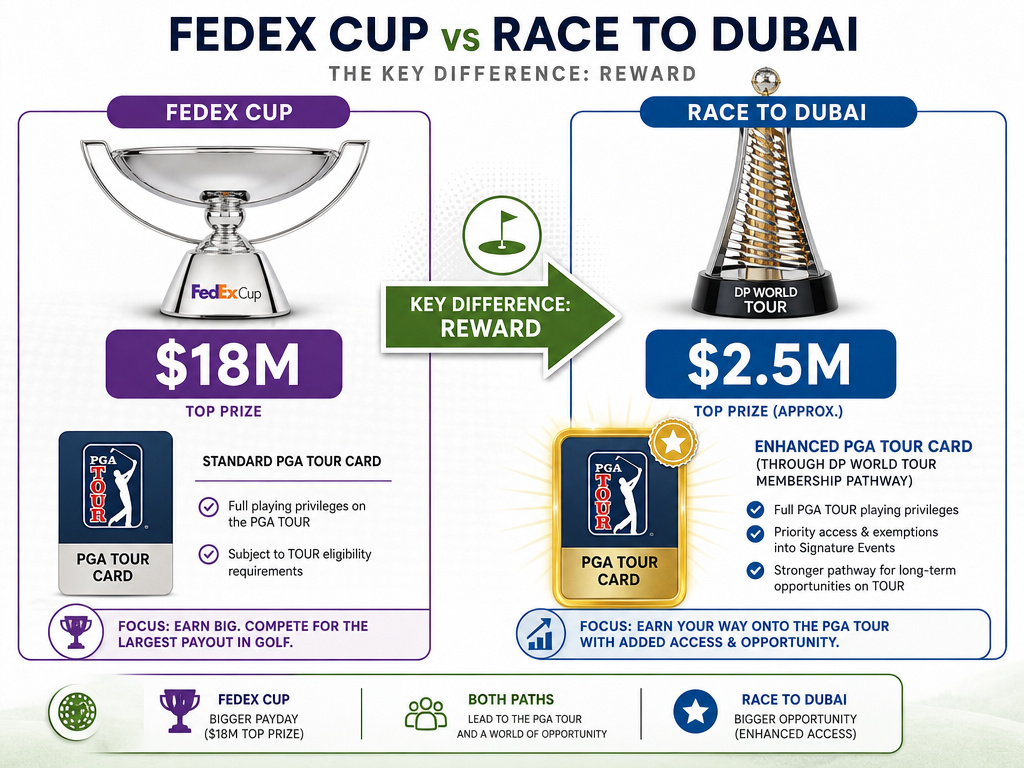
How does the Race to Dubai differ from the FedEx Cup?
Both are season-long points competitions. The FedEx Cup is the PGA Tour’s championship, culminating in a playoff series. The Race to Dubai is the DP World Tour’s equivalent, ending with the DP World Tour Championship. The key difference is the reward: the FedEx Cup winner gets a $18 million bonus; the Race to Dubai winner gets a smaller bonus but, more importantly, that top-10 finish can mean a PGA Tour card.
Can DP World Tour players compete in majors?
Absolutely. Strong performance on the DP World Tour earns Official World Golf Ranking points. A high enough ranking is one of the main avenues to qualify for the four major championships (The Masters, PGA Championship, U.S. Open, The Open). Winning a DP World Tour event itself can also come with a major championship invitation.
What is the tour’s relationship with team events like the Ryder Cup?
The DP World Tour is a co-sanctioning body for the Ryder Cup (alongside the PGA of America). European Ryder Cup points are earned primarily through performance in DP World Tour events and major championships. Similarly, the tour is involved with the Solheim Cup, the premier women’s team event, though that falls under the Ladies European Tour and LPGA Tour umbrella.
The Bottom Line
The DP World Tour is far more than the European Tour with a new logo. It’s a global tour with a specific identity: a gateway, a test of adaptability, and a crucial partner in golf’s evolving ecosystem. Its value for a player isn’t just in the prize money—it’s in the passport stamps, the variety of golf courses, and the golden ticket to the PGA Tour that awaits the top performers.
For fans, it offers a chance to see the stars of tomorrow, follow golf in incredible international settings, and witness the intense drama of the Race to Dubai. Understanding its structure and pathways makes watching any event more meaningful. You’re not just seeing who wins a trophy; you’re watching who earns a dream.
