
Swing Tempo vs Speed: Learn the Difference & Key 3:1 Ratio
This post contains affiliate links. As an Amazon Associate, we earn from qualifying purchases.
This post contains affiliate links. As an Amazon Associate, we earn from qualifying purchases.
Swing tempo is the consistent ratio of your backswing time to your downswing time, proven to be 3:1 for elite players. Swing speed is the raw measurement of how fast the clubhead is traveling at impact, measured in miles per hour. They are connected, a proper 3:1 tempo allows your body to sequence efficiently, which often increases swing speed as a natural byproduct, not by forcing it.
The connection is mechanical, not magical. Your body transfers energy from the ground up through a kinetic chain: pelvis, torso, arms, club. A mismatched tempo, like a slow backswing followed by a rushed downswing, breaks that chain. You leak power before it ever reaches the clubhead.
What follows breaks down the biomechanical proof, the tools to measure both, and the single training method that fixes tempo to unlock speed you’re already capable of generating.
Key Takeaways
- Tempo is a timing ratio, speed is an outcome. Elite players average a 3:1 backswing-to-downswing ratio; amateurs are often 4:1 or higher with a slow, deliberate takeaway.
- Fixing tempo often fixes speed. Speeding up your backswing to hit the 3:1 ratio lets your body unload like a coiled spring, adding 5-10 mph of clubhead speed without “swinging harder.”
- You need two tools to train it. Use tempo tones (like the Tour Tempo app) to hear the rhythm, and a swing analyzer (like Zepp or Swingbyte) to see your actual ratio. Practice with both for 10 minutes a day.
- Club choice changes the feel, not the ratio. Drivers require more horizontal force, irons more vertical. Your 3:1 tempo stays constant, but the weight shift and ground pressure feel different.
- Ignore the “slow and smooth” myth. This advice causes most amateur tempo problems. Smooth means even, not slow. A quicker, even backswing prevents overthinking and mechanical manipulation.
The 3:1 Ratio: The Biomechanical Clock
For decades, golf instruction treated tempo as a personal preference, some players were “long and slow,” others “short and quick.” That changed when video analyst John Novosel, editing a pro’s swing in 2000, counted the frames. The backswing took exactly three times longer than the downswing. He checked Tiger Woods’ 1997 Masters swing. Same 3:1 ratio. Jack Nicklaus, Sam Snead, Arnold Palmer, all 3:1. He published this in Tour Tempo, naming four specific ratios: 27/9, 24/8, 21/7, and 18/6 (backswing frames/downswing frames).
The golf establishment largely ignored an outsider’s discovery. Then a Yale physicist, Dr. Robert Grober, put sensors in clubs and studied hundreds of swings. His 2012 peer-reviewed study, “Towards a Biomechanical Understanding of Tempo in the Golf Swing,” confirmed Novosel’s finding. Touring pros clustered tightly around a 3:1 average. Amateurs were scattered, with ratios as high as 4:1 or 5:1. The conclusion: elite performance hinges on a remarkably uniform biomechanical clock.
A 2024 biomechanical swing technique study in the Journal of Sports Science analyzed drivers, 5-irons, and 7-irons. It found that while kinematic sequences differ by club, the timing ratio of the pelvis-torso-arm sequence remains consistent, supporting the 3:1 framework as a foundation for efficient energy transfer.
This isn’t about aesthetics. A 3:1 ratio is the signature of an efficient kinetic chain. The backswing loads your muscles and stores elastic energy. The downswing unleashes it in the correct sequence. Stretch the backswing to 4:1, and you must forcibly re-accelerate from a dead stop. That disrupts the sequence, costing both consistency and power.
Swing Speed: The Measurement, Not The Method
Swing speed is what you measure on a launch monitor: clubhead miles per hour at impact. It’s the result of everything working together, technique, strength, flexibility, and yes, tempo. The obsession with adding speed has created an entire industry of weighted trainers, overspeed protocols, and radar devices.
But here’s the disconnect most players hit. They work on techniques to increase golf swing speed by trying to move their arms faster. That’s like revving a car’s engine while the parking brake is on. If your pelvis and torso haven’t rotated in sequence, your arms have nowhere to channel that force. The club lags behind, you cast from the top, and you hit weak, high slices even with a fast arm swing.
The real speed gains come from fixing the sequence, which is a function of tempo. Dr. Grober’s study noted that amateurs often “equate smooth with slow.” They intentionally slow the backswing, then muscle the downswing. This creates a huge ratio gap, a 4:1 or 5:1 tempo, that forces the body to work against itself. When those same players quicken their backswing to approach 3:1, their swing speed often increases by 5-10 mph because the stored energy releases naturally.
| Focus | Tempo (The Ratio) | Swing Speed (The Result) |
|---|---|---|
| What it is | Timing relationship (Backswing Time : Downswing Time) | Measurement of clubhead velocity (MPH) at impact |
| Primary Goal | Consistency, efficient energy transfer | Distance, ball speed |
| How to Improve | Auditory training (tones), rhythm drills | Strength training, overspeed drills, technique refinement |
| Best Measured By | Swing analyzer with tempo tracking (Zepp, Swingbyte) | Launch monitor or swing speed radar (TrackMan, PRGR) |
| Common Amateur Error | Slow backswing (4:1+ ratio), creating a disjointed sequence | Trying to arm-whip the club from the top, breaking the kinetic chain |
Think of it this way. Tempo is the rhythm of the song. Swing speed is how loud the chorus hits. You can’t just scream the chorus louder if the verses are dragging.
Why a Mismatch Feels Broken (And How to Diagnose It)
Your body knows when tempo and speed are out of sync. The feel is “rushed” or “stuck.” You might have a fast swing speed but zero control, spraying shots left and right. This is the swing rhythm equivalent of a baby swing malfunctioning, a useful, if unusual, analogy.
Consider the Graco Slim Spaces Compact Baby Swing. It’s advertised with “adjustable speeds.” But hundreds of parents filed reports that after a few weeks, a red light would flash and the swing would lock into “turbo mode,” rocking uncontrollably fast on any setting. The manufacturer claimed no defect, but the Consumer Reports investigation documented the pattern: the system’s internal timing failed, forcing maximum output regardless of the dial. The result wasn’t more soothing motion; it was a dangerous, erratic jerk.
Where this goes sideways: Forcing swing speed with a poor tempo. It’s the golf equivalent of that swing’s “turbo mode.” You’re telling your body to produce maximum output while the timing mechanism is broken. The result is erratic, unpredictable ball flight, and a feeling that you have no control over the club.
Diagnosing your own mismatch requires separating the two metrics. 1. Check your ratio. Use any swing analyzer that provides a tempo number (like the Zepp 2 or a Garmin Approach CT10). Hit ten 7-irons. If your average is above 3.3:1, your backswing is too slow. 2. Check your speed. Use a basic swing speed radar like the PRGR Black. Note your baseline. 3. Compare feel to data. Do your “smooth” swings feel slow but actually produce a 4:1 ratio? Does your “hard” swing add only 2 mph of speed but wreck your strike?
Most amateurs find a 0.5 mph gain in clubhead speed for every 0.1 they improve their ratio toward 3:1. The speed comes from efficiency, not effort.
How to Measure and Fix Your Tempo
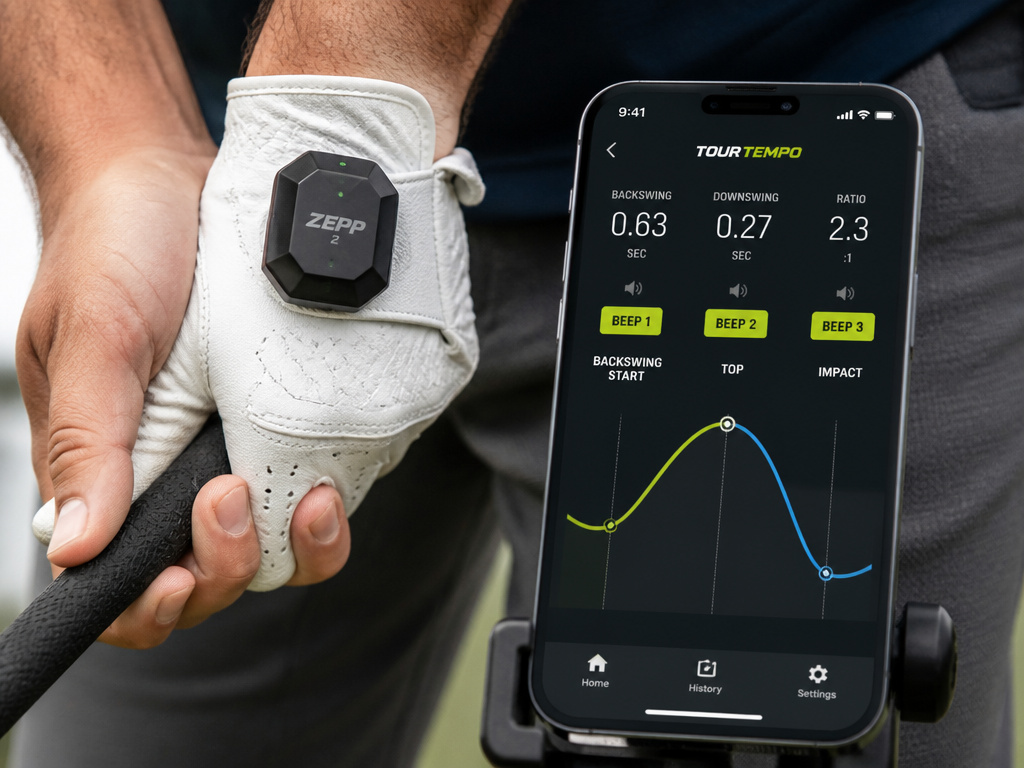
You can’t manage what you don’t measure. This requires two dedicated tools: one for auditory guidance, one for visual feedback. Guessing based on feel is how you stay stuck.
Step 1: Get the Tones.
Download the Tour Tempo app or find the tones online. Start with the 27/9 setting (slowest). The beeps mark the start of the backswing, the top, and impact. Your job is to match your swing to the beats.
Step 2: Get a Swing Analyzer.
A simple sensor like the Zepp 2 or Swingbyte 3 clips on your glove or club. It gives you a numeric ratio after every swing. This is your truth-teller. The app will show a graph of your swing, with the time segments clearly marked.
Step 3: The 10-Minute Drill.
- Hit 5 shots with the tones ON, focusing only on matching the beeps. Ignore ball flight.
- Hit 5 shots with the tones OFF, but keep the analyzer running. Try to replicate the feel.
- Check the data. Is your ratio between 2.9:1 and 3.1:1? If not, repeat.
The Orange Whip trainer is the perfect complement. Its weighted, flexible shaft physically prevents a slow backswing. If you swing it too slowly, it won’t load. It teaches the feel of the loaded-unload sequence that the 3:1 ratio demands. Swing it for three minutes before every range session.
Common mistake: Using a launch monitor alone to fix tempo. Launch monitors like TrackMan are brilliant for measuring swing speed, spin, and path, but most don’t give a simple backswing/downswing time ratio. You need the dedicated tempo feedback from a simpler device.
This process turns an abstract concept into a measurable, repeatable skill. It removes the guesswork from golf swing rhythm fundamentals.
Club-by-Club Differences: Why Your Driver and 7-Iron Feel Different
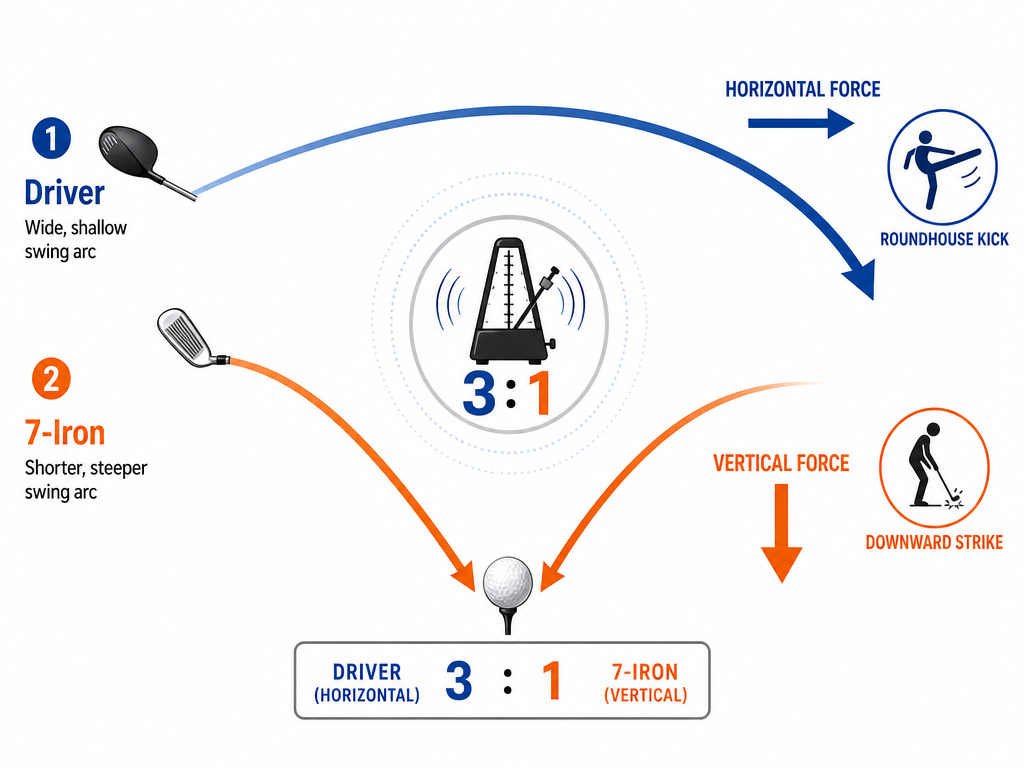
Your 3:1 tempo is a constant, but the physical swing changes with the club. A driver is longer, lighter in the head, and swung on a more horizontal plane. A 7-iron is shorter, heavier, and struck on a steeper angle. The biomechanics study from the NIH library shows these differences clearly.
The research found that with a driver, golfers generate greater horizontal angular impulse, think of a roundhouse kick. This requires a wider turn and a later release. With a 5-iron, the frontal angular impulse (related to a more vertical, downward strike) is greater. The study also noted that the peak vertical Ground Reaction Force in the trail foot happens earlier in the downswing with an iron.
| Club | Key Biomechanical Focus | What Changes (Tempo Stays 3:1) |
|---|---|---|
| Driver | Horizontal force generation, wide arc | Feel: Larger shoulder turn, later release. Pressure: More weight shift into trail side in backswing. |
| 5-Iron | Vertical force & downward strike | Feel: More centered pivot, steeper angle of attack. Pressure: Earlier shift to lead side in downswing. |
| 7-Iron | Control & precision | Feel: Compact, faster backswing. Pressure: Quickest transition, firm lead side at impact. |
This is why you can have a great consistent tempo with your irons but feel out of sync with the driver. You’re not changing the metronome beat; you’re changing the dance move within that beat. For the driver, think “wide and late.” For the mid-iron, think “centered and down.” The 3:1 timing glues it all together.
Tempo Trainers vs. Speed Trainers: Which Do You Need?
The market is flooded with aids. Knowing which one addresses your primary flaw saves time and money. Use this table to decide where to invest.
| Training Aid Type | Primary Target | Best For This Problem | Example Products |
|---|---|---|---|
| Tempo/Rhythm Trainers | Timing Ratio (Backswing:Downswing) | Slow, disjointed backswing; inconsistent strike | Orange Whip, Tour Tempo Tones, Swingyde |
| Swing Speed Trainers | Clubhead MPH | Already efficient but physically lack power | SuperSpeed Golf, The Stack System, Rypstick |
| Weighted Swing Trainers | Strength & Kinesthetic Feel | Poor sequence awareness; weak core engagement | SKLZ Gold Flex, Momentus Speed Whoosh |
| Swing Analysers | Data Feedback (Both) | Guessing about your numbers; no feedback loop | Zepp 2, Garmin Approach CT10, Blast Motion Golf |
If you spray the ball and have no consistent strike pattern, start with a tempo trainer like the Orange Whip. If you hit the ball straight but short, and your tempo is already near 3:1, then a speed trainer like SuperSpeed Golf is the logical next step. The best devices for measuring golf swing speed, like a PRGR radar, are useful for everyone to track progress, but they don’t fix the underlying cause.
The short version: Fix the sequence first, then add horsepower. Buying a speed trainer with a 4.5:1 tempo is like putting a turbocharger on a car with flat tires.
Frequently Asked Questions
What is a good swing tempo ratio for an amateur?
Aim for between 3:1 and 3.3:1. The classic 3:1 of the pros is the ideal, but a 3.3:1 is a massive improvement for most recreational players who start near 4:1. Consistency is more important than perfection. If you can repeat a 3.2:1 ratio every time, you’ll play much better golf.
Can I increase swing speed without changing my tempo?
Yes, but only to a point. You can gain some speed through strength training, flexibility work, and overspeed drills. However, if your tempo is inefficient (like 4:1), you have a ceiling. Improving your tempo to 3:1 removes a brake on your system, allowing any speed training you do to translate more directly to the clubhead.
How do I know if my backswing is too slow?
You’ll feel like you have to “start the downswing” with a forceful jerk from the top. There’s a noticeable pause or feeling of being “stuck.” On video, your club will appear to stop at the top before you begin moving down. Data from a swing analyser will show a ratio of 3.5:1 or higher.
Do different swing speeds use different tempo ratios?
No. The ratio is independent of speed. John Novosel’s four tempos (27/9, 24/8, 21/7, 18/6) all maintain the 3:1 ratio. A player with a 27/9 tempo has a slower overall swing than a player with an 18/6 tempo, but their backswing is still three times longer than their downswing. You choose the overall cadence that fits your athleticism.
What’s the fastest way to ruin good tempo?
The fastest way is to obsess over swing positions during your actual swing. “Keep my head down,” “straight left arm,” “turn your shoulders”, these mechanical thoughts disrupt the athletic motion. Tempo is a rhythm, not a position. Practice mechanics in slow motion, but when you swing, have one thought: match the beat.
The Bottom Line
Stop trying to swing faster. Start trying to swing in time. The 3:1 tempo ratio is the game’s open secret, backed by physics and the swings of every great player who ever lived. It is not a style; it’s a signature of efficiency.
Measure your ratio with a simple analyzer. Train it with tones and a trainer like the Orange Whip. Your swing speed will increase as a side effect of a system that finally works in sequence. This is how you add yards without losing accuracy, and how you find a swing you can trust when the pressure is on. The difference between tempo and speed is the difference between the clock and the stopwatch. Master the clock, and the stopwatch takes care of itself.
