
The Physics of Tempo for Better Golf Swing Rhythm and Timing
This post contains affiliate links. As an Amazon Associate, we earn from qualifying purchases.
This post contains affiliate links. As an Amazon Associate, we earn from qualifying purchases.
Golf swing rhythm and timing are the measurable, physics-governed patterns that transfer energy from your body to the club. Rhythm is the flow of the entire motion; timing is the specific order your body segments peak in speed. Pros maintain a consistent tempo (often a 3:1 backswing-to-downswing ratio) while amateurs show erratic timing and a reversed body sequence that leaks power.
That 3:1 ratio is the output of your body acting as a simple harmonic oscillator, a biomechanical clock dictated by the rotational inertia of your body-club system. The real difference between a pure strike and a weak slice often lies beyond the hands or the grip.It’s in the milliseconds between your hips stopping and your arms accelerating.
What follows breaks down the two measurable components, the one sequence error 90% of amateurs make, and the drills that rewire motor timing in under four weeks.
Key Takeaways
- Tempo is global, rhythm is local. Your overall swing tempo (e.g., 24 frames backswing, 8 frames downswing) stays consistent across clubs. Your swing rhythm, the flow within that tempo, changes with the task, slowing for wedges and speeding for drivers.
- Amateurs reverse the pro sequence. Research shows pros peak in order: pelvis, thorax, arm, club. Amateurs often fire their arm before their thorax, which kills lag and reduces clubhead speed by 10-15 mph.
- Timing is a trainable skill, not just feel. Synchronized metronome training (SMT) for four weeks significantly improves motor timing and reduces shot dispersion, proving the underlying neural clock can be tuned independently of swing mechanics.
- “Lag” is a timing metric, not a position. True lag is the delay in wrist uncocking created by the proper kinematic sequence. Trying to “hold lag” as a static position usually results in a late release and a block right.
- Wearable sensors make the invisible visible. Inertial Measurement Unit (IMU) sensors can quantify your exact tempo, rhythm, and functional swing plane, moving feedback from guesswork to data.
The Two Numbers That Define Your Swing
You hear “tempo” and “rhythm” used interchangeably. They’re not. For your swing to repeat under pressure, you need to separate them.
Swing tempo is the total duration and the ratio. It’s the metronome click for your entire motion. Studies using accelerometers in club shafts find a consistent pattern among elite players: a backswing that’s about three times longer than the downswing. This 3:1 ratio emerges because the golf swing behaves like a simple harmonic oscillator. The system’s resonant frequency, set by the mass of the club and the elasticity of your muscles and tendons, dictates the timing. This is why your tempo doesn’t wildly change from a driver to a 7-iron; the physical system is similar.
A 2020 study in the Journal of Mechanical Science and Technology using wearable inertial sensors confirmed that swing tempo is consistent across different clubs for a given golfer. The total swing time might vary by a few hundredths of a second, but the fundamental clock ticks at the same rate.
Swing rhythm is the internal flow and pacing. This is where club choice matters. The same study found that swing rhythm tends to decrease for clubs with less carrying distance. Your wedge swing has a different internal cadence than your driver swing, more pause at the top, a smoother transition. Rhythm is what you’re adjusting when you try to hit a “3/4 shot” or a low punch. You’re altering the flow within your stable tempo.
| Metric | What It Measures | Pro Tendency | Amateur Pitfall |
|---|---|---|---|
| Tempo | Total swing time & backswing/downswing ratio | Consistent 3:1 ratio across clubs | Erratic ratio; slows down entire motion under pressure |
| Rhythm | Internal flow, smoothness of acceleration | Rhythmic flow changes predictably with club | Jerky transition; “hitting from the top” destroys rhythm |
| Timing | Order and synchronization of body segments | Pelvis → Thorax → Arm → Club | Arm fires before torso, sequence is reversed |
If you only work on one, work on tempo. A repeatable, consistent tempo is the foundation. You can build different rhythms on top of a solid clock. You can’t build a repeatable swing on a chaotic one.
The Pro’s Secret: It’s a Sequence, Not a Snap
This is where timing gets surgical. Power is created by moving things in the right order, so energy transfers like a whip from your core to your hands.
The research calls this the kinematic sequence. Motion capture studies comparing PGA professionals to amateurs show a stark, measurable difference.
Professionals peak in this order: pelvis rotational speed first, then the thorax (upper torso), then the lead arm, and finally the club. Each segment accelerates, then decelerates, passing its energy to the next link in the chain. The pelvis actually slows down before impact in every pro swing, a clear sign of energy transfer.
Amateurs, especially higher handicappers, show a reversed sequence. The most common fault is the arm peaking in speed before the thorax. This is “casting” or “early extension” measured in data. The arm runs out of runway, so the only way to hit the ball is to stall the body and flip the wrists. Power leaks everywhere.
Where this goes sideways: Trying to start the downswing with your arms. The moment your arms pull down from the top, you’ve bypassed the kinetic chain. The result is a loss of 20-30 yards off the tee and a face that’s impossible to square consistently, leading to a two-way miss.
The goal isn’t to think about each segment. The goal is to create a swing where the sequence happens automatically. This is why the kinematic sequence is a non-negotiable concept for improvement. You’re not just swinging a club; you’re orchestrating a timed energy transfer.
Why Does Rhythm Change But Tempo Stay the Same?
It seems contradictory. If your body is a harmonic oscillator with a fixed tempo, how can you alter rhythm for a finesse wedge shot?
The model explains this, too. Think of a pendulum. Its natural swing period is fixed by its length and gravity, that’s your tempo. But you can drive that pendulum with different forces. A gentle push creates a smooth, slow-looking arc (a wedge rhythm). A sharp impulse creates a faster, more aggressive swing within the same period (a driver rhythm). You’re not changing the clock; you’re changing how you excite the system.
This is crucial for club selection. A wedge requires more precision than raw power. The slower rhythm allows for finer motor control and a steeper, more descending blow. The sensor study showed the functional swing plane slope tends to decrease for clubs with greater carrying distance. Your driver swing is longer and flatter; your wedge swing is shorter and steeper. Different rhythms produce different geometries.
So you don’t “slow down your tempo” for a wedge. You maintain your inherent tempo but execute a different rhythm within it. This is why using a tempo trainer that beeps at a fixed rate can be so effective, it locks in the clock while you learn to vary the dance.
The Drills That Rewire Your Internal Clock
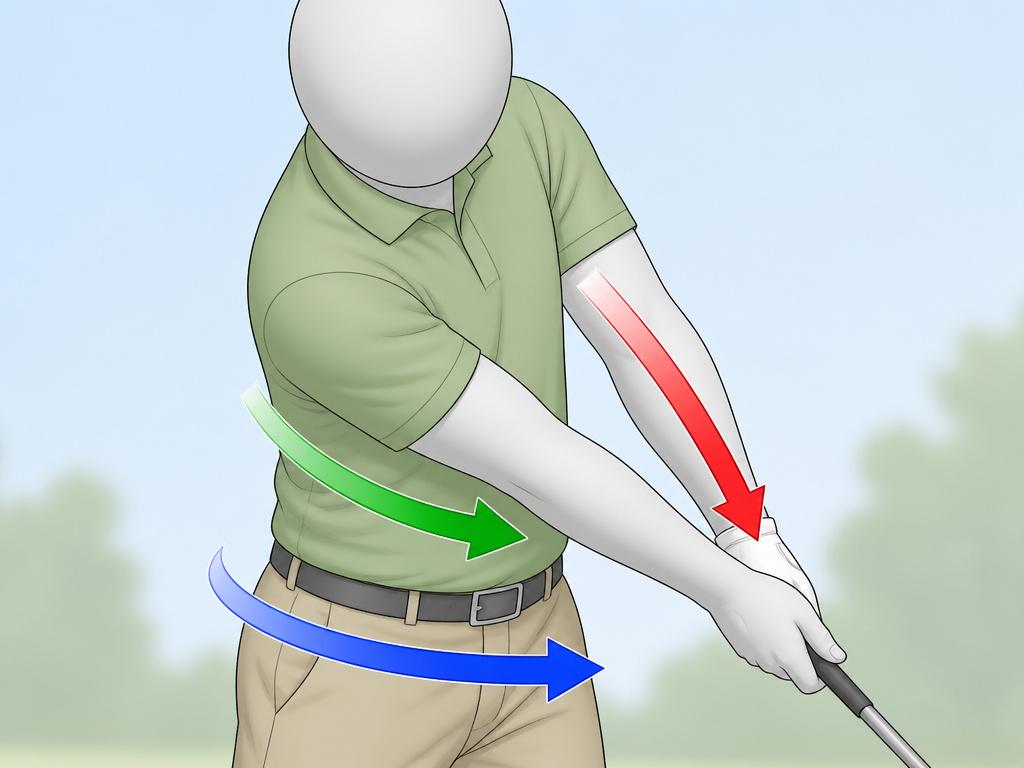 Knowing the theory is one thing. Changing a motor pattern ingrained over years is another. These drills target the specific flaws in timing and sequence.
1. The Two-Step Swing Drill (TSSD)
This is a deliberate, segmented motion that enforces the proper sequence. Research on competitive junior golfers found that a single TSSD session (under 45 minutes) significantly increased clubhead speed and improved horizontal motion rhythm.
How to do it:
- Take your normal backswing. Pause completely at the top for two full seconds. This eliminates any momentum-driven rush.
- From a dead stop, initiate the downswing only with your lower body. Feel your hips begin to rotate while your arms and club are still fully back.
- Let that hip rotation pull your torso, then your arms, then the club through impact.
The consequence of skipping the pause: You’ll default to your old arm-led swing every time. The pause is the circuit breaker for your bad habit.
2. Synchronized Metronome Training (SMT)
This is the most direct proof that timing is a trainable brain function. Studies using the Interactive Metronome (IM) system, where you match a beat with hand or foot taps, show clear results. A four-week SMT program led to significant improvements in motor timing and, crucially, golf shot accuracy with less variability.
The system measures three things: your average timing error (in milliseconds), your consistency (rhythmic skill), and your stability (how long you can stay on beat). Golfers who improved these metrics saw tighter shot dispersion. It trains the underlying neural conductor, not the musicians.
This means tools like the Sonic Golf training system, which provides audio feedback based on clubhead speed, are grounded in real biomechanics. You’re not just listening for a beep; you’re aligning your motor output with a precise auditory cue.
3. The Step-Through Drill
This drill fixes the weight shift and sequence together. It’s impossible to do it correctly with an arm-led swing.
How to do it:
- Set up to a middle iron, but take your trail foot and place it behind your lead foot, so you’re in a narrow, staggered stance.
- Make a normal backswing.
- On the downswing, your goal is to step your trail foot forward, past your lead foot, and finish in a full follow-through with your weight on your new front foot.
If you start the downswing with your arms, you’ll fall over backward. The drill forces you to lead with your lower body to move your mass forward. It directly connects weight shift to sequencing.
Tools That Give You Real Feedback
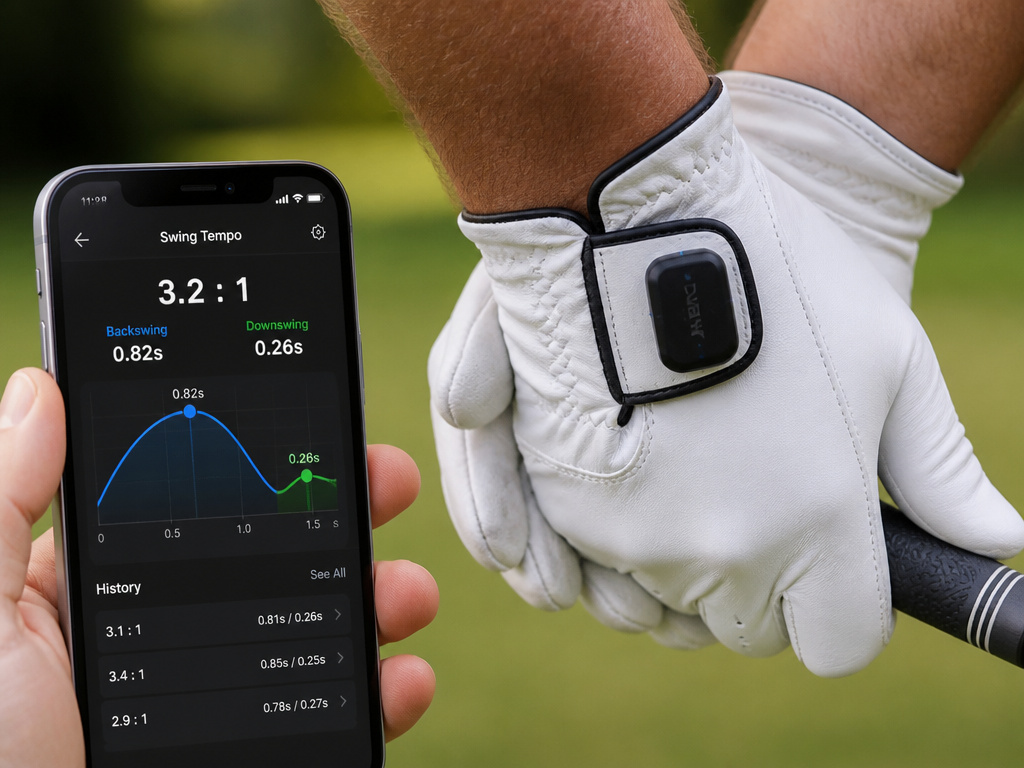 Guessing at your tempo is over. Several golf swing training aids now provide quantifiable data.
- Wearable IMU Sensors: Devices like the Arccos Caddie Smart Sensors or dedicated swing analyzers clip onto your glove or club. They measure your exact tempo, rhythm, and swing plane, giving you a post-swing report. This is how you move from “my rhythm felt off” to “my downswing was 22ms faster than last week.”
- Auditory Tempo Trainers: The simplest tool. A metronome app set to beep at your ideal backswing and impact points. The Tour Tempo program popularized the 3:1 ratio with specific audio tracks. Use it during practice to entrain the rhythm.
- Weighted Trainers: Don’t confuse these with swing speed trainers. A weighted swing trainer like the Orange Whip emphasizes rhythm and sequence. The counterweight forces you to swing in balance and use your body correctly. It’s excellent for learning the feel of the kinematic sequence.
For a beginner swing trainer, a simple metronome and the two-step drill are the highest-value starting points. You don’t need tech to learn the correct order of operations.
Frequently Asked Questions
Can you have good rhythm but bad tempo?
Yes, but it’s uncommon. You might have a beautifully smooth, flowing swing (good rhythm) that is simply too slow or too fast overall (bad tempo). More often, bad tempo, like a violently fast backswing, destroys any chance of good rhythm. They’re linked, but tempo is the priority fix.
What is the ideal backswing to downswing ratio?
For most elite players, it clusters around a 3:1 ratio. This means if your backswing takes 0.9 seconds, your downswing should take about 0.3 seconds. However, your personal “ideal” is the ratio that produces your most consistent, centered strikes. The key is that the ratio is stable, not the specific number.
How does swing rhythm affect distance?
Indirectly, but powerfully. Poor rhythm, usually a jerky transition, breaks the kinematic sequence. When the sequence breaks, energy transfer from your body to the club is inefficient. You might swing your arms fast, but with a broken sequence, you’re not delivering that speed to the clubhead effectively. Good rhythm enables a efficient sequence, which maximizes power.
Are tempo and timing the same thing?
No. This is a critical distinction. Tempo is the speed of the overall swing. Timing is the synchronization of the parts within the swing. You can have a fast tempo with good timing (a quick, efficient swing) or a fast tempo with terrible timing (a quick, disjointed slash). Good timing is what makes any tempo effective.
Can timing be improved without hitting balls?
Absolutely. The research on Synchronized Metronome Training proves this. The IEEE neural engineering research into muscle synergy refinement shows timing is a neural-level skill. Drills like the two-step swing drill or even rhythmic tapping exercises can improve the underlying motor timing that governs your swing.
The Bottom Line
Stop searching for a secret move. The difference between a repeating swing and an erratic one lives in the measurable domains of rhythm and timing. Work to establish a consistent personal tempo, your biomechanical clock. Then, focus relentlessly on the sequence: hips first, then torso, then arms. Use a pause drill to feel it. Use a metronome to hear it.
The data doesn’t lie. Pros sequence. Amateurs don’t. Your path to better ball striking is less about finding a new tip and more about reprogramming an old, inefficient timing pattern. That reprogramming takes focused, deliberate practice. But the reward is a swing that holds up when it matters, because it’s built on physics, not just feel.
