
What is a Golf Course Superintendent? Role & Career Path Explained
This post contains affiliate links. As an Amazon Associate, we earn from qualifying purchases.
This post contains affiliate links. As an Amazon Associate, we earn from qualifying purchases.
A golf course superintendent is the senior manager responsible for all aspects of a golf course’s maintenance, operation, and environmental health. They oversee turfgrass science, manage personnel and budgets, and ensure the course is playable, safe, and aesthetically pleasing for golfers. The path to this role typically requires post-secondary education in turfgrass management or agronomy, followed by 3–5 years of progressive experience, and often leads to certification by the Golf Course Superintendents Association of America (GCSAA).
Let’s strip it back. Most people picture the superintendent as the person mowing the greens. That’s about five percent of the job. The rest is a high-stakes balance of science, business, and people management. Think of a superintendent as the CEO of the playing field, where a single misjudged chemical application can kill $100,000 worth of turf overnight, and a poorly communicated maintenance schedule can ruin a member’s wedding-day round. Good golf should feel less complicated the more you understand it, and that includes knowing who makes the course great.
What follows is a breakdown of the role beyond the mower: the four core responsibilities that define the job, the real career path (spoiler: it’s not glamorous), the hard numbers behind GCSAA certification, and the one trait that separates the good superintendents from the great ones.
Key Takeaways
- A superintendent’s primary duty is managing the entire golf course ecosystem, which includes turfgrass health, water usage, environmental compliance, and long-term agronomic planning, not just daily mowing.
- Up to 80% of a golf course’s operational budget falls under the superintendent’s control, making financial acumen and strategic golf course management as critical as agronomic knowledge.
- GCSAA certification (CGCS) can command a salary premium of $20,000 or more and requires a combination of formal education, documented experience, and a rigorous multi-part exam.
- The job demands constant adaptation to extreme conditions, from drought and disease outbreaks to tournament prep, requiring decisions that range from patient monitoring to complete course renovations.
- Success hinges on communication and collaboration with everyone from groundskeepers and club pros to general managers, municipal officials, and the golfers themselves.
What is a Golf Course Superintendent? Beyond the Greenskeeper
The title “superintendent” carries a weight that “greenskeeper” doesn’t. A greenskeeper executes tasks. A superintendent designs the system those tasks fit into. According to the official GCSAA Certified Superintendent Code of Standards, a golf course superintendent is entrusted with the management and operation of the golf course, including construction and maintenance.
The golf course superintendent is the manager of the game’s most valuable resource: the golf course. The career is multi-faceted. It involves turfgrass management, environmental stewardship, research, personnel management, budget development, accounting, event management, inventory control, communications, and a variety of other tasks.
That’s the official description from the Rutgers continuing education program for superintendents. It’s a job where you might analyze soil samples at 7 AM, approve a $50,000 irrigation part invoice at 10 AM, train a new crew member on bunker raking technique at 2 PM, and present the seasonal maintenance plan to the club’s board at 6 PM. The superintendent is the central hub where agronomy, business, and hospitality intersect.
The 4 Cornerstones of a Superintendent’s Job
If you break down the role, it rests on four pillars. Miss one, and the course, and your career, suffers.
1. Turfgrass and Agronomic Management
This is the science. It’s knowing why the Poa annua on the seventh green is dying while the bentgrass thrives. It involves planning the annual calendar of aeration, topdressing, fertilization, and overseeding. Superintendents must hold state pesticide applicator certifications and understand integrated pest management to control weeds, insects, and diseases with minimal environmental impact. They manage complex computer-controlled irrigation systems, often the course’s single largest water expense. This is where the post-secondary education in turfgrass management or horticulture pays off daily.
2. Financial and Operational Leadership
Here’s the truth nobody sells: you’re running a multimillion-dollar asset. John Jeffreys, superintendent at the famed Pinehurst No. 2, notes in an NC State career guide for superintendents that the superintendent can be responsible for up to 80% of the course’s operational resources. You’re not just growing grass; you’re managing a golf course business management operation. This means developing and adhering to an annual budget, forecasting capital expenses for equipment replacement, and negotiating contracts with vendors. A superintendent with sharp financial skills is far more valuable to a club’s bottom line.
3. Personnel and Project Management
A superintendent doesn’t work alone. They lead a team that can range from a handful of seasonal workers at a small public course to a staff of 50+ at a large private club or resort. This requires hiring, training, scheduling, and motivating a diverse crew. They also manage large projects, installing new drainage, rebuilding bunkers, or overseeing a course renovation, which demands skills in planning, logistics, and contractor coordination. Strong communication is essential; you’re the link between the maintenance staff, the head pro, the general manager, and the membership.
4. Communication and Stakeholder Relations
The superintendent is the public face of the course’s maintenance. They must effectively communicate why the greens are sanded, why a hole is closed, or what that mysterious sprayer is applying. They present reports to ownership or boards, educate members on sustainable maintenance practices, and work closely with the golf shop to minimize disruption to play. At a municipal course, they may report to a Director of Parks and Recreation. At a private club, they answer to a green committee or general manager. This aspect of the job is what often surprises people who think the role is purely outdoors.
| Core Responsibility | Daily Focus | Long-Term Focus |
|---|---|---|
| Turfgrass Management | Mowing, moisture management, pest scouting. | Annual agronomic plan, soil testing, cultivar selection. |
| Financial Oversight | Labor payroll, daily supply costs. | Annual budget, capital improvement planning, ROI analysis. |
| Personnel Leadership | Daily crew assignments, safety meetings. | Hiring, training, career development, team culture. |
| Stakeholder Communication | Daily playability updates, member inquiries. | Board presentations, long-range planning collaboration, community outreach. |
The GCSAA CGCS Certification: Is It Worth It?
The Golf Course Superintendents Association of America (GCSAA) offers the Certified Golf Course Superintendent (CGCS) designation. It’s the industry’s gold standard. Let’s be clear about this: it’s not a participation trophy. The process is rigorous, but the payoff is real.
The official CGCS professional standards document outlines a multi-step path. Applicants need a combination of formal education (a turf-related degree significantly reduces the required experience) and verifiable tenure as a superintendent. You then have a 12-month window to pass a series of exams covering agronomy, business management, and environmental science. The final hurdle is a practical “attestation,” where a GCSAA evaluator visits your course and assesses your operation firsthand.
What most people get wrong: Thinking certification is just for resume padding. GCSAA data suggests the CGCS designation can add $20,000 or more to a superintendent’s annual salary. It’s a third-party validation of your expertise that signals to employers you understand the full spectrum of the job, not just how to run a fairway mower.
Is it mandatory? No. Many superintendents have long, successful careers without it. But for those aiming for top-tier positions at championship course or resort course facilities, it’s increasingly expected. It’s the difference between being a candidate and being the candidate.
A Day in the Life: From Dawn to Desk
 The romantic view is sunrise over the first fairway, a quiet moment of inspection. The reality is more… Layered. Here’s a synthesized look at a typical day, drawn from superintendent accounts:
Pre-Dawn (5:00 AM – 6:30 AM): Arrive before the crew. Check weather forecasts and radar. Walk key areas, greens, tournament tees, to assess moisture, frost risk, or overnight damage. Adjust the day’s mowing and spraying schedule based on what you see and what’s coming weather-wise. This quiet hour is critical for situational awareness.
Morning Execution (6:30 AM – 10:00 AM): The crew arrives. Morning meeting to assign tasks, emphasizing safety (equipment operation, chemical handling). The team fans out to mow greens, tee boxes, and fairways; change cup locations; rake bunkers; and perform detailed golf course maintenance. The superintendent is mobile, troubleshooting issues, checking work quality, and ensuring playability for the first groups.
Mid-Day Shift (10:00 AM – 2:00 PM): As play increases, the crew transitions to less disruptive tasks: irrigation repair, project work, equipment maintenance, or rough mowing. The superintendent spends this time in the office: answering emails, placing orders, scouting for pests, or meeting with the head pro to coordinate for an upcoming outing. The smell of cut grass gives way to the hum of the computer.
Afternoon Management (2:00 PM – 5:00 PM): Finalize paperwork, payroll, and compliance logs. Plan for tomorrow. Meet with vendors, the general manager, or the greens committee. This is when the business of golf happens, reviewing budgets for a new irrigation head, discussing member feedback on green speed, or planning a golf course design project with an architect.
The balance tips heavily toward the desk as you advance. A seasoned superintendent might only spend 2-3 hours physically on the course on a typical day. The rest is management.
Career Path and Salary Outlook: Building a Life on the Grass
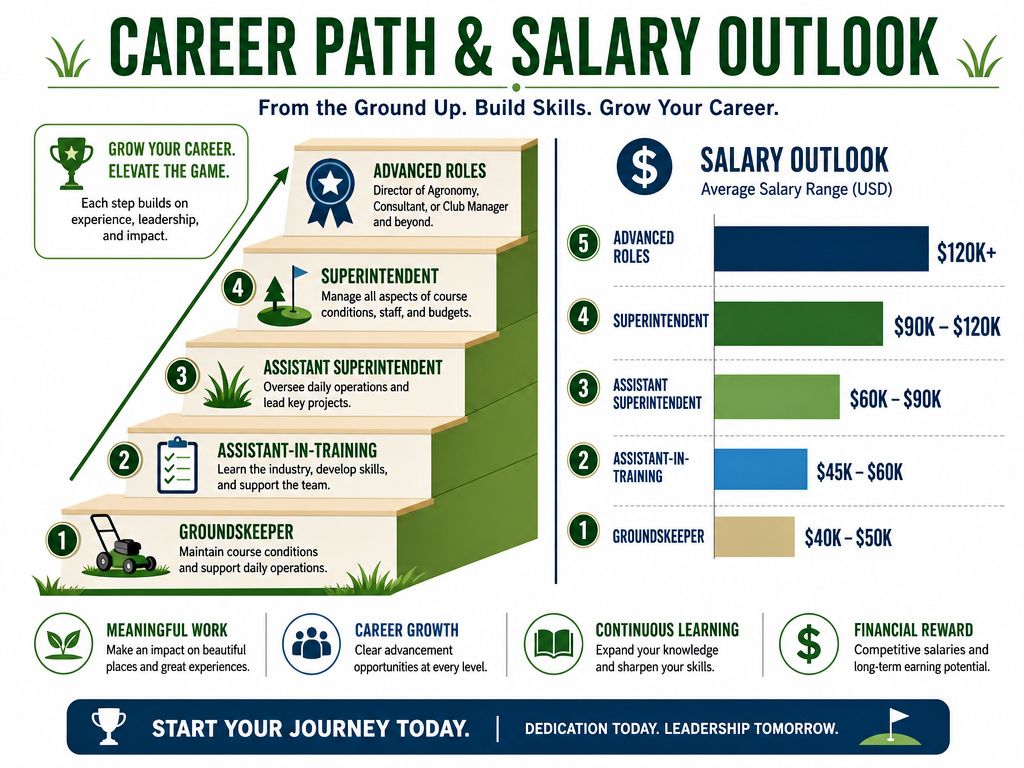 This isn’t a career you fall into out of business school. It’s a trade built from the ground up, literally.
The Traditional Path:
- Entry-Level Groundskeeper: Start in high school or college mowing greens, raking bunkers, and laying sod. This is where you learn the feel of the grass and the rhythm of the course.
- Assistant-in-Training / 2nd Assistant: Move into a role with more responsibility, perhaps overseeing a small crew or a specific project. You start learning spray calibration, irrigation basics, and crew management.
- Assistant Superintendent: Now you’re deeply involved in agronomic planning, scheduling, and budgeting. You’re the superintendent’s right hand, covering for them when they’re away. This stage lasts 3-7 years for most.
- Golf Course Superintendent: Your first head role. Often starts at a smaller public or semi-private course. The learning curve is vertical, you’re now responsible for everything.
- Advanced Roles: Director of Agronomy (overseeing multiple courses), Regional Superintendent, or positions at elite private vs public clubs or resort golf destinations.
Salary Reality:
Salaries vary wildly based on geography, course type (a great golf course like Augusta National pays differently than a municipal nine-hole), and experience. The Rutgers program cites that “financial rewards (often in the six figures)” are possible. Entry-level assistants might earn $40,000-$50,000. Superintendents at mid-level clubs often earn $70,000-$90,000. Those with CGCS certification at high-end clubs can surpass $120,000, plus benefits like housing. The $20,000 certification premium is a powerful motivator.
Essential Skills and Traits: Do You Have What It Takes?
Technical knowledge can be taught. The right mindset is harder to find.
- Agronomic Curiosity: You need a genuine interest in the science of plants, soil, and water.
- Business Acumen: You must be comfortable with spreadsheets, budgets, and golf course economics.
- Leadership & Communication: You’ll lead a diverse team and must explain complex issues simply to members and boards.
- Adaptability & Problem-Solving: Weather, disease, equipment breakdowns, something breaks every single day.
- Stamina & Organization: Long seasonal hours (60-70/week during peak season) require physical and mental resilience.
- Passion for Golf: It helps immensely to love the game and understand the player’s perspective.
I once tried to teach a complex technical shot to a beginner who just wanted to hit the ball straight, wasting a lesson for both of us. A similar principle applies here. A superintendent who gets lost in the science but can’t relate to a member’s frustration over a bumpy green is missing the point. The job is to blend the science with the sport’s enjoyment.
Frequently Asked Questions
What’s the difference between a superintendent and a greenskeeper?
Greenskeeper is a crew member who performs specific maintenance tasks like mowing or raking. A superintendent is the manager who plans all those tasks, manages the greenskeeping staff, oversees the budget, and is responsible for the entire course’s health and playability.
What education is needed to become a golf course superintendent?
Most superintendents hold at least a two-year certificate or associate’s degree in turfgrass management, horticulture, or agronomy from a specialized program (like Rutgers, Penn State, or Michigan State). A four-year bachelor’s degree in a related field is increasingly common and can accelerate career advancement and certification.
Do superintendents need to be certified?
Legally, no. However, certification through the GCSAA (CGCS) is a major career accelerator that signifies proven expertise in agronomy, business management, and environmental practices. It is often required or strongly preferred for top positions.
Who does a golf course superintendent report to?
It depends on the course. At a private club, they typically report to the General Manager or a Green Committee. At a municipal course, they may report to a Director of Parks and Recreation. At a resort, they report to the resort’s general manager or director of operations.
Is being a superintendent a year-round job?
Yes, but the intensity varies. Peak season (spring through fall) involves long days managing daily maintenance and high play. The off-season (“winter” in many climates) is for major projects, equipment overhaul, budgeting, planning, and continuing education.
What are the biggest challenges for a modern superintendent?
Balancing high play expectations with necessary maintenance windows, managing water resources and environmental regulations, staying within tightening budgets, and adapting to more extreme weather patterns due to climate change are among the top challenges.
The Bottom Line
A golf course superintendent is the operational and agronomic CEO of the golf course. It’s a career that demands a rare mix of scientist, accountant, mechanic, coach, and diplomat. The path is hands-on and requires patience, you’ll spend years learning the trade before you earn the title.
If you’re considering this path, strip it back to one question: Do you love the process of building and sustaining something complex more than you need immediate glory? If yes, find a local course and ask for a summer job mowing greens. That’s the first, and most honest, step. You’ll know within a month if the smell of cut grass and the satisfaction of a perfectly rolled green is worth the early mornings and the constant problem-solving. For those who stick with it, it’s not just a job; it’s a vocation rooted in the land and the game.
