
The Ultimate Guide to Steel vs Graphite Golf Shafts
This post contains affiliate links. As an Amazon Associate, we earn from qualifying purchases.
This post contains affiliate links. As an Amazon Associate, we earn from qualifying purchases.
Choosing between steel and graphite shafts comes down to three measurable things: your swing speed, your tolerance for vibration, and the specific weight class of graphite you’re willing to pay for. For players under 85 mph driver speed or anyone with joint pain, graphite is the clear answer. For faster players seeking maximum shot control and a lower ball flight, steel remains the default, unless you move into premium, heavier graphite models designed to mimic steel’s stability.
That vibration clause isn’t a minor detail. Graphite absorbs 30 to 50 percent more shock than steel. That difference is the line between playing 18 holes and needing an ice pack after nine. The old stigma that graphite is only for slow swings is dead; the new question is whether you value that dampening enough to navigate graphite’s wider performance spectrum.
What follows is a breakdown of the material science, the real-world performance trade-offs, and the specific player profiles that fit each side of the divide. By the end, you’ll know which category you belong in and the exact models that bridge the gap.
Key Takeaways
- Graphite shafts dampen 30-50% more vibration than steel, making them a practical necessity for players with elbow, wrist, or shoulder issues.
- Swing speed under 85 mph with a driver is the strongest technical indicator for a graphite benefit; over 100 mph, steel is still the safe default for control.
- The real performance gap isn’t between steel and all graphite, it’s between steel and cheap graphite. Premium models like the KBS TGI or Graphite Design Tour AD iron series are built for stability.
- Switching from a 120g steel shaft to a 70g graphite shaft drops swing weight dramatically (roughly 9 points). You must add head weight or use tip weights to regain feel.
- Graphite shafts can be damaged by excessive heat during grip changes, creating invisible micro-fractures. Always use a low-temperature heat gun and a shaft protector.
The Core Difference is Vibration, Not Just Weight
Forget the simple “graphite is lighter” line. The defining mechanical difference is how the two materials handle energy transfer at impact. Steel is an isotropic metal, it transmits vibration efficiently along its entire length. Graphite is a composite (Carbon Fiber Reinforced Plastic, or CFRP), a weave of fibers in a resin matrix that dissipates energy laterally.
A steel shaft acts like a tuning fork, ringing at impact. A graphite shaft acts like a dampened rod, absorbing the high-frequency vibrations before they reach your hands. Industry testing shows this damping reduces felt shock by 30 to 50 percent.
That range isn’t marketing. It’s the difference between a stiff, metallic ping and a muted thud. For a player with healthy joints, steel’s feedback can feel connected and precise. For someone with tendonitis, arthritis, or prior injury, that same feedback is pain. The vibration travels directly into the joint, accelerating inflammation.
Why does this matter on a Tuesday afternoon round? Cumulative damage. You might not feel a single shot. After 70 shots, the aggregate vibration has fatigued the tendons in your lead elbow. Graphite interrupts that chain. It’s not about making bad strikes feel good; it’s about letting you practice without paying for it the next morning.
The part nobody mentions: This damping also slightly mutes feedback on center strikes. Some better players interpret the softer feel as a loss of control or “boardiness,” especially in early-generation graphite. Modern premium shafts use materials like TORAYCA T1100G in the tip section to create a firm, stable feel that communicates impact without the sting.
Who Actually Should Play Graphite Shafts?
The old rule, graphite for seniors, steel for everyone else, is obsolete. The decision matrix now uses swing speed and medical history as the primary filters.
| Player Profile | Recommended Shaft Type | Primary Reason | What Happens If You Choose Wrong |
|---|---|---|---|
| Driver Swing Speed < 85 mph | Graphite | Lighter weight promotes higher clubhead speed and launch. The vibration benefit is a bonus. | Steel feels too heavy, slows swing down, leads to low, weak shots that lack carry distance. |
| Any player with joint pain (elbow, wrist, shoulder) | Graphite | Vibration dampening is non-negotiable for pain management and longevity. | Steel aggravates inflammation, limits practice, can force extended time off. |
| Player seeking maximum distance & height | Graphite (Lightweight, <80g) | Lower total weight allows faster acceleration; design promotes higher launch. | Steel keeps ball flight too low, sacrifices potential carry yards. |
| Driver Swing Speed 100+ mph, prioritizes control | Steel (or Premium Heavy Graphite >110g) | Steel’s consistent flex profile and heavier weight support a aggressive transition and low spin. | Light graphite can feel unstable, exaggerates hooks or fades, reduces shot-shaping confidence. |
| Mid-handicap player, no pain, speed 85-95 mph | Either (Weight is key) | This is the grey zone. Outcome depends on finding the correct weight (95-110g range) in either material. | Getting the weight wrong disrupts tempo more than the material choice itself. |
Where this goes sideways: Choosing graphite solely for distance when you have a late release. A lighter, softer-tip graphite shaft can exaggerate a hook or slice if your hands are active through impact. The fix is a heavier, stiffer-tip graphite model, not a switch back to steel.
The medical case is the simplest. Conditions like tennis elbow, golfer’s elbow, carpal tunnel, or arthritis in the hands aren’t just inconveniences. They are structural limitations. A Mitchell Golf technical note explicitly recommends graphite for golfers with these issues, citing the carbon fiber construction’s superior absorption of shock. Playing steel against that advice isn’t tough, it’s shortening your playing career.
For the speed-based decision, launch monitor data doesn’t lie. A player at 78 mph with a 7-iron needs help launching the ball. A 70-gram graphite shaft can add 3-5 mph of clubhead speed where it matters most. That translates directly to more carry distance. A player at 92 mph might gain only 1 mph, but lose the tight dispersion pattern they get from a familiar 120-gram steel shaft. The trade-off shifts.
The Modern Graphite Shaft: Not Your Grandpa’s Whippy Stick
The stereotype of graphite as unstable and loose persists because cheap, early-generation shafts were exactly that. Today’s premium graphite is an engineered composite, with specific materials laid in specific zones to control bend profile, torque, and weight distribution. The technology has converged on steel’s performance from the other side.
The key terms are MSI (Material Stiffness Integration) and high-modulus carbon fiber. MSI is Graphite Design’s philosophy of mapping different materials to the butt, mid, and tip sections based on their mechanical job. For example, the Graphite Design Tour AD VF uses TORAYCA M40X fiber in the butt for smooth loading and ultra-stiff T1100G fiber in the tip for stability. This lets the shaft feel smooth during the swing but resist twisting at impact.
Common mistake: Assuming all graphite feels the same. A 50-gram senior flex shaft and a 105-gram KBS TGI Tour Graphite Iron shaft are both graphite. They are as different as a hatchback and a race car.
This engineering allows graphite to target specific player needs: * For the steel player wanting graphite feel: The Aerotech SteelFiber winds a steel fiber wire around a graphite core. It delivers vibration dampening with a steel-like impact sensation. It’s the most popular graphite iron shaft on professional tours for a reason. * For the speed-seeking amateur: The UST Mamiya Recoil DART uses Dual Action Recoil Technology to optimize hoop stiffness, eliminating the inconsistent “dead” zones of older graphite. * For the player needing weight: The KBS TGI series runs from 60 to 110 grams, with a bend profile designed to mirror the popular KBS Tour steel shaft. It’s a direct replacement, not an alternative.
The takeaway? You can’t shop for “graphite.” You must shop for a specific graphite model with a defined weight, flex profile, and torque rating. The category has splintered into as many options as steel.
The Steel Shaft’s Unshakeable Case: Consistency and Cost
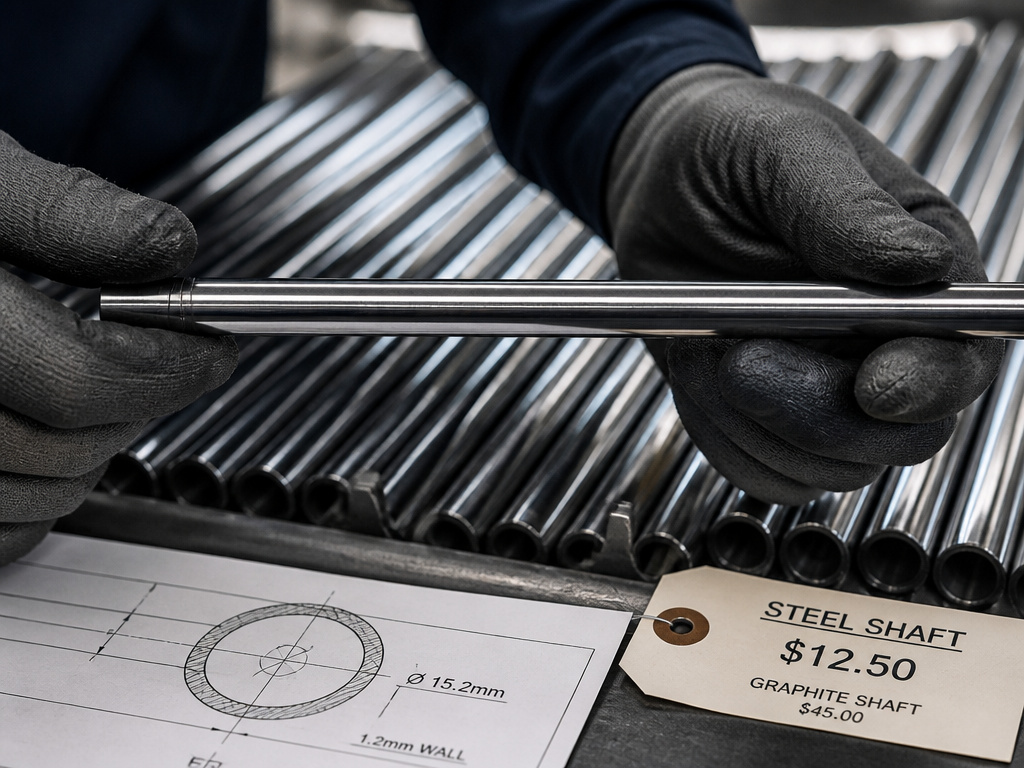
Steel’s advantage isn’t about feeling traditional. It’s about manufacturing simplicity leading to extreme consistency, and a lower price point for that reliability.
A steel shaft is drawn from a single tube of metal. Its flex profile is uniform and predictable. When you buy a Dynamic Gold 120 gram S300 shaft, you know exactly how it will behave. That repeatability is why club fitters and competitive players have trusted steel for decades. There are no hidden variables in the resin mix or fiber layup.
The cost advantage is stark. A set of premium steel shafts might cost a third of a set of equivalent premium graphite shafts. The material and manufacturing process for graphite, weaving fibers, precision layup, curing in autoclaves, is inherently more expensive. If your swing doesn’t need the vibration dampening or lightweight benefits, steel is the rational economic choice.
Steel’s manufacturing simplicity is its superpower. The same process that makes it less expensive also makes it remarkably consistent from shaft to shaft. Graphite’s performance envelope is wider, but its quality control is more challenging.
Steel also maintains its playing characteristics longer. A graphite shaft can be compromised by invisible damage, a cart path strike, excessive heat during a grip change. The resin can degrade. Steel is susceptible to rust if the chrome is scratched, but it’s generally more durable against incidental abuse. For a player who travels often or practices off tight lies, that durability matters.
Finally, steel promotes a lower, more penetrating ball flight by default. Its higher weight and stiffness profile keep spin down. For a high-speed player who already generates enough launch, this is a benefit, not a drawback. It’s why the majority of PGA Tour players still use steel in their irons, they need that predictable, low-spin flight for control into firm greens.
Making the Switch: The Two Critical Adjustments
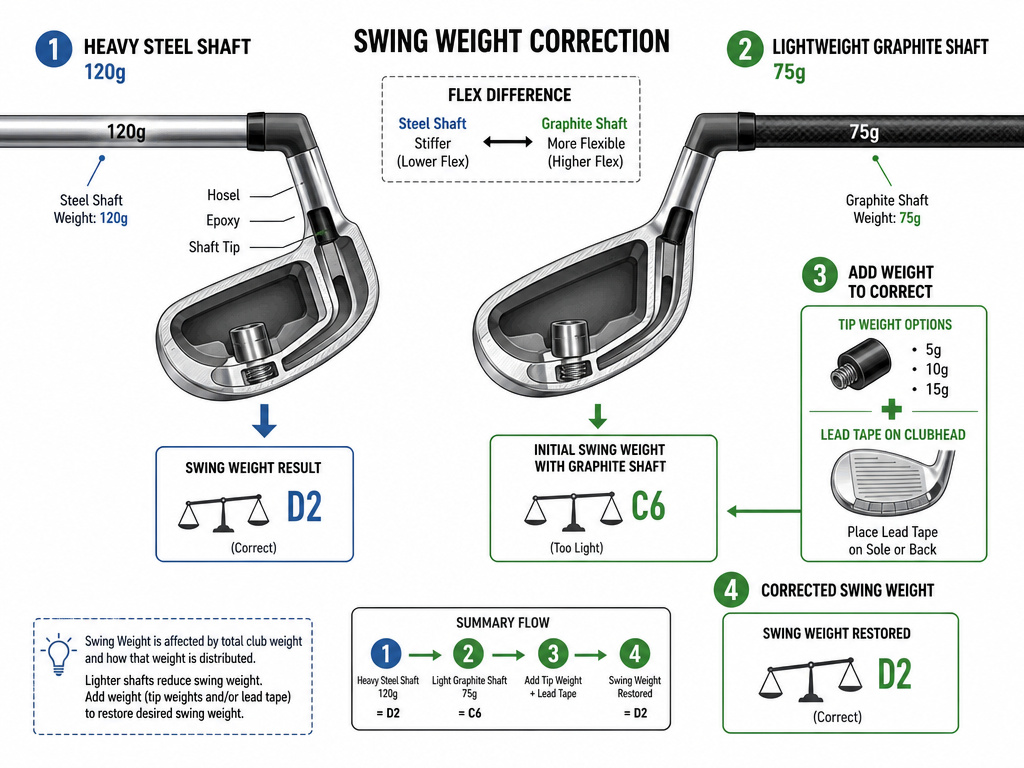
Swapping from steel to graphite (or vice versa) isn’t a straight pull-and-plug operation. If you change the shaft, you change the entire club’s balance. Ignoring this step is the fastest way to hate your new investment.
1. Swing Weight Must Be Corrected. Shaft weight is the biggest driver of swing weight (the club’s balance point). A typical 120-gram steel shaft replaced by a 75-gram graphite shaft will cause a swing weight drop from D2 to around C3. The club will feel like a feather, and you’ll lose all sense of the head during the swing. * The fix: Add weight to the clubhead. This can be done with tip weights inserted into the shaft tip, lead tape on the head, or using a heavier head model. A professional club builder will measure the swing weight and add mass precisely to match your old feel.
2. Your Flex Might Change. Graphite and steel flex differently. A “Stiff” graphite shaft often plays softer to flex than a “Stiff” steel shaft due to material deflection. Don’t assume the label translates. * The fix: Get fitted, or at least test the specific model. Rely on the shaft’s measured frequency (CPM) and your own ball flight data, not the flex letter on the label. The right shaft flex is about matching your transition tempo, not your ego.
Before you start: Always use a low-temperature heat gun and a shaft protector when removing grips from graphite. Excessive heat can delaminate the resin, creating weak points that fail later. Steel is more forgiving, but graphite requires a gentle touch.
For players moving into lightweight golf shafts for speed or health reasons, this adjustment is mandatory. The new shaft is a component, not a solution. The completed club must be tuned.
Steel vs Graphite: The Final Decision Flowchart
When the back-and-forth gets overwhelming, follow this sequence. It cuts through the noise and lands on a material recommendation based on primary need.
-
Do you have persistent pain in your elbows, wrists, or shoulders when playing?
- YES → Choose Graphite. The vibration dampening is your primary goal. Start looking at models in the 90-110 gram range for stability, like the Aerotech SteelFiber or KBS TGI. The decision ends here.
- NO → Proceed to question 2.
-
What is your driver swing speed?
- UNDER 85 mph → Choose Graphite. The lightweight benefit for clubhead speed and launch outweighs other factors. Look at models like the UST Recoil DART 75 or Fujikura Vista Pro 50i.
- 85 – 100 mph → Proceed to question 3. This is the true decision zone.
- OVER 100 mph → Lean Steel. Your priority is control and low spin. Premium heavy graphite (110g+) is an option, but steel is the proven, cost-effective default. Consider Dynamic Gold or KBS Tour models.
-
What is your miss, and what do you value more?
- Miss is low/weak, value distance & comfort → Choose Graphite in a mid-weight class (95-105g). This gives some dampening without sacrificing control. The Mitsubishi MMT or KBS TGI 95 are perfect here.
- Miss is left/right dispersion, value shot-shaping & cost → Choose Steel. The consistent feedback and lower torque will help you manage curvature. A True Temper Dynamic Gold or Project X LZ is a reliable pick.
This flowchart prioritizes health first, speed second, and personal preference third. It also acknowledges that for the fast-swinging player who wants graphite, the answer isn’t any graphite, it’s the small, expensive tier of heavy, stable graphite designed to compete directly with steel.
Frequently Asked Questions
Can you mix steel and graphite shafts in your set?
Yes, but plan it. A common mix is graphite in the long irons (3-5) for help with launch and steel in the scoring irons (6-PW) for control. The challenge is maintaining a consistent swing weight and feel through the set. It’s a job for a skilled club builder, not a DIY project.
Do any pros use graphite iron shafts?
Absolutely, and the list is growing. Matt Kuchar, Brandt Snedeker, and Bryson DeChambeau have used graphite models like Aerotech SteelFiber. On the LPGA Tour, graphite use is even more widespread. They use them for the vibration benefit and the ability to fine-tune weight, not because they need help getting the ball airborne.
Do graphite shafts break more easily than steel?
They fail differently. Steel can bend permanently. Graphite is more susceptible to crushing or impact damage (like a cart path strike) and can suffer internal delamination from heat. A visibly intact graphite shaft can be structurally compromised. Treat them with more care during transport and grip changes.
How much distance can I gain switching to graphite?
It depends entirely on your swing speed. For a player under 85 mph, gains of 5-10 yards per iron are possible from the combined effect of higher clubhead speed and optimized launch. For a player over 95 mph, the distance gain is often negligible, sometimes zero. The benefit shifts entirely to vibration reduction and potential accuracy from a better weight match.
Is graphite worth the extra money?
It is if you fall into its primary benefit categories: joint pain or low swing speed. For those players, graphite isn’t an upgrade; it’s a tool that enables continued play. For a strong, young player with no physical issues, the performance difference may not justify the 2-3x cost over steel. Your needs define the value.
The Bottom Line
The steel vs graphite debate is no longer about good vs bad. It’s about matching a tool to a specific job.
If your job is to play without pain, or to maximize speed from a slower swing, graphite is your only logical choice. Start your search in the 90-110 gram weight range and ignore the outdated “whippy” stereotype.
If your job is to control trajectory and shape shots with a faster, aggressive swing, steel remains the benchmark. Its consistency and lower cost are real advantages.
For everyone in the middle, the answer lies in a single spec: weight. Find the shaft weight, whether it’s a 105-gram graphite model or a 115-gram steel model, that keeps your tempo smooth and your strike centered. That number matters more than the material it’s made from. The best shaft is the one you don’t have to think about after you swing.
