
Types of Golf Tees and When to Use Them | The 4-Inch Rule
This post contains affiliate links. As an Amazon Associate, we earn from qualifying purchases.
You need four types of golf tees: 1.5-inch for irons, 2.75-inch for fairway woods and older drivers, 3.25-inch for modern 460cc drivers, and 4-inch for maximum flexibility. The correct tee positions the ball’s equator at the top of your driver’s clubface and barely lifts an iron off the turf. This is governed by the USGA and R&A rule that a tee cannot exceed 4 inches in length.
That 4-inch limit is where the rules stop and your choices begin. The difference between a 2.75-inch and a 3.25-inch tee with a modern driver isn’t about preference, it’s about the fixed crown height of a 460cc clubhead. Get it wrong, and you change launch angle, spin, and contact point before you even swing.
What follows: the four standard lengths, the one material that lasts longer and breaks down faster, and the tournament-legal loopholes most weekend players miss. By the end, you’ll know which tee to pull for every club in your bag.
Key Takeaways
- For any driver made after 2010 (a 460cc head), use a 3.25-inch tee. This positions the ball’s equator at the crown, optimizing launch angle.
- Keep 1.5-inch tees in your pocket for all iron and hybrid shots off a tee. They provide just enough lift without promoting a scooping swing.
- Bamboo tees offer the durability of plastic and the biodegradability of wood. They’re the practical middle ground.
- Step tees (or castle tees) guarantee identical tee height every time, a measurable advantage for golfers with grip stiffness or arthritis.
- Avoid brush tees in tournament play. Their legality under USGA Rule 6.2b is contested, and officials can rule them non-conforming.
The 4-Inch Rule and Standard Sizes
The Rules of Golf don’t give you much room for experimentation. Under Rule 6.2b, a tee must not be longer than 4 inches (101.6 mm), cannot indicate your line of play, and must not unduly influence the ball’s movement. That first spec is the only one that matters for buying.
The Equipment Rules state a tee is “a device designed to raise the ball off the ground” and that it “must not be longer than 4 inches (101.6 mm).” This is a restrictive rule, not a suggestion.
All tee design works within that box. The standard lengths you’ll find are 1.5 inches, 2 1/8 inches, 2.75 inches, 3.25 inches, and the maximum 4 inches. The most common length, the 2.75-inch tee, is actually wrong for the driver in your bag right now if it was made in the last 15 years.
| Tee Length | Common Name | Best For | Ball Position (Driver) |
|---|---|---|---|
| 1.5″ (38mm) | Short / Petite | Irons, hybrids, par 3s | N/A |
| 2.125″ (54mm) | Medium-Short | Fairway woods, compact drivers | Below the crown |
| 2.75″ (70mm) | Standard | Pre-2010 drivers, 3-woods | At or slightly below crown |
| 3.25″ (83mm) | Driver Length | Modern 460cc drivers | Equator at the crown |
| 4″ (102mm) | Long / Performance | High-loft drivers, slow swing speeds | Above the crown |
The goal with a driver is to strike the ball on a slight upward angle, hitting the sweet spot on the upper half of the face. A 3.25-inch tee, pushed into the ground until about a thumb’s width remains above the turf, sets this up perfectly for a 460cc head. A 2.75-inch tee forces you to hit lower on the face, adding spin and killing distance.
Tee Materials: Wood, Plastic, Bamboo
Material choice is about durability, feel, and how much litter you leave on the tee box. It doesn’t change the physics of the shot, but it changes your experience, and your conscience.
Wooden tees are the default. They’re cheap, biodegradable, and provide instant feedback because they snap on a bad strike. A birch tee is the standard, found in every pro shop bucket. The downside is you’ll break them, often. That’s not a bug; it’s a feature for beginners learning ground contact. For a deeper look at the best options, our review of golf tees breaks down specific models.
Plastic tees are for golfers who hate buying tees. A well-made plastic tee can last hundreds of drives. The downside is environmental, they sit in a landfill for centuries, and some players dislike the harder feel when pushing them into firm ground. If durability is your main concern, our guide to the best plastic tees lists the most resilient options.
Bamboo tees are the smart compromise. Bamboo is a grass, not a wood, and it grows back incredibly fast. A bamboo tee has the natural feel and biodegradability of wood but is often more flexible and resistant to snapping. You get multiple uses, and when it does break, it decomposes quickly. This makes them a favorite for eco-conscious courses and players.
Specialized Tee Designs: Brush, Step, and Zero Friction
Once you move past the basic peg, designs get clever. Some aim to reduce friction, others to enforce consistency. Know which ones are gimmicks and which ones solve a real problem.
Brush Tees use a cluster of soft plastic bristles to cradle the ball, minimizing contact area. The theory is less friction means less spin and more distance. The reality is the gain is marginal for most amateurs. The bigger issue is legality. While some claim they’re tournament-legal, many officials interpret the rule against tees that “influence the ball’s movement” to prohibit them. Don’t risk it in a competition.
Step Tees (Castle Tees) have a graduated, stair-step design. You push the tee in until the first step hits the ground, guaranteeing the same height every single time. This is their real value: eliminating variance. For a golfer with arthritis or anyone whose tee-height consistency drifts through a round, a step tee is a simple fix. The classic is the Pride PTS-60 pink castle tee.
Zero Friction Tees and other pronged designs use three or four small prongs instead of a solid cup. Like brush tees, they reduce contact. They’re generally more durable than wood and are typically considered legal for play. They’re a fine choice if you like the feel, but don’t expect a magic distance boost.
Where this goes sideways: Using a brush tee in a club tournament. If the committee deems it non-conforming under Rule 6.2b, you’ll be disqualified from that round, not just penalized.
Matching Tee to Club: A Hole-by-Hole Guide
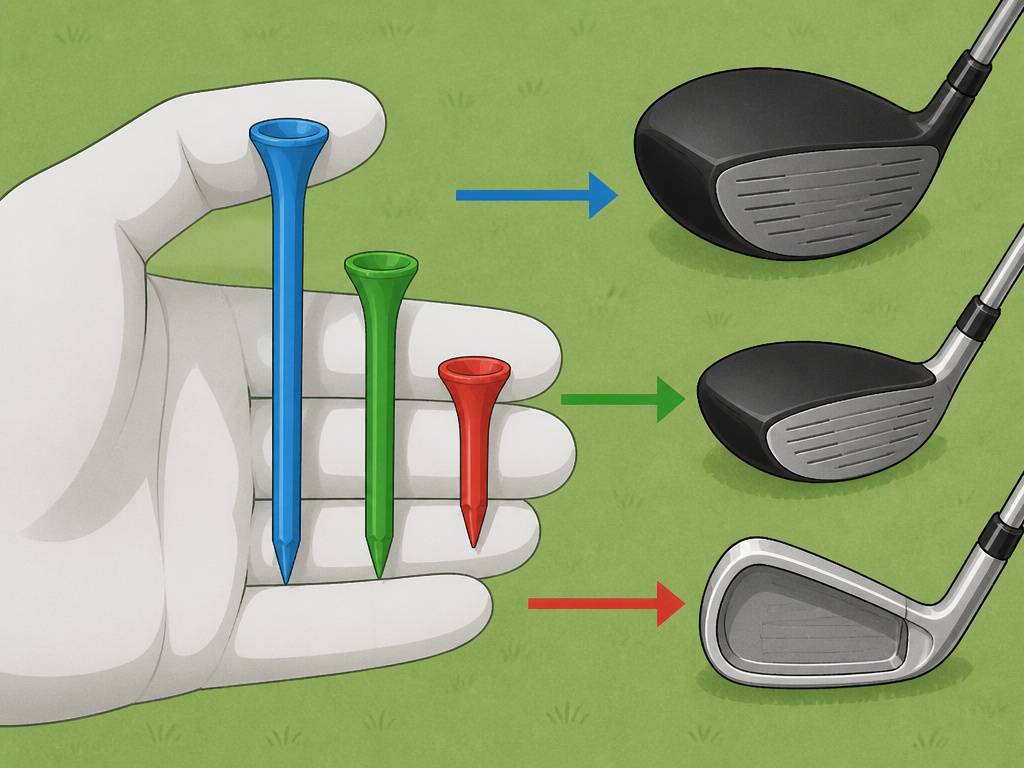 Your driver isn’t the only club you tee up with. Using the same long tee for an iron shot is a common mistake that encourages poor contact. Here’s the simple system.
For Drivers: Reach for the 3.25-inch tee. Push it into the ground until about 3/4 of an inch remains above the turf. The bottom of the golf ball should be level with the top of your driver’s clubhead. This is non-negotiable for modern equipment. If you struggle with consistency here, that’s when a step tee earns its spot in your bag.
For Fairway Woods and Hybrids: Switch to a 2.125-inch or 2.75-inch tee. The goal is minimal lift, just enough to guarantee a clean, sweeping strike off the top of the grass. You’re not trying to hit up on these clubs like a driver. A tee that’s too high leads to pop-ups or thin shots.
For Irons on Par 3s: This is the job for a 1.5-inch tee. Push it almost all the way in, so the cup is barely peeking above the ground. The ball should be hovering just above the grass blades. This allows for a crisp, descending strike, the same swing you’d use from the fairway. It eliminates the chance of fat contact from digging into the turf, but doesn’t let you cheat by scooping. Many tees for beginners are sold in mixed packs specifically to teach this club-by-club discipline.
When to Use a 4-Inch Tee: This is a specialty tool. It’s useful if you have a very high-lofted driver (12°+) and a slow swing speed, as it lets you tee the ball exceptionally high to maximize launch. It’s also the base for many step-tee designs. For most players, it’s overkill and can be less stable in the ground.
The Impact of Tee Height on Performance
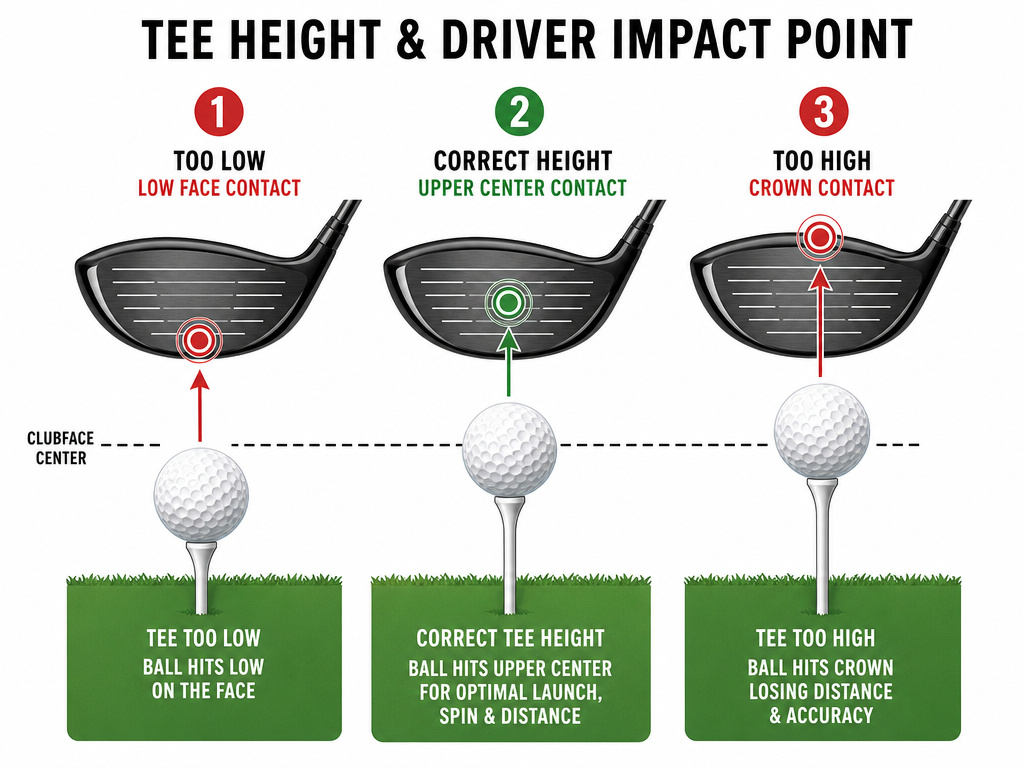 Why does a half-inch matter so much? Because it directly controls your angle of attack and the point of contact on the clubface. Get it wrong, and you fight physics on every drive.
A tee that’s too low for your driver forces a level or downward strike. You hit the ball on the lower half of the face. This increases backspin, decreases launch angle, and often produces a low line drive with no carry. It’s the most common distance killer.
A tee that’s too high encourages hitting the ball on the extreme upper half of the face or even on the crown. This reduces spin drastically but also saps ball speed, resulting in a weak, ballooning shot. You might also sky the ball, hitting the top of the clubhead with a painful ping.
The correct height, set by a 3.25-inch tee for a modern driver, promotes the ideal positive angle of attack. You strike the ball on the upper center of the face, maximizing both launch and ball speed while keeping spin in an optimal window. This combination is what produces your longest, most forgiving drives. Golfers looking to fine-tune this for their swing should consider tees for distance designed with this precise launch window in mind.
I watched a player with an 85mph swing speed stubbornly use 2.75-inch tees with his new TaylorMade Stealth driver for a full season. His average carry was 198 yards. After one range session forcing the 3.25-inch height, his carry jumped to 209. The only thing that changed was the tee.
Frequently Asked Questions
Are brush tees legal in tournament play?
The official answer is maybe, but you shouldn’t risk it. The USGA and R&A rule states a tee must not be “designed or manufactured in such a way that it could indicate line of play or unduly influence the movement of the ball.” Many tournament officials rule that the bristles of a brush tee could influence movement, making them non-conforming. For any serious competition, use a traditional wooden, bamboo, or plain plastic tee.
How many tees should I carry in my bag?
Carry a mix. Have a bundle of 10-15 of your primary driver tee (likely 3.25-inch). Then keep 5-10 short tees (1.5-inch) in a separate pocket. This covers every situation on the course. There’s no need to carry 50 tees unless you lose them constantly.
Do zero-friction or pronged tees add distance?
For most amateur golfers, any distance gain is negligible, perhaps 1-3 yards under perfect laboratory conditions. The primary benefit of these tees is durability, not a breakthrough in performance. A consistent swing and correct tee height with a standard tee will gain you far more yards.
What’s the best tee for a beginner?
Beginner should start with standard 3.25-inch wooden tees for the driver and 1.5-inch wooden tees for irons. The wood provides useful feedback by breaking on bad strikes, teaching you about ground contact. Once ball-striking is more consistent, you can explore longer-lasting bamboo or plastic options. Our dedicated resource on beginner tees explains this progression in detail.
Can I use a broken tee?
Absolutely. A broken tee is perfectly legal under the rules, as long as the remaining part is not longer than 4 inches. Using a broken tee top for an iron shot on a par 3 is a classic play, it gives you that tiny bit of lift you need. Just be sure it’s firmly planted.
Before You Go
Your tee is the first piece of equipment you use on every hole. It sets the stage for everything that follows. Stop treating it as a disposable afterthought.
The rule is simple: match the tee length to the clubhead. 3.25 inches for the modern driver, 2.75 inches or less for everything else. Choose a material you like, bamboo is the savvy pick, and if you struggle with consistency, invest in a pack of step tees. This small, disciplined choice eliminates one variable before you even take the club back. It’s the easiest equipment fix in golf. For the complete picture on how this fits with the rest of your gear, see our guide to the types of clubs in your bag.
