
Master a Balanced Finish in the Golf Swing for Consistent Power
This post contains affiliate links. As an Amazon Associate, we earn from qualifying purchases.
This post contains affiliate links. As an Amazon Associate, we earn from qualifying purchases.
A balanced finish in the golf swing happens when about 90 percent of your weight is on your lead foot, your hips and chest have rotated left of target, and your body is stacked vertically. This position is the result of a proper kinematic sequence where ground-up force generation transfers energy efficiently to the club, not a pose you force at the end.
That 90 percent figure isn’t a guess. It’s the quantifiable target from a PGA professional’s analysis of tour player finishes. The finish isn’t the goal; it’s the receipt. Your body’s position after impact is the clearest evidence of how you moved—or didn’t move—during the downswing.
What follows breaks down the two non-negotiable physical requirements, the sourced biomechanics behind them, and the one historical debate that changes how you think about balance. You’ll learn why a short finish costs distance, how improper weight shift manifests as a reverse pivot, and what Jack Nicklaus’ hip surgeries might tell us about modern instruction.
Key Takeaways
- Aim for 90% of your weight on your lead foot at the finish; less than 70% signals a major swing fault like a reverse pivot.
- The body generates power from the ground up in a kinematic sequence; a cramped finish means this sequence broke down before impact.
- Let your trailing foot release naturally off the ground; forcing it to stay planted creates an unnatural “Reverse-C” spine angle and increases injury risk.
- Practice your full finish in slow motion during your pre-shot routine; if you can’t rehearse it, you won’t execute it under pressure.
- A 2008 biomechanics study found over 70% of total body work comes from the hips and spine; a balanced finish confirms you used your core.
The 90% Rule and the Finish Position
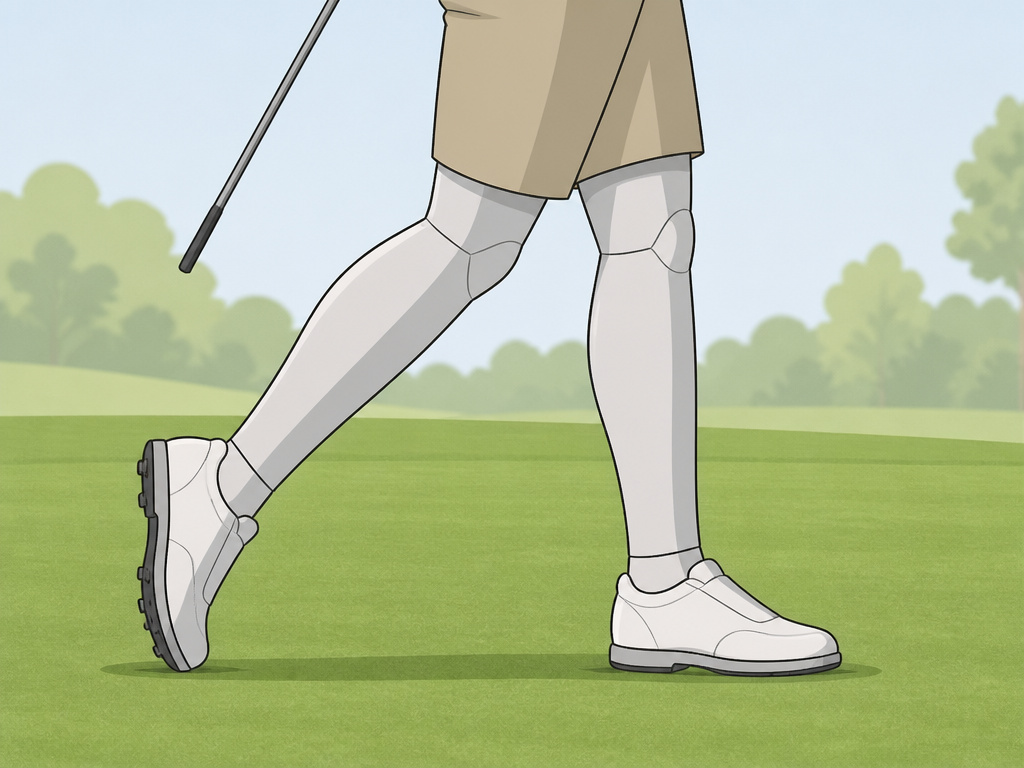
Forget holding a statue-like pose. A balanced finish has a measurable spec. According to a Golf Monthly Top 50 Coach, a model finish should have around 90 per cent of your weight on your left side (for a right-handed golfer). You finish on the toe of your trail foot, with your hips and sternum rotated left of target.
This isn’t about aesthetics. This weight distribution is the direct outcome of a correct weight shift that started in your downswing. If you finish with 50/50 weight or, worse, more weight on your back foot, you’ve made a fundamental error in your weight transfer. That error usually means you hit the ball with mostly your arms, losing both power and consistency.
A 2008 study in the Journal of Sports Science and Medicine used 3D modeling to analyze the golf swing’s energy transfer. It found that 71-72% of the total body work generated in a swing comes from the hip and spinal joints. A finish with 90% weight forward is the visible proof that this core engine was engaged.
Where This Goes Sideways: The Reverse Pivot
The most common thief of a balanced finish is the reverse pivot. This is when your weight moves onto your back foot during the backswing but never fully shifts forward in the downswing. At the finish, your weight is stuck on your trail side. The result isn’t just a weak shot; it’s a complete breakdown of the kinematic sequence. You cannot generate power from the ground up if your weight is going the wrong way.
Fixing it starts with the feeling of squeezing a sponge under your lead foot to start the downswing. Your first move down should be a lateral shift of your lower body toward the target, not a spin of your shoulders. If you struggle with a reverse pivot fault, your finish will always tell you. You’ll feel off-balance, unable to hold the position without stepping back.
It’s a Swing, Not a Hit: The Role of Rhythm
You hear it all the time, but most golfers don’t internalize it. Golf is a swing sport. The word “hit” implies a violent, localized effort at the ball. A “swing” implies a continuous, rhythmic motion that carries through to a natural conclusion. Your finish position is the best indicator of which one you did.
When you try to hit at the ball, you decelerate through impact. Your body stops rotating because all your focus is on making contact at a single point. This leads to the “chicken wing” – the lead elbow collapsing – and a short, cramped finish where your chest still faces the ball. You haven’t swung through the shot.
Common mistake: Taking practice swings that stop at impact. You’re rehearsing a hit, not a swing. Your body never learns the feeling of a complete motion.
To build the right habit, your practice swing must be a full rehearsal. Take the club back and swing all the way to a complete, balanced follow-through as if you just hit the perfect drive. This programs the feeling of rhythm and completion into your muscle memory. Advanced PGA professional Katie Dawkins emphasizes that rehearsing the full finish is how you raise awareness of where you intend the ball to fly, taking tension and effort out of the actual shot.
| Swing Thought | Feels Like | Resulting Finish |
|---|---|---|
| “Swing to the finish” | A continuous, unhurried motion | Balanced, weight forward, full rotation |
| “Hit the ball hard” | A sudden burst of arm effort at the ball | Cramped, weight back, incomplete rotation |
| “Spin my shoulders” | Upper body dominating the move | Swaying, off-balance, falling backward |
| “Shift then turn” | Lower body leading, core winding up | Powerful, stacked, and stable |
The Trailing Foot Debate: History vs. Modern Athletics

Here’s where instruction isn’t unanimous. For decades, the “Reverse-C” finish was taught. Characterized by a pronounced backward spine tilt and the trailing foot firmly planted, it was a hallmark of the Classic Golf Swing era. The problem? It’s potentially harmful.
Analysis from sites like WAX Golf argues this position is unnatural and increases stress on the lower back. The blog speculates that Jack Nicklaus’ hip replacement surgeries “were necessitated in small or large part to his own failure to release the trailing foot on the finish.” The argument is that keeping the foot anchored against a powerful rotational force is not athletic.
The modern, athletic view is that the trailing foot should release naturally. As your body fully rotates through the shot, the force will pull the heel of your back foot off the ground. Your weight finishes on the ball of that foot, or it comes up completely. This isn’t a flaw; it’s evidence of a full, powerful release.
“There is no reason on this planet to insist on keeping the trailing foot anchored when performing a forceful athletic motion that involves turning in place,” states one golf swing analyst. This release allows the weight to shift fully forward into a balanced position, not an artificially held pose.
So who’s right? Look at the swings of Ben Hogan in his prime versus a stiff, posed finish from modern instruction. Hogan’s finish often had a slight, natural spine tilt and freedom in his back foot. The key is balance. Whether your back foot is up or down, if 90% of your weight is forward and you’re stable, you’ve achieved the goal. Forcing either extreme is where the trouble starts.
How to Practice a Balanced Finish (The Right Way)
Knowing the theory is one thing. Feeling it is another. These drills ingrain the correct motion.
- The Slow-Motion Rehearsal: Before every shot, take one practice swing in extreme slow motion. Focus solely on swinging the club to a perfect, balanced finish. Hold it for three seconds. This isn’t a waggle; it’s a full-speed swing slowed down. It tells your body what the end of the motion must be.
- The Two-Tee Drill: Place a tee in the ground. Place another tee a grip’s length directly in front of it. Set up with your clubhead behind the first tee. Make a swing where you brush the first tee away in your backswing and brush the second tee away in your follow-through. This forces extension and a complete follow-through.
- The Step-Through Drill: Hit some shots where you allow your back foot to step forward toward the target after impact, like a baseball hitter. This exaggerates the feeling of transferring all your weight forward and continuing your rotation. It kills any tendency to hang back.
The Bottom Line: A balanced finish isn’t decoration. It’s diagnostic. If you can’t hold it, your swing broke down earlier. Start with the end in mind.
Frequently Asked Questions
Can you hit a good shot with a bad finish?
Yes, but it’s unreliable. Even Jack Nicklaus and Gary Player were occasionally off-balance at the finish. The critical factor is being in the correct position at impact. A bad finish often means you saved the shot with hand-eye coordination, not a sound swing. You can’t repeat that.
How do I stop falling backward after my swing?
You are likely starting your downswing with your upper body. Focus on initiating the downswing by pressing your lead knee toward the target. This lateral move shifts your weight forward first. Feel like you’re shifting your weight onto your lead foot before your shoulders even begin to unwind.
Is a full finish necessary for short chip shots?
No. The finish should match the length of the swing. For a chip, your weight should still be predominantly on your lead foot, but your backswing and follow-through will be abbreviated. The principle of weight-forward and body-led motion still applies, just on a smaller scale.
Does physical fitness affect my balance?
Absolutely. A 2019 study indexed on PubMed about biomechanical analysis highlighted the need for core stability. The study, focused on trial methodology, underscores that reliable swing data comes from a stable body. Poor core strength or flexibility makes it harder to maintain posture and rotate into a balanced finish.
What’s the one check I can do after every shot?
Hold your finish until the ball lands. If you can’t, you moved too early. This simple discipline trains rhythm and confirms whether your body was in control or if you were just hacking at the ball.
