
Golf Swing Kinematic Sequence: Analyzing the Critical Pro-Am Split
This post contains affiliate links. As an Amazon Associate, we earn from qualifying purchases.
This post contains affiliate links. As an Amazon Associate, we earn from qualifying purchases.
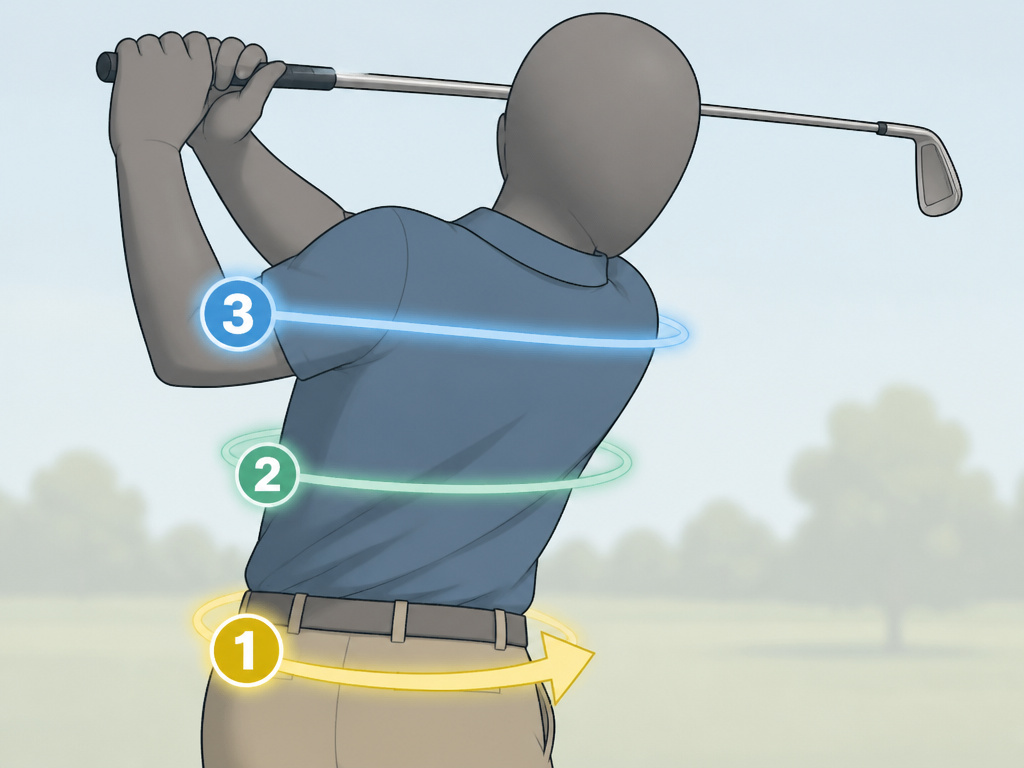
The kinematic sequence in the golf swing is the specific, proximal-to-distal order in which your body segments reach peak rotational speed during the downswing. For a skilled player, the sequence is pelvis first, then torso, then arms, and finally the club. This order efficiently transfers energy up the chain for maximum clubhead speed, and research shows a pro’s sequence is not just faster, its timing is dramatically more consistent than an amateur’s.
That order, pelvis, torso, arms, club, is the target. But the real gap between a good swing and a powerful one isn’t just hitting those peaks; it’s the precise millisecond delays between them and the controlled deceleration of each segment as the next one fires. Amateurs often reverse the torso and arm peaks, leaking speed before the club even starts moving.
What follows is a breakdown of the sequence pulled straight from motion-capture labs, the measurable differences that separate touring pros from weekend players, and the practical drills that make this biomechanical concept something you can feel on the range.
Key Takeaways
- The optimal sequence is a strict pelvis → torso (thorax) → lead arm → club peak speed order during the downswing.
- Pros decelerate each segment on schedule. A 2007 study found every professional golfer showed a clear slowing of the pelvis before impact, while amateurs did not.
- Amateurs often reverse the torso and arm peaks, leading with the arms and losing the kinetic chain’s power.
- The sequence is most consistent in the transition phase (backswing to downswing), especially with driver and long irons.
- Clubhead speed correlates with delayed peak timing in the backswing, not how fast you move in the downswing.
What is the Kinematic Sequence in the Golf Swing?
The kinematic sequence is the roadmap of energy transfer. Think of it as a domino effect inside your body. You start the downswing by rotating your pelvis. As that rotation reaches its top speed and begins to slow, the energy transfers to your torso. Your torso accelerates, peaks, and then decelerates, passing the energy to your arms. Your arms then whip the club through the hitting area.
The kinematic sequence describes the order of peak rotational speeds of the body segments during the golf downswing. This proximal-to-distal (from the center outward) pattern, pelvis, torso, arms, club, is the biomechanical mechanism for efficient speed summation. Research using systems like the Polhemus Liberty electromagnetic tracker at 240 Hz confirms this sequence in skilled players.
If this domino chain breaks, if your arms fire before your torso has peaked, you’ve just disconnected the engine from the wheels. You’re using muscle, not momentum. The 2007 conference paper Body Segment Sequencing and Timing in Golf put it bluntly: while we know the sequence is optimal, “we still do not understand how long the delays or lags between peak segment speeds should be.” That’s the coaching frontier.
This sequence is the physical foundation of a good golf swing rhythm and timing. It’s why a swing looks “fluid” instead of jerky. The segments aren’t just moving fast; they’re moving fast in a coordinated sequence.
The Pro vs. Amateur Split: It’s in the Data
The difference isn’t subtle. It’s quantifiable. A pivotal study titled Comparison of Kinematic Sequence Parameters between Amateur and Professional Golfers compared 19 PGA Tour pros to 19 amateurs using 3D motion capture.
The findings were stark. All the magnitude variables, peak rotational speeds, accelerations, speed gains, were higher for the pros. But the real separator was timing and order.
| Parameter | Professional Golfer | Amateur Golfer |
|---|---|---|
| Peak Order | Pelvis → Thorax → Arm → Club | Pelvis → Arm → Thorax → Club |
| Timing Consistency | Very High (Low Standard Deviation) | Low (Standard Deviation 2x Higher) |
| Pelvis Deceleration | Always present before impact | Often absent or inconsistent |
| Primary Power Source | Kinetic Chain (Proximal-to-Distal) | Arm Muscles (Early Upper Body) |
The pros displayed a textbook sequence. The amateurs, on average, showed a reversed torso and arm peak. Their arms outran their core. This isn’t a small flaw; it’s a fundamental power leak.
Furthermore, the standard deviation for the amateurs’ peak timings was at least double that of the pros for every segment. A pro’s swing is a metronome. An amateur’s is unpredictable. This inconsistency is why you can pipe one drive 280 yards and top the next one. The kinematic sequence never got set.
This reversal is a direct kin to the common fault of casting or a reverse pivot. When the sequence is off, the body compensates in visible, destructive ways.
The Science Behind the Sequence: What the Research Says
The research landscape is deep, but a lack of methodological consensus means you have to read carefully. A 2022 NIH systematic review on biomechanics analyzed 92 articles and noted that contradictory findings often stem from how scientists measure things.
One critical variable is angular velocity component selection. A 2019 peer-reviewed kinematic sequence methodology paper in Acta of Bioengineering and Biomechanics tested seven different methods for calculating segment speeds. The shocking result? “Almost as many kinematic sequences were identified as the number of tested methods for every golfer.”
This means two studies can look at the same golfer and report different sequences based on their math. The takeaway for you? Focus on the big, consistent picture from high-quality research: the proximal-to-distal flow.
Another key finding from a Sports Engineering journal article on elite golfers is that the sequence holds true for both full and partial swings, but it can be a “partial” sequence on shorter shots. With a wedge, the upper arm and club transitions might not separate cleanly. The body knows a full kinetic chain isn’t needed for a 70-yard shot.
Where does speed really come from? A 2020 study of 66 skilled male golfers (handicap ≤ 3) found higher clubhead speed was associated with delayed onset of angular velocity peaks during the backswing. It wasn’t about how violently you started down; it was about how well you loaded the spring going back. This directly connects to a proper backswing sequence.
The Critical Components of an Efficient Sequence
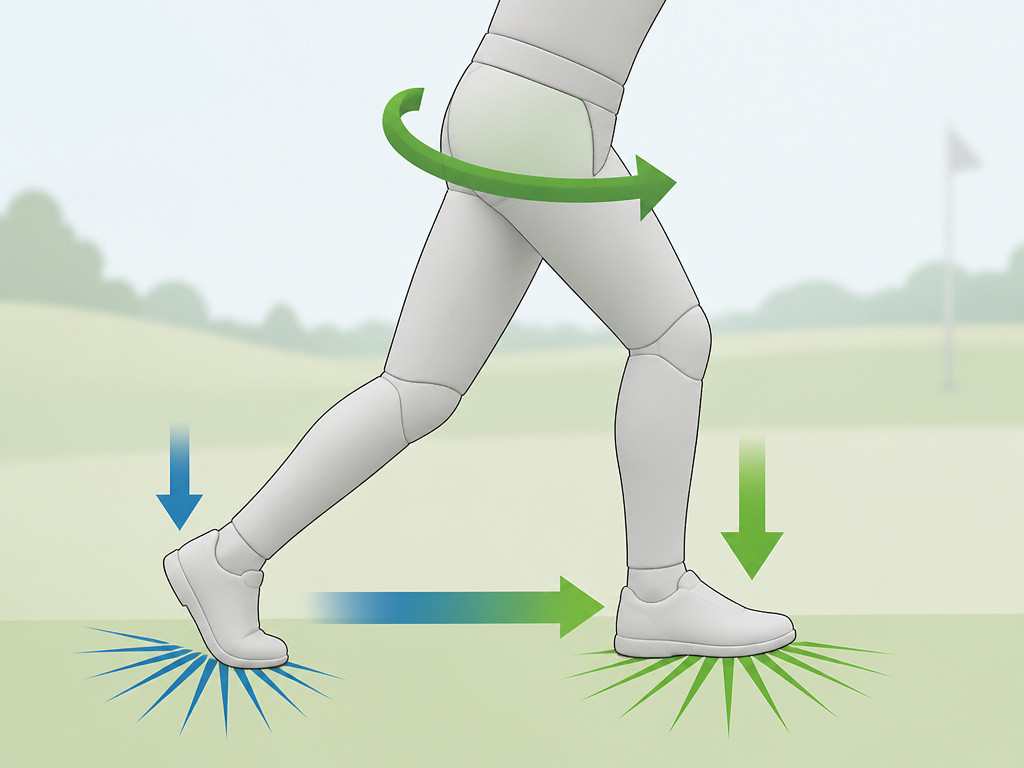
The sequence doesn’t work in isolation. It’s fueled by and dependent on three other biomechanical events. Miss one, and the domino chain fizzles.
1. The Transition: Where the Sequence is Set
The move from backswing to downswing is the sequence’s launchpad. This is the moment the proximal-to-distal order is either established or lost. The 2020 study mentioned earlier found the most consistent sequencing across all clubs happened in this phase.
A good transition starts from the ground up. It’s not a shoulder spin or a hand lunge. It’s a subtle, initiating the downswing with the lower body while the upper body is still completing its turn. This creates the “stretch” or X-Factor that stores elastic energy. If your transition is all one piece, you’ve lost before you’ve started.
2. Weight Shift: The Foundation of Pelvis Speed
You cannot rotate a fast pelvis from a static base. The weight shift, the pressure moving into your lead foot in the downswing, is what allows your pelvis to rotate aggressively without falling over.
Think of it as throwing a punch. You step forward to put force behind it. In golf, that “step” is the pressure shift. It creates the ground reaction forces in golf (GRF) that your body uses to push against and generate rotational speed. No shift, no pelvis speed. No pelvis speed, no sequence.
3. Lag: The Signature of Delayed Release
Lag is the visual proof your sequence is on track. It’s the angle maintained between your lead arm and the club shaft late into the downswing. If your sequence is pelvis-torso-arms-club, the club is the last thing to release.
When the arms fire early (the amateur reversal), that angle is lost immediately, that’s casting. Maintaining lag is the result of the torso accelerating while the arms and hands are still passive. It’s not something you force with your wrists; it’s something that happens because the earlier segments did their job. Creating lag is the effect of a good sequence, not a separate trick.
How to Apply the Kinematic Sequence to Your Swing
Knowing the theory is one thing. Feeling it is another. These drills isolate the segments to reprogram your muscle memory.
Common mistake: Trying to swing the arms faster to increase speed. This disrupts the sequence at its source, guaranteeing the arm peak will precede the torso’s and drain power.
Drill 1: The Step Drill (Isolating the Pelvis Start)
- How: Take your normal address with a 7-iron. Start your backswing. As you begin the downswing, literally step your lead foot toward the target (about 6 inches). Hit the ball with this exaggerated step.
- Why: This forces your lower body to initiate. It’s impossible to step with your foot without your pelvis rotating first. It ingrains the feeling of the downswing starting from the ground.
Drill 2: The Towel Drill (Connecting Arms to Torso)
- How: Tuck a small hand towel under both armpits. Make slow, half-swings, focusing on keeping the towel pinned from start to finish.
- Why: This physically prevents your arms from running independently of your torso. You must rotate your core to move the club, enforcing the torso-to-arm connection. It kills the amateur arm-led reversal.
Drill 3: The Pause at the Top (Mastering Transition)
- How: Take your backswing to the top and pause for a full two seconds. Then, consciously start the downswing by rotating your lead hip backward.
- Why: The pause eliminates any momentum cheat. You must actively choose to start with your lower body. It exposes whether you default to spinning your shoulders or pulling with your hands.
What most people get wrong: They do these drills for five swings and revert to habit. Repetition under fatigue is key. Do a full bucket focusing on just one of these feels. The sequence is a motor pattern, not a quick fix.
Frequently Asked Questions
Does the kinematic sequence change with different clubs?
The fundamental order does not change for a skilled player, but the completeness of the sequence can. Research shows a full proximal-to-distal sequence is clear with driver and 5-iron. With a pitching wedge, the upper arm and club peaks may not separate significantly, it becomes a “partial” sequence because maximum kinetic chain recruitment isn’t necessary for shorter shots.
Can I see my own kinematic sequence?
Without professional motion capture (like the systems used by the Titleist Performance Institute), you cannot see the precise angular velocity peaks. However, you can infer it. High-speed video (240+ fps) viewed frame-by-frame can show if your hips clear before your shoulders open, and if your wrists are still hinged as your chest faces the ball. Signs of a broken sequence are an early release of the club (casting) or a stagnant lower body.
How does swing speed relate to the sequence?
Speed is the result of an efficient sequence, not the cause of it. The 2020 study of skilled golfers found clubhead speed correlated with larger rotation ranges and, critically, delayed transitions in the backswing. It’s about loading the sequence, not unleashing it prematurely. Trying to swing faster often breaks the sequence and actually reduces speed.
Is a “one-piece takeaway” important for the sequence?
The backswing sets the table. A connected, rotational swing where the arms, torso, and pelvis turn together in the initial takeaway sequence creates a unified coil. This makes it easier to initiate the downswing as one coordinated unit starting from the ground. A disjointed backswing makes a sequenced downswing far more difficult to achieve.
The Bottom Line
The kinematic sequence isn’t an abstract theory. It’s the measurable engine of the golf swing. Pros don’t just swing harder; they swing smarter in a strict, consistent order: ground, pelvis, core, arms, club.
Your number one priority is to stop trying to hit the ball with your hands. Your job is to rotate your body and let the club be the last thing to react. Use the step drill to feel the true start of the downswing. Use the towel drill to weld your arms to your torso. The data doesn’t lie, the amateur reversal of torso and arm peaks is the biggest power leak in the game.
Focus on the cause (the sequence), not the effect (club speed). Clean up the order, and the speed will follow. It’s the difference between muscling a drive 230 yards and unleashing one 270 yards with less effort. That’s the real power of the kinetic chain.
