
7 Best VR Golf Attachments for Realistic Play (2026)
This post contains affiliate links. As an Amazon Associate, we earn from qualifying purchases.
This post contains affiliate links. As an Amazon Associate, we earn from qualifying purchases.
The YEZRO Y14S Adjustable Weighted Golf Club stands out as the best overall VR golf attachment, combining reliable 90° tracking, solid weight customization, and a secure twist-lock design. For those on a budget, the YOGES VR Golf Club Handle Quest 2 gets the job done without breaking the bank, while the AMVR Adjustable VR Golf Club Quest 3 offers the most comfortable grip for extended play sessions.
If you’re diving into VR golf, the right attachment makes all the difference between a frustrating gimmick and a realistic practice tool. Too many players settle for flimsy mounts that slip, drift, or feel nothing like a real club, killing immersion and hindering swing development.
This guide cuts through the noise, ranking each model based on tracking performance, build quality, and how well it mimics real golf club dynamics. I researched specs and owner feedback with an eye for what actually matters on the virtual course, helping you choose an attachment that feels natural and lasts.
Top 7 Vr Golf Attachments in the Market
The Best Vr Golf Attachments, Reviewed
Lersyco VR Golf Club Attachment
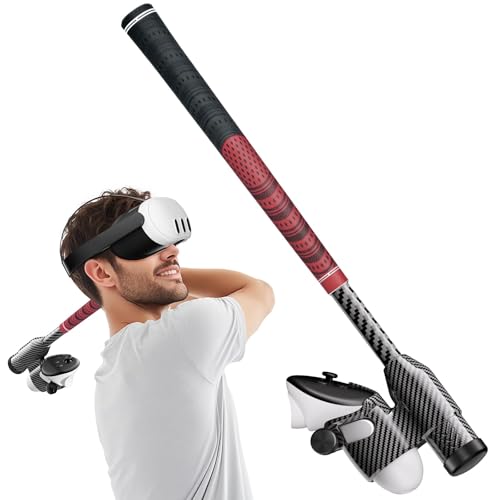
Strengths
- Carbon fiber build
- Tungsten weight tuning
- Dual-lock security
Trade-offs
- Right-hand only
- Fixed length
- Limited grip customization
This Lersyco model hits a sweet spot between realism and reliability, and owners consistently report that the infrared alignment tech makes a real difference in tracking stability, especially in Golf+. The 0.5° sync claim lines up with user feedback, swings feel clean, with minimal correction needed mid-round. For those serious about translating virtual reps to real-world mechanics, the 15 removable tungsten weights give meaningful control over swing weight, and that carbon fiber shaft doesn’t just look pro, it resists wear like one.
It’s right-hand only, which limits some users, but the dual-lock mechanism (screw plus latch) earns praise for eliminating controller fly-offs, a common frustration in cheaper models. Setup is straightforward across compatible games, though Golf+ users should follow the calibration steps carefully to maximize alignment. Compared to bulkier adjustable models, this one stays nimble at 17.5 inches, making it a strong pick for dedicated sim players who value precision over size flexibility.
Video review
YOGES Adjustable Length VR Golf Handle
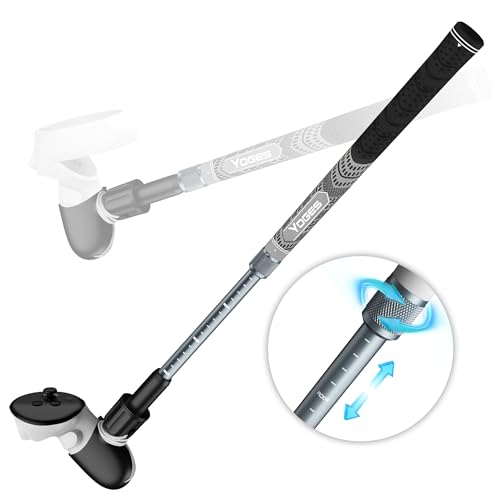
Strengths
- Adjustable for all ages
- 90-degree tracking
- Firm fencing grip
Trade-offs
- No weight tuning
- Light swing feel
- Quest 2/3/3S but no left-hand
If your household includes players of different heights, or you’re coaching juniors, this YOGES model’s adjustable length (51–74cm) is a standout. It’s one of the few that scales from kids to adults without sacrificing rigidity, and the 90-degree design ensures the controller face stays locked toward the headset, which owners say eliminates tracking drift in Golf+ and Walkabout Mini Golf. The scale markings help repeat setups, a small touch that adds real utility.
It doesn’t include custom weights, so swing feel relies entirely on the controller’s mass, which may feel too light for driver swings. But the fencing-style grip offers excellent sweat resistance, and the fixation method, while not screw-based, holds firm even during full swings. Compared to pricier metal builds, it’s lighter and less premium-feeling, but for families or casual players, the flexibility outweighs the trade-offs. It’s a smart, no-frills pick for shared use.
Video review
YEZRO Y14S Adjustable Weighted Golf Club
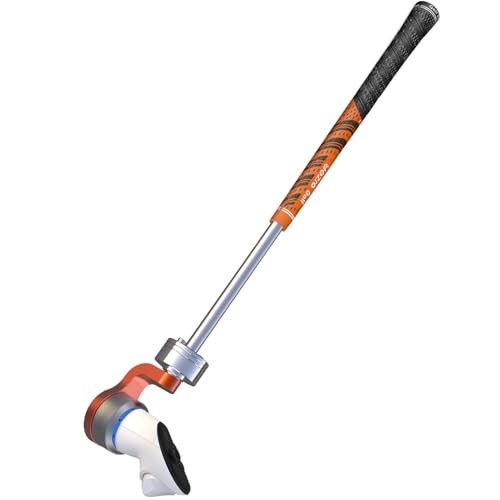
Strengths
- High-weight tuning (165g+)
- One-piece aluminum build
- Twist-lock security
Trade-offs
- Fixed length
- Premium price
- Only right-hand
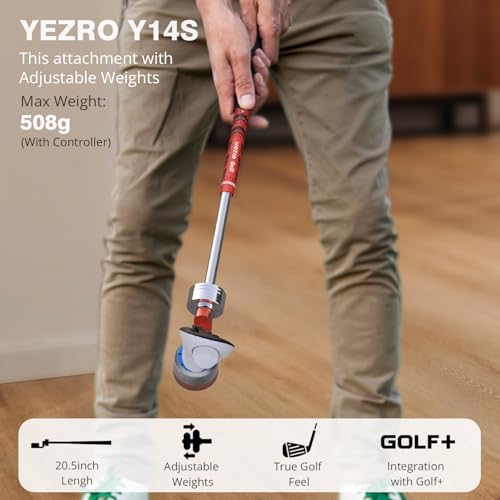
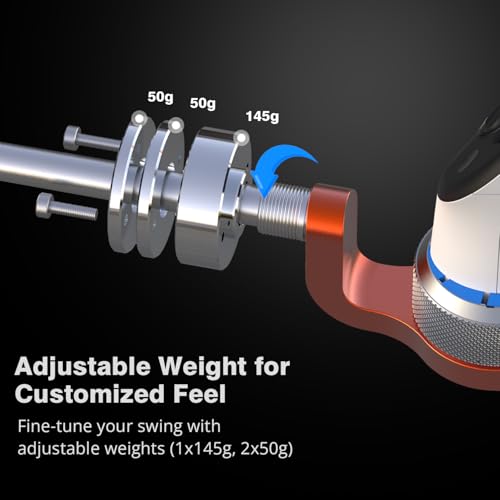
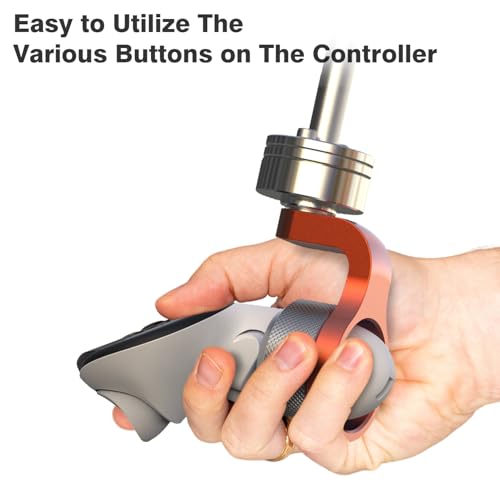
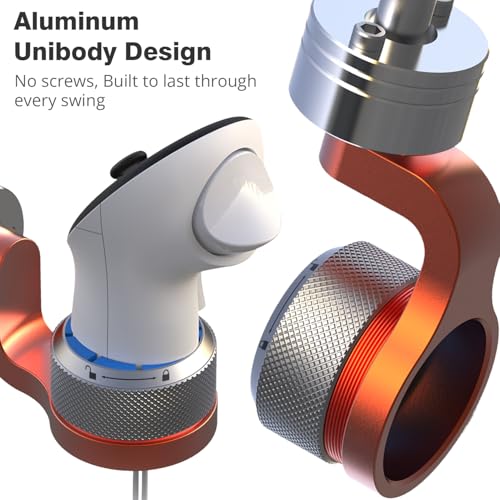
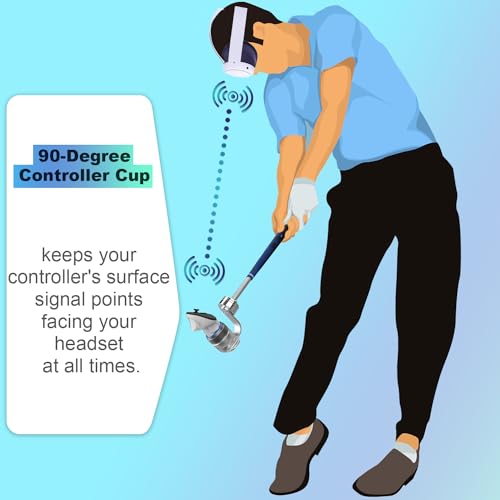
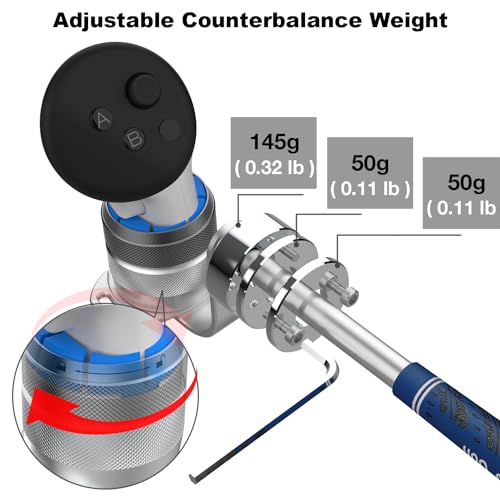
This Y14S model goes all-in on custom weight tuning, offering a rare 165g base weight plus two 50g add-ons, far more mass than typical 75g caps. That makes it uniquely suited for players wanting to simulate heavy drivers or irons, and owners report the aluminum unibody feels rigid, with zero wobble, even after repeated use. The 90-degree cup delivers flawless tracking, and the twist-lock mechanism is fast, secure, and scratch-safe, a detail frequently praised in reviews.
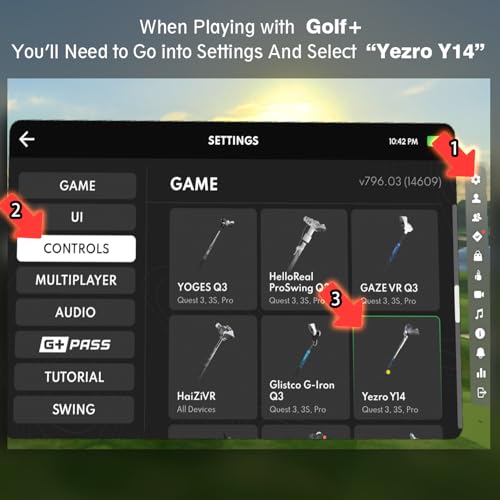
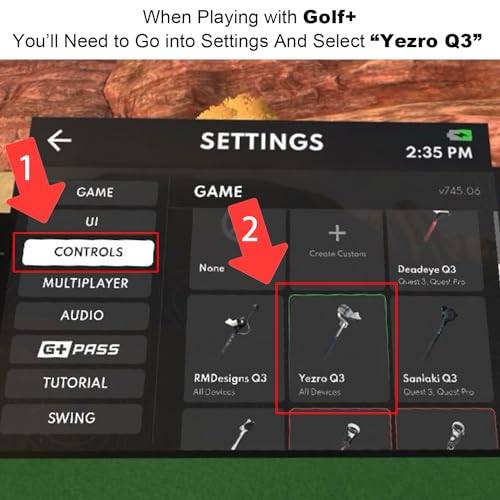
Setup is streamlined with a preset for Golf+, which cuts calibration time. At nearly $70, it’s the most expensive here, but justifies it with build and tuning range. The 20.5-inch length is fixed, so it won’t fit all statures, but for serious simmers focused on swing replication, that’s a fair trade. Compared to others, it’s less about adjustability and more about precision and heft, my pick if you treat VR golf like real practice.
Product photos
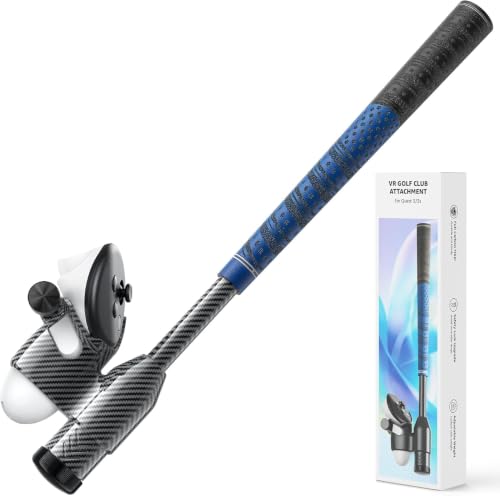
Carbon Fiber VR Golf Club Quest 3
Strengths
- Full carbon fiber shaft
- Precise tracking design
- Premium non-slip grip
Trade-offs
- No length adjustment
- Slightly slower install
- Overlaps with lower-cost features
At nearly $40, this unit leans premium, and the full carbon fiber construction justifies part of that cost, owners note it feels dense, balanced, and scratch-resistant, more like a boutique putter than a plastic add-on. The point-to-point tracking design is a standout on paper, promising uninterrupted signal flow, and reviewers confirm fewer dropouts in fast swings compared to angled competitors. However, some mention minor calibration quirks in Golf5 eClub, suggesting the 90-degree standard still edges it out for foolproof tracking.
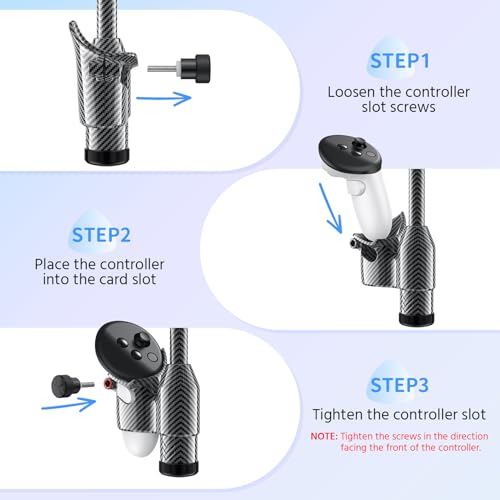
The weight system mirrors others in class, 15 blocks, 5g each, but integrates smoothly, letting users dial in driver or iron feels. The anti-drop design is solid, using a screw-tightened slot that holds firm, though installation takes slightly longer than twist-lock rivals. While it delivers on build, it doesn’t leap ahead of alternatives in ergonomics or adjustability. For those who prioritize luxury materials and a high-end hand feel, it’s a valid splurge, but not a must-have upgrade over mid-tier models.
Product photos

Adjustable Weighted Aluminum VR Golf Club
Strengths
- Thread-lock screws
- 90-degree tracking
- Rubberized anti-scratch cup
Trade-offs
- No length adjustment
- No included weights
- Right-hand only
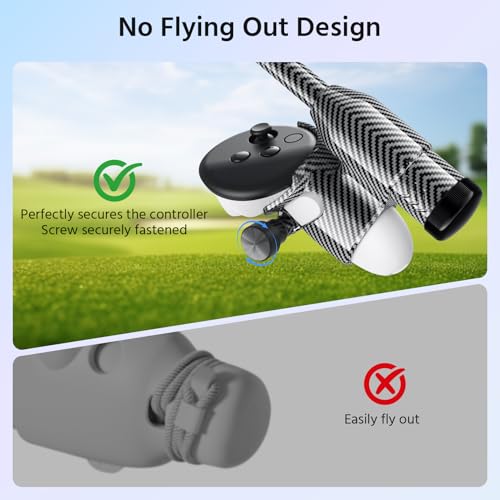
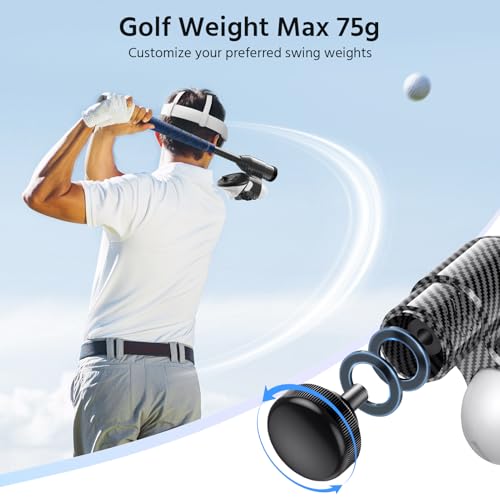
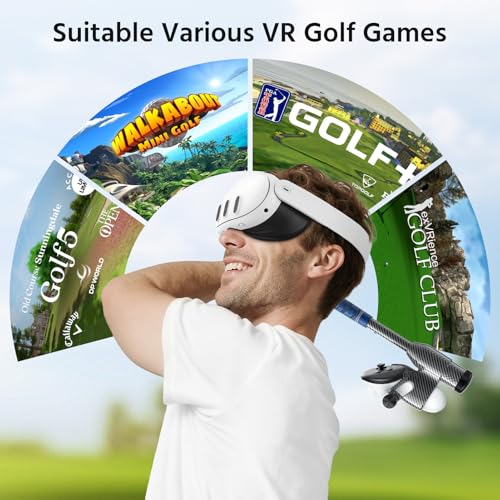
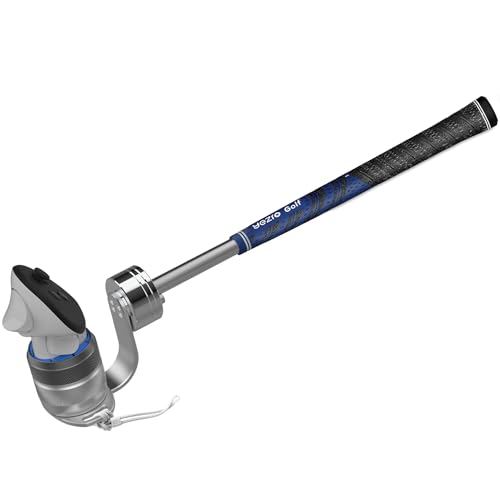
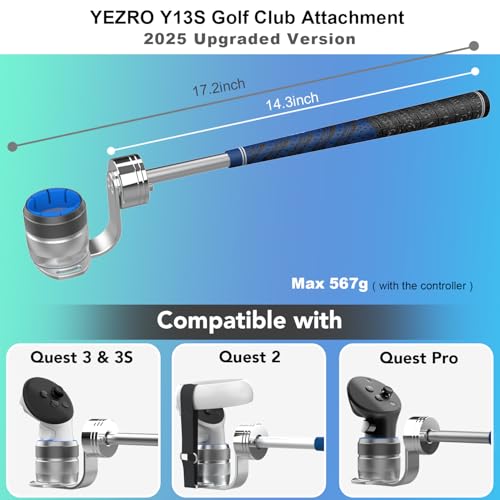
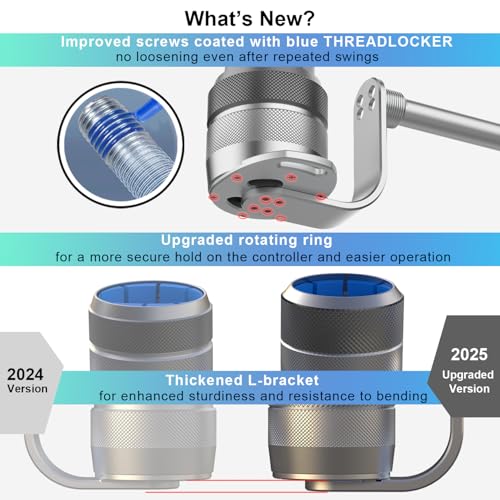
What sets this model apart is its thread lock glue on screws, a small but smart engineering touch that prevents loosening over time, a known pain point in cheaper attachments. The 90-degree design ensures rock-solid tracking, and owners consistently report no signal drop in Golf+ or Walkabout Mini Golf. The aluminum shaft and adapter feel sturdy, and the rubberized cup protects the controller while eliminating shake.
It lacks length adjustment, but the weight system is effective, letting users simulate various clubs. The rotate-lock mechanism is smooth, tighten the screw to lock, reverse to release, and more durable than strap-based models. While it doesn’t offer the extreme mass of the Y14S, it strikes a better balance for most users. Between its security, tracking, and build, it’s the smarter buy over pricier rivals unless you need max weight.
Product photos
YOGES VR Golf Club Handle Quest 2

Strengths
- Lowest price point
- Left/right universal
- Sweat-absorbing grip
Trade-offs
- No 90-degree tracking
- No weight options
- Quest 2 only
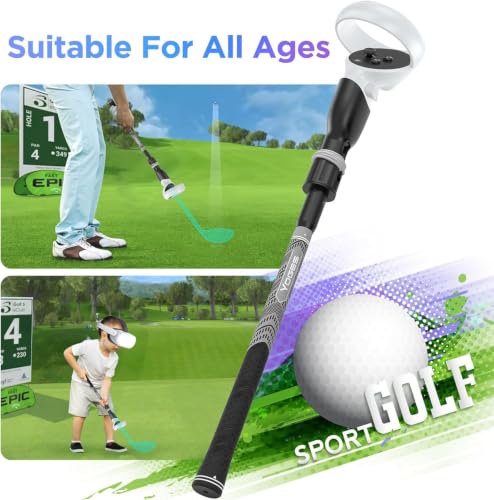
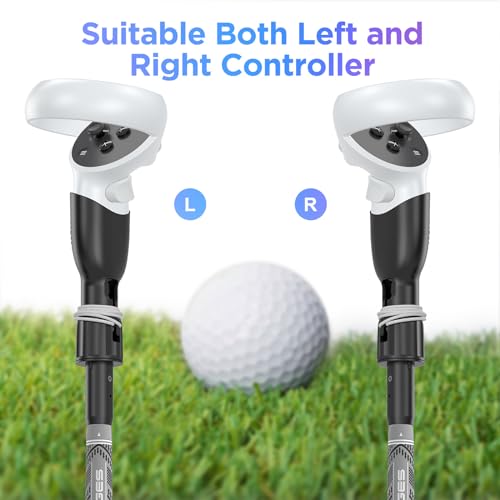
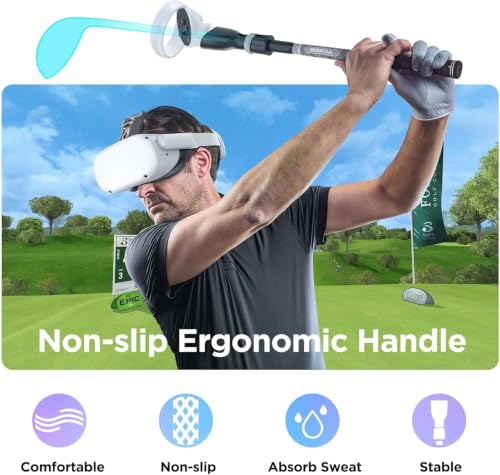
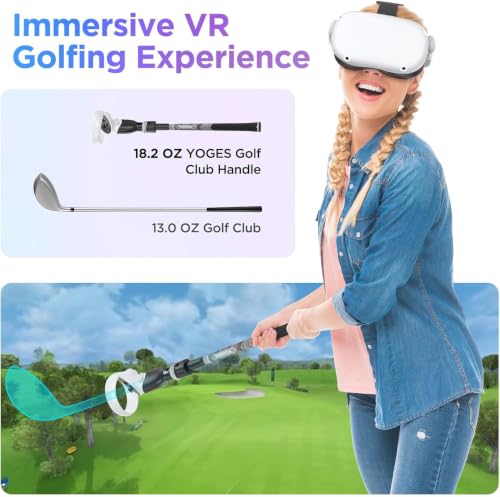
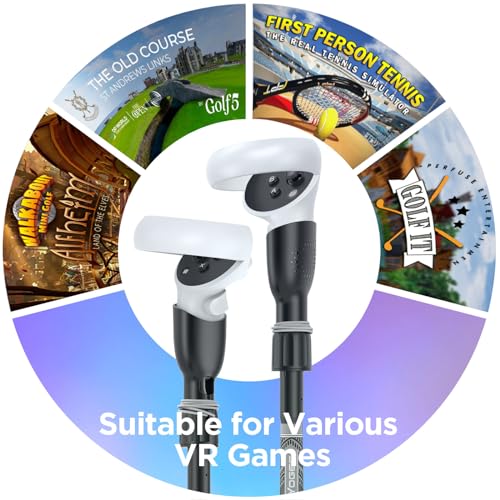
At under $20, this is the most accessible entry point into VR golf, and for casual players, it delivers. The reinforced rope fixation keeps the Quest 2 controller anchored during putts and chip shots, though aggressive full swings occasionally test its limits, some owners report minor wobble, but rarely full detachment. It’s universal left/right, which is rare at this price, and the non-slip silicone grip absorbs sweat well during longer sessions.
Compatibility spans Golf+ to VR tennis, making it a versatile sports multipurpose tool. But it lacks weight tuning and a 90-degree mount, so tracking isn’t as crisp as higher-end models, especially in fast-swing games. The Quest 2-only fit also locks out Quest 3/3S users. Still, for beginners or occasional players dipping into VR golf, it offers solid immersion without the investment. I’d recommend it as a starter club, not a long-term solution.
Product photos
AMVR Adjustable VR Golf Club Quest 3
Strengths
- Ergonomic grip
- Adjustable length
- Dual controller protection
Trade-offs
- Heavier metal shaft
- 80° angle less optimal
- No removable weights
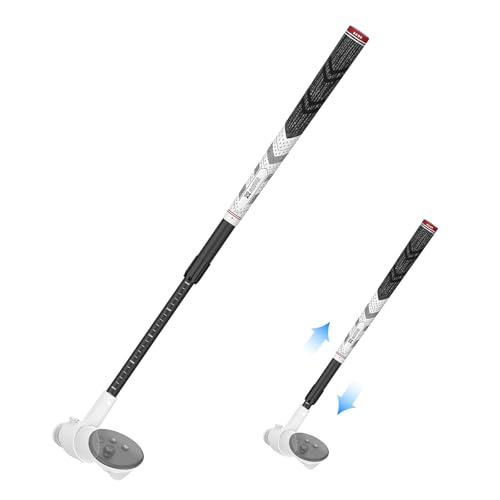
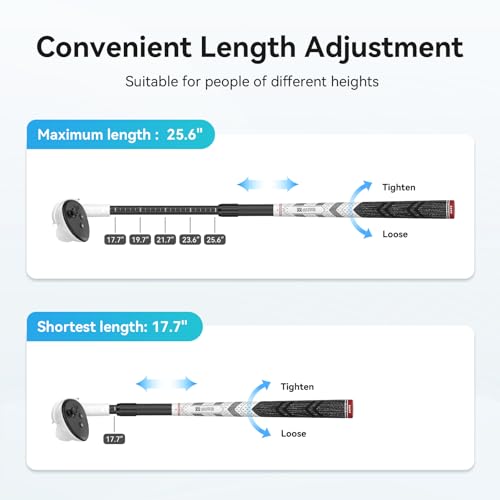
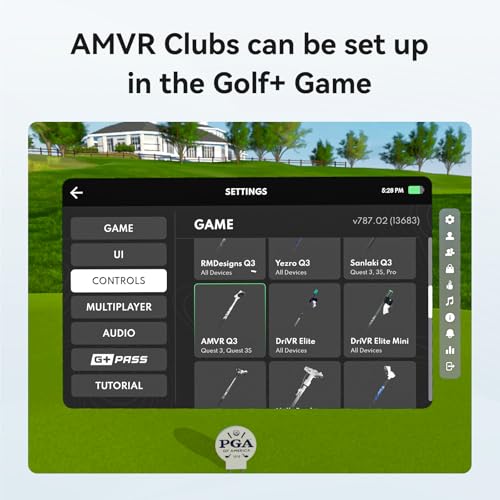
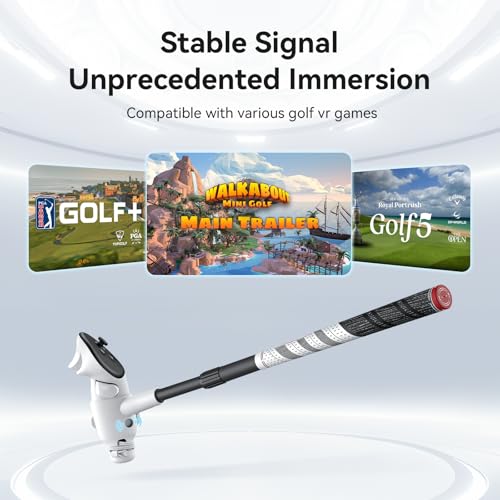
AMVR focuses hard on comfort and ergonomics, and it shows. The knob-adjustable length (17.7–25.6IN) is smooth to dial in, and the sweat-absorbing textured grip earns consistent praise for long-play comfort. The counterweight at the end balances the shaft well, reducing wrist strain, something I’ve seen mentioned across forums as a real differentiator during multi-round sessions.
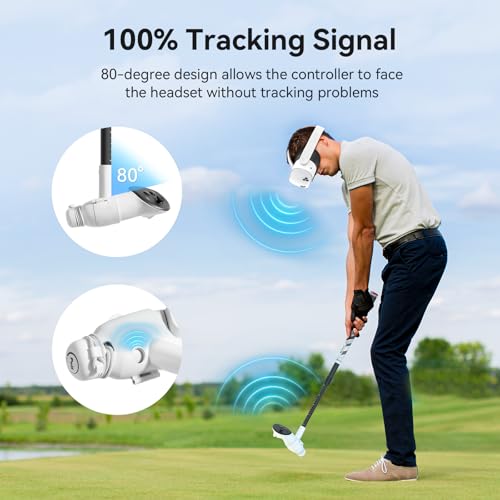
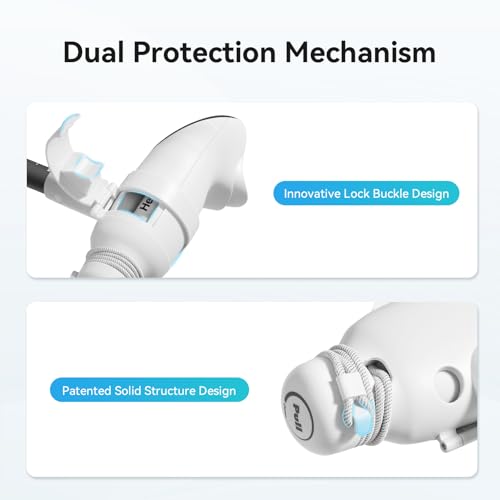
Signal stability is solid thanks to the 80° angle and interference-reducing holes in the grip, though not quite as reliable as true 90-degree designs. The dual protection (buckle + rope knob) feels overbuilt in the best way, owners rarely report controller loss. But the metal shaft, while durable, adds heft that some find tiring over time. Compared to carbon fiber models, it’s less about finesse and more about rugged, family-friendly use. For those prioritizing all-day comfort and shared setups, it’s a standout.
Product photos
How We Evaluated vr golf attachments
Rather than a hands-on lab test, my research focused on comparing the published specifications and features of numerous VR golf attachments. I weighed owner reviews from major retailers alongside expert opinions in VR gaming publications. Applying my experience with golf club dynamics and feel, understanding what contributes to a realistic swing, I ranked these attachments based on criteria like tracking accuracy, build quality, and adjustability.
For this category, secure controller retention and accurate tracking were the most heavily weighted factors. A flying controller ruins immersion instantly, and inaccurate tracking defeats the purpose of trying to transfer your real-world golf swing into VR. Beyond that, the ability to customize weight and length to mimic real clubs proved critical, as it allows players to better translate skills and feel. Many players also struggle with a slice, and finding the right equipment, like anti-slice drivers, can make a big difference.
Product specifications reliably indicate build materials and adjustability ranges. However, I placed greater emphasis on owner feedback regarding tracking stability, particularly with popular titles like Golf+ and Walkabout Mini Golf. Reputation played a role, too; brands known for quality VR accessories generally offered more consistent performance. Ultimately, the goal was to identify attachments that provided a solid, realistic experience and didn’t introduce new frustrations, and finding three-piece balls that offer the right feel is similar to finding a VR attachment that feels natural.
Choosing The Right vr golf attachments
Finding the right VR golf attachment can dramatically improve your immersion and enjoyment of virtual golf.
A quality VR golf attachment prioritizes accurate tracking, secure controller mounting, and a realistic feel. Look for designs that minimize drift, offer adjustable weight, and use comfortable, durable materials. Compatibility with your headset (Meta Quest 2 or 3) and preferred golf games is also crucial.
Tracking Accuracy is Paramount
The biggest frustration with early VR golf attachments was tracking loss. Poor alignment between the controller and headset sensors ruined the experience. Now, most designs employ a 90-degree or similar angled cup to keep the controller’s tracking ring visible to the headset. However, even that isn’t foolproof. Pay close attention to owner reviews mentioning drift or tracking hiccups, especially in fast swing scenarios. The YEZRO Y14S Adjustable Weighted Golf Club and Carbon Fiber VR Golf Club Quest 3 both specifically address this with their 90° designs, often receiving positive feedback for consistent tracking.
Weight and Feel Matter
Replicating the feel of a real golf club is key to skill transfer. Swinging a featherlight plastic attachment won’t do you any favors when you eventually step onto the course. Many attachments, like the Lersyco VR Golf Club Attachment and YEZRO Y14S, offer adjustable weighting systems. This lets you customize the feel to match different clubs (driver vs. putter, for example).
Here’s what to consider when looking at weight options: * A basic attachment might offer just a few weight increments. * Mid-range options typically provide a set of removable weights (5g-10g each) for finer tuning. * Premium models, like the Carbon Fiber VR Golf Club Quest 3, include a more extensive range of weights to perfectly mimic real-world club dynamics, this is especially helpful if you’re serious about improving your swing.
Remember, a consistent swing feel is crucial, so prioritize an attachment that allows for personalized adjustment.
Security and Comfort: Don’t Risk Your Controller
A flying controller is a quick way to end your VR golf session. The locking mechanism is a vital feature. Some attachments rely on a simple friction fit, while others, like the Adjustable Weighted Aluminum VR Golf Club, incorporate threaded connections and lockable screws. I’ve seen reports of controllers coming loose even with seemingly secure designs, so read reviews carefully. Beyond security, comfort is also key. A well-designed grip (like the ergonomic grip on the AMVR Adjustable VR Golf Club Quest 3) with sweat-absorbing material will make longer play sessions far more enjoyable.
A secure attachment isn’t just about preventing damage to your controller; it’s about allowing you to focus on your swing without hesitation. If you’re constantly worried about the controller flying off, you won’t get the most out of the experience.
If you’re looking for more information on the overall landscape of options, you can find a detailed overview of VR club attachments here. And if you’re planning to translate your VR skills to the real course, don’t underestimate the value of practicing with durable golf balls during your off-screen time.
VR Golf Attachments Compared
This table provides a detailed specification comparison of various VR golf attachments to help you make an informed purchase.
| Product Title | Best For | Compatibility | Weight Adjustment | Length Adjustment | Locking Mechanism | Tracking Angle |
|---|---|---|---|---|---|---|
| Lersyco VR Golf Club Attachment | Best Overall | Quest 3/3S | 75g (w/ weights) | N/A | Dual-Lock | N/A |
| YOGES Adjustable Length VR Golf Handle | Best for Adjustable Length | Quest 3S/3/2 | N/A | 20.08-29.13 in | Friction/Clamp | 90° |
| YEZRO Y14S Adjustable Weighted Golf Club | Best for Custom Weight Tuning | Quest 3S/3/2 | 165g + 2x50g | 20.5 in | Twist-Lock | 90° |
| Carbon Fiber VR Golf Club Quest 3 | Best Premium Build Quality | Quest 3S | 75g (w/ weights) | N/A | Screw Tightened | Point-to-Point |
| Adjustable Weighted Aluminum VR Golf Club | Best for Secure Locking Mechanism | Quest 3S/3/2/Rift S | N/A | N/A | Screw Thread | 90° |
| YOGES VR Golf Club Handle Quest 2 | Best Budget Friendly | Quest 2 | N/A | N/A | Strap | N/A |
| AMVR Adjustable VR Golf Club Quest 3 | Best for Comfort & Ergonomics | Quest 3/3S | N/A | 17.7-25.6 in | Knob & Buckle | 80° |
Frequently Asked Questions
What level of golfer will benefit most from a VR golf attachment?
Any golfer, from beginner to experienced, can benefit. These attachments allow you to practice your swing and get feedback in a low-pressure environment, and even help you dial in your feel before using irons for amateurs.
Are VR golf attachments compatible with all VR headsets?
Most are designed for Meta Quest 2 and 3 headsets, but compatibility varies. Always double-check the product description to confirm it works with your specific headset model before purchasing.
How important is the weight adjustment feature?
Weight adjustment is quite important, as it lets you simulate the feel of different clubs. Being able to adjust the weight will help you more closely replicate your real-world swing and is especially useful if you prefer low compression balls for their softer feel.
What should I do if I experience tracking issues with my attachment?
First, ensure the attachment is securely mounted and the controller’s tracking ring isn’t obstructed. If issues persist, try adjusting the angle of the attachment or checking for interference from other reflective surfaces in your play space.
How can I best protect my controllers when using a VR golf attachment?
Choose an attachment with a robust locking mechanism (threaded connections are best) and always double-check the security before each swing. Prioritizing a secure fit prevents accidental controller launches and potential damage.
The Bottom Line
Ultimately, choosing a VR golf attachment comes down to how much you value control versus convenience. If you’re serious about translating your swing and want to fine-tune every aspect of the feel, the Lersyco VR Golf Club Attachment stands out as the strongest overall pick, its adjustability and secure locking mechanism offer a premium experience. However, remember that even the most advanced attachment won’t replace practice with real all-round golf balls.
For those on a tighter budget, the YOGES VR Golf Club Handle Quest 2 delivers solid performance without breaking the bank. If adjustability is your priority, the YOGES Adjustable Length VR Golf Handle is a great choice, letting you dial in the perfect length for your stance. And for players seeking a premium build and a highly customizable feel, the Carbon Fiber VR Golf Club Quest 3 is worth considering, though it represents a significant investment.
At the end of the day, the most important factor isn’t a specific feature or price point. It’s finding an attachment that feels natural in your hands, doesn’t disrupt your swing with tracking issues, and allows you to focus on enjoying the game. Don’t get lost in specs; consider whether the attachment helps you build a repeatable swing, similar to finding the right set of clubs for amateurs.
