
What Are Dogleg Holes in Golf? A Full Explanation & Guide
This post contains affiliate links. As an Amazon Associate, we earn from qualifying purchases.
This post contains affiliate links. As an Amazon Associate, we earn from qualifying purchases.
A dogleg hole in golf is a par-4 or par-5 where the fairway bends left or right between the tee and green, requiring strategic shot placement. The term originates from the shape of a dog’s hind leg, and the bend must be more than 5 degrees to qualify. Yardage is measured along the intended playing route, from tee to the turning point, then to the green, not in a straight line.
That definition is the foundation for every decision you’ll make on the tee box of a bending hole. The specific angle of the turn, where that turn is located, and how the yardage is officially calculated change your club selection, your target, and your entire strategy.
What follows is a breakdown of the dogleg’s design, its history, and the concrete choices it forces on you. By the end, you’ll read a bending fairway not as an obstacle, but as a question you’re equipped to answer.
Key Takeaways
- A dogleg’s bend must be more than 5 degrees; most fall between 10 and 45 degrees. This is a designed kink in the fairway. The hole’s yardage is a “sight-line” measurement: tee to the turning point, then turning point to the green.Your GPS gives you the straight-line distance, which is useless for planning a corner cut.
- Always identify the “turning point” first. Its location, close to the tee or near the green, dictates whether you can challenge the corner or must play positionally.
- The inside of the dogleg is almost always defended. Bunkers, water, or dense rough there punish the aggressive line, a classic example of strategic design.
- Your natural shot shape pairs best with a dogleg in the opposite direction (a right-handed draw loves a dogleg left). Fighting your shape here costs strokes.
What Is a Dogleg Hole in Golf?
Forget the vague “a hole that bends.” Golf course architect Scott Macpherson gives us a measurable spec: a dogleg is a hole with a kink of more than 5 degrees but less than 90. Most designed bends sit between 10 and 45 degrees. A 2-degree drift is just a fairway following the land. A 30-degree turn is a deliberate test.
The dogleg is essentially a bent golf hole. I would propose the degree of the kink must be more than 5 degrees and less than 90. Most commonly they are between 10 and 45 degrees.
This bend creates a “turning point” or “corner.” Your primary strategic decision revolves around this spot. The turning point is where the fairway changes direction, and it’s often armored with hazards to penalize the shortcut. This is a core tool in golf course architecture, used to inject mandatory decision-making.
You’ll only find doglegs on par-4 and par-5 holes. Par-3s are too short; the green is the target from the tee, so there’s nothing to bend around. The extra length of a par-4 or par-5 gives architects the space to create a meaningful detour.
The part nobody mentions: If you can’t see the turning point from the tee, because of a hill or trees, the posted hole yardage is practically a lie. That number is measured along the fairway’s center. Your direct line to the corner is shorter, and misjudging that delta is how aggressive plays turn into lost balls.
A Quick History: From “Dog’s Hind Leg” to Design Cornerstone
The name is literal. In 1902, a critic in Golf Illustrated described a hole’s layout as “rather like a dog’s hind leg.” The label stuck because it was perfectly descriptive.
The celebrated architect A.W. Tillinghast, designer of Winged Foot and Baltusrol, later claimed in 1926 that he originated the “double dog-leg” for a three-shot hole. Whether he was first is debated, but his advocacy cemented the feature’s place in classic golf course design. Tillinghast argued that straight lines are rare in nature, so golf holes shouldn’t be linear either. A bend forces a player to think about angles and positioning, not just raw power.
This historical context matters because it underscores intent. Doglegs were added to make courses smarter, not longer. They are the original strategic vs penal vs heroic design.com/strategic-vs-penal-vs-heroic-golf-design/)** element, offering options with clear risks and rewards.
How Doglegs Are Measured (It’s Not a Straight Line)
This is the most practically important detail most golfers miss. The yardage on your scorecard for a dogleg is not the straight-line distance from tee to green.
It’s measured as a “sight-line” or “down the sprinkler line” calculation. Surveyors add the yardage from the tee to the turning point to the yardage from the turning point to the center of the green. This official number represents the intended playing route down the fairway.
| Measurement Type | What It Is | Why It Matters to You |
|---|---|---|
| Official Hole Yardage | Tee → Turning Point → Green (sum) | The number on the card. Plans for a lay-up or positional shot. |
| Straight-Line Distance | Tee → Green (direct) | Shorter than the official yardage. Crucial for calculating a “corner cut.” |
| Tee to Corner Distance | Tee → Turning Point (direct) | The critical number for aggression. Can you carry the hazard guarding the corner? |
Your GPS watch or laser rangefinder typically gives you the straight-line distance. On a straight hole, that’s fine. On a dogleg, that number is misleading if you’re trying to understand the challenge. You need to know the tee-to-corner distance to assess the risk. If you don’t have a detailed yardage book, you’re guessing.
The Strategic Choices Every Dogleg Presents
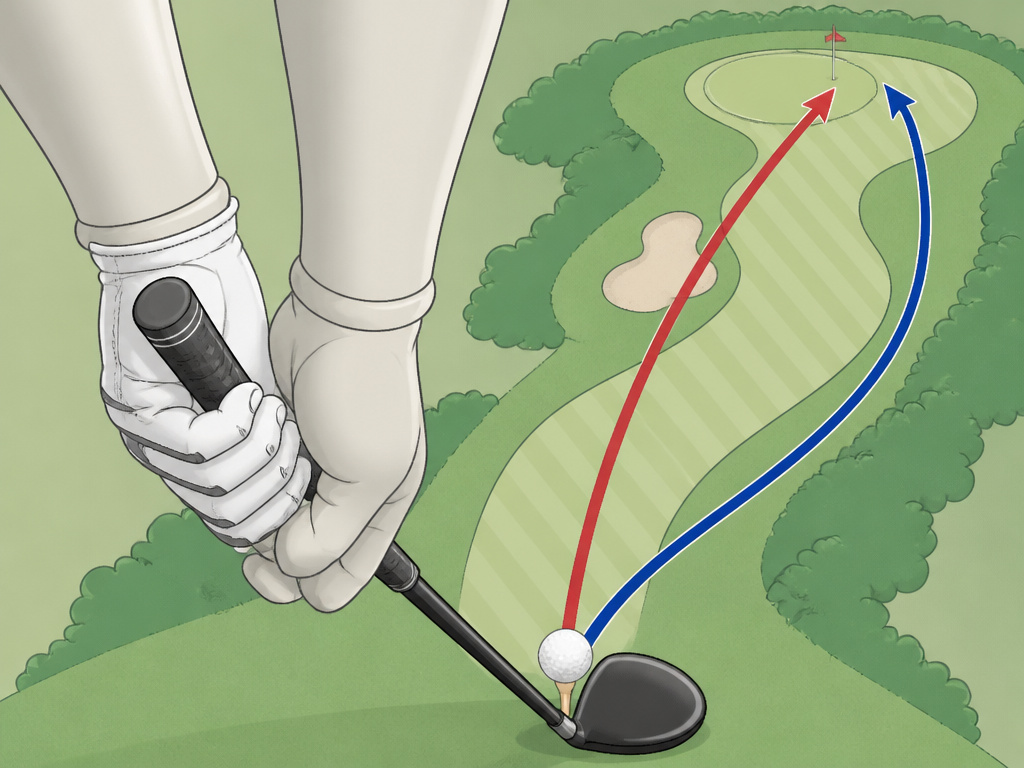
A straight hole asks, “How far can you hit it?” A dogleg asks, “Where should you hit it?” Your answer depends on three factors.
First, locate the turning point. Is it near the landing zone of your drive, or farther ahead, affecting your second shot on a par-5? A close turning point invites long hitters to cut the corner. A distant one turns the hole into a two-stage puzzle.
Second, audit the hazards. What defends the inside of the bend? A bunker complex? Water? Thick native grass? Architect Robert Trent Jones called doglegs a “grand opportunity to practice deception.” The hazard often looks more in play than it is, pushing you toward a safer, longer route. This is deferred danger, the trouble isn’t at your drive’s landing area, but it controls the angle of your next shot.
Third, match the hole to your shot shape. This is basic but frequently ignored. A right-handed player who hits a natural draw (right-to-left curve) is ideally suited for a dogleg left. The ball’s flight follows the bend. That same player is at a disadvantage on a dogleg right, which demands a fade. You can fight your shape, but why add difficulty?
Common mistake: Automatically pulling driver on a sharp dogleg. A 3-wood or hybrid to the corner often leaves a clearer, if longer, approach than a driver flirtation with the inside hazard.
I used to think there was one ideal strategy for every dogleg. Then I worked with players of vastly different abilities. A 25-handicap’s “perfect” play is a hybrid to the fat part of the fairway, short of the trouble. A scratch player’s calculation involves wind, firmness, and the pin position. Good golf should feel less complicated the more you understand it, the right choice is the one that fits your game.
Dogleg Left vs. Dogleg Right
The direction changes your tactical focus, especially based on your dominant hand.
| Hole Type | Best For (Righty) | Common Hazard Placement | Key Mental Check |
|---|---|---|---|
| Dogleg Left | Natural Draw | Right side of corner (to catch cuts) | Don’t over-swing trying to force the draw. |
| Dogleg Right | Natural Fade | Left side of corner (to catch hooks) | Accept a longer approach if you can’t fade it reliably. |
For left-handed players, simply flip the advice. The principle is constant: play toward the hazard if you can curve it away, or play away from the hazard if you can’t.
Famous Doglegs and What They Teach
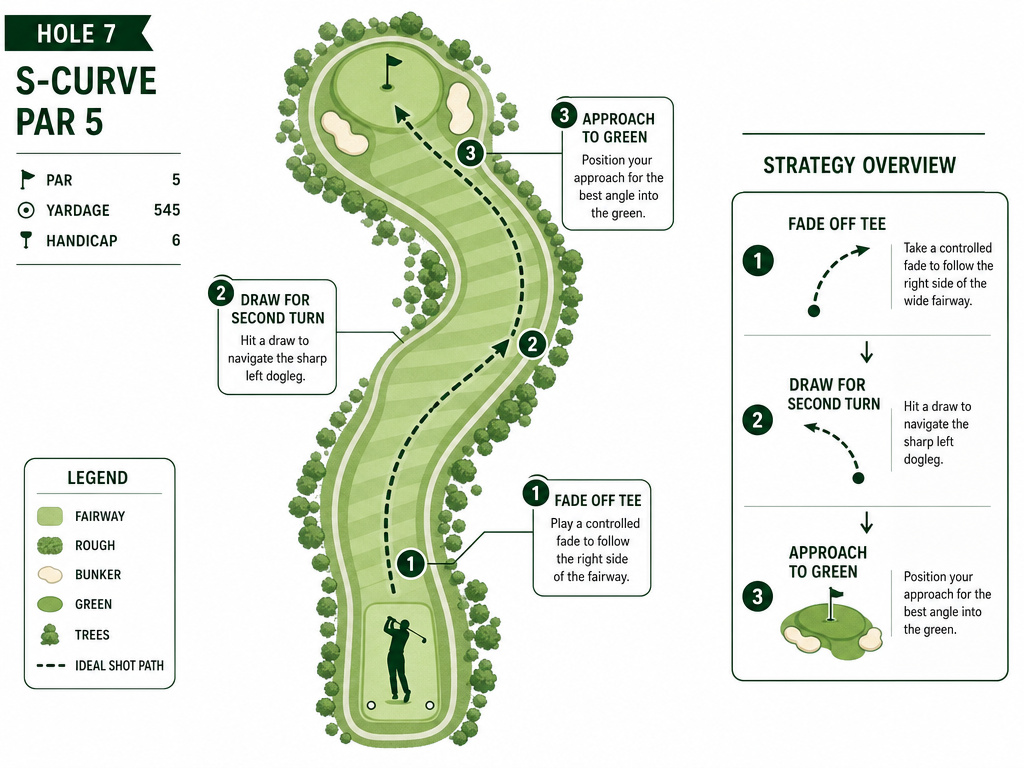
You can study design theory, but real-world examples cement the lesson. Two holes stand out.
Augusta National’s 13th (Azalea): This par-5 is a textbook severe dogleg left. Rae’s Creek guards the entire inside of the bend. The decision is legendary: lay up safely to the right, or take on the creek with a towering draw for a chance to reach the green in two. The hole’s strategic design is pure risk-reward. In 2023, Augusta lengthened it specifically to reduce the advantage of the longest hitters, proving that even classic doglegs evolve to test modern power.
The Double Dogleg: Some par-5s feature two distinct bends. A.W. Tillinghast’s claimed innovation forces two separate strategic decisions. You might hit a fade off the tee to navigate the first right turn, then a draw for the second left turn. It’s target golf at its most demanding, requiring precise distance control and shape on consecutive shots. These holes feel like a three-shot chess match.
How to Play a Dogleg: A Step-by-Step Routine
When you step onto a dogleg tee, silence the noise. Follow this sequence.
- Find the turning point. Use your eyes, a yardage book, or ask a playing partner. If you can’t see it, assume the conservative route.
- Get your yardages. What’s the distance to the corner? What’s the distance to carry the hazard guarding it? These are different numbers. Know both.
- Pick your side of the fairway. Choose based on the hazard location and your intended shot shape. Err toward the safe side.
- Select your club last. Don’t default to driver. Choose the club that reliably delivers your ball to the chosen side. This might be a 5-iron for precision golf.
- Commit to the target. Visualize a specific landing spot, not a general area. A focused swing beats a hopeful one every time.
Skipping step 2 is where big numbers happen. Without the true carry distance, you’re guessing. And guesswork leads to penalty strokes, which destroys pace of play for everyone behind you.
Before You Go
One rule I’ve learned from both design books and weekend rounds: if the dogleg is sharper than 30 degrees and you can’t see the landing area, take the conservative route. The single stroke you might save with a heroic cut isn’t worth the double or triple bogey lurking in the hazard.
Your first step this week shouldn’t be on the course. It should be with your notes. The next time you play, write down the yardage to the corner of every dogleg you face, not just the total. That simple act of observation will sharpen your course management faster than any swing tip.
Doglegs exist to engage you. They transform a game of power into a game of position, angles, and decisions.That’s the heart of golf course architecture, and understanding it is what separates a player from a golfer.
Frequently Asked Questions
What’s the difference between a dogleg and a slight bend?
True dogleg has a defined “turning point” where the fairway changes direction by more than 5 degrees, per architect Scott Macpherson’s definition. A slight bend is a gentle curve that doesn’t alter the essential straight-line strategy. If you don’t have to consciously adjust your target to set up your next shot, it’s probably just a bending fairway, not a strategic dogleg.
Can a par-3 be a dogleg?
No. By definition, doglegs only occur on par-4 and par-5 holes. A par-3 is designed to be reached from the tee with a single shot, so there’s no “second shot” to set up with a bend. The strategic element of a dogleg requires the hole to be long enough to demand multiple shots.
Why is it called a “dogleg”?
The term comes directly from the shape of a dog’s hind leg, which has a distinct bend. The first known printed comparison dates to a 1902 issue of Golf Illustrated, where a critic described a hole’s layout as “rather like a dog’s hind leg.” The visual analogy was so perfect that the golf world adopted it.
What is a “double dogleg”?
Double dogleg is a par-5 hole with two distinct bends in the fairway, creating a hole that essentially zigzags. It requires two separate strategic decisions, one off the tee and another on the second shot, and is considered one of the most complex tests in golf course design. Architect A.W. Tillinghast famously claimed to have originated the concept.
How do I know if I should try to cut the corner?
Ask three questions. First, what is the exact carry distance over the hazard? Second, what is my consistent carry distance with the club I need? Third, what is the penalty for failure? If the carry is at the limit of your ability and the penalty is severe (water, out-of-bounds), the risk almost never justifies the reward. Play for position.
